Implementing effective health and safety training is a fundamental responsibility for organisations striving to maintain a safe, compliant, and efficient working environment. Following the identification of competence requirements, it is essential to adopt a structured and systematic approach to ensure that employees develop the appropriate skills, knowledge, and understanding necessary to carry out their duties safely and responsibly.
Health and safety training should be viewed as an ongoing and dynamic process rather than a one-time activity. It involves careful planning, thoughtful design, effective delivery, and continuous evaluation to ensure that learning objectives are achieved and sustained over time. When properly implemented, training not only reduces the likelihood of workplace incidents but also enhances employee confidence, supports regulatory compliance, and strengthens the overall safety culture within the organisation.
A well-developed training framework enables organisations to align learning initiatives with identified competence needs, ensuring that both individual and organisational safety objectives are effectively met.
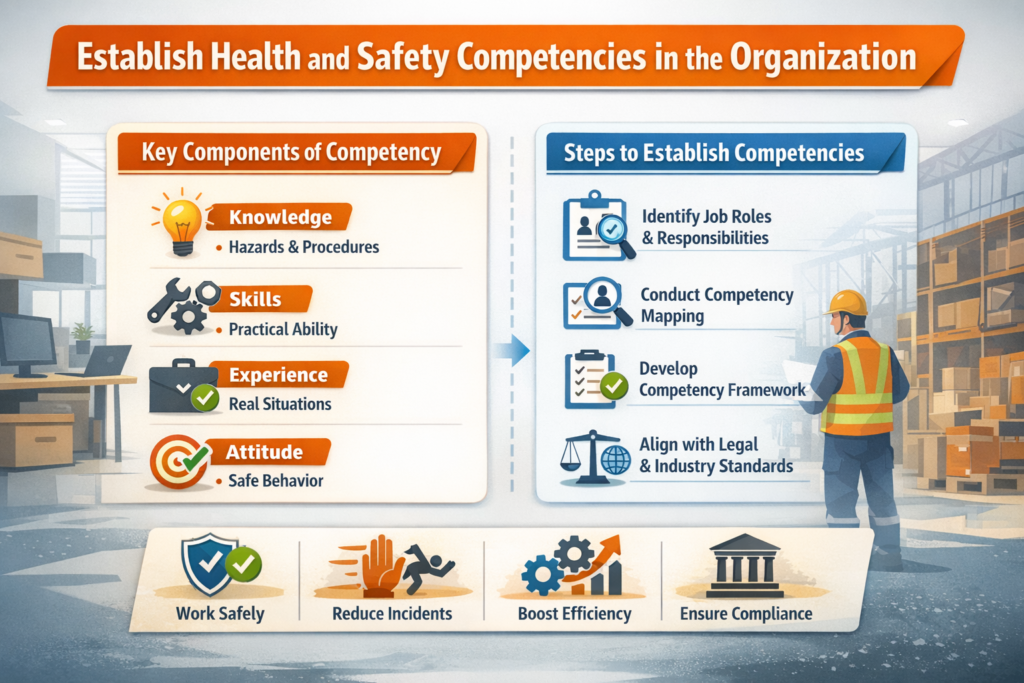
Establishing health and safety competencies within an organisation is a foundational step in ensuring that all employees are capable of performing their roles in a safe and responsible manner. Competency is not limited to formal qualifications alone; it is a comprehensive combination of knowledge, practical skills, experience, and behavioural attitude. When these elements are properly developed and aligned with organisational needs, they contribute significantly to reducing risks, improving operational efficiency, and fostering a strong safety culture.
A structured approach to defining and implementing competencies allows organisations to identify what is required for each role, assess current employee capabilities, and address any gaps through targeted development initiatives. This process ensures that safety is not treated as an isolated function but is embedded into everyday work practices and decision-making processes across all levels of the organisation.

Health and safety competency refers to the ability of individuals to perform their tasks in a manner that does not expose themselves or others to harm. It is achieved through a balanced combination of:
A competent employee is one who can consistently apply these elements in real workplace situations, ensuring that tasks are completed safely, efficiently, and in compliance with established procedures.
Competency is dynamic in nature, meaning it evolves over time as employees gain experience, undergo training, and adapt to new technologies or processes. Therefore, organisations must continuously review and update competency requirements to reflect changing workplace conditions.
Knowledge forms the foundation of health and safety competency. It provides employees with the necessary understanding of workplace risks and the procedures required to manage them effectively.
Key aspects of knowledge include:
A strong knowledge base enables employees to make informed decisions and recognise potential risks before they lead to incidents.
Skills represent the practical application of knowledge. They enable employees to carry out tasks safely and effectively in real workplace situations.
Important skill areas include:
Developing these skills requires hands-on training, supervision, and continuous practice.
Understanding goes beyond knowledge and skills. It reflects the ability to interpret and apply information in real-life situations.
This includes:
A deep level of understanding promotes critical thinking and proactive risk management.
Establishing competencies requires a systematic and organised approach. The following steps outline how organisations can effectively implement this process.
The first step is to clearly define each job role within the organisation.
This involves:
This step ensures that competency requirements are directly linked to actual job functions.
Competency mapping involves comparing required competencies with the current capabilities of employees.
Key activities include:
Competency mapping provides a clear picture of organisational strengths and weaknesses in relation to health and safety.
A competency framework is a structured system that defines the standards required for each role.
This includes:
A well-developed framework ensures consistency across the organisation and provides a reference point for training and development activities.
Organisations must ensure that their competency requirements meet external expectations.
This involves:
Alignment with standards ensures that competency systems are robust, credible, and legally compliant.
Establishing health and safety competencies provides several important benefits to organisations.
When employees possess the required competencies, they are better equipped to:
This reduces the likelihood of unsafe actions and improves overall workplace safety.
Competent employees are less likely to make errors that could lead to accidents.
This results in:
Employees who understand their roles and responsibilities can perform tasks more effectively.
Benefits include:
Organisations have a legal duty to ensure that employees are competent.
Establishing competencies helps:
A competency-based approach encourages employees to take responsibility for safety.
This leads to:
Establishing health and safety competencies within an organisation is a critical step in creating a safe and effective working environment. By focusing on the development of knowledge, skills, and understanding, organisations can ensure that employees are fully prepared to manage workplace risks and perform their duties responsibly.
A structured approach that includes identifying roles, mapping competencies, developing frameworks, and aligning with legal standards provides a strong foundation for continuous improvement. The benefits of this process extend beyond compliance, contributing to reduced incidents, enhanced productivity, and the development of a positive safety culture.
Ultimately, a competent workforce is essential for achieving long-term organisational success, as it ensures that safety is integrated into every aspect of operations and becomes a shared responsibility across all levels.
Designing and developing health and safety training courses is a critical stage in ensuring that identified competence needs are effectively addressed within an organisation. Once the required competencies have been established, organisations must convert these requirements into structured and well-planned training programmes that are practical, relevant, and aligned with operational objectives. This process involves a systematic approach that integrates organisational goals, workforce requirements, and regulatory expectations.
The development of training courses is not simply about delivering information; it is about creating meaningful learning experiences that enable employees to apply knowledge and skills in real workplace situations. Effective training must be carefully planned, appropriately resourced, and continuously evaluated to ensure that it contributes to improved safety performance.
A well-designed training programme enhances employee capability, reduces workplace risks, improves operational efficiency, and strengthens compliance with health and safety legislation. It also supports the development of a proactive safety culture where employees take responsibility for their own safety and that of others.
Effective training design is guided by several key principles that ensure learning is meaningful, practical, and sustainable.
Training must be directly aligned with the specific roles and responsibilities of employees within the organisation. Relevance ensures that the content delivered is applicable and useful in real work situations.
Training content should reflect the actual tasks performed by employees. This includes incorporating job-specific hazards, procedures, and responsibilities into the training material. For example, employees working in construction require training related to working at heights, while office staff may need training on ergonomics and fire safety.
Training should also address real risks associated with each role. This means identifying the hazards employees are likely to encounter and ensuring that the training provides practical solutions to manage those risks effectively.
Employees should be able to apply what they learn immediately in their workplace. This enhances retention and ensures that training has a direct impact on safety performance.
Training should focus on real-world application rather than purely theoretical knowledge. Practical and engaging training methods improve understanding and retention.
Including hands-on activities and demonstrations allows employees to practice skills in a controlled environment. This is particularly important for tasks that involve machinery, equipment, or hazardous processes.
Encouraging participation through discussions and exercises helps learners actively engage with the content. Interactive learning methods such as group activities, role-playing, and problem-solving exercises make training more effective.
Using interactive techniques such as quizzes, case studies, and simulations helps maintain learner interest and ensures that training sessions are dynamic rather than passive.
Training materials and delivery methods should be clear, simple, and accessible to all employees, regardless of their educational background or experience level.
Using simple and clear language ensures that information is easily understood. Avoiding unnecessary technical jargon is important, especially when training a diverse workforce.
Providing examples helps clarify complex concepts and allows learners to relate information to their own work environment. Visual aids such as diagrams, charts, and videos can further enhance understanding.
Clear communication is essential to ensure that employees fully understand safety procedures and can apply them effectively.
Training should be designed to reflect real-life situations that employees may encounter in their work environment.
Using case studies and real-life examples helps employees understand how safety principles apply in practice. These examples can be based on past incidents, industry experiences, or hypothetical scenarios.
Simulating workplace conditions allows employees to practice responding to hazards and emergencies in a safe and controlled setting. This prepares them for real situations and improves confidence.
Addressing common challenges and risks ensures that training is relevant and prepares employees to handle typical workplace issues effectively.
Training must have clearly defined outcomes that can be measured to evaluate its effectiveness.
Setting clear learning objectives provides direction and helps determine what learners should achieve by the end of the training. Objectives should be specific, realistic, and aligned with organisational goals.
Using assessments such as tests, quizzes, and practical evaluations helps measure understanding and identify areas for improvement.
Tracking improvements in performance, such as reduced incidents or improved compliance, provides evidence of training effectiveness and supports continuous improvement.
Designing training programmes involves a structured process that ensures all aspects of learning are addressed effectively.
The first step in designing training programmes is to identify the specific needs of the organisation and its employees.
This involves comparing current employee competencies with the required standards. Organisations must identify areas where employees lack knowledge, skills, or understanding.
Prioritising critical training needs ensures that resources are focused on areas that pose the greatest risk or have the highest impact on safety performance.
Different groups within the organisation have different training needs.
Identifying groups such as workers, supervisors, and managers helps ensure that training is tailored appropriately. Understanding their roles and responsibilities allows for the development of relevant content.
Considering the existing level of knowledge and experience ensures that training is neither too basic nor too advanced.
Learning objectives define what employees should achieve after completing the training.
Objectives should clearly state expected outcomes and provide a basis for evaluating training effectiveness. They must be realistic, measurable, and aligned with organisational goals.
Examples include:
Clear objectives guide both the design and delivery of training programmes.
Selecting appropriate training methods is essential to ensure effective learning.
Classroom training is suitable for delivering theoretical knowledge and allows for interaction between trainers and learners.
E-learning provides flexibility and allows employees to learn at their own pace. It is also cost-effective and suitable for large organisations.
On-the-job training provides practical experience in the actual work environment. It is highly effective for developing skills and reinforcing learning.
Workshops and simulations provide interactive learning experiences and allow employees to practice problem-solving and decision-making.
The choice of method should be based on the nature of the training, the target audience, and available resources.
Training materials support the learning process and ensure consistency in delivery.
Manuals and handbooks provide detailed information and serve as reference materials for employees.
Presentations help structure training sessions and highlight key points.
Videos and demonstrations provide visual examples that enhance understanding, particularly for complex tasks.
Case studies encourage critical thinking and allow learners to apply knowledge to real situations.
High-quality materials improve the overall effectiveness of training programmes.
Training programmes must be designed within organisational limitations. Effective planning ensures that training remains practical and sustainable.
Financial resources must be managed carefully to ensure that training programmes are cost-effective.
Allocating financial resources efficiently involves prioritising essential training needs and avoiding unnecessary expenses.
Balancing cost with quality is important to ensure that training remains effective without exceeding budget limits.
Using cost-effective methods such as e-learning and internal trainers can help reduce costs while maintaining quality.
Training must be delivered within appropriate timeframes to ensure timely development of competencies.
Ensuring that training is delivered within deadlines requires careful planning and scheduling.
Aligning training with project schedules helps avoid conflicts with operational activities.
Avoiding disruption to operations is important, and this can be achieved by scheduling training during less busy periods or using flexible learning methods.
The availability of both employees and trainers must be considered when planning training programmes.
Scheduling training sessions based on staff availability ensures maximum participation and effectiveness.
Avoiding overloading employees helps maintain productivity and prevents fatigue.
Ensuring that trainers are available and qualified is essential for delivering high-quality training.
Different groups within the organisation require different types of training. Customisation ensures that training is relevant and effective.
New employees require induction training to familiarise them with organisational policies and procedures.
This includes introduction to safety policies, basic hazard awareness, and emergency procedures. Induction training helps new employees integrate safely into the workplace.
Supervisors play a key role in managing safety and ensuring compliance.
They require training in leadership, safety management, monitoring safety performance, and incident reporting. Effective supervisor training strengthens overall safety management.
Employees in specialised roles require advanced and technical training.
This includes hazard-specific training, technical skills related to equipment or processes, and compliance with industry standards.
Specialised training ensures that high-risk tasks are performed safely and effectively.
Designing and developing health and safety training courses is a structured and essential process that enables organisations to address competence needs effectively. By applying key principles, following systematic steps, and considering organisational constraints, organisations can develop training programmes that are practical, relevant, and impactful.
Customising training for different groups ensures that learning is targeted and effective, while continuous evaluation supports ongoing improvement. Ultimately, effective training design contributes to the development of a competent workforce, reduces workplace risks, enhances productivity, and supports long-term organisational success.
Delivering suitable health and safety training is the stage where planning is translated into practical action. It is at this point that carefully designed training programmes are implemented to ensure that employees gain the required knowledge, skills, and understanding necessary to perform their roles safely. The effectiveness of any training programme depends not only on its design but also on how it is delivered, communicated, and received by learners.
Training delivery must be structured, engaging, and aligned with organisational objectives. It should take into account the nature of the workforce, the complexity of tasks, and the risks associated with different roles. Effective delivery ensures that employees are able to understand, retain, and apply what they have learned in real workplace situations.
A well-delivered training programme contributes to improved safety performance, reduced workplace incidents, and enhanced employee confidence. It also supports compliance with legal and regulatory requirements while promoting a positive safety culture across the organisation.
Selecting appropriate training delivery methods is essential to ensure that learning objectives are achieved effectively. Different methods are suitable for different types of training, depending on the nature of the content and the target audience.
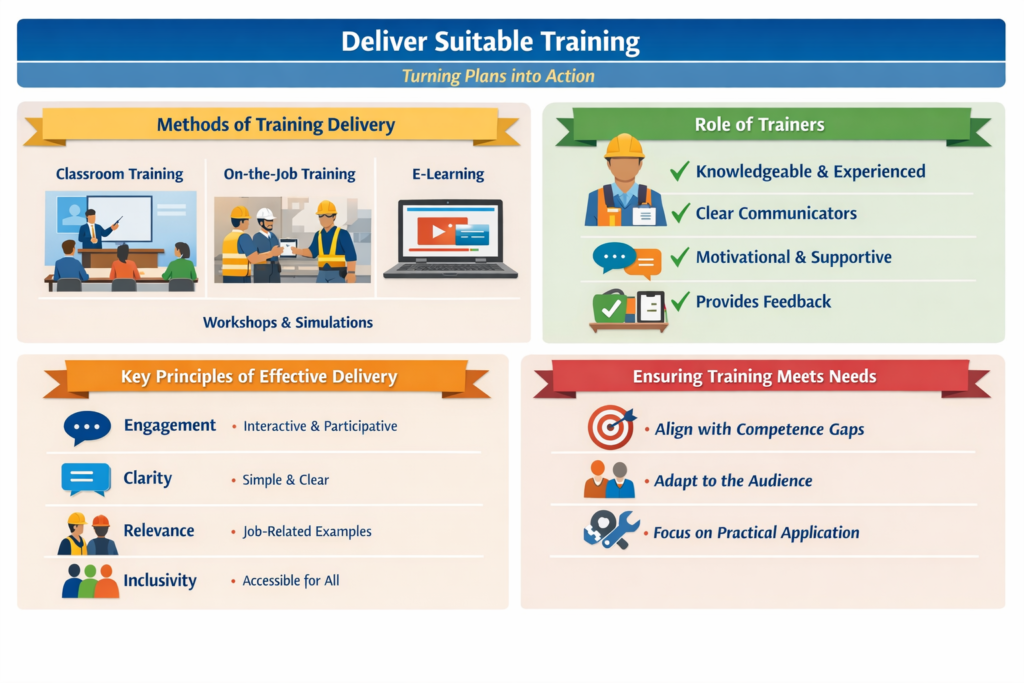
Classroom-based training is one of the most traditional and widely used methods of delivering health and safety training.
This method is particularly effective for introducing new concepts, policies, and procedures.
Classroom-based training is beneficial when foundational knowledge needs to be established before practical application.
On-the-job training involves learning through practical experience in the actual workplace.
This method is particularly effective for developing practical skills.
On-the-job training ensures that learning is directly relevant to job roles and responsibilities.
E-learning has become increasingly popular due to its flexibility and accessibility.
This flexibility makes e-learning an effective option for continuous learning.
E-learning is particularly useful for delivering standardised training across an organisation.
Workshops and simulations provide interactive and experiential learning opportunities.
This method is highly effective for developing critical thinking and practical skills.
To ensure that training is successful, certain principles must be followed during delivery.
Engagement is essential to maintain learner interest and ensure active participation.
Engaged learners are more likely to retain information and apply it effectively.
Clarity in communication ensures that training content is understood by all participants.
Clear communication reduces misunderstandings and ensures effective learning.
Training must be relevant to the actual work environment and job roles.
Relevant training increases motivation and improves practical application.
Training should be accessible and beneficial to all employees.
Inclusive training promotes fairness and ensures that all employees benefit equally.
Trainers play a critical role in the success of training programmes. Their competence, communication skills, and approach significantly influence learning outcomes.
Motivated learners are more engaged and willing to apply what they learn.
Continuous support helps learners build confidence and competence.
To achieve the desired outcomes, training delivery must align with identified competence requirements.
This ensures that training is targeted and effective.
Adapting training improves understanding and engagement.
Practical application ensures that training leads to real improvements in workplace safety.
Delivering suitable health and safety training is a vital component of an effective safety management system. It ensures that employees are equipped with the knowledge, skills, and understanding required to perform their roles safely and responsibly.
By selecting appropriate training methods, applying key principles of effective delivery, and ensuring that trainers are competent and supportive, organisations can maximise the impact of their training programmes. Aligning training with identified needs and promoting practical application further enhances its effectiveness.
Ultimately, well-delivered training contributes to reduced workplace risks, improved employee performance, and the development of a strong safety culture. It plays a crucial role in ensuring that health and safety objectives are achieved and sustained across the organisation.
4.Monitor the Effectiveness of Training
Monitoring the effectiveness of health and safety training is a crucial stage in ensuring that training programmes achieve their intended outcomes and contribute to improved workplace safety performance. It is not sufficient to simply deliver training; organisations must evaluate whether employees have actually gained the required knowledge, skills, and understanding, and whether they are applying this learning effectively in their daily work activities.
A structured monitoring process allows organisations to assess the real impact of training. It helps determine whether training objectives have been achieved, whether behaviour has improved, and whether workplace risks have been reduced. Monitoring also ensures that training remains aligned with organisational goals, legal requirements, and industry standards.
Effective monitoring supports better decision-making, enhances accountability, and ensures that resources invested in training deliver measurable value. It also plays a key role in strengthening the overall safety culture by promoting continuous learning and improvement.
Monitoring training effectiveness provides several important benefits that directly support organisational performance and safety management.
Monitoring helps determine whether employees have successfully met the intended learning outcomes of the training programme.
This ensures that training has fulfilled its purpose and contributed to employee competence.
Monitoring allows organisations to identify weaknesses or gaps in training programmes.
This process ensures that training continues to evolve and improve over time.
Training requires significant investment in terms of time, financial resources, and effort.
This ensures that training investments are justified and contribute to organisational success.
Monitoring plays a key role in maintaining and enhancing training quality over time.
Continuous improvement helps organisations maintain high standards of safety and performance.
A range of evaluation methods can be used to assess training effectiveness. These methods provide valuable data that supports decision-making and improvement.
Participant feedback is one of the most direct and useful methods of evaluation.
Feedback helps organisations understand how training is perceived and where improvements are needed.
Assessment tests are used to measure the knowledge and skills gained by employees.
Assessments provide objective evidence of training outcomes and employee competence.
Observation involves monitoring employee behaviour in the workplace after training.
Observation ensures that training leads to real improvements in workplace safety.
Analysing workplace incidents provides valuable insights into training effectiveness.
This method directly links training outcomes to organisational safety performance.
Key Performance Indicators are measurable values used to evaluate the success of training programmes.
KPIs provide clear and measurable evidence of training effectiveness.
Continuous improvement ensures that training programmes remain effective and relevant.
Continuous improvement ensures that training evolves with organisational needs and remains effective.
If monitoring reveals that training is not effective, organisations must take corrective action.
Addressing training gaps ensures that training achieves its intended objectives.
Monitoring the effectiveness of health and safety training is an essential component of a successful training system. It ensures that training programmes deliver meaningful results, improve employee competence, and contribute to a safer working environment.
By using a combination of evaluation methods, measuring performance through key indicators, and implementing continuous improvement processes, organisations can maintain high standards of training effectiveness. Addressing identified gaps further strengthens the impact of training and ensures that employees remain capable and confident in their roles.
Ultimately, effective monitoring supports organisational success by reducing workplace risks, improving compliance, and promoting a strong safety culture where continuous learning and improvement are embedded in everyday practices.
WhatsApp us