
Contact Us: +44 7441 396751 Reach us: info@inspirecollege.co.uk
Curriculum
- 10 Sections
- 45 Lessons
- 60 Weeks
Expand all sectionsCollapse all sections
- Unit 1: Promote a Health and Safety CulturePromoting a strong health and safety culture within an organization is essential for preventing workplace accidents, protecting employees, and ensuring overall organizational efficiency. A positive health and safety culture exists when safety is recognized as a shared responsibility and is integrated into everyday workplace practices, decision-making processes, and organizational values.In the context of the ProQual Level 6 NVQ Diploma in Occupational Health and Safety Practice, promoting a health and safety culture involves encouraging employees, managers, and stakeholders to actively participate in maintaining safe working conditions. This includes raising awareness of potential hazards, promoting open communication about safety concerns, and ensuring that safety policies and procedures are consistently followed.8
- 1.1Lesson 1: Be Able to Advocate Commitment to a Positive Health and Safety Culture in the Organisation
- 1.2Quiz No 1: Be Able to Advocate Commitment to a Positive Health and Safety Culture in the Organisation30 Minutes30 Questions
- 1.3Lesson 2: Be Able to Develop Links with Appropriate People and Groups on Health and Safety Matters
- 1.4Quiz No 2: Be Able to Develop Links with Appropriate People and Groups on Health and Safety Matters30 Minutes30 Questions
- 1.5Lesson 3: Understand the importance of promoting a positive health and safety culture within the organisation.
- 1.6Quiz No 3: Understand the importance of promoting a positive health and safety culture within the organisation.30 Minutes30 Questions
- 1.7Lesson 4: Be able to maintain and record their professional development
- 1.8Quiz No 4 : Be able to maintain and record their professional development30 Minutes30 Questions
- Unit 2: Develop and implement the health and safety policyThis chapter provides a comprehensive understanding of how to develop, implement, and manage an effective health and safety policy within an organization. It explains the key components of a well-structured policy, including the statement of intent, roles and responsibilities, and arrangements for ensuring workplace safety. Learners will gain knowledge of how to align policies with legal and regulatory requirements while addressing organizational needs and risks.The chapter also focuses on practical steps for successful implementation, such as communication, training, and employee involvement. It highlights the importance of monitoring performance, reviewing policies regularly, and making continuous improvements to ensure effectiveness. By the end of this chapter, learners will be able to contribute to creating a safer work environment and support a positive health and safety culture.10
- 2.1Lesson 1: Be able to define the statutory and workplace health and safety requirements for the organisation.
- 2.2Quiz no 1 : Be able to define the statutory and workplace health and safety requirements for the organisation.30 Minutes30 Questions
- 2.3Lesson 2: Be able to develop the Health and Safety Policy.
- 2.4Quiz No 2: Be able to develop the Health and Safety Policy.30 Minutes30 Questions
- 2.5Lesson 3: Be able to implement the Health and Safety Policy.
- 2.6Quiz no 3 : Be able to implement the Health and Safety Policy.30 Minutes30 Questions
- 2.7Lesson 4: Know the steps required to develop and implement the Health and Safety Policy.
- 2.8Quiz no 4 : Know the steps required to develop and implement the Health and Safety Policy.28 Minutes30 Questions
- 2.9Lesson 5: Be able to maintain and record their professional development
- 2.10Quiz no 5 : Be able to maintain and record their professional development29 Minutes30 Questions
- Unit 3: Develop and implement effective communication systems for health and safety informationEffective communication is essential for building and maintaining a safe workplace. Health and safety information must be shared in a way that is clear, timely, and accessible to everyone, regardless of their role or level of responsibility. Without effective communication systems, even well-designed safety policies can fail to protect workers, leading to misunderstandings, accidents, and non-compliance. This chapter emphasizes the importance of communication in promoting a strong safety culture, preventing incidents, and ensuring that employees understand their responsibilities in maintaining workplace safety.In addition, the chapter explores practical strategies for developing and implementing communication systems that work across diverse organizational settings. Learners will examine methods such as safety signage, notice boards, digital platforms, reporting mechanisms, and training sessions, while also considering barriers like language differences and literacy levels. By the end of this chapter, learners will be equipped with the knowledge to design communication systems that are consistent, responsive, and inclusive—ensuring that health and safety information is not only delivered but also understood and acted upon effectively.10
- 3.1Lesson 1: Be able to evaluate health and safety information.
- 3.2Quiz no 1 : Be able to evaluate health and safety information.30 Minutes30 Questions
- 3.3Lesson 2: Be able to produce communication systems for health and safety information into the organisation.
- 3.4Quiz No :2 Be able to produce communication systems for health and safety information into the organisation.30 Minutes30 Questions
- 3.5Lesson 3: Be able to control the effectiveness of the communication systems for health and safety information going out of the organisation.
- 3.6Quiz No 3 : Be able to control the effectiveness of the communication systems for health and safety information going out of the organisation.30 Minutes30 Questions
- 3.7Lesson 4: Know how to develop and implement effective communication systems for health and safety information.
- 3.8Quiz No 4 : Know how to develop and implement effective communication systems for health and safety information.30 Minutes30 Questions
- 3.9Lesson 5: Be able to maintain and record their professional development
- 3.10Quiz No : 5 Be able to maintain and record their professional development30 Minutes30 Questions
- Unit 4: Develop and maintain individual and organisational competence in health and safety mattersThis chapter focuses on the systematic development and maintenance of both individual and organisational competence in health and safety matters. It explains that competence is not a one-time achievement but an ongoing process that requires continuous learning, practical application, and regular updating of knowledge and skills. Emphasis is placed on structured approaches such as training, continuous professional development, performance evaluation, and effective communication systems to ensure that individuals can perform their roles safely and efficiently. The chapter also highlights the importance of aligning individual capabilities with organisational requirements to maintain compliance with health and safety standards and legal obligations.In addition, the chapter explores how organisations can foster a culture of continuous improvement by embedding competence development into their management systems. It discusses the role of leadership in promoting safety awareness, supporting professional growth, and ensuring that employees, contractors, and stakeholders possess the required competencies. The importance of maintaining accurate records, reflecting on professional experiences, and setting development goals is also addressed. By focusing on both individual and organisational competence, the chapter demonstrates how organisations can enhance overall performance, reduce workplace risks, and build a strong, proactive health and safety culture.8
- 4.1Lesson 1: Be able to assess the health and safety competence needs of the organisation.
- 4.2Quiz No1 : Be able to assess the health and safety competence needs of the organisation.30 Minutes30 Questions
- 4.3Lesson :2 Be able to implement health and safety training to meet identified needs.
- 4.4Quiz No: 2 Be able to implement health and safety training to meet identified needs.30 Minutes30 Questions
- 4.5Lesson:3 Know how to develop and maintain individual and organisational competence in health and safety matters.
- 4.6Quiz No 3 : Know how to develop and maintain individual and organisational competence in health and safety matters.30 Minutes30 Questions
- 4.7Lesson :4 Be able to maintain and record their professional development
- 4.8Quiz No: 4 Be able to maintain and record their professional development30 Minutes30 Questions
- Unit 5: Identify, assess and control health and safety risksThis chapter focuses on the systematic approach required to identify, assess, and control health and safety risks within the workplace. It emphasises the importance of recognising potential hazards arising from work activities, equipment, environments, and human behaviour. By applying structured risk assessment methods, organisations can evaluate the likelihood and severity of harm, enabling informed and proactive decision-making. The content highlights the need to move beyond reactive measures and adopt preventative strategies that reduce risks before incidents occur.In addition, the chapter explores practical techniques for implementing effective risk control measures. It introduces the hierarchy of control as a key framework for managing risks, encouraging the prioritisation of elimination, substitution, and engineering controls over administrative measures and personal protective equipment. Continuous monitoring and regular review of control measures are also emphasised to ensure their effectiveness over time. Overall, the chapter reinforces the importance of risk management in creating safer workplaces, improving organisational performance, and fostering a culture of continuous improvement.10
- 5.1Lesson 1: Be able to conduct an inspection of the workplace
- 5.2Quiz No1: Be able to conduct an inspection of the workplace30 Minutes30 Questions
- 5.3Lesson 2: Be able to assess risks to health and safety.
- 5.4Quiz No:2 Be able to assess risks to health and safety.30 Minutes30 Questions
- 5.5Lesson 3: Be able to implement risk control measures and safe systems of work in the organisation.
- 5.6Quiz No:3 Be able to implement risk control measures and safe systems of work in the organisation.30 Minutes30 Questions
- 5.7Lesson 4: Know how to identify, assess and control health and safety risks
- 5.8Quiz No:4 Know how to identify, assess and control health and safety risks30 Minutes30 Questions
- 5.9Lesson 5: Be able to maintain and record their professional development
- 5.10Quiz No:5 Be able to maintain and record their professional development30 Minutes30 Questions
- Unit 6: Develop and implement proactive monitoring systems for health and safetyThis section focuses on the development and implementation of proactive monitoring systems for health and safety, which play a crucial role in preventing workplace incidents before they occur. Instead of relying on reactive approaches that address issues after an accident, proactive monitoring emphasises early identification of potential hazards, unsafe practices, and system weaknesses. It involves regular inspections, safety audits, performance measurement, and the use of key indicators to evaluate workplace conditions. By consistently monitoring and assessing safety performance, organisations can identify risks at an early stage and implement corrective actions to minimise harm and improve overall safety standards.Furthermore, the section highlights the importance of embedding proactive monitoring into daily organisational practices. Effective systems depend on well-defined procedures, skilled personnel, accurate data collection, and ongoing review processes. Active employee involvement is also essential, as workers can provide valuable insights into potential risks within their work environment. By promoting a culture of awareness, responsibility, and continuous improvement, organisations can maintain high safety standards and prevent incidents more effectively. Ultimately, proactive monitoring contributes to legal compliance, enhances operational efficiency, and supports the long-term health and well-being of employees.8
- 6.1Lesson 1: Be able to devise inspection and monitoring systems for health and safety proactive performance monitoring.
- 6.2Quiz No :1 Be able to devise inspection and monitoring systems for health and safety proactive performance monitoring.30 Minutes30 Questions
- 6.3Lesson 2: Be able to keep stakeholders informed of health and safety proactive performance monitoring outcomes.
- 6.4Quiz No: 2 Be able to keep stakeholders informed of health and safety proactive performance monitoring outcomes.30 Minutes30 Questions
- 6.5Lesson 3: Understand how to develop and implement proactive monitoring systems for health and safety.
- 6.6Quiz No : 3 Understand how to develop and implement proactive monitoring systems for health and safety.30 Minutes30 Questions
- 6.7Lesson 4: Be able to maintain and record their professional development
- 6.8Quiz No : 4 Be able to maintain and record their professional development30 Minutes30 Questions
- Unit 7: Develop and implement reactive monitoring systems for health and safetyDeveloping and implementing reactive monitoring systems is a critical aspect of effective health and safety management. These systems focus on identifying and analyzing incidents that have already occurred, such as accidents, near misses, injuries, or cases of ill health. By systematically collecting and reviewing this information, organizations can uncover underlying causes, identify patterns, and evaluate the effectiveness of existing control measures. Reactive monitoring provides valuable insights into areas where safety arrangements may have failed, enabling organizations to take corrective actions and prevent recurrence.An effective reactive monitoring system goes beyond simply recording incidents; it involves thorough investigation, accurate reporting, and continuous improvement. Organizations must establish clear procedures for incident reporting, ensure timely investigations, and maintain detailed records for analysis. This process helps in strengthening risk management strategies, improving workplace safety culture, and ensuring compliance with legal requirements. Ultimately, reactive monitoring supports learning from past events, allowing organizations to enhance their safety performance and protect employees from future harm.12
- 7.1Lesson No 1: Be able to develop a health and safety loss event reporting and recording system.
- 7.2Quiz No:1 Be able to develop a health and safety loss event reporting and recording system.30 Minutes30 Questions
- 7.3Lesson No 2: Be able to implement health and safety loss event investigation systems and procedures.
- 7.4Quiz No:2 Be able to implement health and safety loss event investigation systems and procedures.30 Minutes30 Questions
- 7.5Lesson No :3 Be able to conduct statistical and epidemiological analyses.
- 7.6Quiz No :3 Be able to conduct statistical and epidemiological analyses.30 Minutes30 Questions
- 7.7Lesson:4 Be able to maintain communication with stakeholders of health and safety reactive performance monitoring outcomes.
- 7.8Quiz No: 4 Be able to maintain communication with stakeholders of health and safety reactive performance monitoring outcomes.30 Minutes30 Questions
- 7.9Lesson No :5 Understand how to develop and implement reactive monitoring systems for health and safety
- 7.10Quiz No:5 Understand how to develop and implement reactive monitoring systems for health and safety30 Minutes30 Questions
- 7.11Lesson No: 6 Be able to maintain and record their professional development
- 7.12Quiz No:6 Be able to maintain and record their professional development30 Minutes30 Questions
- Unit 8: Develop and implement health and safety emergency response systems and proceduresThis chapter focuses on the systematic development and implementation of effective health and safety emergency response systems within the workplace. It highlights the importance of being prepared for a wide range of potential emergencies such as fires, medical incidents, hazardous material spills, and natural disasters. The chapter explains how organizations can identify possible emergency scenarios through risk assessment and develop structured response plans that clearly define roles, responsibilities, and procedures. It also emphasizes the need for effective communication systems, proper resource allocation, and coordination with external emergency services to ensure a timely and organized response.In addition, the chapter explores the practical aspects of implementing and maintaining these emergency response procedures. It underlines the importance of regular training, awareness programs, and emergency drills to ensure that all employees are capable of responding appropriately during critical situations. Continuous monitoring, evaluation, and improvement of emergency systems are also discussed to ensure their effectiveness over time. By following these approaches, organizations can enhance their preparedness, minimize risks, protect lives and property, and maintain operational continuity during emergencies.8
- 8.1Lesson No 1: Be able to develop health and safety emergency response procedures.
- 8.2Quiz No :1 Be able to develop health and safety emergency response procedures.30 Minutes30 Questions
- 8.3Lesson No 2: Be able to implement procedures for the control of a health and safety emergency.
- 8.4Quiz No : 2 Be able to implement procedures for the control of a health and safety emergency.30 Minutes30 Questions
- 8.5Lesson No 3: Understand how to develop and implement health and safety emergency response systems and procedures.
- 8.6Quiz No:3 Understand how to develop and implement health and safety emergency response systems and procedures.30 Minutes30 Questions
- 8.7Lesson No 4: Be able to maintain and record their professional development
- 8.8Quiz No : 4 Be able to maintain and record their professional development30 Minutes30 Questions
- Unit 9: Develop and implement health and safety review systemsDeveloping and implementing health and safety review systems is a critical process that enables organizations to continuously evaluate and improve their safety performance. These systems provide a structured approach for monitoring existing policies, procedures, and practices to ensure they remain effective, relevant, and compliant with legal and regulatory requirements. A well-established review system helps identify gaps, weaknesses, and emerging risks within the organization, allowing timely corrective and preventive actions to be taken. It also supports informed decision-making by providing accurate data and insights into safety performance, incident trends, and operational risks.Effective health and safety review systems go beyond periodic checks; they promote a culture of continuous improvement and accountability. By incorporating regular audits, inspections, performance reviews, and feedback mechanisms, organizations can ensure that safety standards are consistently maintained and enhanced. These systems also encourage employee involvement, enabling workers to contribute to identifying hazards and suggesting improvements. Ultimately, implementing robust review systems strengthens organizational resilience, enhances compliance, reduces incidents, and ensures a safer and more sustainable working environment.8
- 9.1Lesson No 1: Be able to investigate the efficiency and cost effectiveness of health and safety management systems.
- 9.2Quiz No :1 Be able to investigate the efficiency and cost effectiveness of health and safety management systems.30 Minutes30 Questions
- 9.3Lesson No 2: Be able to confirm that each part of the health and safety management system is working as intended.
- 9.4Quiz No : 2 Be able to confirm that each part of the health and safety management system is working as intended.30 Minutes30 Questions
- 9.5Lesson No:3 Be able to confirm that the entire health and safety system is working as intended.
- 9.6Quiz No : 3 Be able to confirm that the entire health and safety system is working as intended.30 Minutes30 Questions
- 9.7Lesson No : 4 Be able to maintain and record their professional development
- 9.8Quiz No : 4 Be able to maintain and record their professional development30 Minutes30 Questions
- Unit 10: Maintain knowledge of improvements to influence health and safety practiceThis chapter focuses on the importance of continuously updating and maintaining knowledge to support improvements in health and safety practices within the workplace. It highlights that health and safety is not a static field; it evolves due to changes in legislation, emerging risks, technological advancements, and lessons learned from incidents and industry developments. Professionals are therefore required to stay informed through regular training, professional development activities, research, and engagement with industry updates. By doing so, they ensure that their knowledge remains current, relevant, and aligned with best practices and regulatory requirements.Furthermore, the chapter emphasizes the role of individuals in using their updated knowledge to positively influence health and safety standards within their organization. This includes applying new learning to risk assessments, improving procedures, promoting a strong safety culture, and sharing insights with colleagues and stakeholders. By actively contributing to improvements and encouraging others to adopt safer practices, professionals not only enhance workplace safety but also support organizational compliance and continuous improvement. Ultimately, maintaining up-to-date knowledge enables individuals to make informed decisions, reduce risks, and foster a proactive approach to health and safety management.8
- 10.1Lesson No :1 Be able to identify new developments in health and safety.
- 10.2Quiz No:1 Be able to identify new developments in health and safety.30 Minutes30 Questions
- 10.3Lesson No :2 Be able to influence colleagues on health and safety matters
- 10.4Quiz No :2 Be able to influence colleagues on health and safety matters30 Minutes30 Questions
- 10.5Lesson No:3 Know how to maintain knowledge of improvements in health and safety practice
- 10.6Quiz No : 3 Know how to maintain knowledge of improvements in health and safety practice30 Minutes30 Questions
- 10.7Lesson No:4 Be able to maintain and record their professional development
- 10.8Quiz No : 4 Be able to maintain and record their professional development30 Minutes30 Questions
Lesson 1: Be able to conduct an inspection of the workplace
Workplace inspections are a critical component of an effective health and safety management system. They provide a structured and proactive method for identifying hazards, assessing associated risks, and implementing appropriate control measures before incidents occur. Rather than reacting to accidents, inspections enable organisations to anticipate potential dangers and take preventive action, thereby reducing the likelihood of injuries, ill health, and operational disruptions.
A well-conducted inspection not only ensures compliance with statutory and organisational requirements but also contributes to the development of a strong safety culture. It promotes awareness among employees, encourages safe behaviours, and supports continuous improvement in workplace conditions. This lesson explores the comprehensive process of conducting workplace inspections, including preparation, hazard identification, evaluation, use of equipment, and effective record-keeping.
1. Identify the Requirements to Carry Out a Health and Safety Inspection
Carrying out an effective health and safety inspection requires more than simply observing workplace conditions. It demands a clear understanding of legal obligations, organisational expectations, and the practical requirements needed to ensure that inspections are thorough, systematic, and meaningful. Proper preparation plays a vital role in ensuring that inspections achieve their intended purpose, which is to identify hazards, evaluate risks, and recommend appropriate control measures.
Understanding the requirements for conducting inspections ensures that the process is structured and aligned with both statutory regulations and organisational goals. It also enhances the credibility of the inspection process and supports consistent decision-making. This section provides a comprehensive explanation of the essential requirements needed to carry out a health and safety inspection effectively, covering legal frameworks, organisational considerations, planning processes, inspector competence, and the use of appropriate tools and checklists.
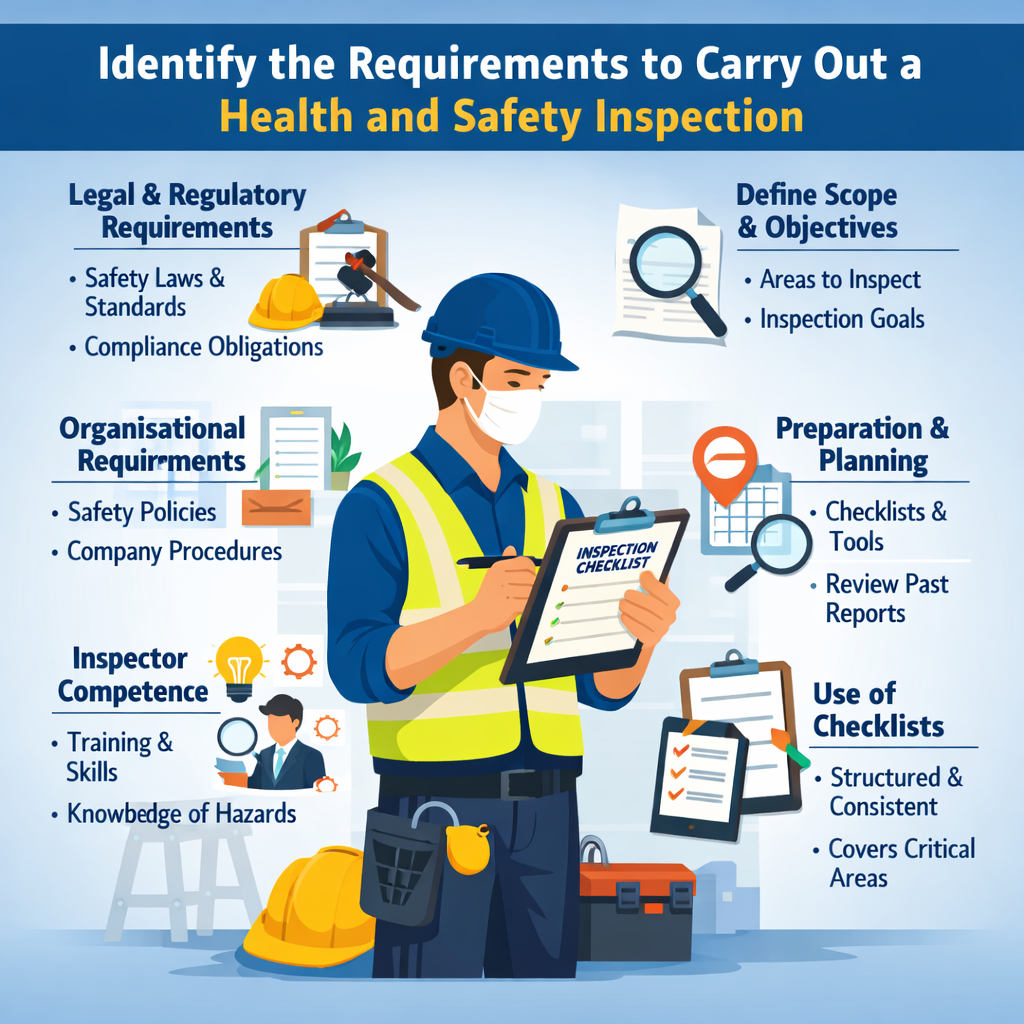
Understanding Legal and Regulatory Requirements
A fundamental requirement for conducting any health and safety inspection is a thorough understanding of the legal and regulatory framework governing workplace safety. These laws are designed to protect employees, employers, and the public by establishing minimum safety standards and responsibilities.
Compliance with National Health and Safety Legislation
Organisations are legally required to comply with national health and safety laws. These laws outline the duties of employers to provide a safe working environment and the responsibilities of employees to follow safety procedures.
- Employers must ensure safe systems of work
- Workplaces must be free from hazards as far as reasonably practicable
- Adequate training, supervision, and resources must be provided
- Risk assessments must be conducted and reviewed regularly
Failure to comply with these legal requirements can result in penalties, legal action, and reputational damage.
Awareness of Regulatory Standards and Codes of Practice
In addition to legislation, regulatory standards and approved codes of practice provide detailed guidance on how to achieve compliance.
- Standards define acceptable safety levels and procedures
- Codes of practice offer practical guidance for implementation
- Industry-specific regulations address unique risks and hazards
- Compliance with these standards demonstrates due diligence
Understanding these documents ensures that inspections are conducted in line with recognised best practices.
Understanding Employer and Employee Responsibilities
Health and safety is a shared responsibility between employers and employees.
- Employers are responsible for providing safe working conditions
- Employees must follow safety instructions and use equipment properly
- Supervisors play a role in enforcing safety practices
- Cooperation between all parties ensures effective implementation.
Inspectors must be aware of these responsibilities to evaluate compliance accurately.
Knowledge of Enforcement Authorities and Inspection Requirements
Regulatory authorities are responsible for monitoring and enforcing health and safety laws.
- Inspectors should understand the role of enforcement agencies
- Awareness of inspection criteria used by authorities
- Understanding reporting requirements and legal documentation
- Knowledge of potential enforcement actions
This knowledge helps ensure that internal inspections align with external expectations.
Understanding Organisational Requirements
In addition to legal obligations, organisations have their own internal requirements that must be considered during inspections.
Review of Internal Health and Safety Policies
Organisations develop policies to define their approach to health and safety.
- Policies outline objectives, responsibilities, and procedures
- They provide a framework for managing risks
- Inspectors must ensure that workplace practices align with these policies
Familiarity with Standard Operating Procedures (SOPs)
Standard operating procedures provide detailed instructions for performing tasks safely.
- SOPs define correct methods of work
- They help ensure consistency and reduce errors
- Inspectors should verify whether procedures are being followed
Alignment with Organisational Safety Objectives
Organisations often set specific safety goals to improve performance.
- Objectives may include reducing incidents or improving compliance
- Inspections should support these goals
- Findings should contribute to organisational improvement
Consideration of Company-Specific Risks and Processes
Every organisation has unique risks based on its operations.
- The type of industry influences the nature of hazards.
- Specific processes may introduce unique risks
- Inspectors must understand these factors to conduct effective inspections
Defining the Scope and Objectives of Inspection
A clear definition of scope and objectives ensures that inspections are focused and effective.
Identifying areas, departments, or activities to be inspected
- Identifying specific locations or operations
- Prioritising high-risk areas
- Ensuring comprehensive coverage of the workplace
Identifying Specific Hazards or Risks to Focus On
- Targeting known hazards or previous incident areas
- Considering both routine and non-routine activities
- Including environmental and behavioural risks
Setting Clear Inspection Goals
- Determining whether the inspection is for compliance, hazard identification, or improvement
- Establishing measurable outcomes
- Ensuring clarity of purpose
Determining Frequency and Timing of Inspections
- Scheduling regular inspections
- Conducting additional inspections after incidents or changes
- Timing inspections to observe actual work activities
Competence and Skills of the Inspector
The effectiveness of an inspection largely depends on the competence of the person conducting it.
Adequate Training in Health and Safety Practices
- Formal training in health and safety principles
- Knowledge of inspection techniques
- Understanding of risk assessment methods
Knowledge of Hazard Identification and Risk Assessment
- Ability to recognise different types of hazards
- Understanding of risk evaluation methods
- Capability to recommend appropriate control measures
Strong Observation and Analytical Skills
- Attention to detail
- Ability to identify unsafe conditions and behaviours
- Analytical thinking to assess risks
Effective Communication and Reporting Abilities
- Clear documentation of findings
- Ability to communicate risks and recommendations
- Engagement with employees and management
Preparation and Planning
Proper planning ensures that inspections are organised and efficient.
Reviewing Previous Inspection Reports and Incident Records
- Identifying recurring issues
- Understanding past incidents and corrective actions
- Tracking progress over time
Preparing Inspection Checklists Tailored to the Workplace
- Customising checklists based on specific risks
- Ensuring coverage of all relevant areas
- Including both general and specific inspection points
Ensuring Availability of Necessary Tools and Equipment
- Availability of PPE for inspectors
- Access to measuring instruments if required
- Ensuring all resources are ready before inspection
Coordinating with Relevant Personnel and Departments
- Informing departments about inspections
- Engaging supervisors and employees
- Ensuring cooperation during the inspection process
Use of Checklists and Inspection Tools
Checklists and tools are essential for ensuring consistency and completeness in inspections.
Structured Checklists Ensure Consistency
- Provide a systematic approach
- Ensure no critical areas are missed
- Facilitate standardised inspections across the organisation
Customised Checklists Address Specific Workplace Risks
- Tailored to industry and organisational needs
- Include specific hazards related to operations
- Improve relevance and effectiveness
Digital Tools Can Enhance Efficiency and Accuracy
- Use of mobile applications and software
- Real-time data recording and reporting
- Improved data analysis and tracking
Checklists help ensure that all critical areas are covered.
- Ensure comprehensive inspection coverage
- Support thorough hazard identification
- Reduce reliance on memory and subjective judgment
Conclusion
Identifying the requirements to carry out a health and safety inspection is a critical first step in ensuring the effectiveness of the inspection process. A clear understanding of legal and regulatory requirements ensures compliance, while knowledge of organisational policies and procedures supports alignment with internal objectives.
Defining the scope and objectives of inspections provides direction and focus, while the competence of the inspector ensures accurate identification and evaluation of hazards. Proper preparation, including reviewing past records and using appropriate tools, enhances the efficiency and reliability of inspections.
The use of structured and customised checklists further strengthens the inspection process by ensuring consistency and completeness. Overall, a well-prepared and professionally conducted inspection not only identifies risks but also contributes to continuous improvement, helping organisations maintain safe and healthy working environments.
2. Inspect the Workplace to Identify and Evaluate Hazards
Workplace inspection is a fundamental process in health and safety management that focuses on identifying hazards and evaluating their potential risks before they lead to accidents or incidents. A systematic and well-structured inspection allows organisations to proactively manage workplace risks, ensure compliance with legal requirements, and maintain a safe working environment for all employees.
The process of inspection involves more than simply observing the workplace; it requires a detailed and methodical approach to recognising different types of hazards, assessing their impact, and determining appropriate control measures. By carefully examining workplace conditions, equipment, and employee behaviour, organisations can identify both obvious and hidden risks. This section provides a comprehensive explanation of how to inspect the workplace effectively, focusing on hazard identification, inspection methods, evaluation techniques, and key considerations that contribute to a safe and compliant workplace.
Types of Hazards to Identify
Identifying hazards is the first and most critical step in workplace inspection. Hazards can arise from various sources and may differ depending on the nature of the work environment, processes, and activities.
Physical Hazards
Physical hazards are among the most common risks found in workplaces and can lead to immediate injuries.
- Slips, trips, and falls caused by wet floors, uneven surfaces, or obstacles
- Noise exposure from machinery and equipment
- Vibration from tools and heavy equipment
- Poor lighting conditions
- Extreme temperatures and environmental conditions
These hazards often result in injuries such as fractures, cuts, or long-term health issues like hearing loss.
Chemical Hazards
Chemical hazards involve exposure to harmful substances that can affect health through inhalation, ingestion, or skin contact.
- Exposure to hazardous chemicals and toxic substances
- Fumes, vapours, and dust particles
- Improper storage or handling of chemicals
- Lack of appropriate labelling and safety data sheets
Such hazards can lead to respiratory problems, skin irritation, or more severe health conditions if not properly controlled.
Biological Hazards
Biological hazards are associated with exposure to living organisms or their by-products.
- Bacteria and viruses
- Fungi and moulds
- Allergens from plants or animals
- Contaminated materials or waste
These hazards are particularly significant in healthcare, laboratories, and food-related industries.
Ergonomic Hazards
Ergonomic hazards arise from poor workplace design or improper work practices.
- Poor posture during work activities
- Repetitive movements leading to strain injuries
- Manual handling of heavy loads
- Inadequate workstation design
These hazards can result in musculoskeletal disorders and long-term health issues.
Psychosocial Hazards
Psychosocial hazards relate to the psychological and social aspects of the workplace.
- Work-related stress and pressure
- Fatigue due to excessive workload
- Poor communication or lack of support
- Workplace conflicts or harassment
These hazards can affect mental health, productivity, and overall wellbeing.
Inspection Methods
Effective workplace inspection requires the use of appropriate methods to identify hazards accurately and comprehensively.
Visual Inspection of Workplace Conditions
- Observing the physical condition of the workplace
- Identifying visible hazards such as spills, obstructions, or damaged equipment
- Checking overall cleanliness and organisation
Visual inspection is the most basic and widely used method for hazard identification.
Examination of Machinery, Tools, and Equipment
- Checking equipment for defects or damage
- Ensuring safety guards and protective devices are in place
- Verifying maintenance and inspection records
- Identifying unsafe or outdated equipment
Proper equipment inspection reduces the risk of mechanical failures and accidents.
Review of Safety Signs, Labels, and Warnings
- Ensuring safety signs are visible and clearly understood
- Verifying correct labelling of hazardous substances
- Checking compliance with safety standards
Clear signage helps communicate risks and safety instructions effectively.
Checking Housekeeping Standards and Cleanliness
- Ensuring work areas are clean and organised
- Proper storage of materials and tools
- Removal of waste and debris
- Maintaining clear walkways and access routes
Good housekeeping reduces the likelihood of accidents and improves efficiency.
Observing Employee Behaviour and Work Practices
- Monitoring how tasks are performed
- Identifying unsafe actions or shortcuts
- Checking use of personal protective equipment (PPE)
- Evaluating adherence to safety procedures
Behavioural observation provides insight into real workplace practices.
Evaluating Identified Hazards
Once hazards are identified, it is essential to evaluate their potential impact and determine appropriate actions.
Determining Likelihood of Occurrence
- Assessing how often a hazard may lead to an incident
- Considering frequency and duration of exposure
- Evaluating environmental and operational factors
Assessing Severity of Potential Harm
- Identifying the possible consequences of the hazard
- Considering both immediate and long-term effects
Assessing the impact on individuals and the organisation
Reviewing Existing Control Measures
- Identifying current safety controls in place
- Evaluating effectiveness of these measures
- Determining whether controls are adequate
Identifying Gaps in Safety Controls
- Recognising areas where controls are missing or insufficient
- Highlighting weaknesses in safety systems
- Recommending improvements
Prioritising Hazards Based on Risk Level
- Ranking hazards according to their risk level
- Focusing on high-risk hazards first
- Allocating resources effectively for risk control
Additional Considerations During Inspection
In addition to hazard identification and evaluation, several important factors must be considered during workplace inspections.
Accessibility of Emergency Exits and Escape Routes
- Ensuring exits are clearly marked and unobstructed
- Verifying that escape routes are easily accessible
- Checking emergency lighting and signage
Availability and Condition of Fire Safety Equipment
- Inspecting fire extinguishers and alarms
- Ensuring equipment is properly maintained
- Checking accessibility and visibility
Adequacy of Lighting and Ventilation
- Ensuring sufficient lighting for safe work
- Verifying proper ventilation to control air quality
- Reducing risks associated with poor environmental conditions
Safe Storage of Materials and Substances
- Proper storage of hazardous and non-hazardous materials
- Use of appropriate containers and labelling
- Preventing spills, leaks, and contamination
Ensuring proper supervision and safety signage
- Ensuring adequate supervision of workers
- Verifying presence of clear and visible safety signs
- Supporting compliance with safety procedures
Conclusion
Inspecting the workplace to identify and evaluate hazards is a vital process in maintaining a safe and healthy working environment. By systematically identifying different types of hazards, organisations can gain a clear understanding of potential risks and take proactive measures to control them.
The use of structured inspection methods, combined with careful evaluation of hazards, enables organisations to prioritise risks and implement effective control strategies. Additional considerations such as emergency preparedness, environmental conditions, and proper supervision further enhance the effectiveness of workplace inspections.
Ultimately, a thorough and professional approach to workplace inspection not only ensures compliance with health and safety requirements but also contributes to the prevention of accidents, protection of employees, and promotion of a strong safety culture. Continuous monitoring and improvement of inspection practices are essential for achieving long-term success in health and safety management.
3. Evaluate Hazards Through Observation of Work Activities
Evaluating hazards through the observation of work activities is a critical aspect of workplace inspection and risk management. While documentation, policies, and procedures provide a theoretical framework for safe operations, observing actual work practices offers a realistic and practical understanding of how tasks are performed in everyday situations. This approach enables inspectors to identify hazards that may not be evident through documentation alone.
Observation-based hazard evaluation focuses on understanding human behaviour, work processes, and environmental interactions. It helps identify unsafe acts, procedural deviations, and hidden risks that could lead to accidents or incidents. By closely examining how work is carried out, organisations can bridge the gap between planned procedures and actual practices, ensuring that safety measures are effectively implemented.
This section provides a detailed explanation of the importance of observational assessment, the key elements to observe, behavioural considerations, and methods for evaluating risks based on observed work activities.
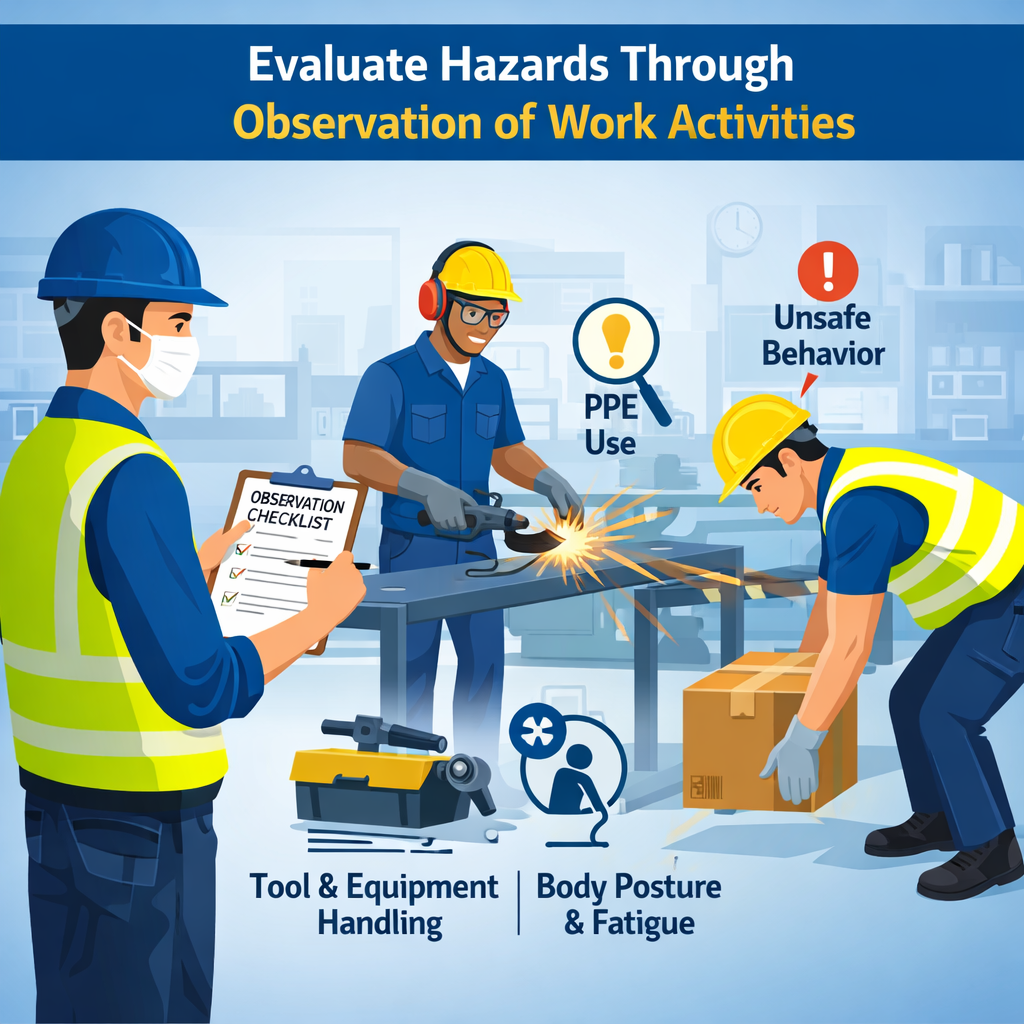
Importance of Observational Assessment
Observation plays a vital role in identifying hazards that may otherwise remain unnoticed. It provides direct insight into workplace operations and helps assess the effectiveness of existing safety controls.
Reveals Real Working Conditions and Behaviours
- Observation allows inspectors to see how tasks are actually performed rather than how they are intended to be performed
- It highlights the real conditions under which employees operate, including environmental factors and operational constraints
- It provides a true picture of workplace practices, enabling accurate hazard identification
Identifies Unsafe Acts and Deviations from Procedures
- Workers may unintentionally or deliberately deviate from established procedures
- Observation helps identify unsafe actions such as shortcuts, improper use of equipment, or ignoring safety rules
- It enables early detection of behaviours that could lead to accidents
Highlights Inefficiencies and Potential Risks
- Inefficient work practices often increase the likelihood of errors and hazards
- Observational assessment helps identify unnecessary movements, delays, or poor workflow design
- It allows organisations to improve both safety and productivity
Provides Context for Hazard Evaluation
- Observation helps understand the circumstances under which hazards occur
- It provides context regarding frequency, duration, and exposure levels
- This information is essential for accurate risk assessment and prioritisation
Key Elements to Observe
A comprehensive observation requires focusing on specific aspects of work activities to identify potential hazards effectively.
Worker Posture and Movements
Observation of body posture during tasks
- Identifying awkward or repetitive movements
- Assessing manual handling techniques
- Recognising risks of musculoskeletal disorders
Handling of Tools and Equipment
- Observing how tools and machinery are used
- Checking whether equipment is used correctly and safely
- Identifying misuse, overuse, or lack of maintenance
- Ensuring appropriate tools are selected for tasks
Compliance with Safety Procedures and Protocols
- Verifying whether employees follow established procedures
- Observing adherence to safety guidelines and instructions
- Identifying gaps between procedures and actual practices
- Ensuring proper implementation of control measures
Interaction Between Workers and Their Environment
- Observing how workers interact with their surroundings
- Identifying environmental hazards such as noise, lighting, and space constraints
- Assessing how these factors influence behaviour and safety
Level of Fatigue and Workload
- Monitoring signs of fatigue such as reduced concentration or slow reactions
- Assessing workload and work pace
- Identifying risks associated with overwork or insufficient rest
- Evaluating impact on performance and safety
Behavioural Observations
Human behaviour plays a significant role in workplace safety. Observing behaviour helps identify risks associated with human factors.
Use or Misuse of Personal Protective Equipment (PPE)
- Checking whether PPE is worn correctly and consistently
- Identifying situations where PPE is not used or used improperly
- Assessing adequacy of PPE for specific tasks
Communication Between Team Members
- Observing clarity and effectiveness of communication
- Identifying misunderstandings or lack of coordination
- Evaluating teamwork and collaboration
Response to Hazards and Emergencies
- Observing how workers react to potential hazards
- Assessing preparedness for emergency situations
- Identifying gaps in emergency response procedures
Adherence to Training and Instructions
- Evaluating whether employees apply their training in practice
- Identifying gaps between knowledge and behaviour
- Ensuring that training is effective and relevant
Evaluating Risks from Observations
After observing work activities, it is essential to evaluate the risks associated with identified hazards.
Identifying Unsafe Practices and Behaviours
- Recognising actions that increase risk
- Identifying repeated unsafe behaviours
- Determining root causes of unsafe practices
Assessing Frequency and Duration of Exposure
- Evaluating how often workers are exposed to hazards
- Determining duration of exposure during tasks
- Assessing cumulative impact on health and safety
Determining Potential Consequences
- Identifying possible outcomes of hazards
- Considering both immediate and long-term effects
- Evaluating impact on individuals and organisational operations
Recommending Corrective and Preventive Actions
- Suggesting measures to eliminate or reduce risks
- Recommending improvements in procedures and practices
- Promoting training and awareness programs
- Implementing monitoring and follow-up actions
Conclusion
Evaluating hazards through observation of work activities is an essential process in effective health and safety management. It provides a realistic understanding of workplace conditions, behaviours, and risks, enabling organisations to identify hazards that may not be visible through documentation alone.
By focusing on key elements such as worker behaviour, equipment use, and environmental interactions, organisations can gain valuable insights into potential risks. Behavioural observations further enhance this understanding by highlighting human factors that influence safety performance.
The evaluation of risks based on observation allows organisations to implement targeted corrective and preventive measures, improving both safety and efficiency. Ultimately, a systematic and professional approach to observational assessment contributes to the prevention of accidents, the protection of employees, and the development of a strong and proactive safety culture.
4. Examine Proposed Activities to Identify and Evaluate Hazards
Workplace environments are constantly evolving due to the introduction of new workplaces, equipment, processes, and activities. While these changes often aim to improve efficiency, productivity, and innovation, they can also introduce new and unforeseen risks. Therefore, it is essential to systematically examine all proposed activities before implementation to ensure that potential hazards are identified and effectively managed.
Examining proposed changes is a proactive approach to health and safety management. It enables organisations to prevent incidents before they occur rather than reacting to them after the fact. By carefully evaluating risks associated with new developments, organisations can implement appropriate control measures, ensure compliance with legal and organisational requirements, and maintain a safe working environment.
This section provides a detailed explanation of how to examine proposed activities, including new workplaces, equipment, processes, and activities, as well as the importance of conducting thorough risk assessments for all changes.
New Workplaces
Introducing a new workplace or modifying an existing one requires careful evaluation to ensure that it is safe, functional, and compliant with health and safety standards.
Evaluation of Layout and Workspace Design
- Assessing the overall design and arrangement of the workplace
- Ensuring sufficient space for movement and operations
- Identifying potential hazards related to layout, such as congestion or restricted access
- Considering workflow efficiency and safe movement of personnel and materials
Adequacy of Emergency Exits and Evacuation Routes
- Ensuring that emergency exits are clearly marked and easily accessible
- Verifying that evacuation routes are free from obstructions
- Assessing the number and location of exits in relation to occupancy levels
- Ensuring compliance with fire safety regulations
Assessment of Environmental Conditions
- Evaluating lighting levels to ensure safe visibility
- Assessing ventilation systems to maintain air quality
- Monitoring temperature conditions for worker comfort and safety
- Identifying environmental hazards such as noise or humidity
Accessibility for Workers, Including Those with Special Needs
- Ensuring that the workplace is accessible to all employees
- Providing appropriate facilities for individuals with disabilities
- Considering ergonomic design to support different physical needs
- Promoting inclusivity in workplace design
New Equipment
The introduction of new equipment can significantly impact workplace safety. It is essential to ensure that all equipment is safe, suitable, and properly managed.
Compliance with Safety Standards and Certifications
- Verifying that equipment meets regulatory and industry standards
- Ensuring certification from recognised authorities
- Checking compliance with manufacturer specifications
Availability of Safety Features and Guards
- Ensuring that protective guards and safety devices are installed
- Verifying the functionality of emergency stop mechanisms
- Assessing the adequacy of safety controls
Training Requirements for Operators
- Identifying the skills required to operate the equipment safely
- Providing appropriate training and instruction to employees
- Ensuring competence before allowing operation
Maintenance and Inspection Schedules
- Establishing regular maintenance routines
- Conducting periodic inspections to identify faults
- Keeping records of maintenance activities
- Ensuring equipment remains in safe working condition
New Processes
Changes in processes can introduce new hazards that must be carefully evaluated.
Identification of New Hazards Introduced by Processes
- Analysing each step of the process to identify risks
- Considering chemical, physical, and operational hazards
- Identifying potential failure points
Evaluation of Workflow and Operational Risks
- Assessing how tasks are performed within the process
- Identifying bottlenecks or inefficiencies
- Evaluating risks associated with sequencing and timing
Compatibility with Existing Systems
- Ensuring that new processes integrate smoothly with current operations
- Identifying conflicts or inconsistencies
- Maintaining overall system stability
Implementation of Control Measures and Safeguards
- Introducing engineering controls to reduce risks
- Establishing safe operating procedures
- Providing appropriate supervision and monitoring
New Activities
New activities or tasks can present unfamiliar risks that require careful assessment.
Assessment of Unfamiliar Tasks and Procedures
- Identifying tasks that employees have not performed before
- Evaluating potential hazards associated with these tasks
- Considering complexity and risk level
Evaluation of Required Skills and Competencies
- Determining the level of skill required for safe performance
- Assessing whether employees have the necessary competence
- Providing training and support where needed
Identification of Potential Risks and Hazards
- Analysing possible risks associated with the activity
- Considering both immediate and long-term hazards
- Evaluating impact on workers and operations
Planning of Training and Supervision
- Developing training programs for new activities
- Ensuring adequate supervision during initial stages
- Monitoring performance and compliance
Risk Assessment for Changes
A structured risk assessment process is essential when introducing any change in the workplace.
Conducting Pre-Implementation Risk Assessments
- Identifying hazards before changes are implemented
- Evaluating risks and determining control measures
- Documenting findings and recommendations
Consulting Employees and Safety Representatives
- Involving employees in the assessment process
- Gathering feedback from those directly affected
- Encouraging participation and communication
Testing and Reviewing New Systems
- Conducting trials or pilot testing of new systems
- Identifying issues and making necessary adjustments
- Ensuring systems function as intended
Monitoring and Reviewing After Implementation
- Continuously monitoring the effectiveness of changes
- Reviewing performance and safety outcomes
- Making improvements based on feedback and observations
Conclusion
Examining proposed activities to identify and evaluate hazards is a crucial aspect of proactive health and safety management. By carefully assessing new workplaces, equipment, processes, and activities, organisations can identify potential risks before they impact employees and operations.
The implementation of structured risk assessment processes ensures that hazards are effectively managed and that appropriate control measures are in place. Involving employees, providing training, and continuously monitoring changes further enhance the effectiveness of this approach.
Ultimately, a thorough and systematic evaluation of proposed activities helps organisations maintain a safe working environment, comply with regulatory requirements, and support continuous improvement. By prioritising safety during periods of change, organisations can minimise risks and ensure long-term success in health and safety management.
5. Select and Use Appropriate Measuring Equipment
In modern health and safety management, accurate measurement of workplace hazards plays a crucial role in ensuring effective risk assessment and control. While visual inspections and observations provide valuable insights, they are often insufficient for identifying hazards that require precise quantification, such as noise levels, gas concentrations, lighting conditions, temperature variations, and vibration exposure. Measuring equipment provides objective and reliable data that supports informed decision-making and enhances the overall effectiveness of workplace inspections.
The correct selection and proper use of measuring equipment enable organisations to identify risks more accurately, ensure compliance with regulatory standards, and implement appropriate control measures. It also strengthens the credibility of inspection findings and supports continuous improvement in workplace safety. This section provides a comprehensive explanation of the types of measuring equipment, selection criteria, proper usage practices, and the importance of accurate measurement in health and safety management.
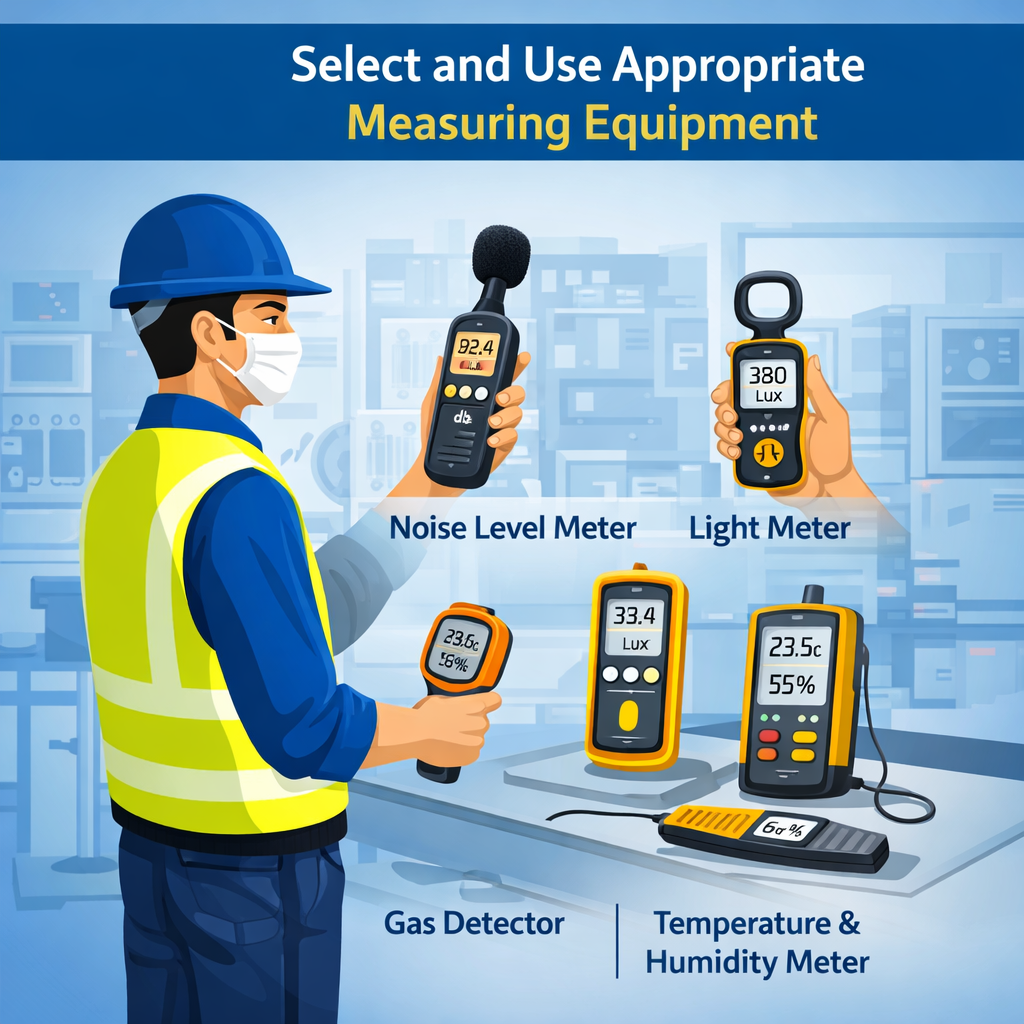
Types of Measuring Equipment
Different workplace hazards require specific types of measuring instruments to assess their presence and impact accurately. Selecting the appropriate equipment depends on the nature of the hazard being evaluated.
Noise Level Meters for Measuring Sound Exposure
- Used to measure sound levels in the workplace
They help identify areas with excessive noise exposure.
- Support compliance with occupational noise exposure limits
- Help prevent hearing damage and long-term health effects
Noise level meters are particularly important in industrial environments where machinery and equipment generate high levels of noise.
Gas Detectors for Identifying Hazardous Gases
- Detect the presence of toxic or flammable gases
- Provide real-time monitoring of gas concentrations
- Help prevent exposure to harmful substances
- Essential in confined spaces and chemical environments
Gas detectors play a critical role in ensuring worker safety in environments where invisible hazards may exist.
Light Meters for Assessing Illumination Levels
- Measure the intensity of lighting in the workplace
- Ensure adequate visibility for safe operations
- Help reduce eye strain and errors
- Support compliance with lighting standards
Proper lighting is essential for both safety and productivity.
Temperature and Humidity Meters
- Monitor environmental conditions in the workplace
- Help identify risks related to heat stress or cold exposure
Ensure comfort and wellbeing of employees
- Support control of humidity levels to prevent mould or equipment damage
Environmental monitoring is important for maintaining safe and comfortable working conditions.
Vibration Meters for Equipment-Related Risks
- Measure vibration levels from tools and machinery
- Help identify risks associated with prolonged exposure
- Support prevention of musculoskeletal and neurological disorders
- Assist in equipment maintenance and monitoring
Vibration measurement is particularly important in industries involving heavy machinery or power tools.
Criteria for Selecting Equipment
Selecting the appropriate measuring equipment is essential to ensure accurate and reliable results. Several factors must be considered during the selection process.
Suitability for the Specific Hazard
- Equipment must be appropriate for the type of hazard being measured
- Different hazards require specialised instruments
- Incorrect selection may lead to inaccurate results
Accuracy and Reliability
- Equipment should provide precise and consistent readings
- High-quality instruments ensure dependable data
- Reliable measurements support effective decision-making
Compliance with Industry Standards
- Equipment must meet recognised standards and certifications
- Compliance ensures credibility and acceptance of results
- Supports alignment with legal and regulatory requirements
Ease of Use and Portability
- Equipment should be user-friendly and easy to operate
- Portable devices allow flexibility during inspections
- Simplicity reduces the likelihood of user errors
Calibration and Maintenance Requirements
- Equipment must be regularly calibrated to maintain accuracy
- Maintenance ensures proper functioning and longevity
- Calibration records should be maintained for verification
Proper Use of Measuring Equipment
Proper use of measuring instruments is essential to ensure accurate and meaningful results. Incorrect usage can lead to unreliable data and ineffective risk management.
Following Manufacturer Guidelines
- Equipment should be used according to manufacturer instructions
- Proper handling ensures accurate readings
- Misuse can damage equipment or produce incorrect results
Ensuring Equipment is Properly Calibrated
- Calibration should be performed at regular intervals
- Pre-use checks should be conducted before measurements
- Calibration ensures consistency and accuracy
Using Equipment Under Appropriate Conditions
- Measurements should be taken in suitable environmental conditions
- External factors such as temperature or interference should be considered
- Proper positioning of equipment is essential
Recording Measurements Accurately and Consistently
- Data should be recorded clearly and systematically
- Consistent methods should be used for all measurements
- Accurate records support analysis and reporting
Importance of Accurate Measurement
Accurate measurement is a key factor in effective health and safety management. It provides reliable data that supports various aspects of risk assessment and control.
Provides Objective Data for Risk Assessment
- Measurement eliminates guesswork and subjective judgment
- Provides factual evidence of hazard levels
- Supports accurate risk evaluation
Helps Determine Compliance with Exposure Limits
- Ensures that workplace conditions meet regulatory standards
- Identifies areas where limits are exceeded
- Supports implementation of corrective actions
Supports Decision-Making for Control Measures
- Data helps determine appropriate control strategies
- Enables prioritisation of risks
- Supports cost-effective safety improvements
Enhances Credibility of Inspection Findings
- Accurate data strengthens the validity of inspection reports
- Builds trust with stakeholders and regulatory authorities
- Demonstrates professionalism and accountability
Conclusion
Selecting and using appropriate measuring equipment is a vital aspect of effective workplace inspection and hazard management. By accurately measuring workplace conditions, organisations can identify risks that may not be visible through observation alone and take appropriate actions to control them.
The use of specialised equipment for different hazards, combined with careful selection based on suitability, accuracy, and compliance, ensures reliable results. Proper usage, including adherence to manufacturer guidelines and regular calibration, further enhances the quality of measurements.
Accurate measurement provides objective data that supports risk assessment, ensures compliance with exposure limits, and strengthens decision-making processes. Ultimately, it contributes to improved safety performance, enhanced credibility, and the development of a proactive approach to health and safety management.
6. Maintain Records of the Hazards Identified
Maintaining accurate and detailed records of hazards identified during workplace inspections is a fundamental requirement of effective health and safety management. Record-keeping serves as a critical tool for documenting findings, tracking risks, and demonstrating compliance with legal and organisational requirements. It ensures that all identified hazards are properly recorded, assessed, and addressed in a structured and transparent manner.
In addition to supporting compliance, proper documentation enhances communication, accountability, and decision-making within the organisation. It allows stakeholders to monitor safety performance, identify recurring issues, and implement corrective actions efficiently. This section provides a comprehensive explanation of the importance of record keeping, statutory and organisational requirements, industry best practices, and the key elements that should be included in effective records.
Importance of Record Keeping
Record keeping is an essential component of health and safety systems, providing a reliable foundation for managing workplace risks.
Provides Evidence of Compliance with Legal Requirements
- Records demonstrate that the organisation is meeting its legal obligations
- They provide documented proof during inspections by regulatory authorities
- Help avoid penalties and legal consequences
Supports Internal and External Audits
- Enables auditors to review safety practices and procedures
- Provides structured evidence of risk assessments and actions taken
- Facilitates smooth and efficient audit processes
Helps Track Trends and Recurring Issues
- Identifies patterns in workplace hazards and incidents
- Supports analysis of recurring problems
- Helps in developing long-term preventive strategies
Facilitates Communication and Accountability
- Ensures that information is shared among relevant personnel
- Clarifies responsibilities for corrective actions
- Enhances coordination between departments
Supports Continuous Improvement Initiatives
- Provides data for evaluating safety performance
- Helps measure effectiveness of control measures
- Encourages ongoing improvement in workplace safety
Statutory Requirements
Organisations are legally required to maintain specific records related to health and safety.
Maintaining Legally Required Documentation
- Keeping records as mandated by national laws and regulations
- Ensuring documentation is complete and up to date
- Retaining records for required time periods
Recording Risk Assessments and Inspection Findings
- Documenting identified hazards and associated risks
- Recording outcomes of inspections and evaluations
- Providing clear evidence of risk management activities
Keeping Incident and Accident Reports
- Recording details of workplace incidents and near misses
- Including causes, consequences, and corrective actions
- Supporting investigation and prevention efforts
Ensuring Records Are Available for Inspection
- Making records accessible to regulatory authorities
- Ensuring proper storage and retrieval systems
- Maintaining transparency and accountability
Organisational Requirements
In addition to legal obligations, organisations must follow internal requirements for record keeping.
Following Internal Documentation Procedures
- Adhering to company policies and guidelines
- Ensuring consistency in documentation practices
- Aligning records with organisational objectives
Using Standard Templates and Formats
- Maintaining uniformity in records
- Ensuring clarity and ease of understanding
- Facilitating efficient data analysis and reporting
Ensuring Records Are Accessible to Relevant Personnel
- Providing access to authorised employees
- Supporting effective communication and decision-making
- Ensuring timely availability of information
Maintaining Confidentiality and Data Protection
- Protecting sensitive information from unauthorised access
- Complying with data protection regulations
- Ensuring secure storage of records
Industry Best Practice
Adopting industry best practices enhances the effectiveness and reliability of record keeping systems.
Keeping Detailed and Accurate Records
- Ensuring completeness and accuracy of information
- Avoiding errors and inconsistencies
- Providing reliable data for analysis
Updating Records Regularly
- Ensuring records reflect current workplace conditions
- Recording changes and updates promptly
- Maintaining relevance and accuracy
Using Digital Systems for Efficiency
- Implementing electronic record-keeping systems
- Improving data storage, retrieval, and analysis
- Reducing paperwork and manual errors
Ensuring Traceability and Version Control
- Tracking changes in records over time
- Maintaining history of updates and revisions
- Ensuring accountability and transparency
Key Elements of Effective Records
Effective records should include all relevant information necessary for understanding and managing hazards.
Description of Hazards Identified
- Clear and detailed explanation of each hazard
- Identification of potential sources and causes
- Classification of hazard type
Location and Date of Inspection
- Recording where and when the hazard was identified
- Providing context for the inspection
- Supporting traceability
Names of Persons Involved
- Identifying individuals involved in the inspection
Recording the persons responsible for actions
- Ensuring accountability
Risk Assessment Results
- Documenting likelihood and severity of risks
- Providing risk ratings or categories
- Supporting prioritisation of hazards
Control Measures Implemented
- Recording actions taken to reduce or eliminate risks
- Identifying existing and additional controls
- Evaluating effectiveness of measures
Recommended Actions and Follow-Up
- Listing required corrective actions
- Setting priorities for implementation
- Ensuring follow-up and monitoring
Deadlines and Responsible Persons
- Assigning responsibility for each action
- Setting clear timelines for completion
- Ensuring accountability and timely execution
Conclusion
Maintaining records of hazards identified during workplace inspections is a vital aspect of effective health and safety management. Accurate and comprehensive documentation not only ensures compliance with statutory and organisational requirements but also supports transparency, accountability, and informed decision-making.
By keeping detailed records, organisations can track trends, identify recurring issues, and implement effective control measures. The integration of best practices, such as the use of digital systems and regular updates, further enhances the efficiency and reliability of record-keeping processes.
Overall, a structured and professional approach to maintaining records contributes significantly to improving workplace safety, supporting continuous improvement, and fostering a proactive safety culture. By embedding robust record-keeping practices into daily operations, organisations can ensure long-term success in managing health and safety risks.