
Contact Us: +44 7441 396751 Reach us: info@inspirecollege.co.uk
Curriculum
- 10 Sections
- 45 Lessons
- 60 Weeks
Expand all sectionsCollapse all sections
- Unit 1: Promote a Health and Safety CulturePromoting a strong health and safety culture within an organization is essential for preventing workplace accidents, protecting employees, and ensuring overall organizational efficiency. A positive health and safety culture exists when safety is recognized as a shared responsibility and is integrated into everyday workplace practices, decision-making processes, and organizational values.In the context of the ProQual Level 6 NVQ Diploma in Occupational Health and Safety Practice, promoting a health and safety culture involves encouraging employees, managers, and stakeholders to actively participate in maintaining safe working conditions. This includes raising awareness of potential hazards, promoting open communication about safety concerns, and ensuring that safety policies and procedures are consistently followed.8
- 1.1Lesson 1: Be Able to Advocate Commitment to a Positive Health and Safety Culture in the Organisation
- 1.2Quiz No 1: Be Able to Advocate Commitment to a Positive Health and Safety Culture in the Organisation30 Minutes30 Questions
- 1.3Lesson 2: Be Able to Develop Links with Appropriate People and Groups on Health and Safety Matters
- 1.4Quiz No 2: Be Able to Develop Links with Appropriate People and Groups on Health and Safety Matters30 Minutes30 Questions
- 1.5Lesson 3: Understand the importance of promoting a positive health and safety culture within the organisation.
- 1.6Quiz No 3: Understand the importance of promoting a positive health and safety culture within the organisation.30 Minutes30 Questions
- 1.7Lesson 4: Be able to maintain and record their professional development
- 1.8Quiz No 4 : Be able to maintain and record their professional development30 Minutes30 Questions
- Unit 2: Develop and implement the health and safety policyThis chapter provides a comprehensive understanding of how to develop, implement, and manage an effective health and safety policy within an organization. It explains the key components of a well-structured policy, including the statement of intent, roles and responsibilities, and arrangements for ensuring workplace safety. Learners will gain knowledge of how to align policies with legal and regulatory requirements while addressing organizational needs and risks.The chapter also focuses on practical steps for successful implementation, such as communication, training, and employee involvement. It highlights the importance of monitoring performance, reviewing policies regularly, and making continuous improvements to ensure effectiveness. By the end of this chapter, learners will be able to contribute to creating a safer work environment and support a positive health and safety culture.10
- 2.1Lesson 1: Be able to define the statutory and workplace health and safety requirements for the organisation.
- 2.2Quiz no 1 : Be able to define the statutory and workplace health and safety requirements for the organisation.30 Minutes30 Questions
- 2.3Lesson 2: Be able to develop the Health and Safety Policy.
- 2.4Quiz No 2: Be able to develop the Health and Safety Policy.30 Minutes30 Questions
- 2.5Lesson 3: Be able to implement the Health and Safety Policy.
- 2.6Quiz no 3 : Be able to implement the Health and Safety Policy.30 Minutes30 Questions
- 2.7Lesson 4: Know the steps required to develop and implement the Health and Safety Policy.
- 2.8Quiz no 4 : Know the steps required to develop and implement the Health and Safety Policy.28 Minutes30 Questions
- 2.9Lesson 5: Be able to maintain and record their professional development
- 2.10Quiz no 5 : Be able to maintain and record their professional development29 Minutes30 Questions
- Unit 3: Develop and implement effective communication systems for health and safety informationEffective communication is essential for building and maintaining a safe workplace. Health and safety information must be shared in a way that is clear, timely, and accessible to everyone, regardless of their role or level of responsibility. Without effective communication systems, even well-designed safety policies can fail to protect workers, leading to misunderstandings, accidents, and non-compliance. This chapter emphasizes the importance of communication in promoting a strong safety culture, preventing incidents, and ensuring that employees understand their responsibilities in maintaining workplace safety.In addition, the chapter explores practical strategies for developing and implementing communication systems that work across diverse organizational settings. Learners will examine methods such as safety signage, notice boards, digital platforms, reporting mechanisms, and training sessions, while also considering barriers like language differences and literacy levels. By the end of this chapter, learners will be equipped with the knowledge to design communication systems that are consistent, responsive, and inclusive—ensuring that health and safety information is not only delivered but also understood and acted upon effectively.10
- 3.1Lesson 1: Be able to evaluate health and safety information.
- 3.2Quiz no 1 : Be able to evaluate health and safety information.30 Minutes30 Questions
- 3.3Lesson 2: Be able to produce communication systems for health and safety information into the organisation.
- 3.4Quiz No :2 Be able to produce communication systems for health and safety information into the organisation.30 Minutes30 Questions
- 3.5Lesson 3: Be able to control the effectiveness of the communication systems for health and safety information going out of the organisation.
- 3.6Quiz No 3 : Be able to control the effectiveness of the communication systems for health and safety information going out of the organisation.30 Minutes30 Questions
- 3.7Lesson 4: Know how to develop and implement effective communication systems for health and safety information.
- 3.8Quiz No 4 : Know how to develop and implement effective communication systems for health and safety information.30 Minutes30 Questions
- 3.9Lesson 5: Be able to maintain and record their professional development
- 3.10Quiz No : 5 Be able to maintain and record their professional development30 Minutes30 Questions
- Unit 4: Develop and maintain individual and organisational competence in health and safety mattersThis chapter focuses on the systematic development and maintenance of both individual and organisational competence in health and safety matters. It explains that competence is not a one-time achievement but an ongoing process that requires continuous learning, practical application, and regular updating of knowledge and skills. Emphasis is placed on structured approaches such as training, continuous professional development, performance evaluation, and effective communication systems to ensure that individuals can perform their roles safely and efficiently. The chapter also highlights the importance of aligning individual capabilities with organisational requirements to maintain compliance with health and safety standards and legal obligations.In addition, the chapter explores how organisations can foster a culture of continuous improvement by embedding competence development into their management systems. It discusses the role of leadership in promoting safety awareness, supporting professional growth, and ensuring that employees, contractors, and stakeholders possess the required competencies. The importance of maintaining accurate records, reflecting on professional experiences, and setting development goals is also addressed. By focusing on both individual and organisational competence, the chapter demonstrates how organisations can enhance overall performance, reduce workplace risks, and build a strong, proactive health and safety culture.8
- 4.1Lesson 1: Be able to assess the health and safety competence needs of the organisation.
- 4.2Quiz No1 : Be able to assess the health and safety competence needs of the organisation.30 Minutes30 Questions
- 4.3Lesson :2 Be able to implement health and safety training to meet identified needs.
- 4.4Quiz No: 2 Be able to implement health and safety training to meet identified needs.30 Minutes30 Questions
- 4.5Lesson:3 Know how to develop and maintain individual and organisational competence in health and safety matters.
- 4.6Quiz No 3 : Know how to develop and maintain individual and organisational competence in health and safety matters.30 Minutes30 Questions
- 4.7Lesson :4 Be able to maintain and record their professional development
- 4.8Quiz No: 4 Be able to maintain and record their professional development30 Minutes30 Questions
- Unit 5: Identify, assess and control health and safety risksThis chapter focuses on the systematic approach required to identify, assess, and control health and safety risks within the workplace. It emphasises the importance of recognising potential hazards arising from work activities, equipment, environments, and human behaviour. By applying structured risk assessment methods, organisations can evaluate the likelihood and severity of harm, enabling informed and proactive decision-making. The content highlights the need to move beyond reactive measures and adopt preventative strategies that reduce risks before incidents occur.In addition, the chapter explores practical techniques for implementing effective risk control measures. It introduces the hierarchy of control as a key framework for managing risks, encouraging the prioritisation of elimination, substitution, and engineering controls over administrative measures and personal protective equipment. Continuous monitoring and regular review of control measures are also emphasised to ensure their effectiveness over time. Overall, the chapter reinforces the importance of risk management in creating safer workplaces, improving organisational performance, and fostering a culture of continuous improvement.10
- 5.1Lesson 1: Be able to conduct an inspection of the workplace
- 5.2Quiz No1: Be able to conduct an inspection of the workplace30 Minutes30 Questions
- 5.3Lesson 2: Be able to assess risks to health and safety.
- 5.4Quiz No:2 Be able to assess risks to health and safety.30 Minutes30 Questions
- 5.5Lesson 3: Be able to implement risk control measures and safe systems of work in the organisation.
- 5.6Quiz No:3 Be able to implement risk control measures and safe systems of work in the organisation.30 Minutes30 Questions
- 5.7Lesson 4: Know how to identify, assess and control health and safety risks
- 5.8Quiz No:4 Know how to identify, assess and control health and safety risks30 Minutes30 Questions
- 5.9Lesson 5: Be able to maintain and record their professional development
- 5.10Quiz No:5 Be able to maintain and record their professional development30 Minutes30 Questions
- Unit 6: Develop and implement proactive monitoring systems for health and safetyThis section focuses on the development and implementation of proactive monitoring systems for health and safety, which play a crucial role in preventing workplace incidents before they occur. Instead of relying on reactive approaches that address issues after an accident, proactive monitoring emphasises early identification of potential hazards, unsafe practices, and system weaknesses. It involves regular inspections, safety audits, performance measurement, and the use of key indicators to evaluate workplace conditions. By consistently monitoring and assessing safety performance, organisations can identify risks at an early stage and implement corrective actions to minimise harm and improve overall safety standards.Furthermore, the section highlights the importance of embedding proactive monitoring into daily organisational practices. Effective systems depend on well-defined procedures, skilled personnel, accurate data collection, and ongoing review processes. Active employee involvement is also essential, as workers can provide valuable insights into potential risks within their work environment. By promoting a culture of awareness, responsibility, and continuous improvement, organisations can maintain high safety standards and prevent incidents more effectively. Ultimately, proactive monitoring contributes to legal compliance, enhances operational efficiency, and supports the long-term health and well-being of employees.8
- 6.1Lesson 1: Be able to devise inspection and monitoring systems for health and safety proactive performance monitoring.
- 6.2Quiz No :1 Be able to devise inspection and monitoring systems for health and safety proactive performance monitoring.30 Minutes30 Questions
- 6.3Lesson 2: Be able to keep stakeholders informed of health and safety proactive performance monitoring outcomes.
- 6.4Quiz No: 2 Be able to keep stakeholders informed of health and safety proactive performance monitoring outcomes.30 Minutes30 Questions
- 6.5Lesson 3: Understand how to develop and implement proactive monitoring systems for health and safety.
- 6.6Quiz No : 3 Understand how to develop and implement proactive monitoring systems for health and safety.30 Minutes30 Questions
- 6.7Lesson 4: Be able to maintain and record their professional development
- 6.8Quiz No : 4 Be able to maintain and record their professional development30 Minutes30 Questions
- Unit 7: Develop and implement reactive monitoring systems for health and safetyDeveloping and implementing reactive monitoring systems is a critical aspect of effective health and safety management. These systems focus on identifying and analyzing incidents that have already occurred, such as accidents, near misses, injuries, or cases of ill health. By systematically collecting and reviewing this information, organizations can uncover underlying causes, identify patterns, and evaluate the effectiveness of existing control measures. Reactive monitoring provides valuable insights into areas where safety arrangements may have failed, enabling organizations to take corrective actions and prevent recurrence.An effective reactive monitoring system goes beyond simply recording incidents; it involves thorough investigation, accurate reporting, and continuous improvement. Organizations must establish clear procedures for incident reporting, ensure timely investigations, and maintain detailed records for analysis. This process helps in strengthening risk management strategies, improving workplace safety culture, and ensuring compliance with legal requirements. Ultimately, reactive monitoring supports learning from past events, allowing organizations to enhance their safety performance and protect employees from future harm.12
- 7.1Lesson No 1: Be able to develop a health and safety loss event reporting and recording system.
- 7.2Quiz No:1 Be able to develop a health and safety loss event reporting and recording system.30 Minutes30 Questions
- 7.3Lesson No 2: Be able to implement health and safety loss event investigation systems and procedures.
- 7.4Quiz No:2 Be able to implement health and safety loss event investigation systems and procedures.30 Minutes30 Questions
- 7.5Lesson No :3 Be able to conduct statistical and epidemiological analyses.
- 7.6Quiz No :3 Be able to conduct statistical and epidemiological analyses.30 Minutes30 Questions
- 7.7Lesson:4 Be able to maintain communication with stakeholders of health and safety reactive performance monitoring outcomes.
- 7.8Quiz No: 4 Be able to maintain communication with stakeholders of health and safety reactive performance monitoring outcomes.30 Minutes30 Questions
- 7.9Lesson No :5 Understand how to develop and implement reactive monitoring systems for health and safety
- 7.10Quiz No:5 Understand how to develop and implement reactive monitoring systems for health and safety30 Minutes30 Questions
- 7.11Lesson No: 6 Be able to maintain and record their professional development
- 7.12Quiz No:6 Be able to maintain and record their professional development30 Minutes30 Questions
- Unit 8: Develop and implement health and safety emergency response systems and proceduresThis chapter focuses on the systematic development and implementation of effective health and safety emergency response systems within the workplace. It highlights the importance of being prepared for a wide range of potential emergencies such as fires, medical incidents, hazardous material spills, and natural disasters. The chapter explains how organizations can identify possible emergency scenarios through risk assessment and develop structured response plans that clearly define roles, responsibilities, and procedures. It also emphasizes the need for effective communication systems, proper resource allocation, and coordination with external emergency services to ensure a timely and organized response.In addition, the chapter explores the practical aspects of implementing and maintaining these emergency response procedures. It underlines the importance of regular training, awareness programs, and emergency drills to ensure that all employees are capable of responding appropriately during critical situations. Continuous monitoring, evaluation, and improvement of emergency systems are also discussed to ensure their effectiveness over time. By following these approaches, organizations can enhance their preparedness, minimize risks, protect lives and property, and maintain operational continuity during emergencies.8
- 8.1Lesson No 1: Be able to develop health and safety emergency response procedures.
- 8.2Quiz No :1 Be able to develop health and safety emergency response procedures.30 Minutes30 Questions
- 8.3Lesson No 2: Be able to implement procedures for the control of a health and safety emergency.
- 8.4Quiz No : 2 Be able to implement procedures for the control of a health and safety emergency.30 Minutes30 Questions
- 8.5Lesson No 3: Understand how to develop and implement health and safety emergency response systems and procedures.
- 8.6Quiz No:3 Understand how to develop and implement health and safety emergency response systems and procedures.30 Minutes30 Questions
- 8.7Lesson No 4: Be able to maintain and record their professional development
- 8.8Quiz No : 4 Be able to maintain and record their professional development30 Minutes30 Questions
- Unit 9: Develop and implement health and safety review systemsDeveloping and implementing health and safety review systems is a critical process that enables organizations to continuously evaluate and improve their safety performance. These systems provide a structured approach for monitoring existing policies, procedures, and practices to ensure they remain effective, relevant, and compliant with legal and regulatory requirements. A well-established review system helps identify gaps, weaknesses, and emerging risks within the organization, allowing timely corrective and preventive actions to be taken. It also supports informed decision-making by providing accurate data and insights into safety performance, incident trends, and operational risks.Effective health and safety review systems go beyond periodic checks; they promote a culture of continuous improvement and accountability. By incorporating regular audits, inspections, performance reviews, and feedback mechanisms, organizations can ensure that safety standards are consistently maintained and enhanced. These systems also encourage employee involvement, enabling workers to contribute to identifying hazards and suggesting improvements. Ultimately, implementing robust review systems strengthens organizational resilience, enhances compliance, reduces incidents, and ensures a safer and more sustainable working environment.8
- 9.1Lesson No 1: Be able to investigate the efficiency and cost effectiveness of health and safety management systems.
- 9.2Quiz No :1 Be able to investigate the efficiency and cost effectiveness of health and safety management systems.30 Minutes30 Questions
- 9.3Lesson No 2: Be able to confirm that each part of the health and safety management system is working as intended.
- 9.4Quiz No : 2 Be able to confirm that each part of the health and safety management system is working as intended.30 Minutes30 Questions
- 9.5Lesson No:3 Be able to confirm that the entire health and safety system is working as intended.
- 9.6Quiz No : 3 Be able to confirm that the entire health and safety system is working as intended.30 Minutes30 Questions
- 9.7Lesson No : 4 Be able to maintain and record their professional development
- 9.8Quiz No : 4 Be able to maintain and record their professional development30 Minutes30 Questions
- Unit 10: Maintain knowledge of improvements to influence health and safety practiceThis chapter focuses on the importance of continuously updating and maintaining knowledge to support improvements in health and safety practices within the workplace. It highlights that health and safety is not a static field; it evolves due to changes in legislation, emerging risks, technological advancements, and lessons learned from incidents and industry developments. Professionals are therefore required to stay informed through regular training, professional development activities, research, and engagement with industry updates. By doing so, they ensure that their knowledge remains current, relevant, and aligned with best practices and regulatory requirements.Furthermore, the chapter emphasizes the role of individuals in using their updated knowledge to positively influence health and safety standards within their organization. This includes applying new learning to risk assessments, improving procedures, promoting a strong safety culture, and sharing insights with colleagues and stakeholders. By actively contributing to improvements and encouraging others to adopt safer practices, professionals not only enhance workplace safety but also support organizational compliance and continuous improvement. Ultimately, maintaining up-to-date knowledge enables individuals to make informed decisions, reduce risks, and foster a proactive approach to health and safety management.8
- 10.1Lesson No :1 Be able to identify new developments in health and safety.
- 10.2Quiz No:1 Be able to identify new developments in health and safety.30 Minutes30 Questions
- 10.3Lesson No :2 Be able to influence colleagues on health and safety matters
- 10.4Quiz No :2 Be able to influence colleagues on health and safety matters30 Minutes30 Questions
- 10.5Lesson No:3 Know how to maintain knowledge of improvements in health and safety practice
- 10.6Quiz No : 3 Know how to maintain knowledge of improvements in health and safety practice30 Minutes30 Questions
- 10.7Lesson No:4 Be able to maintain and record their professional development
- 10.8Quiz No : 4 Be able to maintain and record their professional development30 Minutes30 Questions
Lesson No:3 Know how to maintain knowledge of improvements in health and safety practice
In today’s rapidly changing working environment, maintaining current and accurate knowledge of health and safety practices is a fundamental requirement for organisations seeking to operate responsibly and efficiently. The nature of workplace risks is continually evolving due to factors such as legislative updates, advancements in technology, changes in organisational structures, and the emergence of new hazards. Consequently, health and safety professionals must remain vigilant and responsive, ensuring that their knowledge and practices reflect the most recent developments in the field.
Keeping knowledge up to date is not a passive or occasional task; it is an ongoing and structured process that requires active engagement. Professionals must continuously seek relevant information from reliable sources, critically evaluate its accuracy and applicability, and integrate new learning into their daily practices. This approach enables them to respond effectively to changing conditions, improve risk management strategies, and ensure that safety measures remain both practical and compliant with current standards.
Furthermore, maintaining knowledge involves more than individual learning; it also includes the ability to communicate and share information effectively within the organisation. Health and safety professionals must be capable of translating complex information into clear and actionable guidance for colleagues at all levels. This ensures that improvements are understood, accepted, and implemented consistently, contributing to a strong and proactive safety culture.
This lesson is designed to develop a comprehensive understanding of how to maintain and apply knowledge of improvements in health and safety practice. It explores the nature and impact of such improvements, the evaluation of various information sources, the principles of effective communication, and the influence of external factors. By developing these competencies, professionals can enhance their effectiveness, support continuous improvement, and contribute to creating safer, more resilient, and high-performing workplaces.
1. Explain the nature and role of improvements in health and safety practice within the organisation and how they can impact on the business
In modern organisations, health and safety management is not a static system but a continuously evolving process that requires regular review and improvement. As workplaces become more complex and dynamic, organisations must ensure that their health and safety practices are regularly updated to reflect new risks, technological advancements, and regulatory requirements. Improvements in health and safety practice are therefore essential for maintaining effective risk control, protecting employees, and ensuring organisational sustainability.
Health and safety professionals play a key role in identifying, implementing, and monitoring these improvements. Their ability to understand the nature of changes and evaluate their impact on organisational performance is critical for achieving long-term success. Improvements are not limited to compliance; they also contribute to operational efficiency, financial performance, and organisational reputation.
This section focuses on the nature of improvements in health and safety practice, their role within the organisation, and their wider impact on business performance. It provides a structured understanding of how continuous improvement supports both safety and organisational objectives.
Overview
Improvements in health and safety practice refer to the ongoing development and enhancement of systems, processes, and behaviours aimed at reducing risks and improving workplace safety. These improvements are essential for maintaining compliance, enhancing performance, and adapting to changing conditions.
Organisations must adopt a proactive approach to improvement, ensuring that their safety systems are regularly reviewed and updated. This helps prevent incidents, improve efficiency, and ensure that the organisation remains aligned with current standards and expectations.
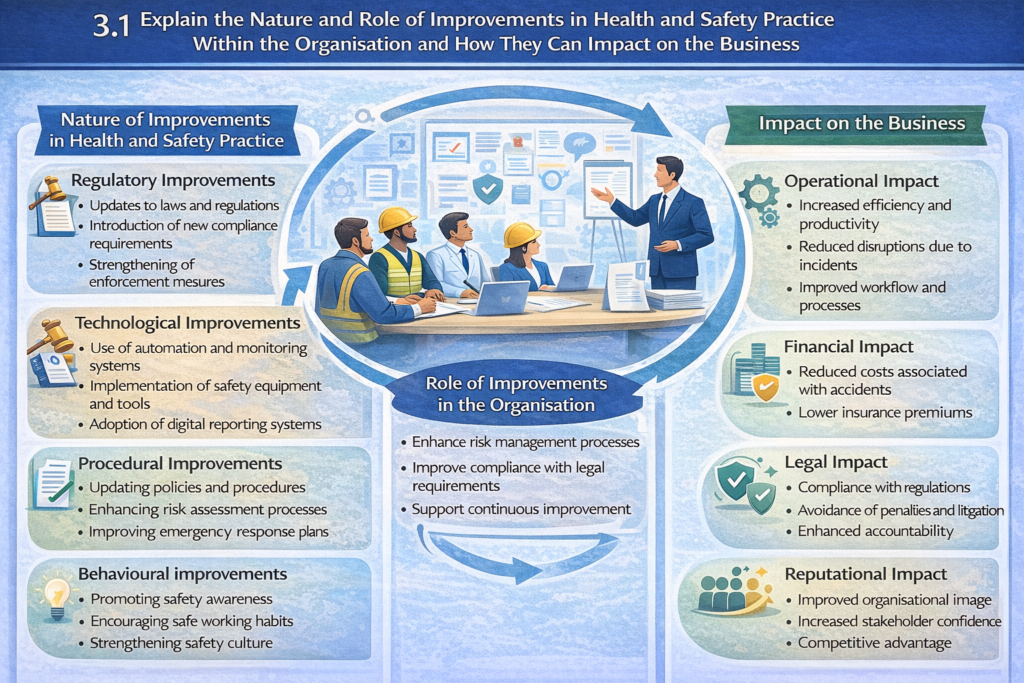
Nature of Improvements in Health and Safety Practice
Improvements in health and safety practice can take various forms depending on organisational needs, industry requirements, and external influences. These improvements can be broadly categorised into regulatory, technological, procedural, and behavioural developments.
Regulatory improvements
Regulatory improvements are driven by changes in laws, regulations, and enforcement practices. These changes require organisations to adapt their systems to remain compliant.
Updates to laws and regulations
- Introduction of new legal requirements
- Amendments to existing legislation
- Updates to standards and codes of practice
Organisations must stay informed about these changes and ensure that their policies and procedures are aligned with legal expectations.
Introduction of new compliance requirements
- Implementation of additional safety controls
- Adoption of new reporting and documentation processes
- Enhanced monitoring and evaluation systems
These requirements often aim to address emerging risks and improve overall safety standards.
Strengthening of enforcement measures
- Increased inspections and audits
- Stricter penalties for non-compliance
- Greater accountability for organisations
Stronger enforcement encourages organisations to prioritise health and safety and maintain high standards of compliance.
Technological improvements
Technological advancements have significantly influenced health and safety practices by introducing new tools and systems for risk management.
Use of automation and monitoring systems
- Automated machinery to reduce manual risks
- Monitoring systems for detecting hazards
- Real-time data collection and analysis
These technologies help improve accuracy and reduce the likelihood of human error.
Implementation of safety equipment and tools
- Personal protective equipment (PPE)
- Safety devices and alarms
- Advanced machinery with built-in safety features
The use of appropriate equipment enhances worker protection and reduces exposure to hazards.
Adoption of digital reporting systems
- Electronic incident reporting
- Digital risk assessment tools
- Online safety management systems
Digital systems improve efficiency, accuracy, and accessibility of safety information.
Procedural improvements
Procedural improvements involve updating organisational processes and systems to enhance safety performance.
Updating policies and procedures
- Revising safety policies to reflect current standards
- Improving clarity and consistency in procedures
- Ensuring alignment with legal requirements
Updated policies provide clear guidance for employees and support effective implementation.
Enhancing risk assessment processes
- Identifying new hazards
- Evaluating risks more effectively
- Implementing appropriate control measures
Improved risk assessment processes help organisations manage risks proactively.
Improving emergency response plans
- Updating emergency procedures
- Conducting regular drills and training
- Ensuring availability of resources
Effective emergency planning reduces the impact of incidents and improves response times.
Behavioural improvements
Behavioural improvements focus on influencing employee attitudes and actions to promote a positive safety culture.
Promoting safety awareness
- Conducting awareness campaigns
- Providing training and education
- Communicating safety information
Increased awareness helps employees recognise and manage risks effectively.
Encouraging safe working habits
- Reinforcing safe practices
- Monitoring behaviour and performance
- Providing feedback and support
Safe habits reduce the likelihood of accidents and improve overall safety performance.
Strengthening safety culture
- Promoting shared responsibility for safety
- Encouraging employee participation
- Recognising positive behaviour
A strong safety culture supports continuous improvement and organisational success.
Role of Improvements in the Organisation
Improvements in health and safety practice play a vital role in ensuring that organisational systems remain effective, relevant, and aligned with current requirements.
Enhance risk management processes
Continuous improvement strengthens the organisation’s ability to identify, assess, and control risks.
- Improve hazard identification
- Enhance risk assessment methods
- Implement more effective control measures
Improve compliance with legal requirements
Updating practices ensures that organisations meet regulatory standards.
- Align policies with legislation
- Maintain accurate documentation
- Demonstrate compliance during audits
Support continuous improvement
Improvements promote a culture of ongoing learning and development.
- Encourage regular review of practices
- Identify opportunities for enhancement
- Foster innovation and adaptability
Strengthen organisational performance
Effective health and safety practices contribute to overall organisational success.
- Improve efficiency and productivity
- Reduce downtime and disruptions
- Enhance employee well-being
Impact on the Business
Improvements in health and safety practice have a significant impact on various aspects of business performance.
Operational impact
Operational improvements enhance efficiency and effectiveness in daily activities.
Increased efficiency and productivity
- Reduce delays caused by incidents
- Improve workflow and processes
- Enhance employee performance
Reduced disruptions due to incidents
- Minimise downtime
- Prevent accidents and injuries
- Ensure continuity of operations
Improved workflow and processes
- Streamline procedures
- Enhance coordination and communication
- Support effective task management
Financial impact
Health and safety improvements contribute to better financial performance.
Reduced costs associated with accidents
- Lower compensation and medical expenses
- Reduce costs of repairs and replacements
- Minimise production losses
Lower insurance premiums
- Improved safety performance reduces risk
- Organisations may benefit from lower insurance costs
Improved resource utilisation
- Efficient use of materials and equipment
- Reduced waste and inefficiencies
- Better allocation of resources
Legal impact
Compliance with health and safety requirements protects organisations from legal consequences.
Compliance with regulations
- Meet legal obligations
- Avoid non-compliance issues
Avoidance of penalties and litigation
- Reduce risk of fines and legal action
- Protect organisational reputation
Enhanced accountability
- Clear roles and responsibilities
- Improved documentation and reporting
- Greater transparency
Reputational impact
Health and safety performance influences how organisations are perceived by stakeholders.
Improved organisational image
- Demonstrate commitment to employee well-being
- Build trust with stakeholders
Increased stakeholder confidence
- Gain confidence from clients, employees, and regulators
- Strengthen business relationships
Competitive advantage
- Stand out as a responsible organisation
- Attract clients and talent
- Support long-term growth
| Category | Area | Key Elements | Purpose | Impact on Organisation |
|---|---|---|---|---|
| Nature of Improvements | Regulatory | Laws, compliance requirements, enforcement | Ensure legal compliance | Reduces legal risks |
| Nature of Improvements | Technological | Automation, monitoring systems, digital tools | Improve safety efficiency | Enhances accuracy and control |
| Nature of Improvements | Procedural | Policies, risk assessments, emergency plans | Strengthen systems | Improves consistency |
| Nature of Improvements | Behavioural | Awareness, habits, safety culture | Influence behaviour | Builds safety culture |
| Role of Improvements | Risk management | Hazard identification and control | Reduce risks | Safer workplace |
| Role of Improvements | Compliance | Meeting legal requirements | Avoid penalties | Legal protection |
| Role of Improvements | Continuous improvement | Ongoing updates and learning | Improve systems | Long-term growth |
| Role of Improvements | Performance | Efficiency and productivity | Improve operations | Better performance |
| Business Impact | Operational | Workflow, productivity, reduced disruptions | Improve efficiency | Smooth operations |
| Business Impact | Financial | Cost reduction, insurance savings | Reduce expenses | Increased profitability |
| Business Impact | Legal | Compliance, accountability | Avoid fines | Strong legal standing |
| Business Impact | Reputational | Image, trust, competitive advantage | Build reputation | Market advantage |
Challenges in Implementing Improvements
While improvements are essential, organisations may face challenges in implementing them.
- Resistance to change
- Limited resources or budget
- Lack of awareness or training
- Complexity of new systems
Addressing these challenges requires effective planning, communication, and leadership.
Improvements in health and safety practice are essential for maintaining effective risk management, ensuring compliance, and supporting organisational success. By understanding the nature of these improvements and their role within the organisation, professionals can implement strategies that enhance safety performance and contribute to continuous improvement.
The impact of these improvements extends beyond safety, influencing operational efficiency, financial performance, legal compliance, and organisational reputation. A proactive and structured approach to health and safety improvement enables organisations to create safer workplaces, reduce risks, and achieve sustainable success.
2. Evaluate print-based and electronic sources of information and advice on health and safety matters
In the field of health and safety, access to accurate and reliable information is essential for making informed decisions, maintaining compliance, and ensuring effective risk management. As workplace risks and regulatory requirements continue to evolve, professionals must rely on a wide range of information sources to remain updated and competent in their roles. These sources include both traditional print-based materials and modern electronic platforms, each offering unique benefits and challenges.
However, simply accessing information is not sufficient. Health and safety professionals must be able to critically evaluate the quality, relevance, and reliability of the information they use. Inaccurate or outdated information can lead to poor decision-making, increased risks, and potential non-compliance with legal requirements. Therefore, the ability to assess and select appropriate sources is a key professional competency.
This section focuses on evaluating print-based and electronic sources of information, understanding their advantages and limitations, and applying appropriate criteria to ensure that the information used is accurate, relevant, and trustworthy.
Overview
Health and safety professionals rely on various sources of information to stay updated. Evaluating these sources ensures that information is accurate, relevant, and reliable.
Both print-based and electronic sources play an important role in providing guidance, research findings, and practical insights. A balanced approach that considers the strengths and limitations of each type of source enables professionals to make well-informed decisions and maintain high standards of safety practice.
Print-Based Sources
Print-based sources are traditional forms of information that provide structured and often authoritative content. These sources are typically produced through rigorous processes and are widely recognised for their reliability.
Examples
Print-based sources include a variety of materials that are commonly used in health and safety practice.
- Books and textbooks
- Journals and research publications
- Government reports and guidelines
- Industry magazines
These sources provide comprehensive and detailed information that supports learning and professional development.
Advantages
Print-based sources offer several benefits that make them valuable for health and safety professionals.
Reliable and well-researched
- Content is often developed by experts
- Information is based on research and evidence
- High level of accuracy
Often peer-reviewed
- Reviewed by experts before publication
- Ensures credibility and quality
- Reduces the risk of errors
Provide detailed analysis
- In-depth exploration of topics
- Comprehensive explanations
- Useful for complex issues
Limitations
Despite their strengths, print-based sources also have certain limitations.
May become outdated quickly
- Information may not reflect recent changes
- Updates require new editions
- Risk of using outdated guidance
Limited accessibility
- Physical copies may not always be available
- Access may require purchase or subscription
- Less convenient compared to digital sources
Slower updates
- Time-consuming publication process
- Delays in reflecting new developments
- Less responsive to emerging risks
Electronic Sources
Electronic sources have become increasingly important in health and safety practice due to their accessibility and ability to provide up-to-date information.
Examples
Electronic sources include a wide range of digital platforms and tools.
- Official websites
- Online databases
- Webinars and e-learning platforms
- Blogs and forums
These sources provide flexible access to information and support continuous learning.
Advantages
Electronic sources offer several advantages that enhance their usefulness.
Easily accessible
- Available anytime and anywhere
- Accessible through various devices
- Convenient for quick reference
Frequently updated
- Reflect recent developments and changes
- Provide current information
- Support timely decision-making
Wide range of information
- Access to diverse topics and resources
- Availability of multimedia content
- Opportunities for interactive learning
Limitations
Electronic sources also present certain challenges that must be considered.
Variable credibility
- Not all sources are reliable
- Risk of inaccurate or misleading information
- Requires careful evaluation
Risk of misinformation
- Unverified content may be shared
- Potential for biased or incorrect information
- Need for critical assessment
Requires careful evaluation
- Users must assess quality and relevance
- Requires time and effort
- Dependence on user judgment
Evaluation Criteria
To ensure that information sources are reliable and suitable for use, health and safety professionals must apply specific evaluation criteria.
Accuracy
Accuracy refers to the correctness and validity of the information.
- Check facts and data
- Verify information with multiple sources
- Ensure consistency with established knowledge
Accurate information is essential for effective decision-making.
Credibility
Credibility relates to the trustworthiness of the source.
- Consider the author’s qualifications and expertise
- Evaluate the reputation of the organisation
- Check for peer review or official endorsement
Credible sources provide reliable and authoritative information.
Relevance
Relevance determines whether the information is applicable to the specific context.
- Assess alignment with organisational needs
- Consider industry-specific requirements
- Ensure applicability to current situations
Relevant information supports effective implementation.
Timeliness
Timeliness refers to how current and up to date the information is.
- Check publication or update dates
- Ensure information reflects recent developments
- Avoid outdated sources
Timely information ensures compliance with current standards.
Objectivity
Objectivity ensures that the information is unbiased and balanced.
- Identify potential bias or conflicts of interest
- Evaluate whether multiple perspectives are presented
- Ensure information is based on evidence
Objective information supports fair and informed decision-making.
| Category | Source Type | Examples | Advantages | Limitations |
|---|---|---|---|---|
| Information Sources | Print-Based | Books, journals, government reports, magazines | Reliable, well-researched, detailed analysis | May be outdated, limited access, slow updates |
| Information Sources | Electronic | Websites, databases, webinars, blogs | Easily accessible, frequently updated, wide range | Variable credibility, risk of misinformation |
| Evaluation Criteria | Accuracy | Correct and verified information | Supports sound decisions | Errors can lead to risks |
| Evaluation Criteria | Credibility | Trusted authors and organisations | Ensures reliability | Unverified sources reduce trust |
| Evaluation Criteria | Relevance | Applicable to organisation or industry | Improves implementation | Irrelevant info wastes time |
| Evaluation Criteria | Timeliness | Up-to-date information | Ensures compliance | Outdated info causes risk |
| Evaluation Criteria | Objectivity | Unbiased and evidence-based | Supports fair decisions | Bias reduces effectiveness |
Comparing Print-Based and Electronic Sources
Both print-based and electronic sources have unique strengths and limitations, and their use should be balanced.
- Print sources offer reliability and depth
- Electronic sources provide accessibility and timeliness
- Combining both sources enhances overall understanding
- Critical evaluation is essential for both types
A balanced approach ensures that professionals benefit from the strengths of each source.
Importance of Evaluating Information Sources
Evaluating information sources is essential for maintaining high standards in health and safety practice.
- Prevents the use of inaccurate information
- Supports informed decision-making
- Ensures compliance with legal requirements
- Enhances organisational safety performance
Challenges in Evaluation
Health and safety professionals may face challenges when evaluating information sources.
- Information overload
- Difficulty in assessing credibility
- Limited time for evaluation
- Rapid changes in information
Overcoming these challenges requires strong analytical skills and a systematic approach to evaluation.
Evaluating print-based and electronic sources of information is a critical skill for health and safety professionals. By understanding the advantages and limitations of different sources and applying appropriate evaluation criteria, professionals can ensure that the information they use is accurate, reliable, and relevant.
A balanced approach that combines traditional and digital sources supports continuous learning and effective decision-making. By maintaining high standards in information evaluation, organisations can enhance their health and safety practices, reduce risks, and ensure compliance with regulatory requirements.
3. Explain principles of effective written and verbal communication and electronic means of communication
Effective communication is a fundamental component of successful health and safety management within any organisation. It ensures that information related to hazards, risks, policies, and procedures is clearly conveyed, accurately understood, and consistently applied by all employees. Without effective communication, even well-developed health and safety systems may fail due to misunderstandings, lack of awareness, or incorrect implementation.
Health and safety professionals must be able to communicate across different levels of the organisation, from senior management to frontline workers. This requires the ability to present information in a clear, structured, and engaging manner, using both written and verbal methods. Additionally, with the increasing use of digital technologies, electronic communication has become an essential tool for sharing information quickly and efficiently.
This section focuses on the principles of effective written and verbal communication, as well as the role of electronic communication in health and safety practice. It highlights how these communication methods contribute to improved understanding, compliance, and overall organisational performance.
Overview
Effective communication is essential for sharing health and safety information and ensuring that it is understood and applied correctly.
Clear and effective communication helps reduce risks, improve compliance, and promote a strong safety culture. By using appropriate communication methods and techniques, organisations can ensure that employees are informed, engaged, and capable of carrying out their responsibilities safely.
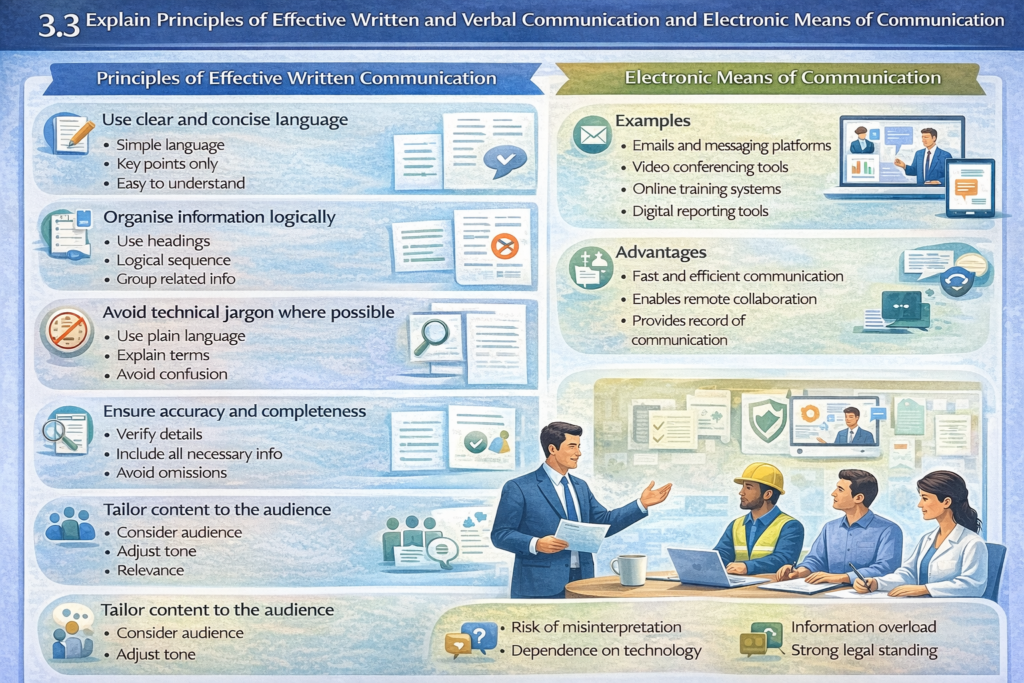
Principles of effective written communication
Written communication plays a critical role in documenting and conveying health and safety information. It provides a permanent record that can be referenced and reviewed when necessary.
Written communication includes reports, policies, emails, and procedures.
Use clear and concise language
Clarity is essential in written communication to ensure that information is easily understood.
- Use simple and straightforward language
- Avoid unnecessary complexity
- Focus on key points and essential information
Clear communication reduces the risk of misinterpretation and errors.
Organise information logically
A well-structured document improves readability and understanding.
- Use headings and subheadings
- Present information in a logical sequence
- Group related information together
Logical organisation helps readers quickly find and understand relevant information.
Avoid technical jargon where possible
Technical language can create confusion, especially for employees who may not be familiar with specific terms.
- Use plain language where appropriate
- Explain technical terms when necessary
- Ensure accessibility for all employees
This approach ensures that communication is inclusive and effective.
Ensure accuracy and completeness
Accurate and complete information is essential for effective decision-making.
- Verify facts and data
- Include all relevant details
- Avoid omissions that may affect understanding
Accurate communication supports compliance and reduces risks.
Tailor content to the audience
Different audiences require different levels of detail and complexity.
- Consider the knowledge and experience of the audience
- Adjust language and tone accordingly
- Provide relevant and appropriate information
Tailoring communication ensures that it is meaningful and effective.
Principles of effective verbal communication
Verbal communication is essential for direct interaction and immediate feedback. It plays a key role in meetings, presentations, and discussions.
Verbal communication includes meetings, presentations, and discussions.
Speak clearly and confidently
Clear and confident speech helps convey information effectively.
- Use appropriate pace and volume
- Pronounce words clearly
- Maintain a confident tone
This ensures that messages are understood and taken seriously.
Use appropriate tone and language
The tone and language used in communication influence how messages are received.
- Use professional and respectful language
- Adapt tone to the situation
- Avoid aggressive or unclear communication
Appropriate tone promotes positive interactions and understanding.
Encourage interaction and feedback
Interactive communication enhances understanding and engagement.
- Ask questions to confirm understanding
- Encourage participation
- Invite feedback and suggestions
This approach ensures that communication is two-way and effective.
Listen actively
Active listening is essential for understanding others and responding appropriately.
- Pay attention to the speaker
- Avoid interruptions
- Provide feedback and clarification
Listening builds trust and improves communication effectiveness.
Adapt communication style to the audience
Different individuals may have different communication preferences and needs.
- Adjust style based on audience characteristics
- Use appropriate examples and explanations
- Consider cultural and organisational factors
Adapting communication improves clarity and engagement.
Electronic means of communication
Electronic communication has become an integral part of modern health and safety practice. It enables rapid and efficient sharing of information across organisations.
Examples
Electronic communication includes various digital tools and platforms.
- Emails and messaging platforms
- Video conferencing tools
- Online training systems
- Digital reporting tools
These tools support communication across different locations and time zones.
Advantages
Electronic communication offers several benefits that enhance its effectiveness.
Fast and efficient communication
- Enables quick sharing of information
- Reduces delays in communication
- Supports timely decision-making
Enables remote collaboration
- Connects employees in different locations
- Supports teamwork and coordination
- Facilitates virtual meetings and training
Provides record of communication
- Maintains documented communication
- Supports accountability and transparency
- Allows for future reference
Challenges
Despite its advantages, electronic communication also presents certain challenges.
Risk of misinterpretation
- Lack of non-verbal cues
- Messages may be misunderstood
- Requires clear and precise wording
Dependence on technology
- Requires reliable systems and infrastructure
- Technical issues may disrupt communication
- Need for user competence
Information overload
- Large volume of messages
- Difficulty in prioritising information
- Risk of important information being overlooked
| Category | Communication Type | Key Principles / Examples | Purpose | Benefits |
|---|---|---|---|---|
| Communication Principles | Written communication | Clear language, logical structure, accuracy, audience-focused | Ensure clarity and documentation | Reduces errors and misunderstandings |
| Communication Principles | Verbal communication | Clear speaking, appropriate tone, active listening, feedback | Enhance interaction | Improves understanding and engagement |
| Communication Methods | Electronic communication | Emails, video calls, training systems, reporting tools | Fast communication | Increases efficiency and accessibility |
| Advantages | Speed and efficiency | Quick information sharing | Save time | Faster decision-making |
| Advantages | Remote collaboration | Work across locations | Improve teamwork | Flexible communication |
| Advantages | Record keeping | Document communication | Ensure accountability | Easy reference |
| Challenges | Misinterpretation | Lack of non-verbal cues | Risk of confusion | Requires clarity |
| Challenges | Technology dependence | System reliance | Possible disruptions | Needs backup systems |
| Challenges | Information overload | Excess messages | Reduce focus | Needs prioritisation |
Integrating Communication Methods in Health and Safety Practice
Effective health and safety management requires the integration of written, verbal, and electronic communication methods.
- Use written communication for documentation and formal guidance
- Use verbal communication for interaction and clarification
- Use electronic communication for speed and accessibility
Combining these methods ensures that communication is comprehensive and effective.
Importance of Effective Communication in Health and Safety
Effective communication plays a vital role in improving health and safety performance.
- Ensures understanding of risks and procedures
- Promotes compliance with policies and regulations
- Enhances employee engagement and participation
- Supports continuous improvement
Challenges in Communication
Organisations may face several challenges in maintaining effective communication.
- Language barriers
- Differences in understanding and interpretation
- Lack of communication skills
- Technological limitations
Addressing these challenges requires training, clear policies, and continuous improvement.
Effective written, verbal, and electronic communication is essential for ensuring that health and safety information is accurately conveyed and properly understood. By applying key communication principles, organisations can improve clarity, reduce risks, and enhance overall safety performance.
The integration of different communication methods allows organisations to address diverse needs and ensure that information reaches all employees effectively. A strong communication strategy supports compliance, promotes a positive safety culture, and contributes to continuous improvement in health and safety practice.
4. Explain external factors influencing improvements in health and safety practice
Health and safety practices within organisations are not developed in isolation; they are significantly influenced by a wide range of external factors that shape how safety is managed, implemented, and improved. These external influences include professional bodies, technical experts, industry groups, and wider societal stakeholders, all of which contribute to the development of standards, guidance, and expectations. Understanding these factors is essential for health and safety professionals, as it enables them to align organisational practices with current industry trends, regulatory requirements, and emerging risks.
In a constantly evolving environment, organisations must remain responsive to external changes to ensure that their health and safety systems remain effective and relevant. External groups often introduce new ideas, innovations, and regulatory updates that drive continuous improvement. By recognising and engaging with these influences, professionals can enhance their knowledge, adopt best practices, and improve overall safety performance.
This section focuses on the key external factors that influence health and safety practice, including professional, non-professional, and technical groups, as well as the role of professional organisations. It also examines the impact of these factors on organisational performance and continuous improvement.
Overview
External factors play a significant role in shaping health and safety practices within organisations. Understanding these influences helps professionals adapt and improve their systems.
These factors provide valuable guidance, introduce new standards, and encourage innovation. By engaging with external influences, organisations can ensure that their health and safety practices remain up to date, effective, and aligned with industry expectations.
Professional, non-professional and technical groups
External groups contribute to the development and improvement of health and safety practices by providing expertise, feedback, and guidance. These groups can be categorised into professional, non-professional, and technical groups.
Professional groups
Professional groups consist of organisations and individuals with expertise in health and safety who provide structured guidance and support.
Health and safety associations
- Develop industry standards and best practices
- Provide training and certification programs
- Offer guidance on regulatory compliance
These associations play a key role in promoting high standards and supporting professional development.
Industry experts and consultants
- Provide specialised knowledge and advice
- Support organisations in identifying and managing risks
- Offer practical solutions to complex safety challenges
Experts and consultants bring valuable experience and insights that enhance organisational practices.
Certification bodies
- Assess compliance with standards
- Provide accreditation and certification
- Monitor ongoing performance
Certification bodies ensure that organisations meet recognised standards and maintain quality in their safety systems.
Non-professional groups
Non-professional groups include individuals and organisations that may not have formal expertise in health and safety but still influence practices through feedback and advocacy.
Employee representatives
- Provide insights into workplace conditions
- Raise concerns and suggest improvements
- Represent the interests of employees
Employee involvement ensures that safety practices are practical and relevant.
Community organisations
- Influence organisational practices through public expectations
- Promote awareness of safety issues
- Encourage responsible business practices
Community engagement supports transparency and accountability.
Public interest groups
- Advocate for improved safety standards
- Raise awareness of risks and issues
- Influence policy and regulatory changes
These groups play a role in shaping public opinion and driving improvements in safety practices.
Technical groups
Technical groups consist of specialists and organisations that contribute to the development of technical solutions and innovations.
Engineers and technical specialists
- Design safe systems and equipment
- Provide technical expertise on risk control
- Support the implementation of safety measures
Their expertise ensures that safety solutions are effective and reliable.
Research organisations
- Conduct studies and investigations
- Provide evidence-based recommendations
- Identify emerging risks and trends
Research organisations contribute to the development of knowledge and innovation.
Standards committees
- Develop technical standards and guidelines
- Ensure consistency across industries
- Update standards based on new developments
These committees play a critical role in maintaining uniformity and quality in safety practices.
Professional organisations
Professional organisations play a central role in influencing health and safety practices across industries. They act as authoritative bodies that provide guidance, set standards, and promote continuous improvement.
Develop standards and guidelines
- Establish best practices for health and safety
- Provide frameworks for implementation
- Ensure consistency across organisations
Provide training and certification
- Offer professional development opportunities
- Enhance knowledge and skills
- Support competency in health and safety roles
Promote best practices
- Share successful strategies and approaches
- Encourage adoption of proven methods
- Support continuous improvement
Influence policy and legislation
- Contribute to the development of regulations
- Provide expert input to policymakers
- Shape the future of health and safety standards
Impact of External Factors
External factors have a significant impact on how organisations develop and improve their health and safety practices.
Drive innovation and improvement
- Introduce new ideas and technologies
- Encourage adoption of advanced practices
- Support continuous development
Ensure alignment with industry standards
- Promote consistency across organisations
- Ensure compliance with recognised standards
- Enhance quality of safety systems
Support compliance with regulations
- Provide guidance on legal requirements
- Help organisations meet regulatory expectations
- Reduce risk of non-compliance
Enhance organisational performance
- Improve efficiency and effectiveness
- Strengthen safety culture
- Support long-term success
| Category | Group Type | Examples | Role / Contribution | Impact on Organisation |
|---|---|---|---|---|
| External Factors | Professional groups | Associations, consultants, certification bodies | Provide guidance, standards, training | Improves compliance and professional standards |
| External Factors | Non-professional groups | Employees, community, public groups | Provide feedback and advocacy | Enhances awareness and accountability |
| External Factors | Technical groups | Engineers, researchers, standards committees | Develop technical solutions and innovations | Improves safety systems and processes |
| Professional Organisations | Standards and guidelines | Industry frameworks | Establish best practices | Ensures consistency and quality |
| Professional Organisations | Training and certification | Courses, qualifications | Develop competence | Skilled workforce |
| Professional Organisations | Policy influence | Regulatory input | Shape legislation | Strong compliance framework |
| Impact of External Factors | Innovation | New ideas and technologies | Improve systems | Continuous improvement |
| Impact of External Factors | Alignment | Industry standards | Ensure consistency | Better safety performance |
| Impact of External Factors | Compliance | Legal requirements | Avoid penalties | Legal protection |
| Impact of External Factors | Performance | Efficiency and safety culture | Improve outcomes | Organisational success |
Challenges in Responding to External Factors
While external influences are beneficial, organisations may face challenges in responding to them.
- Rapid changes in standards and regulations
- Difficulty in accessing reliable information
- Resource constraints
- Resistance to change
Addressing these challenges requires proactive engagement, effective communication, and continuous learning.
Conclusion
Maintaining knowledge of improvements in health and safety practice is essential for ensuring effective risk management and organisational success. External factors play a crucial role in shaping these improvements by providing guidance, promoting best practices, and driving innovation.
By understanding and engaging with professional, non-professional, and technical groups, as well as professional organisations, health and safety professionals can ensure that their practices remain current, effective, and aligned with industry standards. A proactive approach to learning and adaptation supports continuous improvement, enhances workplace safety, and contributes to the overall success of the organisation.