
What is Yellow Belt Certification? Complete Guide, Benefits, Career Opportunities & Training (2026)
In today’s competitive business environment, organisations are constantly seeking ways to improve efficiency, reduce operational costs, eliminate waste, and deliver higher-quality products and services. Whether in manufacturing, healthcare, construction, logistics, finance, retail, education, or information technology, businesses are under increasing pressure to optimise their processes while maintaining customer satisfaction. This growing focus on operational excellence has made Lean Six Sigma one of the most widely adopted process improvement methodologies worldwide.
For individuals who want to develop practical problem-solving and quality improvement skills, Yellow Belt Certification serves as an ideal starting point. It introduces learners to the core concepts of Lean Six Sigma, including waste reduction, process improvement, root cause analysis, teamwork, and continuous improvement. Unlike advanced certification levels, Yellow Belt focuses on building a strong foundation that enables professionals to actively contribute to improvement projects without requiring extensive statistical knowledge or project leadership experience.
Earning a Yellow Belt Certification demonstrates that you understand the basic principles of Lean Six Sigma and can support initiatives aimed at improving organisational performance. It is suitable for students, graduates, supervisors, engineers, quality professionals, healthcare practitioners, project teams, and anyone interested in learning structured approaches to solving workplace challenges.
This comprehensive guide explains everything you need to know about Yellow Belt Certification, including its purpose, history, benefits, certification process, Lean Six Sigma principles, career opportunities, and the essential skills you can develop to support continuous improvement in any industry.
Table of Contents
What is Yellow Belt Certification?
Yellow Belt Certification is an entry-level Lean Six Sigma qualification that equips individuals with the fundamental knowledge and practical skills needed to support process improvement and quality management initiatives within an organisation. It provides a structured introduction to Lean principles, Six Sigma methodologies, and continuous improvement practices, enabling professionals to participate effectively in projects that aim to reduce waste, improve efficiency, and enhance customer satisfaction.
Unlike advanced Lean Six Sigma certifications, which prepare professionals to lead complex improvement projects, Yellow Belt Certification focuses on developing a solid understanding of essential concepts and tools. Certified Yellow Belt professionals typically work as valuable team members, supporting Green Belt and Black Belt practitioners by collecting data, analysing processes, identifying improvement opportunities, and assisting with the implementation of practical solutions.
The certification is recognised across a wide range of industries because the principles of Lean Six Sigma can be applied to almost any organisational process. Whether improving production efficiency in manufacturing, streamlining patient care in healthcare, enhancing project delivery in construction, or reducing service delays in logistics, Yellow Belt professionals contribute to building more efficient and customer-focused organisations.
Why is Yellow Belt Certification Important?
Modern organisations rely on efficient processes to remain competitive and meet increasing customer expectations. Delays, defects, unnecessary costs, and inefficient workflows can negatively affect productivity and profitability. Yellow Belt Certification helps professionals understand how these challenges can be identified and addressed using proven Lean Six Sigma methodologies.
By gaining foundational knowledge of process improvement techniques, certified Yellow Belt professionals become valuable contributors to organisational improvement initiatives. They support project teams by identifying inefficiencies, collecting meaningful data, participating in problem-solving activities, and promoting a culture of continuous improvement.
As businesses continue to embrace digital transformation, automation, and operational excellence, the demand for professionals with process improvement skills continues to grow. Yellow Belt Certification provides a strong foundation for individuals seeking to improve their employability and prepare for more advanced Lean Six Sigma qualifications.
Key Features of Yellow Belt Certification
Yellow Belt Certification offers a practical introduction to Lean Six Sigma while preparing learners to contribute to continuous improvement projects. Some of its key features include:
- Introduces the principles of Lean and Six Sigma.
- Develops practical problem-solving skills.
- Focuses on waste reduction and process optimisation.
- Provides an understanding of continuous improvement methodologies.
- Introduces basic quality management tools.
- Supports participation in Lean Six Sigma projects.
- Builds confidence in data-driven decision-making.
- Creates a pathway towards Green Belt and Black Belt certifications.
- Applies to multiple industries and professional sectors.
- Enhances workplace efficiency and organisational performance.
Understanding Lean Six Sigma
To fully understand the value of Yellow Belt Certification, it is important to first understand the two methodologies that form its foundation: Lean and Six Sigma.
Although these methodologies originated independently, they share a common objective of improving organisational performance. Lean focuses on eliminating activities that do not add value, while Six Sigma concentrates on reducing process variation and improving quality. Together, they create a comprehensive framework that enables organisations to deliver greater value to customers while operating more efficiently.
Lean Six Sigma combines the strengths of both methodologies to help organisations:
- Improve operational efficiency.
- Reduce unnecessary costs.
- Eliminate process waste.
- Improve product and service quality.
- Increase customer satisfaction.
- Reduce defects and errors.
- Standardise business processes.
- Support data-driven decision-making.
- Build a culture of continuous improvement.
Today, Lean Six Sigma is implemented by organisations of all sizes because its principles are adaptable to manufacturing, healthcare, logistics, finance, construction, education, retail, government, hospitality, and many other sectors.
What is Lean?
Lean six sigma is a management philosophy focused on delivering maximum value to customers while minimising waste throughout business processes. Rather than simply increasing speed or productivity, Lean encourages organisations to examine every activity within a process and determine whether it adds value from the customer’s perspective.
Activities that do not contribute value are considered waste and should be reduced or eliminated wherever possible. This allows organisations to improve efficiency, lower operating costs, shorten delivery times, and make better use of available resources.
The core principles of Lean include:
- Identifying customer value.
- Mapping the value stream.
- Creating smooth process flow.
- Responding to customer demand efficiently.
- Pursuing continuous improvement.
By applying Lean principles, organisations can improve workflow, reduce unnecessary activities, and create processes that consistently deliver value.
What is Six Sigma?
Six Sigma is a structured, data-driven methodology designed to improve quality by reducing defects, minimising process variation, and improving consistency. It provides organisations with systematic techniques for identifying the root causes of problems, measuring performance, analysing data, implementing improvements, and maintaining long-term process stability.
Unlike approaches that rely on assumptions or intuition, Six Sigma encourages evidence-based decision-making using measurable data and proven analytical methods.
The primary objectives of Six Sigma include:
- Reducing defects and errors.
- Improving process consistency.
- Enhancing customer satisfaction.
- Improving operational performance.
- Reducing business risks.
- Supporting evidence-based decision-making.
- Standardising organisational processes.
- Driving continuous improvement.
At the Yellow Belt level, learners are introduced to these concepts in a practical and accessible manner, making the methodology suitable for individuals who are new to quality improvement.
Lean vs Six Sigma
Although Lean and Six Sigma are often discussed together, they address different aspects of process improvement. Understanding their differences helps explain why organisations frequently combine them into a single methodology.
| Lean | Six Sigma |
|---|---|
| Focuses on eliminating waste | Focuses on reducing variation and defects |
| Improves process flow | Improves process consistency |
| Seeks greater efficiency | Seeks higher quality |
| Removes non-value-added activities | Reduces process errors |
| Improves speed and productivity | Improves accuracy and reliability |
| Customer value driven | Data-driven decision-making |
| Encourages continuous workflow | Encourages process stability |
When integrated, Lean and Six Sigma complement one another by helping organisations improve both efficiency and quality at the same time.
How Lean Six Sigma Works Together
Lean Six Sigma combines the efficiency-focused principles of Lean with the quality-focused methodology of Six Sigma to create a balanced and systematic approach to continuous improvement.
Lean identifies activities that waste time, effort, and resources, while Six Sigma identifies sources of variation that lead to defects and inconsistent results. By addressing both issues simultaneously, organisations can achieve sustainable improvements that enhance productivity, reduce costs, and improve customer satisfaction.
Together, Lean Six Sigma enables organisations to:
- Deliver products and services more efficiently.
- Improve product and service quality.
- Reduce operational costs.
- Increase productivity.
- Minimise process variation.
- Standardise business processes.
- Improve customer satisfaction.
- Foster a culture of continuous improvement.
This integrated approach has made Lean Six Sigma one of the most widely adopted business improvement methodologies across industries worldwide.
History of Six Sigma
The origins of Six Sigma can be traced back to the growing need for organisations to improve product quality, reduce defects, and increase operational efficiency. As industries became more competitive, businesses recognised that traditional quality control methods were often insufficient to meet rising customer expectations.
Six Sigma was developed as a structured methodology that emphasises data-driven decision-making, process measurement, and continuous improvement. Over time, organisations discovered that reducing defects alone was not enough. They also needed to eliminate unnecessary activities, improve workflow, and optimise resource utilisation.
This led to the integration of Lean principles with Six Sigma, creating the modern Lean Six Sigma methodology that organisations use today. The combined approach is now applied across manufacturing, healthcare, logistics, construction, finance, education, retail, hospitality, government services, and many other sectors to improve efficiency, quality, and overall organisational performance.
Lean Six Sigma Belt Hierarchy
Lean Six Sigma uses a structured belt system to represent different levels of knowledge, experience, and responsibility in process improvement. Each certification level builds upon the previous one, allowing professionals to progressively develop their skills and take on greater responsibilities within improvement projects.
Understanding the belt hierarchy helps learners identify where Yellow Belt Certification fits within the overall Lean Six Sigma framework and how it can support future professional development.
White Belt
White Belt is the introductory level of Lean Six Sigma certification. It provides a basic awareness of Lean principles, Six Sigma concepts, and the importance of continuous improvement within an organisation.
White Belt professionals typically:
- Understand basic Lean Six Sigma terminology.
- Recognise the importance of quality improvement.
- Support improvement initiatives through awareness.
- Gain a foundation for progressing to Yellow Belt Certification.
Yellow Belt
Yellow Belt is the first practical level of Lean Six Sigma certification. Professionals at this level actively participate in improvement projects and apply basic Lean Six Sigma tools to identify inefficiencies, collect data, and support problem-solving activities.
Yellow Belt professionals are expected to:
- Understand Lean and Six Sigma fundamentals.
- Participate in process improvement initiatives.
- Assist Green Belt and Black Belt professionals.
- Apply basic quality improvement tools.
- Support data collection and analysis.
- Identify opportunities for process improvement.
Green Belt
Green Belt professionals possess a deeper understanding of Lean Six Sigma methodologies and often lead small to medium-sized improvement projects within their departments or organisations.
Their responsibilities generally include:
- Leading departmental improvement projects.
- Applying statistical analysis techniques.
- Conducting root cause investigations.
- Managing project teams.
- Implementing sustainable improvement solutions.
- Measuring project outcomes.
Black Belt
Black Belt professionals lead complex organisational improvement initiatives and provide expert guidance on Lean Six Sigma implementation.
Their responsibilities often include:
- Managing large improvement projects.
- Coaching Green Belt professionals.
- Performing advanced statistical analysis.
- Developing improvement strategies.
- Leading cross-functional teams.
- Driving organisational transformation.
Master Black Belt
Master Black Belt is the highest level of Lean Six Sigma certification. These professionals provide strategic leadership, mentor Black Belts, develop organisational improvement programmes, and align Lean Six Sigma initiatives with business objectives.
Typical responsibilities include:
- Developing organisational improvement strategies.
- Coaching and mentoring Lean Six Sigma professionals.
- Supporting executive leadership.
- Establishing governance for improvement programmes.
- Driving enterprise-wide operational excellence.
Lean Six Sigma Belt Comparison
| Belt Level | Primary Role | Typical Responsibility |
|---|---|---|
| White Belt | Awareness | Understands basic Lean Six Sigma concepts |
| Yellow Belt | Team Member | Supports improvement projects |
| Green Belt | Project Leader | Leads departmental improvement initiatives |
| Black Belt | Improvement Expert | Manages complex organisational projects |
| Master Black Belt | Strategic Leader | Oversees organisational Lean Six Sigma programmes |
What Does a Yellow Belt Professional Do?
Yellow Belt professionals play an essential role in supporting process improvement projects. Although they do not usually lead major initiatives, they contribute valuable knowledge, assist with data collection, identify improvement opportunities, and help implement practical solutions.
Their understanding of Lean Six Sigma principles allows them to collaborate effectively with project teams while supporting organisational goals related to quality, efficiency, and customer satisfaction.
Primary Responsibilities
Yellow Belt professionals contribute to improvement initiatives through a variety of practical activities, including:
- Participating in Lean Six Sigma projects.
- Collecting and organising operational data.
- Assisting with process mapping.
- Identifying waste within business processes.
- Supporting root cause analysis.
- Monitoring process performance.
- Participating in improvement workshops.
- Helping implement process improvements.
- Communicating project updates to team members.
- Encouraging continuous improvement within their departments.
Supporting Green Belt and Black Belt Projects
One of the key responsibilities of a Yellow Belt professional is supporting project leaders throughout different stages of improvement initiatives.
This may involve:
- Gathering process information.
- Recording performance measurements.
- Assisting during brainstorming sessions.
- Documenting project findings.
- Monitoring implemented improvements.
- Reporting operational observations.
Their contribution helps ensure improvement projects are supported with reliable information and active team participation.
Why is Yellow Belt Certification Important?
Businesses today operate in an environment where customers expect consistent quality, fast service, and cost-effective solutions. Organisations that fail to improve their processes often experience increased operational costs, customer dissatisfaction, delays, and reduced competitiveness.
Yellow Belt Certification helps professionals understand how structured improvement methodologies can address these challenges through systematic problem-solving and process optimisation.
Rather than relying on assumptions or trial-and-error approaches, Lean Six Sigma encourages evidence-based decision-making supported by measurable data and proven improvement techniques.
As organisations continue to invest in operational excellence, professionals who understand these methodologies become valuable contributors to business improvement initiatives.
Benefits for Organisations
Organisations benefit from employing Yellow Belt professionals because they can help:
- Improve process efficiency.
- Reduce operational waste.
- Increase productivity.
- Improve product and service quality.
- Reduce defects and errors.
- Enhance customer satisfaction.
- Improve teamwork across departments.
- Support continuous improvement initiatives.
- Strengthen operational consistency.
- Promote data-driven decision-making.
Benefits for Professionals
Yellow Belt Certification also provides significant advantages for individuals seeking professional development.
Some of the key benefits include:
- Improved problem-solving abilities.
- Better understanding of quality management principles.
- Enhanced analytical thinking.
- Stronger teamwork and collaboration skills.
- Increased confidence in process improvement.
- Greater career development opportunities.
- Preparation for advanced Lean Six Sigma certifications.
- Recognition of continuous improvement knowledge.
- Transferable skills across multiple industries.
- Improved professional credibility.
Key Objectives of Yellow Belt Certification
Yellow Belt Certification is designed to provide learners with the practical knowledge needed to participate effectively in organisational improvement initiatives.
The primary objectives include:
- Understanding Lean Six Sigma principles.
- Learning the foundations of continuous improvement.
- Recognising different types of operational waste.
- Understanding process variation.
- Supporting improvement projects.
- Applying structured problem-solving techniques.
- Using basic quality improvement tools.
- Participating in process mapping activities.
- Collecting and interpreting operational data.
- Promoting a culture of continuous improvement.
These objectives prepare learners to contribute effectively to process improvement projects regardless of the industry in which they work.
Benefits of Yellow Belt Certification
Yellow Belt Certification provides long-term value for both individuals and organisations by improving the knowledge and practical skills required to support operational excellence.
Develops Practical Problem-Solving Skills
The certification teaches learners how to identify problems, analyse processes, investigate root causes, and contribute to practical improvement solutions.
Improves Workplace Efficiency
Understanding Lean principles enables professionals to identify unnecessary activities and recommend improvements that reduce delays, improve workflow, and increase productivity.
Strengthens Team Collaboration
Improvement projects require effective communication and teamwork. Yellow Belt professionals learn how to work collaboratively with project leaders and colleagues from different departments.
Supports Continuous Improvement
Continuous improvement is an ongoing organisational commitment rather than a one-time activity. Yellow Belt Certification introduces learners to this mindset and encourages continuous evaluation of workplace processes.
Applicable Across Multiple Industries
One of the greatest strengths of Yellow Belt Certification is its versatility. The knowledge gained can be applied across manufacturing, healthcare, logistics, construction, retail, finance, education, hospitality, government services, and many other sectors.
Real-World Example
Consider a distribution company experiencing frequent delays in customer deliveries.
A Yellow Belt professional joins an improvement team and assists in collecting delivery data, documenting workflow processes, and identifying common causes of delays. Using basic Lean Six Sigma tools, the team discovers unnecessary approval steps and inefficient scheduling procedures.
After simplifying the workflow and improving communication between departments, delivery times become more consistent, customer satisfaction improves, and operational efficiency increases.
Although the Yellow Belt professional did not lead the project, their contribution to data collection, process analysis, and team collaboration played an important role in achieving successful results.
Why Organisations Value Yellow Belt Professionals
Modern organisations recognise that continuous improvement is most effective when employees at every level contribute to identifying and solving operational challenges.
Yellow Belt professionals bring practical knowledge, structured thinking, and a collaborative approach to improvement projects. Their ability to support Lean Six Sigma initiatives helps organisations reduce waste, improve quality, and strengthen overall business performance.
As organisations increasingly adopt continuous improvement strategies, professionals with Yellow Belt Certification are well-positioned to contribute meaningfully to operational excellence while building a strong foundation for future career growth.
Understanding the DMAIC Methodology
One of the most important concepts introduced in Yellow Belt Certification is the DMAIC methodology. DMAIC is a structured, data-driven framework used to improve existing business processes by identifying problems, analysing their root causes, implementing effective solutions, and maintaining long-term improvements.
Although Yellow Belt professionals do not usually lead DMAIC projects, they play an active role by supporting data collection, participating in process analysis, and assisting project teams throughout each phase.
What Does DMAIC Stand For?
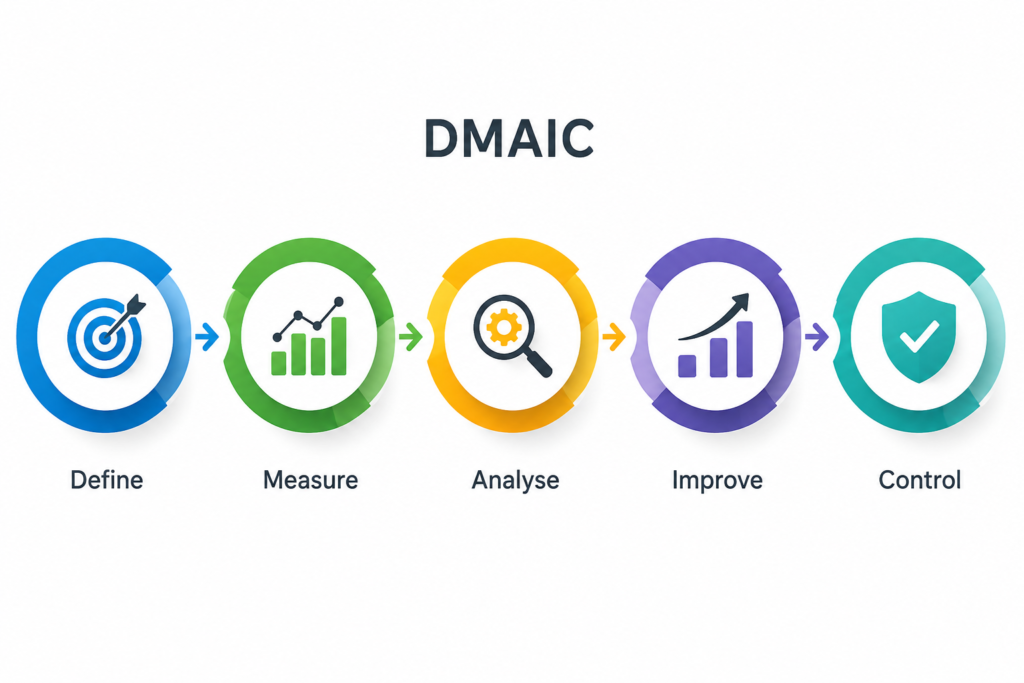
DMAIC consists of five sequential phases:
- Define
- Measure
- Analyse
- Improve
- Control
Each phase serves a specific purpose and helps organisations solve problems systematically rather than relying on assumptions.
Define
The Define phase focuses on clearly identifying the problem, understanding customer requirements, establishing project objectives, and defining the scope of the improvement initiative.
During this phase, project teams answer questions such as:
- What problem needs to be solved?
- Who is affected?
- What are the project objectives?
- What outcomes are expected?
- What processes are involved?
A clearly defined problem creates a strong foundation for the remaining stages of the project.
Measure
The Measure phase involves gathering reliable data to understand current process performance.
Rather than making decisions based on opinions, organisations use measurable information to establish performance baselines and identify areas requiring improvement.
Activities commonly include:
- Collecting operational data.
- Measuring process performance.
- Recording defects or delays.
- Mapping existing workflows.
- Identifying performance indicators.
Accurate measurements help ensure improvement decisions are supported by evidence.
Analyse
During the Analyse phase, the collected data is examined to determine the root causes of process problems.
Instead of addressing symptoms, Lean Six Sigma encourages organisations to identify the underlying factors responsible for poor performance.
Typical activities include:
- Identifying patterns within data.
- Conducting root cause analysis.
- Investigating process variation.
- Identifying waste.
- Reviewing workflow bottlenecks.
This phase helps organisations understand why problems occur before implementing corrective actions.
Improve
Once the root causes have been identified, the Improve phase focuses on developing and implementing practical solutions.
Improvement activities may include:
- Simplifying workflows.
- Removing unnecessary process steps.
- Improving communication.
- Standardising procedures.
- Introducing automation where appropriate.
- Eliminating sources of waste.
The objective is to create sustainable improvements that increase efficiency while maintaining quality.
Control
The Control phase ensures that improvements continue delivering positive results over time.
Organisations establish monitoring procedures, performance indicators, and standard operating practices to prevent processes from returning to their previous state.
Common activities include:
- Monitoring performance metrics.
- Updating process documentation.
- Conducting regular reviews.
- Providing employee training.
- Maintaining standard operating procedures.
The Control phase supports long-term continuous improvement rather than short-term success.
The Eight Wastes of Lean (TIMWOODS)
Lean methodology focuses on eliminating activities that consume resources without creating value for customers. These activities are commonly known as the Eight Wastes of Lean and are remembered using the acronym TIMWOODS.
Understanding these wastes helps Yellow Belt professionals recognise opportunities for improvement within everyday business processes.
| Waste | Description |
|---|---|
| Transportation | Unnecessary movement of products, materials, or information. |
| Inventory | Excess stock or materials that are not immediately required. |
| Motion | Unnecessary movement of people, equipment, or tools. |
| Waiting | Delays caused by idle time between activities. |
| Overproduction | Producing more than customer demand requires. |
| Overprocessing | Performing work that adds little or no customer value. |
| Defects | Errors requiring rework, replacement, or correction. |
| Skills (Unused Talent) | Failing to utilise employees’ knowledge, experience, and ideas effectively. |
Identifying and reducing these wastes enables organisations to improve productivity, reduce costs, and increase customer satisfaction.
The Seven Basic Quality Tools
Yellow Belt Certification introduces learners to several quality improvement tools that help analyse processes, identify problems, and support informed decision-making.
Flowchart
A flowchart visually represents the sequence of activities within a process. It helps teams understand how work is performed and identify unnecessary or inefficient steps.
Check Sheet
A check sheet is a simple data collection tool used to record the frequency of events, defects, or observations in a consistent manner.
Pareto Chart
A Pareto Chart helps organisations identify the most significant causes of problems by ranking issues according to their frequency or impact. It supports prioritisation of improvement efforts.
Cause-and-Effect Diagram (Fishbone Diagram)
This diagram helps teams identify potential root causes of a problem by categorising contributing factors such as people, processes, equipment, materials, and the working environment.
Histogram
A histogram displays the distribution of numerical data, making it easier to identify variation and understand process performance.
Scatter Diagram
A scatter diagram helps determine whether a relationship exists between two variables, supporting data-driven analysis.
Control Chart
A control chart monitors process performance over time and helps identify unusual variations that may require investigation.
Skills You Will Learn Through Yellow Belt Certification
Yellow Belt Certification develops a balanced combination of technical knowledge and professional skills that can be applied across a wide range of industries.
Technical Skills
Learners typically develop knowledge in areas such as:
- Lean principles.
- Six Sigma fundamentals.
- Process mapping.
- Root cause analysis.
- Continuous improvement.
- Basic quality management.
- Waste identification.
- Data collection techniques.
- Process measurement.
- DMAIC methodology.
Professional Skills
In addition to technical knowledge, learners strengthen important workplace skills, including:
- Critical thinking.
- Problem-solving.
- Communication.
- Team collaboration.
- Decision-making.
- Analytical thinking.
- Time management.
- Adaptability.
- Organisational awareness.
- Continuous learning.
These transferable skills make Yellow Belt Certification valuable across many different professional roles.
Industries That Use Yellow Belt Professionals
Lean Six Sigma principles are widely used across both private and public sector organisations.
| Industry | Common Applications |
|---|---|
| Manufacturing | Reducing defects and improving production efficiency |
| Healthcare | Improving patient care and reducing waiting times |
| Construction | Enhancing project quality and workflow efficiency |
| Logistics | Optimising transportation and delivery processes |
| Retail | Improving inventory management and customer service |
| Banking and Finance | Streamlining administrative and financial processes |
| Information Technology | Improving software development and service delivery |
| Hospitality | Enhancing customer experience and operational efficiency |
| Education | Improving administrative and academic processes |
| Government | Increasing efficiency in public service delivery |
This broad applicability makes Yellow Belt Certification valuable regardless of industry or organisational size.
Career Opportunities After Yellow Belt Certification
Although Yellow Belt Certification is an entry-level qualification, it supports career development by providing valuable process improvement skills that employers increasingly seek.
Professionals with Yellow Belt knowledge may contribute to roles such as:
- Quality Assurance Assistant.
- Process Improvement Coordinator.
- Operations Executive.
- Production Supervisor.
- Manufacturing Associate.
- Logistics Coordinator.
- Continuous Improvement Assistant.
- Project Support Officer.
- Business Improvement Assistant.
- Healthcare Quality Coordinator.
The certification also provides an excellent foundation for progressing to Green Belt and Black Belt qualifications.
Who Should Enrol in Yellow Belt Certification?
Yellow Belt Certification is suitable for individuals from a wide variety of professional backgrounds.
It is particularly beneficial for:
- Students preparing for future careers.
- Recent graduates seeking practical business skills.
- Engineers.
- Supervisors.
- Team leaders.
- Project team members.
- Quality professionals.
- Manufacturing employees.
- Healthcare professionals.
- Construction professionals.
- Logistics specialists.
- Business owners.
- Operations managers.
- Administrative professionals.
- Anyone interested in continuous improvement.
No extensive experience in statistics or quality management is typically required, making it an accessible starting point for beginners.
Yellow Belt vs White Belt Certification
Choosing between White Belt and Yellow Belt often depends on your career goals and desired level of involvement in Lean Six Sigma projects.
| White Belt | Yellow Belt |
|---|---|
| Provides basic awareness | Provides practical working knowledge |
| Introduces Lean Six Sigma concepts | Applies Lean Six Sigma concepts |
| Limited project involvement | Actively supports improvement projects |
| Minimal understanding of tools | Understands common quality improvement tools |
| Suitable for complete beginners | Suitable for professionals seeking practical skills |
| Foundation for further learning | Preparation for Green Belt Certification |
Yellow Belt offers a deeper understanding of process improvement and prepares learners to contribute actively within project teams.
Yellow Belt vs Green Belt Certification
Green Belt builds upon the knowledge gained at the Yellow Belt level and introduces more advanced analytical techniques and project leadership responsibilities.
| Yellow Belt | Green Belt |
|---|---|
| Supports improvement projects | Leads improvement projects |
| Basic analytical techniques | Advanced analytical methods |
| Limited statistical analysis | Extensive statistical analysis |
| Team member role | Project leadership role |
| Foundational Lean Six Sigma knowledge | Advanced Lean Six Sigma expertise |
| Entry-level certification | Intermediate certification |
Professionals often pursue Green Belt after gaining practical experience with Yellow Belt concepts.
Common Mistakes Beginners Make
Many learners begin their Lean Six Sigma journey with enthusiasm but may overlook important aspects of effective process improvement.
Common mistakes include:
- Focusing only on passing the certification rather than understanding the concepts.
- Assuming Lean Six Sigma applies only to manufacturing.
- Ignoring customer requirements when evaluating processes.
- Making decisions without sufficient data.
- Looking for quick solutions instead of identifying root causes.
- Overlooking the importance of teamwork.
- Failing to monitor improvements after implementation.
- Attempting to solve every problem simultaneously.
Avoiding these mistakes helps learners apply Lean Six Sigma principles more effectively in real workplace situations.
Myths and Facts About Yellow Belt Certification
| Myth | Fact |
|---|---|
| Yellow Belt is only for manufacturing professionals. | It is used across healthcare, construction, logistics, finance, IT, education, retail, hospitality, and many other industries. |
| You need advanced mathematics. | Yellow Belt focuses on fundamental concepts and practical tools rather than advanced statistical analysis. |
| Only managers benefit from Yellow Belt. | Professionals at all organisational levels can contribute to improvement initiatives. |
| Lean Six Sigma is only for large organisations. | Organisations of all sizes use Lean Six Sigma to improve performance. |
| Certification guarantees immediate promotion. | Certification strengthens knowledge and employability but career progression depends on experience, skills, and organisational opportunities. |
Final Thoughts
Yellow Belt Certification provides an excellent introduction to Lean Six Sigma and equips learners with practical skills that support continuous improvement across a wide range of industries. By understanding Lean principles, Six Sigma methodologies, the DMAIC framework, and essential quality improvement tools, certified professionals can contribute to projects that improve efficiency, reduce waste, enhance quality, and increase customer satisfaction.
Whether you are starting your career, expanding your professional skills, or preparing for more advanced Lean Six Sigma certifications, Yellow Belt Certification offers a strong foundation for long-term personal and professional development. As organisations continue to prioritise operational excellence and evidence-based decision-making, professionals with process improvement knowledge will remain valuable contributors to organisational success.
Ready to Start Your Lean Six Sigma Journey?
If you want to build practical problem-solving skills, improve workplace efficiency, and support continuous improvement initiatives, Yellow Belt Certification is an excellent place to begin. It provides the knowledge, confidence, and foundation needed to contribute effectively to improvement projects while preparing you for future progression to Green Belt and higher-level Lean Six Sigma certifications.