
Six Sigma Explained: Complete Guide to Principles, DMAIC, Certification & Benefits
What is Six Sigma?
Six Sigma is a globally recognized quality management methodology designed to improve business processes by reducing defects, errors, and inefficiencies in a systematic way. It is based on a data-driven approach, meaning decisions are made using facts, measurements, and statistical analysis rather than assumptions or guesswork.
The main goal of Six Sigma is to achieve a very high level of process accuracy and consistency, where the number of defects is reduced to as low as 3.4 per million opportunities. In simple terms, it means creating processes that work almost perfectly with minimal variation and maximum reliability.
Organizations use Six Sigma to identify problems in their operations, understand the root causes, and apply structured solutions that improve overall performance. This leads to better product quality, improved services, and higher customer satisfaction.
Companies across the world apply Six Sigma to reduce operational costs, eliminate waste, and make their systems more efficient. It is widely used in industries such as manufacturing, healthcare, information technology, banking, logistics, and engineering because it helps improve both speed and quality of work.
Unlike traditional quality improvement methods, Six Sigma relies heavily on statistical tools, structured problem-solving techniques, and continuous improvement practices. This makes it a powerful approach for achieving long-term business excellence and sustainable growth.
History and Origin of Six Sigma
Six Sigma was first introduced by Motorola in the 1980s as a quality improvement strategy. Later, General Electric (GE) adopted and expanded it under Jack Welch, making it a global business transformation methodology.
Since then, Six Sigma has evolved into a standard framework used by Fortune 500 companies worldwide for operational excellence.
Core Principles of Six Sigma
Six Sigma is based on a set of fundamental principles that guide organizations in improving quality, efficiency, and performance. These principles ensure that every improvement effort is structured, measurable, and focused on delivering real value.
1. Customer Focus
Customer focus means that every process improvement in Six Sigma starts with understanding the needs and expectations of the customer. Quality is not defined internally by the organization, but by what the customer considers valuable and acceptable. This principle ensures that products and services are designed to meet or exceed customer satisfaction.
2. Data-Driven Decisions
Six Sigma emphasizes making decisions based on accurate data and factual evidence rather than opinions or assumptions. By collecting and analyzing real performance data, organizations can clearly identify problems, understand trends, and make informed decisions that lead to effective solutions.
3. Process Improvement
This principle focuses on improving the process itself instead of blaming individuals for mistakes. Six Sigma believes that most errors come from weak or inefficient processes. By identifying and correcting process issues, organizations can achieve better and more consistent results.
4. Reduction of Variation
Variation refers to inconsistencies in how a process performs. In Six Sigma, the goal is to reduce these variations as much as possible because they often lead to defects and poor quality outcomes. When processes are stable and predictable, the quality of output becomes more reliable.
5. Continuous Improvement
Continuous improvement means that quality enhancement is an ongoing effort, not a one-time activity. Six Sigma encourages organizations to constantly review, analyze, and improve their processes using structured methods. This helps businesses stay competitive and maintain high performance over time.
Six Sigma Methodology (DMAIC Framework)
DMAIC is the core structured approach used in Six Sigma to improve existing processes. It provides a step-by-step method that helps organizations clearly identify problems, analyze data, implement solutions, and maintain long-term improvements in performance and quality.
D – Define
In this stage, the problem is clearly identified along with the project objectives. The team defines what needs to be improved and understands customer requirements and expectations. This step ensures that the project has a clear direction from the very beginning.
M – Measure
In the Measure phase, relevant data is collected to understand how the current process is performing. Key performance indicators are identified and baseline measurements are taken to establish the current level of performance. This helps in understanding the true extent of the problem.
A – Analyze
During the Analyze stage, the collected data is examined in detail to find the root causes of defects, errors, or inefficiencies. The focus is not only on identifying issues but also on understanding why they are occurring.
I – Improve
In this phase, practical solutions are developed and implemented to remove the root causes identified earlier. The aim is to enhance process performance by making effective changes that lead to better quality and efficiency.
C – Control
The final stage ensures that the improvements are maintained over time. Control systems and monitoring methods are applied to prevent the problem from returning. This helps sustain consistent performance and long-term stability.
DMADV Method (For New Processes)
For creating new processes or products, Six Sigma uses DMADV:
- Define requirements
- Measure critical factors
- Analyze design options
- Design the process
- Verify performance
Six Sigma Belt Levels Explained
Six Sigma uses a structured certification system known as “belt levels” to define the skills, responsibilities, and expertise of professionals involved in process improvement projects. Each belt represents a different level of knowledge and leadership in Six Sigma methodology.
White Belt
The White Belt is the entry-level certification in Six Sigma. At this stage, individuals gain basic awareness of Six Sigma concepts, terminology, and purpose. White Belt holders usually understand the importance of quality improvement and may support team activities, but they are not directly involved in leading projects. Their role is mainly to understand how Six Sigma works within an organisation.
Yellow Belt
The Yellow Belt represents a foundational level of practical involvement. Individuals at this level understand basic Six Sigma tools and techniques and often participate as team members in improvement projects. They assist in data collection, support problem-solving activities, and help Green or Black Belts in implementing solutions. Yellow Belts play an important supporting role in process improvement initiatives.
Green Belt
Green Belt professionals have a deeper understanding of Six Sigma principles and tools. They actively work on process improvement projects within their departments while also handling their regular job responsibilities. Green Belts collect and analyze data, identify process problems, and implement improvement solutions under the guidance of Black Belts. They play a key role in driving efficiency and quality improvements at the operational level.
Black Belt
Black Belts are advanced Six Sigma practitioners who lead complex improvement projects across the organisation. They have strong expertise in statistical analysis, problem-solving, and project management. Black Belts are responsible for managing teams, identifying critical business problems, and delivering measurable improvements. They also mentor Green and Yellow Belts and ensure that projects align with organizational goals.
Master Black Belt
Master Black Belts represent the highest level of Six Sigma expertise. They provide strategic leadership, guide organizational-wide Six Sigma deployment, and mentor Black Belts. Their role is more focused on planning, coaching, and ensuring consistency in methodology across all projects. They also help align Six Sigma initiatives with business strategy to achieve long-term operational excellence.
Tools Used in Six Sigma
Six Sigma uses several analytical and quality tools such as:
- Pareto Chart
- Fishbone (Ishikawa) Diagram
- Control Charts
- Histogram Analysis
- Process Mapping
- Root Cause Analysis
- Failure Mode and Effects Analysis (FMEA)
Industries Where Six Sigma is Used
Six Sigma is widely implemented across various industries because it helps organizations improve quality, reduce errors, and enhance overall efficiency. Its flexible methodology makes it suitable for both manufacturing and service-based sectors.
Manufacturing and Production
Six Sigma is heavily used in manufacturing to reduce defects, improve product quality, and ensure consistent production processes. It helps companies minimize waste and maintain high operational standards.
Healthcare and Hospitals
In the healthcare sector, Six Sigma improves patient care by reducing medical errors, optimizing hospital processes, and enhancing service delivery efficiency.
Information Technology (IT)
IT companies use Six Sigma to improve software development processes, reduce system errors, and enhance service reliability and customer satisfaction.
Banking and Finance
In banking and finance, Six Sigma helps improve transaction accuracy, reduce processing errors, and streamline financial operations for better customer service.
Construction and Engineering
This industry uses Six Sigma to improve project quality, reduce construction defects, and ensure better resource management and project delivery.
Logistics and Supply Chain Management
Six Sigma enhances supply chain efficiency by reducing delays, improving inventory management, and optimizing transportation processes.
Telecommunications
Telecom companies apply Six Sigma to improve network performance, reduce service interruptions, and enhance customer experience.
Benefits of Six Sigma
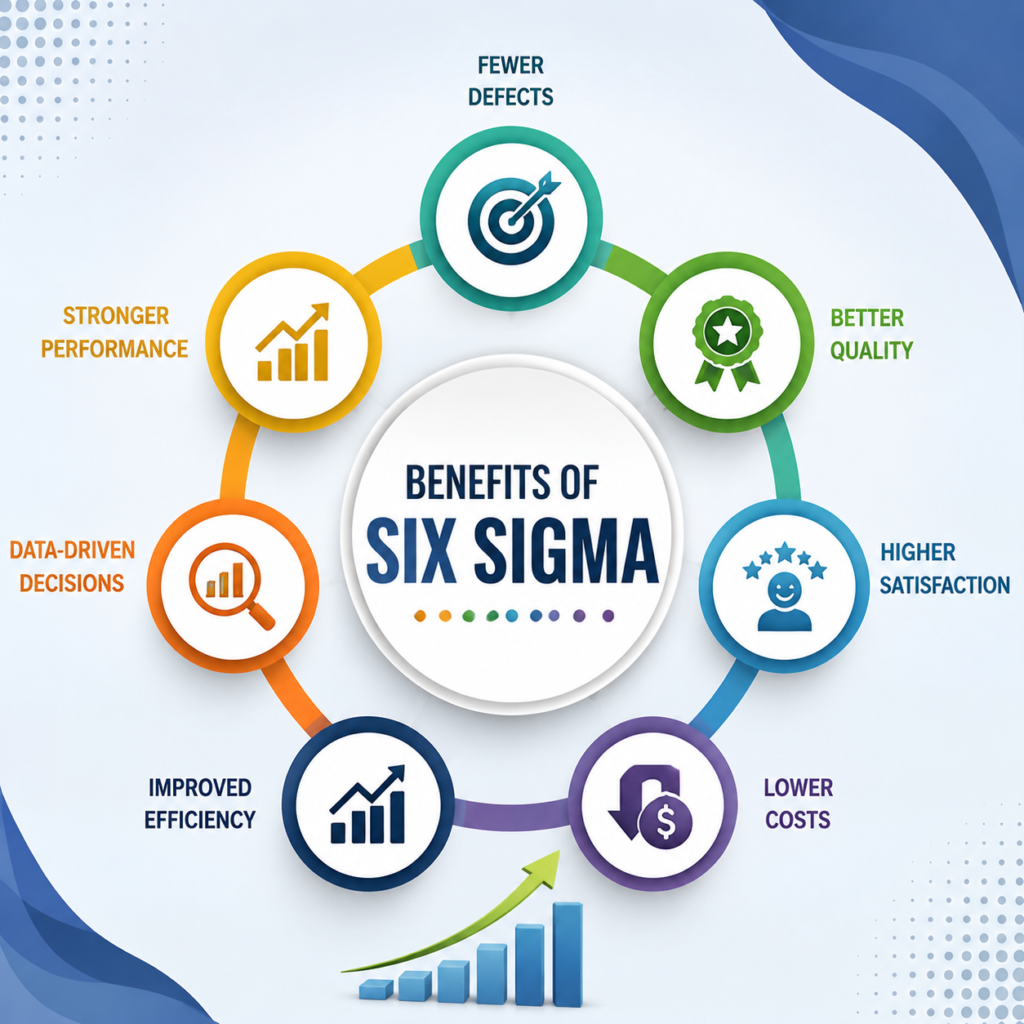
Six Sigma provides a structured approach to improving business processes, reducing inefficiencies, and enhancing overall quality performance. It helps organizations achieve consistent results through data-driven decision-making and continuous improvement.
Reduction in Errors and Defects
Six Sigma significantly reduces operational errors and defects by identifying their root causes and eliminating them from the process. This leads to more accurate, reliable, and consistent outcomes in daily operations.
Improved Product and Service Quality
By minimizing variation in processes, Six Sigma ensures that products and services meet defined quality standards. This results in higher consistency and better overall output quality.
Increased Customer Satisfaction
When processes produce fewer errors and higher-quality results, customer satisfaction naturally improves. Six Sigma ensures that customer expectations are consistently met or exceeded.
Cost Reduction and Waste Elimination
Six Sigma helps organizations reduce unnecessary costs by eliminating waste, rework, and inefficient activities. This leads to better resource utilization and higher profitability.
Enhanced Process Efficiency
Processes become more streamlined and effective through Six Sigma implementation. Tasks are completed faster, with fewer delays and improved accuracy.
Better Data-Driven Decision Making
Six Sigma encourages decisions based on real data and statistical analysis rather than assumptions. This leads to more accurate problem-solving and better business outcomes.
Improved Organizational Performance
Overall performance improves as Six Sigma creates a culture of continuous improvement, efficiency, and accountability across all levels of the organization.
Six Sigma Certification and Career Value
Six Sigma certification is widely recognized across global industries and is highly valued by employers looking for professionals skilled in quality improvement, process optimization, and data-driven decision-making. It demonstrates that an individual has strong analytical abilities and practical knowledge of improving business performance.
Achieving Six Sigma certification can significantly enhance career growth by opening opportunities in quality management, operations, and project leadership roles. It also increases employability in both local and international job markets.
Career Roles in Six Sigma
- Quality Assurance Manager – Responsible for maintaining product and service quality standards and ensuring compliance with quality systems.
- Process Improvement Analyst – Focuses on analyzing business processes and identifying areas for efficiency and performance improvement.
- Six Sigma Consultant – Provides expert guidance to organizations on implementing Six Sigma strategies and improving operational performance.
- Operations Manager – Oversees daily business operations and applies Six Sigma tools to improve productivity and reduce inefficiencies.
- Business Analyst – Uses data analysis techniques to support decision-making and improve business processes.
- Project Manager – Leads projects using structured Six Sigma methodologies to ensure successful and high-quality delivery outcomes.
Professionals with Six Sigma certification often benefit from better job prospects, higher salary potential, and stronger career advancement opportunities in competitive industries.
Who Should Learn Six Sigma?
Six Sigma is a highly valuable methodology for professionals and students who want to improve their skills in quality management, process improvement, and data-driven decision-making. It is suitable for individuals working in different industries where efficiency and quality are important.
- Engineers and Quality Professionals
Six Sigma is ideal for engineers and quality control professionals who are responsible for improving processes, reducing defects, and maintaining high-quality standards in production and operations. - Project Managers
Project managers can benefit from Six Sigma by learning structured problem-solving techniques that help them deliver projects on time, within budget, and with improved quality outcomes. - Business Analysts
Business analysts use Six Sigma to analyze data, identify process gaps, and support decision-making that improves overall business performance. - Operations Managers
Operations managers can apply Six Sigma tools to streamline workflows, reduce inefficiencies, and enhance productivity across departments. - Manufacturing Professionals
In manufacturing industries, Six Sigma helps professionals reduce production errors, minimize waste, and improve product consistency. - IT and Service Industry Employees
IT professionals and service-based employees can use Six Sigma to improve service delivery, reduce system errors, and enhance customer experience. - Students and Career Starters
Students aiming for corporate careers can learn Six Sigma to build strong analytical and problem-solving skills, making them more competitive in the job market.
Difference Between Six Sigma and Lean
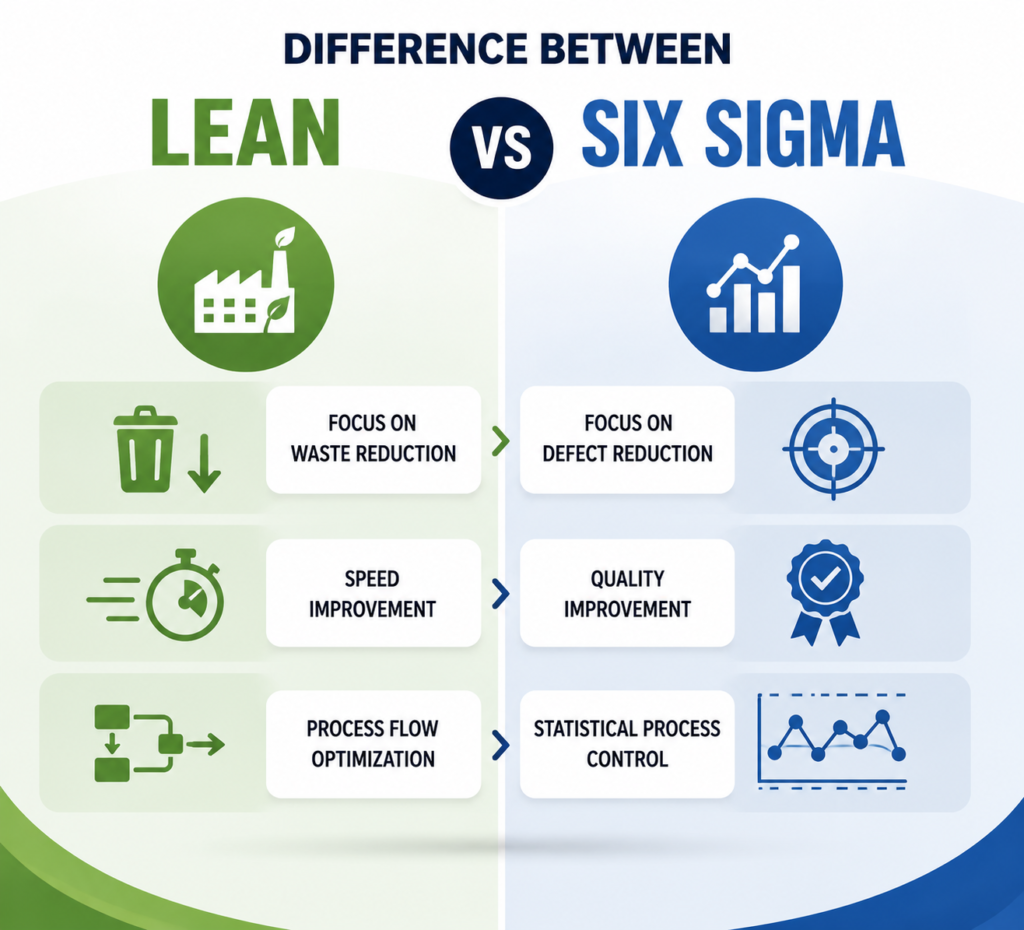
| Lean | Six Sigma |
|---|---|
| Focus on waste reduction | Focus on defect reduction |
| Speed improvement | Quality improvement |
| Process flow optimization | Statistical process control |
Conclusion
Six Sigma is one of the most powerful business improvement methodologies in the world. It helps organizations achieve operational excellence by reducing defects, improving efficiency, and enhancing customer satisfaction.
For professionals, Six Sigma certification opens doors to high-paying global careers and positions in quality management, operations, and consulting.
Frequently Asked Questions (FAQs)
What are the five principles of Six Sigma?
The five key principles of Six Sigma include customer focus, data-driven decision-making, process improvement, reduction of variation, and continuous improvement. These principles guide organizations in achieving consistent quality results.
What are Six Sigma belt levels?
Six Sigma belt levels represent different levels of expertise, including White Belt, Yellow Belt, Green Belt, Black Belt, and Master Black Belt. Each level reflects increasing knowledge, skills, and responsibilities in process improvement projects.
Which industries use Six Sigma?
Six Sigma is used in many industries such as manufacturing, Health and Social Care, IT, banking, construction, logistics, and engineering. It is widely adopted wherever process improvement and quality control are important.
What are the benefits of Six Sigma?
Six Sigma helps reduce errors, improve quality, lower costs, increase efficiency, and enhance customer satisfaction. It also supports better decision-making through data analysis and promotes continuous improvement.
Is Six Sigma certification worth it?
Yes, Six Sigma certification is highly valuable for career growth. It improves job opportunities in quality management, operations, and project management, and is recognized globally by many industries.