
Master Black Belt Certification: Complete Guide to Lean Six Sigma, Eligibility, Benefits & Career Opportunities
Organizations across the globe are continuously striving to improve quality, reduce operational costs, eliminate waste, and deliver outstanding customer experiences. In today’s competitive business landscape, organizations must embrace continuous improvement to remain profitable and efficient. As a result, professionals with advanced expertise in Lean Six Sigma methodologies have become highly sought after.
Among all Lean Six Sigma qualifications, Master Black Belt Certification represents the highest level of professional achievement. It is designed for experienced professionals who can lead enterprise-wide improvement initiatives, mentor Six Sigma practitioners, and align operational excellence with strategic business objectives.
Unlike professionals who focus solely on managing improvement projects, Master Black Belts influence organizational transformation at every level. They guide leadership teams, develop quality strategies, coach Green Belts and Black Belts, implement performance improvement frameworks, and foster a culture of continuous improvement. Their expertise helps organizations increase efficiency, improve product and service quality, reduce process variation, and maximize customer satisfaction.
Whether you are an experienced Six Sigma Black Belt looking to advance your career or a quality management professional aiming for executive leadership, earning a Master Black Belt Certification can significantly enhance your professional credibility and open doors to senior-level opportunities.
In this comprehensive guide, you’ll discover everything you need to know about Master Black Belt Certification, including its purpose, responsibilities, essential skills, organizational value, and why it is regarded as the pinnacle of Lean Six Sigma expertise.
What Is Master Black Belt Certification?
Master Black Belt Certification is the highest professional credential within the Lean Six Sigma certification hierarchy. It validates an individual’s advanced expertise in process improvement, statistical analysis, leadership, organizational transformation, strategic quality management, and continuous improvement.
Unlike lower-level Six Sigma certifications that primarily focus on executing individual improvement projects, a Master Black Belt is responsible for designing enterprise-wide improvement strategies, mentoring project leaders, developing quality systems, and ensuring that continuous improvement initiatives support long-term business objectives.
Professionals who earn this certification are recognized as subject matter experts capable of leading complex improvement programs across multiple departments or entire organizations. They possess extensive experience in Lean Six Sigma methodologies and are trusted advisors for executive leadership teams.
Master Black Belt Certification demonstrates proficiency in advanced analytical tools, leadership development, project governance, risk management, organizational change management, and business performance optimization. As organizations increasingly prioritize operational excellence, certified Master Black Belts play a critical role in driving sustainable growth and long-term success.
Understanding Lean Six Sigma and the Master Black Belt Role
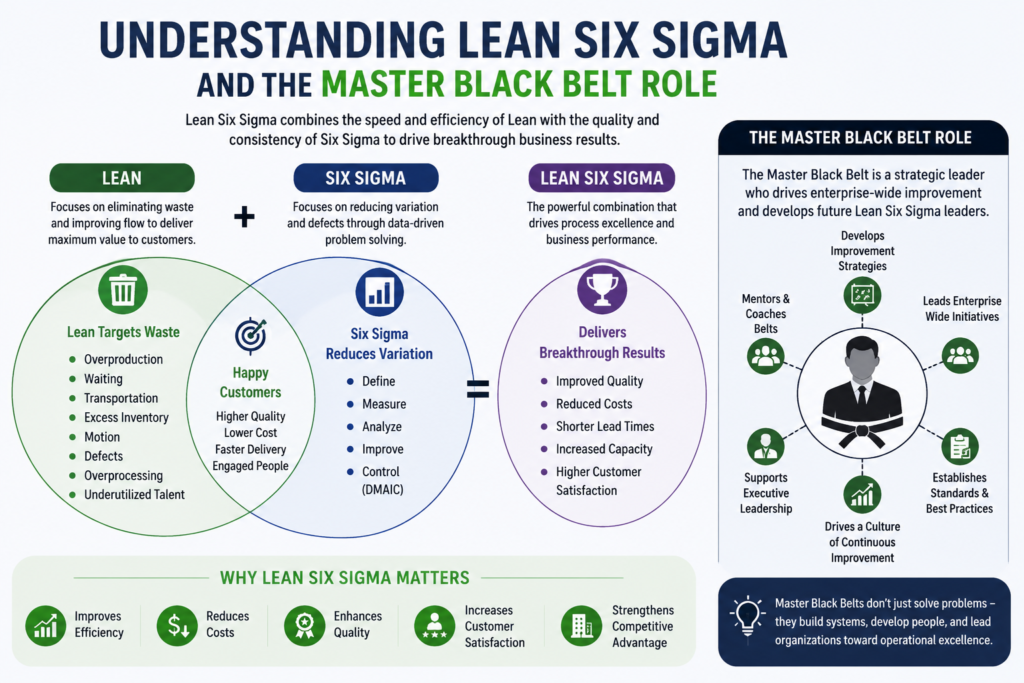
To fully understand the value of a Master Black Belt Certification, it is important to first understand Lean Six Sigma.
Lean Six Sigma is a globally recognized business improvement methodology that combines the strengths of Lean and Six Sigma to enhance organizational performance.
Lean
Lean focuses on maximizing customer value while eliminating activities that do not add value. By removing waste and streamlining workflows, organizations can improve efficiency, reduce costs, and accelerate delivery times.
Common types of waste eliminated through Lean include:
- Overproduction
- Waiting time
- Transportation
- Excess inventory
- Unnecessary motion
- Defects
- Overprocessing
- Underutilized talent
Six Sigma
Six Sigma focuses on reducing process variation and improving quality through data-driven decision-making and statistical analysis. Its primary objective is to minimize defects while ensuring consistent, predictable, and high-quality outcomes.
When Lean and Six Sigma are combined, organizations benefit from improved efficiency, enhanced quality, reduced operational costs, higher customer satisfaction, and stronger overall business performance.
A Master Black Belt serves as the organization’s highest-level expert in applying these methodologies strategically to achieve enterprise-wide operational excellence.
What Does a Master Black Belt Do?
One of the most common misconceptions is that Master Black Belts simply oversee Six Sigma projects. In reality, their responsibilities extend far beyond project management.
Master Black Belts provide strategic leadership, guide organizational transformation, and ensure continuous improvement initiatives align with long-term business goals.
Develop Continuous Improvement Strategies
Master Black Belts design long-term improvement roadmaps that support organizational objectives. Rather than solving isolated operational problems, they establish sustainable systems that drive ongoing business improvement.
Coach and Mentor Lean Six Sigma Professionals
They provide technical guidance and leadership support to:
- White Belts
- Yellow Belts
- Green Belts
- Black Belts
- Project Teams
- Department Managers
Their mentoring ensures consistent project execution and strengthens organizational capability.
Lead Enterprise-Wide Improvement Initiatives
Large organizations often manage multiple improvement projects simultaneously. Master Black Belts oversee these initiatives to ensure consistency, measurable results, and alignment with strategic priorities.
Support Executive Leadership
Senior leaders rely on Master Black Belts to provide data-driven insights that support informed decision-making. They help executives identify performance gaps, evaluate business risks, and prioritize improvement opportunities.
Establish Organizational Standards
Master Black Belts develop and maintain:
- Quality standards
- Process governance frameworks
- Performance measurement systems
- Continuous improvement methodologies
- Best practices
- Training programs
These standards help ensure consistency across departments and business units.
Drive Organizational Culture Change
Continuous improvement is not only about improving processes but also about developing people. Master Black Belts help organizations build cultures where employees actively identify opportunities, solve problems systematically, and contribute to ongoing operational excellence.
Why Is Master Black Belt Certification Important?
Organizations invest significant resources in quality improvement and operational excellence. However, long-term success depends on experienced professionals who can lead transformation efforts across the entire organization.
Master Black Belt Certification demonstrates advanced expertise in:
- Strategic process improvement
- Lean methodologies
- Statistical analysis
- Leadership development
- Risk management
- Organizational transformation
- Business process optimization
- Quality management systems
- Change management
- Performance measurement
These capabilities enable certified professionals to lead high-impact initiatives that improve efficiency, strengthen competitiveness, and contribute directly to organizational growth.
Key Responsibilities of a Master Black Belt
Master Black Belt professionals influence every level of an organization through strategic leadership and operational expertise.
Their responsibilities typically include:
Strategic Planning
Develop long-term operational excellence strategies that align with organizational goals and business priorities.
Project Governance
Review, approve, and monitor improvement projects to ensure measurable business outcomes.
Statistical Analysis
Use advanced analytical techniques to identify process variation, determine root causes, and recommend effective solutions.
Leadership Development
Train, mentor, and develop future Lean Six Sigma professionals within the organization.
Performance Measurement
Design dashboards and establish Key Performance Indicators (KPIs) to evaluate organizational performance and monitor improvement progress.
Risk Assessment
Identify operational risks and implement preventive measures before issues affect productivity or quality.
Cross-Functional Collaboration
Work with multiple departments to address organization-wide challenges and improve overall business performance.
Continuous Improvement Culture
Promote innovation, accountability, collaboration, and continuous learning throughout the organization.
Essential Skills Required for Master Black Belt Certification
Achieving Master Black Belt Certification requires expertise far beyond technical knowledge. Successful professionals combine analytical capability with leadership, strategic thinking, and communication skills.
Some of the most important competencies include:
Advanced Problem-Solving
Master Black Belts solve complex organizational challenges using structured methodologies and data-driven analysis. They focus on identifying root causes instead of addressing symptoms.
Advanced Statistical Analysis
Professionals should have expertise in advanced statistical tools, including:
- Regression Analysis
- Hypothesis Testing
- Analysis of Variance (ANOVA)
- Design of Experiments (DOE)
- Process Capability Analysis
- Control Charts
- Measurement System Analysis (MSA)
- Failure Mode and Effects Analysis (FMEA)
These techniques support informed decision-making and sustainable process improvement.
Leadership Skills
Master Black Belts lead cross-functional teams consisting of managers, engineers, analysts, and executives. Strong leadership enables them to inspire teams, resolve conflicts, encourage collaboration, and deliver successful transformation initiatives.
Communication Skills
Advanced technical knowledge must be supported by excellent communication. Master Black Belts explain complex statistical concepts in a clear and practical manner, enabling stakeholders at every level to understand and support improvement initiatives.
Coaching and Mentoring
One of the defining characteristics of a Master Black Belt is the ability to develop others. They mentor Green Belts, Black Belts, project leaders, department managers, and continuous improvement teams, helping organizations build long-term internal capability.
Strategic Thinking
Unlike lower-level certifications that concentrate on individual projects, Master Black Belts evaluate improvement initiatives from an organizational perspective. They ensure that every project contributes to business growth, operational efficiency, customer satisfaction, and financial performance.
Change Management
Implementing new processes often requires significant organizational change. Master Black Belts manage resistance, engage stakeholders, develop implementation strategies, support leadership communication, and monitor long-term adoption to ensure lasting success.
Characteristics of Successful Master Black Belt Professionals
Highly successful Master Black Belts share several qualities that enable them to lead large-scale organizational improvement.
They are:
- Analytical thinkers who rely on data rather than assumptions.
- Strong leaders who motivate and inspire diverse teams.
- Effective communicators capable of simplifying complex concepts.
- Strategic decision-makers focused on sustainable business success.
- Adaptable professionals committed to continuous learning and innovation.
- Skilled mentors who develop future Lean Six Sigma professionals.
- Results-oriented leaders who measure success through measurable business outcomes.
- Ethical professionals who promote transparency, accountability, and customer-focused improvement.
These characteristics help Master Black Belts build trust, influence executive decision-making, and deliver sustainable improvements across organizations.
Why Organizations Value Master Black Belts
Organizations operate in increasingly competitive markets where even small improvements in quality, efficiency, and customer satisfaction can create significant competitive advantages.
Master Black Belts help organizations:
- Improve operational efficiency.
- Reduce production and operational costs.
- Minimize process variation and defects.
- Enhance customer satisfaction.
- Increase employee engagement in continuous improvement.
- Strengthen quality management systems.
- Improve compliance with industry standards and regulations.
- Support digital transformation initiatives.
- Increase profitability through process optimization.
- Build a culture of innovation and operational excellence.
Rather than delivering temporary improvements, Master Black Belts establish systems, processes, and leadership capabilities that enable organizations to achieve continuous, sustainable success over the long term.
Master Black Belt Certification Course Curriculum
A comprehensive Master Black Belt Certification program is designed to prepare professionals for strategic leadership roles in process improvement and organizational excellence. Unlike lower-level Six Sigma certifications, the curriculum focuses on enterprise-wide transformation, advanced statistical analysis, leadership development, and mentoring future Six Sigma practitioners.
While the exact syllabus may vary depending on the certification provider, most internationally recognized programs include the following core areas.
Advanced Lean Six Sigma Principles
Participants gain an in-depth understanding of Lean Six Sigma philosophies and how they can be integrated into business strategy. This includes developing a culture of continuous improvement, eliminating waste, reducing process variation, and achieving sustainable operational excellence.
Advanced Statistical Analysis
Master Black Belts must be able to interpret complex data and make informed business decisions. Training typically covers:
- Design of Experiments (DOE)
- Regression Analysis
- Hypothesis Testing
- Analysis of Variance (ANOVA)
- Process Capability Analysis
- Measurement System Analysis (MSA)
- Reliability Analysis
- Predictive Data Analysis
These advanced techniques help organizations identify root causes, optimize processes, and improve decision-making.
Enterprise Process Improvement
This module focuses on improving business performance across entire organizations rather than individual departments. Participants learn how to evaluate enterprise-wide systems, identify improvement opportunities, and implement strategic initiatives that deliver measurable results.
Leadership and Change Management
Since Master Black Belts often work directly with senior executives and department leaders, they must possess exceptional leadership skills. This area covers:
- Strategic leadership
- Organizational change management
- Stakeholder engagement
- Team development
- Executive communication
- Conflict resolution
- Performance coaching
Project Portfolio Management
Instead of managing a single Six Sigma project, Master Black Belts oversee multiple improvement initiatives simultaneously. They learn how to prioritize projects, allocate resources, measure business impact, and ensure projects align with organizational objectives.
Coaching and Mentoring
A significant responsibility of a Master Black Belt is developing future Lean Six Sigma professionals. This module focuses on mentoring Green Belts, Black Belts, project managers, and continuous improvement teams through coaching, knowledge sharing, and performance evaluation.
Business Strategy and Operational Excellence
Participants learn how Lean Six Sigma supports strategic planning, business growth, customer satisfaction, innovation, and long-term organizational success.
Who Should Pursue Master Black Belt Certification?
Master Black Belt Certification is designed for experienced professionals who already possess substantial knowledge of quality management, process improvement, and Lean Six Sigma methodologies.
It is particularly suitable for:
- Certified Six Sigma Black Belts seeking career advancement.
- Quality Assurance (QA) and Quality Control (QC) professionals.
- Operational Excellence Managers.
- Continuous Improvement Managers.
- Process Improvement Specialists.
- Manufacturing Managers.
- Operations Directors.
- Engineering Managers.
- Supply Chain and Logistics Professionals.
- Healthcare Quality Managers.
- Business Transformation Consultants.
- Project Management Professionals.
- Senior Operations Executives.
- Organizational Development Leaders.
- Professionals responsible for enterprise-wide improvement initiatives.
Individuals aiming for executive leadership positions within quality management and operational excellence can greatly benefit from this certification.
Eligibility Requirements for Master Black Belt Certification
Eligibility requirements vary among certification providers, but most organizations expect candidates to demonstrate both practical experience and advanced knowledge of Lean Six Sigma principles.
Typical requirements include:
Previous Six Sigma Certification
Most providers require candidates to hold a recognized Six Sigma Black Belt Certification before progressing to the Master Black Belt level.
Professional Experience
Candidates are generally expected to have several years of experience managing Lean Six Sigma projects, implementing quality improvement initiatives, and leading cross-functional teams.
Leadership Experience
Applicants should have experience mentoring teams, leading organizational improvement programs, or managing strategic business initiatives.
Meeting these requirements ensures candidates possess both theoretical knowledge and practical expertise before attempting Master Black Belt Certification.
Benefits of Master Black Belt Certification

Earning a Master Black Belt Certification provides significant professional and organizational advantages.
Recognition as an Industry Expert
Master Black Belt Certification establishes you as one of the highest-qualified professionals in Lean Six Sigma and process improvement.
Enhanced Leadership Opportunities
Organizations trust certified Master Black Belts to lead strategic initiatives, mentor teams, and guide executive decision-making.
Increased Career Opportunities
Certified professionals become eligible for senior leadership roles in quality management, operational excellence, business transformation, and strategic consulting.
Improved Decision-Making Skills
Advanced analytical techniques enable professionals to solve complex organizational challenges using data-driven methodologies rather than assumptions.
Greater Organizational Impact
Master Black Belts influence enterprise-wide improvements that reduce costs, improve quality, enhance productivity, and increase customer satisfaction.
Higher Earning Potential
Because of their advanced expertise and leadership capabilities, Master Black Belts are often among the highest-paid professionals within quality management and operational excellence.
Global Professional Recognition
Lean Six Sigma methodologies are used by organizations worldwide, making Master Black Belt Certification a valuable credential across multiple industries and countries.
Career Opportunities After Master Black Belt Certification
Master Black Belt professionals are in demand across industries that prioritize quality improvement, operational efficiency, and business transformation.
Common career opportunities include:
- Master Black Belt Consultant
- Director of Operational Excellence
- Continuous Improvement Director
- Enterprise Process Improvement Manager
- Quality Director
- Head of Quality Assurance
- Business Excellence Manager
- Lean Transformation Leader
- Process Excellence Consultant
- Strategic Operations Manager
- Organizational Development Manager
- Manufacturing Excellence Manager
- Quality Systems Director
- Performance Improvement Consultant
- Chief Quality Officer (CQO)
Many experienced Master Black Belts also establish independent consulting businesses, helping organizations implement Lean Six Sigma methodologies and achieve operational excellence.
Industries That Hire Master Black Belts
The demand for Master Black Belt professionals extends across numerous sectors where efficiency, quality, and customer satisfaction are critical.
These industries include:
- Manufacturing
- Automotive
- Aerospace
- Construction
- Oil and Gas
- Healthcare
- Pharmaceuticals
- Banking and Financial Services
- Insurance
- Information Technology
- Telecommunications
- Logistics and Supply Chain
- Retail
- Government Agencies
- Education
- Hospitality
- Energy and Utilities
- Food and Beverage
- Mining
- Aviation
As organizations continue investing in digital transformation and continuous improvement, demand for highly skilled Lean Six Sigma leaders is expected to grow further.
Master Black Belt vs Black Belt: What’s the Difference?
Although both certifications are highly respected, they differ significantly in scope, responsibilities, and organizational influence.
| Feature | Black Belt | Master Black Belt |
|---|---|---|
| Primary Focus | Managing improvement projects | Leading organizational transformation |
| Leadership Level | Project Leadership | Executive and Strategic Leadership |
| Responsibilities | Execute Six Sigma projects | Develop improvement strategy, mentor professionals, oversee enterprise initiatives |
| Project Scope | Department or business unit | Organization-wide |
| Mentoring Role | Limited | Extensive mentoring of Green and Black Belts |
| Statistical Expertise | Advanced | Expert-level statistical analysis |
| Strategic Planning | Moderate | Comprehensive strategic planning |
| Organizational Impact | Individual projects | Enterprise-wide operational excellence |
A Black Belt focuses on delivering successful projects, while a Master Black Belt shapes the organization’s overall continuous improvement strategy and develops future Lean Six Sigma leaders.
Is Master Black Belt Certification Worth It?
For experienced professionals committed to operational excellence, the answer is yes.
Master Black Belt Certification is more than an advanced qualification—it is a leadership credential that demonstrates your ability to transform organizations through data-driven decision-making, strategic planning, and continuous improvement.
Professionals who earn this certification often enjoy greater career stability, higher earning potential, increased leadership responsibilities, and recognition as trusted experts in Lean Six Sigma.
As businesses continue to prioritize efficiency, innovation, and quality, Master Black Belt Certification remains one of the most valuable credentials for professionals seeking executive-level opportunities in quality management and business excellence.
How to Become a Certified Master Black Belt
Becoming a Certified Master Black Belt requires a combination of education, practical experience, leadership skills, and a strong understanding of Lean Six Sigma methodologies. Since this is the highest level of Six Sigma certification, candidates are expected to demonstrate not only technical expertise but also the ability to lead organizational transformation and mentor other professionals.
Follow these essential steps to achieve Master Black Belt Certification.
Step 1: Build a Strong Foundation in Lean Six Sigma
Start by developing a thorough understanding of Lean principles, Six Sigma methodologies, quality management systems, and continuous improvement practices. A solid foundation will help you understand how organizations improve efficiency, reduce waste, and enhance customer satisfaction.
Step 2: Gain Professional Experience
Practical experience is essential. Work on real-world projects involving process improvement, quality assurance, operational excellence, or business transformation. The more experience you gain in solving organizational challenges, the stronger your expertise becomes.
Step 3: Earn a Six Sigma Black Belt Certification
Most certification providers expect candidates to hold a recognized Six Sigma Black Belt Certification before pursuing the Six Sigma Master Black Belt Certification level. The Black Belt qualification demonstrates your ability to lead improvement projects and apply advanced statistical tools.
Step 4: Lead Successful Improvement Projects
Organizations value professionals who can deliver measurable business results. Build a portfolio of completed projects that demonstrate improvements in productivity, quality, customer satisfaction, cost reduction, or operational efficiency.
Step 5: Develop Leadership and Coaching Skills
Master Black Belts are responsible for mentoring Green Belts, Black Belts, project managers, and leadership teams. Strengthening your communication, coaching, and leadership skills is just as important as improving your technical expertise.
Step 6: Complete a Master Black Belt Certification Program
Choose a reputable training provider that offers a comprehensive curriculum covering advanced Lean Six Sigma methodologies, strategic leadership, enterprise process improvement, change management, and mentoring techniques.
Step 7: Continue Learning and Improving
Continuous learning is a core principle of Lean Six Sigma. Stay updated with emerging technologies, quality management practices, digital transformation strategies, artificial intelligence, and industry best practices to maintain your expertise.
How to Choose the Best Master Black Belt Certification Provider
Not all certification providers offer the same level of quality, recognition, or learning experience. Choosing the right provider can significantly impact your career development and professional credibility.
Before enrolling, consider the following factors.
Industry Recognition
Select a certification provider that is well respected by employers and recognized within the quality management and process improvement industry.
Comprehensive Curriculum
A high-quality program should include advanced statistical analysis, Lean methodologies, leadership development, project governance, organizational transformation, and strategic process improvement.
Experienced Trainers
Look for programs delivered by experienced professionals who have practical knowledge of implementing Lean Six Sigma across different industries.
Practical Learning Approach
The best training programs combine theoretical knowledge with real-world case studies, business scenarios, project-based learning, and practical problem-solving exercises.
Flexible Learning Options
Many professionals prefer online, blended, or self-paced learning because it allows them to balance professional responsibilities with their studies.
Post-Certification Support
Some providers offer mentoring, alumni communities, career guidance, project support, or continuing education resources after certification, adding long-term value to your investment.
Common Mistakes to Avoid When Pursuing Master Black Belt Certification
Many professionals focus only on passing the certification without developing the broader leadership and strategic capabilities expected at this level.
Avoid these common mistakes.
Choosing Certification Based Only on Cost
The least expensive program may not provide the industry recognition or practical skills needed for career advancement. Focus on quality and credibility rather than price alone.
Neglecting Practical Experience
Certification alone is not enough. Employers look for professionals who have successfully applied Lean Six Sigma methodologies in real business environments.
Ignoring Leadership Development
Technical knowledge is important, but Master Black Belts must also inspire teams, influence stakeholders, and lead organizational change effectively.
Relying Only on Statistical Tools
Data analysis is valuable, but successful Master Black Belts balance analytical thinking with business strategy, customer needs, and organizational objectives.
Failing to Continue Learning
Business environments constantly evolve. Keeping your knowledge updated ensures your skills remain relevant and competitive.
Future Trends in Master Black Belt Certification
The role of Master Black Belts continues to evolve as organizations adopt new technologies and business strategies.
Several emerging trends are shaping the future of Lean Six Sigma.
Artificial Intelligence and Data Analytics
Organizations increasingly combine Lean Six Sigma with artificial intelligence, machine learning, and predictive analytics to improve decision-making and automate process optimization.
Digital Transformation
Master Black Belts are becoming key contributors to digital transformation initiatives by helping organizations redesign workflows, improve efficiency, and integrate new technologies.
Sustainability and Environmental Improvement
Businesses are placing greater emphasis on reducing environmental impact. Lean Six Sigma professionals now contribute to sustainability initiatives by minimizing waste, improving resource efficiency, and supporting environmental compliance.
Customer Experience Improvement
Modern organizations recognize that operational excellence directly affects customer satisfaction. Master Black Belts increasingly focus on improving customer journeys, service quality, and overall customer experience.
Cross-Functional Leadership
Rather than working within individual departments, Master Black Belts now lead organization-wide transformation initiatives involving operations, finance, technology, human resources, supply chain, and customer service.
Final Thoughts
Master Black Belt Certification represents the highest level of expertise in Lean Six Sigma and continuous improvement. It is far more than an advanced qualification—it is a demonstration of leadership, strategic thinking, and the ability to drive meaningful organizational transformation.
Certified Master Black Belts play a crucial role in helping organizations improve efficiency, reduce costs, enhance quality, and build a culture of continuous improvement. Their expertise enables businesses to remain competitive in an increasingly complex and fast-changing global marketplace.
Whether your goal is to lead enterprise-wide improvement initiatives, mentor future Lean Six Sigma professionals, or advance into executive leadership, earning a Master Black Belt Certification can be a significant milestone in your professional journey. By investing in advanced knowledge, practical experience, and continuous learning, you position yourself as a trusted leader capable of delivering sustainable business success across virtually any industry.
Frequently Asked Questions (FAQs)
Who should pursue Master Black Belt Certification?
It is ideal for experienced Six Sigma Black Belts, quality managers, operational excellence leaders, consultants, project managers, and professionals responsible for enterprise-wide process improvement initiatives.
Is Master Black Belt higher than Black Belt?
Yes. Master Black Belt is the highest level within the traditional Lean Six Sigma certification hierarchy. It focuses on strategic leadership, mentoring, organizational transformation, and enterprise-wide improvement.
How long does it take to earn Master Black Belt Certification?
The duration varies depending on the training provider, certification requirements, previous experience, and learning format. Some professionals complete the program within a few months, while others require additional time to meet project or experience requirements.
Is Master Black Belt Certification recognized internationally?
Yes. Lean Six Sigma methodologies are used worldwide across manufacturing, healthcare, finance, information technology, logistics, construction, energy, and many other industries, making Master Black Belt Certification a globally respected credential.
Which industries hire Master Black Belts?
Master Black Belts are employed in manufacturing, healthcare, pharmaceuticals, banking, finance, construction, logistics, aerospace, telecommunications, government, education, retail, energy, and technology sectors.
What skills are required for Master Black Belt Certification?
Key skills include strategic planning, leadership, advanced statistical analysis, project management, change management, coaching, communication, business process improvement, and organizational transformation.