
What Is Lean Six Sigma? A Complete Beginner’s Guide
In today’s highly competitive business environment, organizations are under constant pressure to deliver high-quality products and services while reducing costs, improving efficiency, and meeting customer expectations. Businesses that fail to optimize their processes often struggle with unnecessary waste, production delays, quality defects, and rising operational expenses. To overcome these challenges, organizations across manufacturing, healthcare, construction, logistics, finance, information technology, education, and many other industries rely on Lean Six Sigma a globally recognized methodology for continuous process improvement.
Lean Six Sigma combines the strengths of two proven improvement philosophies: Lean, which focuses on eliminating activities that do not add value, and Six Sigma, which emphasizes reducing process variation and defects through data-driven decision-making. Together, these methodologies help organizations streamline operations, improve quality, increase productivity, reduce waste, and create greater value for customers.
Unlike many management approaches that focus on isolated improvements, Lean Six Sigma provides a structured framework for identifying problems, analyzing their root causes, implementing sustainable solutions, and continuously monitoring performance. This systematic approach enables organizations to achieve measurable improvements rather than temporary fixes.
Whether you are a student exploring career opportunities, a professional looking to develop valuable process improvement skills, a business owner seeking operational excellence, or a manager responsible for improving organizational performance, understanding Lean Six Sigma is an excellent place to begin. This guide explains the fundamental concepts, history, principles, methodologies, and practical applications of Lean Six Sigma in clear and straightforward language, making it ideal for beginners while still providing valuable insights for experienced professionals.
What Is Lean Six Sigma?
Lean Six Sigma is a structured process improvement methodology that combines Lean principles and Six Sigma techniques to help organizations improve efficiency, eliminate waste, reduce process variation, enhance product and service quality, and increase customer satisfaction. It provides organizations with a systematic way to identify inefficiencies, solve operational problems, and create sustainable improvements using factual data rather than assumptions.
At its core, Lean Six Sigma focuses on delivering maximum value to customers while using the minimum amount of resources necessary. Every activity performed within a business process is evaluated to determine whether it adds value from the customer’s perspective. Activities that do not contribute to customer value are identified as waste and become candidates for elimination or improvement.
The methodology also recognizes that even efficient processes can produce inconsistent results if variation is not properly controlled. Excessive variation often leads to defects, delays, customer complaints, rework, increased costs, and reduced profitability. Six Sigma addresses this challenge by applying statistical analysis and structured problem-solving techniques to identify the root causes of variation and minimize defects.
Rather than relying on guesswork or intuition, Lean Six Sigma encourages organizations to make informed decisions based on measurable data. Teams collect relevant information, analyze process performance, identify improvement opportunities, implement targeted solutions, and continuously monitor results to ensure long-term success.
One of the reasons Lean Six Sigma has become widely adopted across industries is its flexibility. The methodology can be applied to manufacturing processes, healthcare services, logistics operations, software development, financial institutions, educational organizations, government departments, retail businesses, hospitality services, and virtually any environment where processes can be measured and improved.
The Two Foundations of Lean Six Sigma
Lean Six Sigma brings together two complementary methodologies, each with a distinct purpose.
| Lean | Six Sigma |
|---|---|
| Eliminates waste | Reduces variation |
| Improves process flow | Improves process consistency |
| Focuses on speed and efficiency | Focuses on quality and accuracy |
| Removes non-value-added activities | Reduces defects and errors |
| Enhances customer value | Enhances customer satisfaction |
When these approaches are combined, organizations can simultaneously improve speed, efficiency, quality, consistency, and overall business performance.
The Primary Objectives of Lean Six Sigma
Organizations implement Lean Six Sigma to achieve several important objectives, including:
- Improve product and service quality.
- Reduce operational costs.
- Eliminate unnecessary process waste.
- Increase productivity and efficiency.
- Improve customer satisfaction.
- Reduce defects and errors.
- Standardize business processes.
- Support data-driven decision-making.
- Strengthen teamwork and problem-solving capabilities.
- Promote a culture of continuous improvement.
These objectives enable organizations to become more competitive while delivering greater value to customers and stakeholders.
Why Lean Six Sigma Matters Today
Modern organizations operate in an environment where customers expect high quality, fast delivery, competitive pricing, and consistent service. Even small process inefficiencies can lead to significant financial losses, reduced customer confidence, and missed business opportunities.
Lean Six Sigma helps organizations address these challenges by providing practical tools and structured methodologies for continuous improvement. Instead of reacting to problems after they occur, organizations learn how to identify potential issues early, analyze their underlying causes, and implement preventive measures that improve long-term performance.
As digital transformation, automation, and data analytics continue to reshape industries, the principles of Lean Six Sigma remain highly relevant. Organizations increasingly combine Lean Six Sigma with modern technologies such as artificial intelligence, business intelligence platforms, predictive analytics, and process automation to drive smarter decision-making and operational excellence.
The History and Evolution of Lean Six Sigma
Understanding the origins of Lean Six Sigma provides valuable insight into why it has become one of the world’s most respected process improvement methodologies. Rather than emerging as a single management system, Lean Six Sigma evolved by combining two independent approaches that were developed decades apart to solve different operational challenges.
The Origins of Lean
The foundations of Lean can be traced back to Japan after the Second World War. During this period, Japanese manufacturers faced limited resources and intense competition, making it essential to maximize efficiency while minimizing waste.
Engineers and managers at Toyota developed what became known as the Toyota Production System (TPS). Instead of focusing solely on increasing production volume, they emphasized creating value for customers by eliminating activities that consumed time, materials, or labor without contributing to the final product.
This approach introduced several important concepts, including continuous improvement, standardized work, just-in-time production, visual management, and respect for people. Over time, organizations around the world recognized the effectiveness of these practices, and the methodology became widely known as Lean.
Today, Lean principles are applied not only in manufacturing but also in health and social care, logistics, construction, financial services, software development, education, and many other industries.
The Origins of Six Sigma
While Lean focused primarily on improving efficiency and eliminating waste, another methodology was emerging to address process quality and consistency.
During the 1980s, engineers at Motorola developed Six Sigma to reduce manufacturing defects and improve product reliability. They recognized that even efficient processes could produce inconsistent results if variation was not properly controlled.
Six Sigma introduced a structured, data-driven approach to problem-solving that relied on statistical analysis rather than assumptions or opinions. Organizations learned how to measure process performance, identify sources of variation, analyze root causes, implement improvements, and maintain consistent results over time.
The methodology gained international recognition after companies such as General Electric successfully implemented Six Sigma across their operations, demonstrating significant improvements in quality, productivity, customer satisfaction, and financial performance.
The Birth of Lean Six Sigma
- As organizations gained experience with both methodologies, they realized that Lean and Six Sigma complemented each other exceptionally well.
- Lean improved process speed by eliminating waste but did not always address process variation in detail.
- Six Sigma improved quality and consistency but could sometimes involve lengthy analytical processes without specifically targeting workflow efficiency.
- Combining these approaches created a more balanced improvement methodology that addressed both efficiency and quality simultaneously.
- This integration became known as Lean Six Sigma.
- Today, Lean Six Sigma is recognized globally as one of the most effective methodologies for continuous improvement, helping organizations reduce costs, improve quality, increase productivity, and achieve long-term operational excellence.
Lean Manufacturing Explained
Lean Manufacturing is a management philosophy that focuses on maximizing customer value while minimizing the resources required to deliver products and services. Rather than simply producing more, Lean encourages organizations to produce better by eliminating unnecessary activities and improving the flow of work.
The central idea behind Lean is straightforward: every activity within a process should contribute value from the customer’s perspective. If an activity does not improve the product or service, customers are generally unwilling to pay for it, making it a form of waste that should be reduced or eliminated.
For example, excessive waiting times, unnecessary transportation of materials, overproduction, duplicate approvals, inefficient workflows, and avoidable rework increase costs without adding value. Lean helps organizations identify these inefficiencies and redesign processes to achieve smoother, faster, and more reliable operations.
One of the defining characteristics of Lean is its emphasis on continuous improvement. Rather than treating improvement as a one-time project, organizations encourage employees at every level to identify opportunities for making processes safer, simpler, faster, and more effective. Small, consistent improvements accumulated over time often produce substantial long-term gains in productivity, quality, and customer satisfaction.
Lean also promotes collaboration across departments, ensuring that teams work together to solve problems rather than operating in isolation. This collaborative culture supports innovation, improves communication, and enables organizations to respond more effectively to changing customer needs.
Because Lean principles can be applied to virtually any repeatable process, they have become valuable in industries far beyond manufacturing, including healthcare, construction, logistics, finance, education, retail, hospitality, telecommunications, and public services.
What Is Six Sigma?
Six Sigma is a data-driven methodology that helps organizations improve quality by identifying, measuring, and reducing process variation. The primary objective of Six Sigma is to produce consistent, predictable outcomes while minimizing defects, errors, and process failures.
Every business process naturally experiences some degree of variation. When variation becomes excessive, it can result in inconsistent product quality, service delays, customer complaints, increased costs, safety concerns, and reduced profitability. Six Sigma provides organizations with structured techniques to understand why variation occurs and how it can be controlled.
Unlike approaches that rely on intuition or experience alone, Six Sigma emphasizes evidence-based decision-making. Teams collect performance data, analyze trends, identify root causes, test potential solutions, and verify improvements before implementing permanent changes.
A key feature of Six Sigma is its focus on measurable performance. Organizations establish clear objectives, monitor key performance indicators, and continuously evaluate results to ensure improvements are sustained over time.
Although Six Sigma originated in manufacturing, its principles are now widely used across industries where consistent quality and reliable processes are essential. Hospitals use Six Sigma to improve patient care, financial institutions apply it to reduce transaction errors, logistics companies optimize delivery processes, and software organizations enhance product reliability through structured quality improvement practices.
By reducing variation and improving consistency, Six Sigma enables organizations to deliver higher-quality products and services while lowering operational costs and increasing customer confidence.
Lean vs Six Sigma: Understanding the Difference
Although Lean and Six Sigma are often mentioned together, they are not the same methodology. Each addresses different aspects of process improvement, and understanding their differences helps explain why they are so effective when combined.
| Feature | Lean | Six Sigma |
|---|---|---|
| Primary Goal | Eliminate waste | Reduce variation and defects |
| Main Focus | Speed, efficiency, and process flow | Quality, accuracy, and consistency |
| Improvement Method | Streamlining workflows | Data-driven problem solving |
| Success Measure | Faster, more efficient processes | Fewer defects and improved quality |
| Key Question | “Can this step be eliminated?” | “Why does this variation occur?” |
| Main Benefit | Reduced waste and lower costs | Improved quality and customer satisfaction |
| Best Used For | Removing non-value-added activities | Solving complex quality problems |
Rather than competing with one another, Lean and Six Sigma address complementary aspects of operational performance. Lean ensures that work flows efficiently, while Six Sigma ensures that the work is completed accurately and consistently. Together, they provide organizations with a balanced framework for achieving operational excellence.
Why Lean and Six Sigma Were Combined
Although Lean and Six Sigma were developed independently, organizations eventually discovered that each methodology solved different business challenges. Lean excelled at improving process speed and eliminating waste, while Six Sigma focused on reducing variation and improving quality. However, using either approach on its own often left opportunities for improvement unaddressed.
For example, a manufacturing company may streamline its production line using Lean principles, reducing unnecessary movement and waiting times. While this makes the process faster, customers may still receive products with inconsistent quality if process variation is not controlled. On the other hand, an organization using only Six Sigma may successfully reduce defects but still experience delays caused by inefficient workflows, excess inventory, or unnecessary process steps.
Combining Lean and Six Sigma creates a more comprehensive improvement methodology that addresses both efficiency and quality simultaneously. Lean removes activities that do not add value, while Six Sigma ensures the remaining activities consistently produce high-quality outcomes. This integrated approach enables organizations to improve productivity, reduce costs, shorten delivery times, increase customer satisfaction, and maintain long-term operational excellence.
Today, Lean Six Sigma is widely recognized as one of the most effective continuous improvement methodologies because it balances speed with quality and efficiency with consistency.
How Lean and Six Sigma Complement Each Other
| Lean | Six Sigma | Combined Result |
|---|---|---|
| Removes waste | Reduces variation | Faster and more reliable processes |
| Improves workflow | Improves quality | Higher customer satisfaction |
| Focuses on efficiency | Focuses on accuracy | Greater operational performance |
| Eliminates unnecessary activities | Solves root causes of defects | Sustainable process improvement |
| Encourages continuous improvement | Uses data-driven decision-making | Better long-term business results |
Core Principles of Lean Six Sigma
Lean Six Sigma is built on several core principles that guide organizations in improving processes, solving problems, and delivering greater value to customers. These principles provide a structured framework that can be applied across virtually every industry.
1. Focus on Customer Value
Every improvement initiative should begin by understanding what customers truly value. Customers are willing to pay for products and services that meet their expectations in terms of quality, reliability, cost, and delivery. Activities that do not contribute to customer value should be questioned and, where possible, eliminated.
For example, if customers expect a product to be delivered within two days, reducing unnecessary processing time directly improves customer satisfaction.
2. Understand the Process
Organizations cannot improve a process unless they fully understand how it currently operates. This involves mapping each process step, identifying inputs and outputs, measuring performance, and recognizing where delays, bottlenecks, or quality issues occur.
Process mapping helps teams visualize workflows and identify opportunities for improvement before implementing changes.
3. Eliminate Waste
One of the primary objectives of Lean Six Sigma is removing activities that consume resources without adding value for customers. Eliminating waste allows organizations to reduce costs, improve efficiency, and shorten process cycle times.
Waste can appear in many forms, including unnecessary transportation, waiting time, excess inventory, duplicate work, and avoidable defects.
4. Reduce Process Variation
Consistent processes produce consistent results. Excessive variation often leads to defects, customer complaints, production delays, and increased operational costs.
Lean Six Sigma encourages organizations to identify the root causes of variation and implement controls that improve consistency and reliability.
5. Make Decisions Using Data
Successful organizations rely on evidence rather than assumptions. Lean Six Sigma emphasizes collecting accurate data, analyzing performance, identifying trends, and measuring improvement results before making important decisions.
This data-driven approach reduces uncertainty and helps organizations implement solutions that are supported by measurable evidence.
6. Solve Root Causes Instead of Symptoms
Many organizations repeatedly fix the same problems because they only address visible symptoms rather than identifying why the problem occurs.
Lean Six Sigma uses structured analytical tools to uncover the underlying causes of problems, allowing organizations to implement permanent solutions rather than temporary fixes.
7. Continuously Improve
Process improvement should never be viewed as a one-time project. Customer expectations, technology, market conditions, and business requirements continue to evolve over time.
Lean Six Sigma promotes a culture of continuous improvement where employees regularly evaluate processes, identify improvement opportunities, and implement changes that enhance long-term performance.
8. Engage Employees
Successful improvement initiatives depend on the knowledge and experience of employees working closest to the process. Their practical understanding often provides valuable insights into inefficiencies and improvement opportunities.
Lean Six Sigma encourages collaboration across departments and empowers employees to contribute ideas that improve organizational performance.
The Eight Wastes (DOWNTIME)
One of the defining characteristics of Lean Six Sigma is its focus on eliminating waste. Waste refers to any activity that consumes time, money, materials, or effort without creating value for the customer.
A widely used framework for identifying waste is the acronym DOWNTIME, which represents the eight most common forms of operational waste.
1. Defects (D)
Defects occur when products or services fail to meet quality requirements. Errors often result in rework, customer complaints, warranty claims, production delays, and additional costs.
Example:
A manufacturer produces damaged components that must be repaired before shipment.
2. Overproduction (O)
Producing more than customers need or producing products earlier than required creates unnecessary inventory, storage costs, and increased financial risk.
Example:
A factory manufactures thousands of units before receiving confirmed customer orders.
3. Waiting (W)
Waiting occurs whenever people, equipment, information, or materials remain idle because another activity has not been completed.
Example:
Employees wait for management approval before continuing production.
4. Non-Utilized Talent (N)
Organizations lose valuable opportunities when employees’ knowledge, creativity, and skills are underused.
Example:
Experienced workers identify process improvements, but their suggestions are never considered.
5. Transportation (T)
Unnecessary movement of materials, products, equipment, or documents increases costs without adding customer value.
Example:
Materials are repeatedly transported between different warehouse locations before production begins.
6. Inventory (I)
Excess inventory ties up capital, requires storage space, and increases the risk of damage, obsolescence, or expiration.
Example:
A company stores several months of raw materials that remain unused.
7. Motion (M)
Motion refers to unnecessary movement by employees that does not contribute directly to completing work.
Example:
Workers repeatedly walk long distances to collect tools because workstations are poorly organized.
8. Extra Processing (E)
Extra processing occurs when work is performed beyond what customers actually require.
Example:
Preparing multiple reports containing duplicate information that no one uses.
Summary of DOWNTIME
| Waste Type | Description | Example |
|---|---|---|
| Defects | Errors requiring correction | Reworking damaged products |
| Overproduction | Producing more than needed | Manufacturing excess inventory |
| Waiting | Idle time between activities | Waiting for approvals |
| Non-Utilized Talent | Underusing employee skills | Ignoring improvement suggestions |
| Transportation | Unnecessary movement | Repeated warehouse transfers |
| Inventory | Excess materials or products | Overstocked raw materials |
| Motion | Unnecessary employee movement | Walking long distances for tools |
| Extra Processing | Doing more work than necessary | Preparing duplicate reports |
Eliminating these eight wastes helps organizations improve efficiency, reduce costs, and increase customer value.
Understanding Variation and Defects
To understand why Six Sigma is so effective, it is important to distinguish between variation and defects.
Although these terms are closely related, they describe different aspects of process performance.
What Is Process Variation?
Variation refers to the natural differences that occur during a process. No process produces identical results every time, but excessive variation often leads to inconsistent quality and unpredictable performance.
For example, consider a bakery that produces loaves of bread weighing 500 grams. If some loaves weigh 460 grams while others weigh 540 grams, the baking process is experiencing excessive variation.
Variation may result from:
- Machine wear
- Human error
- Inconsistent raw materials
- Environmental conditions
- Incorrect process settings
- Measurement inaccuracies
The objective of Six Sigma is to reduce this variation so that outcomes become more consistent.
What Are Defects?
A defect occurs when the final product or service fails to meet customer requirements or established quality standards.
Every defect is a result of unacceptable process variation.
Examples include:
- Incorrect product dimensions
- Missing product components
- Software errors
- Incorrect financial calculations
- Medical record inaccuracies
- Delayed customer deliveries
Reducing variation directly reduces the number of defects produced.
Why Reducing Variation Matters
When organizations reduce process variation, they gain several important advantages:
- Higher product quality
- Greater customer satisfaction
- Lower operational costs
- Reduced rework
- Improved productivity
- Better regulatory compliance
- Increased profitability
Consistent processes also make future improvements easier because organizations can identify performance trends more accurately.
DMAIC Explained with Examples
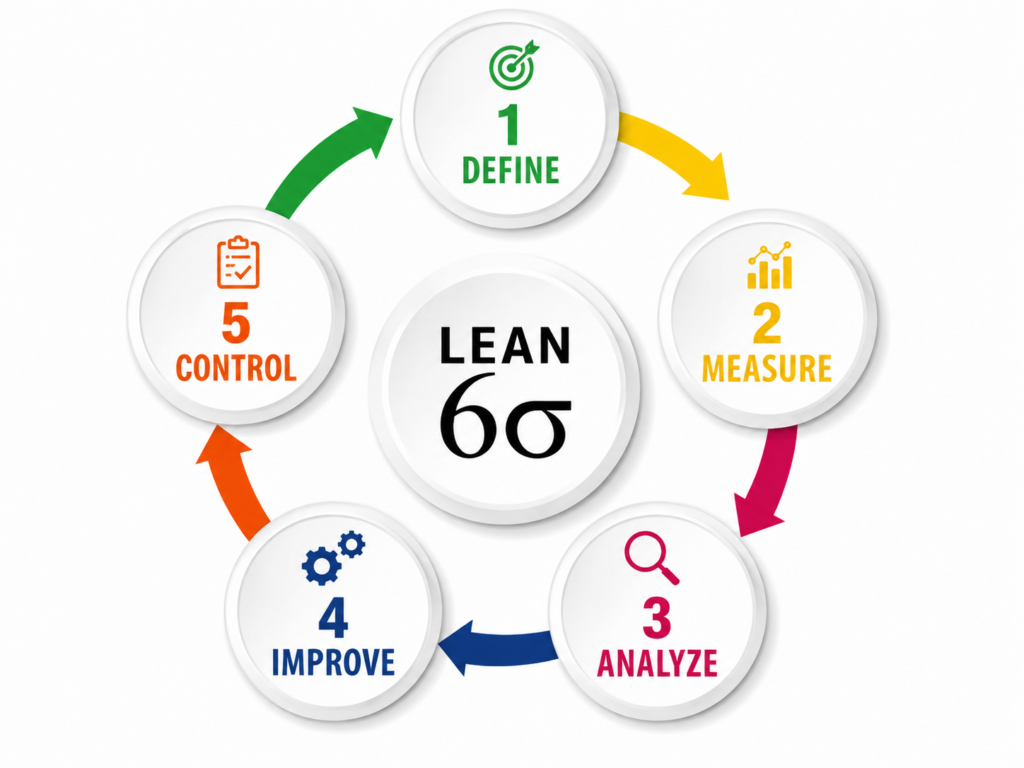
DMAIC is the primary problem-solving framework used in Lean Six Sigma. It provides a structured approach for improving existing processes by identifying problems, analyzing root causes, implementing effective solutions, and maintaining long-term improvements.
DMAIC stands for:
- Define
- Measure
- Analyze
- Improve
- Control
Each phase builds upon the previous one, ensuring improvements are based on objective evidence rather than assumptions.
1. Define
The Define phase establishes the project’s purpose, scope, objectives, stakeholders, customer requirements, and expected outcomes.
During this stage, teams clearly identify:
- What problem needs to be solved?
- Who is affected?
- Why is the problem important?
- What does success look like?
Example
A hospital receives frequent complaints about long patient waiting times.
The project goal is defined as reducing average waiting time from 90 minutes to 45 minutes within six months.
2. Measure
Once the problem has been defined, accurate data is collected to understand current process performance.
Teams measure:
- Current performance
- Process duration
- Defect rates
- Customer complaints
- Process capability
Reliable data establishes a baseline against which future improvements can be evaluated.
Example
The hospital records waiting times for every patient over four weeks and discovers that the average waiting time is actually 97 minutes.
3. Analyze
The Analyze phase focuses on identifying the root causes of the problem.
Rather than making assumptions, teams use data analysis and structured problem-solving tools to determine why the issue occurs.
Typical analytical techniques include:
- Root Cause Analysis
- Fishbone Diagram
- Pareto Analysis
- 5 Whys
- Process Mapping
Example
Analysis reveals that patient delays are primarily caused by inefficient appointment scheduling, incomplete registration forms, and limited consultation rooms.
4. Improve
After identifying the root causes, teams develop and implement solutions designed to eliminate them.
Solutions may involve:
- Process redesign
- Staff training
- Equipment upgrades
- Workflow improvements
- Technology implementation
Each solution is tested to verify its effectiveness before full implementation.
Example
The hospital introduces an online pre-registration system, redesigns appointment scheduling, and allocates additional consultation rooms during peak hours.
Average waiting time decreases from 97 minutes to 48 minutes.
5. Control
The final phase ensures improvements continue after the project has been completed.
Organizations establish monitoring systems, performance indicators, standard operating procedures, and regular reviews to prevent problems from returning.
Example
The hospital creates weekly performance dashboards, trains staff on the new procedures, and monitors waiting times each month to maintain consistent performance.
DMAIC at a Glance
| Phase | Purpose | Practical Example |
|---|---|---|
| Define | Identify the problem and project goals | Reduce patient waiting times |
| Measure | Collect performance data | Record average waiting time |
| Analyze | Identify root causes | Investigate scheduling delays |
| Improve | Implement effective solutions | Introduce online registration |
| Control | Sustain long-term improvements | Monitor waiting times monthly |
DMAIC provides organizations with a repeatable and evidence-based framework for solving complex operational challenges. By following these five phases, businesses can achieve measurable improvements in quality, efficiency, customer satisfaction, and overall performance while ensuring that successful changes are maintained over time.
Lean Six Sigma Belt Levels Explained
Lean Six Sigma certifications are organized into different belt levels, similar to martial arts. Each belt represents a higher level of knowledge, practical skills, leadership responsibility, and project management capability.
As professionals progress through the belt system, they gain a deeper understanding of process improvement methodologies, statistical analysis, and organizational change.
White Belt
The White Belt is the introductory level of Lean Six Sigma.
Individuals learn the basic concepts, terminology, and principles of continuous improvement. Although White Belt holders generally do not lead improvement projects, they understand how Lean Six Sigma supports organizational performance and can contribute as team members.
Suitable For
- Beginners
- Students
- New employees
- Administrative staff
Yellow Belt
Yellow Belt professionals possess a broader understanding of Lean Six Sigma concepts and actively participate in improvement projects under the guidance of experienced practitioners.
They assist with data collection, process mapping, and identifying opportunities for improvement.
Suitable For
- Team members
- Supervisors
- Quality assistants
- Operational staff
Green Belt
Green Belt professionals manage small to medium-sized Lean Six Sigma projects while continuing their regular job responsibilities.
They apply DMAIC, perform data analysis, identify root causes, and implement process improvements that deliver measurable business results.
Suitable For
- Engineers
- Quality professionals
- Production supervisors
- Project coordinators
- Operations managers
Black Belt
Black Belts lead complex improvement projects across departments and mentor Green Belt professionals. They possess advanced knowledge of statistical analysis, leadership, project management, and change management.
Organizations often rely on Black Belts to solve high-impact business challenges.
Suitable For
- Senior managers
- Continuous improvement leaders
- Quality managers
- Operations leaders
Master Black Belt
Master Black Belt is the highest technical certification level within Lean Six Sigma.
These professionals develop organizational improvement strategies, coach Black Belts, oversee enterprise-wide projects, and establish long-term continuous improvement programs.
They often advise executive leadership on operational excellence initiatives.
Suitable For
- Executive consultants
- Continuous improvement directors
- Organizational excellence leaders
Career Opportunities After Learning Lean Six Sigma
Lean Six Sigma has become one of the most valuable professional skill sets across global industries. Organizations increasingly seek individuals who can improve efficiency, solve complex operational problems, reduce costs, and enhance quality.
Whether you work in manufacturing, healthcare, finance, logistics, construction, information technology, or public services, Lean Six Sigma knowledge can strengthen your career prospects and support long-term professional growth.
Popular Job Roles
Professionals with Lean Six Sigma expertise often work in positions such as:
- Quality Assurance Manager
- Quality Control Engineer
- Continuous Improvement Manager
- Process Improvement Specialist
- Operational Excellence Manager
- Production Manager
- Manufacturing Engineer
- Process Engineer
- Supply Chain Manager
- Logistics Manager
- Project Manager
- Business Process Analyst
- Operations Manager
- Healthcare Quality Manager
- Compliance Manager
- Industrial Engineer
- Lean Consultant
- Six Sigma Consultant
Many organizations also require Lean Six Sigma knowledge for leadership positions because process improvement directly contributes to business performance.
Industries Offering Career Opportunities
Lean Six Sigma professionals are employed across numerous sectors, including:
- Manufacturing
- Automotive
- Aerospace
- Healthcare
- Construction
- Oil and Gas
- Pharmaceuticals
- Banking and Financial Services
- Information Technology
- Telecommunications
- Government Organizations
- Education
- Retail
- Hospitality
- Logistics and Supply Chain
- Energy and Utilities
Because nearly every industry relies on efficient processes, Lean Six Sigma skills remain highly transferable.
Skills Employers Value
Employers look for professionals who can:
- Analyze business processes.
- Solve complex operational problems.
- Reduce process waste.
- Improve quality.
- Lead improvement projects.
- Interpret performance data.
- Make evidence-based decisions.
- Work effectively in cross-functional teams.
- Drive organizational change.
- Deliver measurable business improvements.
These competencies increase employability while supporting career advancement into management and leadership positions.
How to Choose the Right Lean Six Sigma Certification
Selecting the appropriate Lean Six Sigma certification depends on your current experience, career objectives, and professional responsibilities. Because certification levels build upon one another, choosing the right starting point is important.
Consider Your Experience Level
Beginners who are new to process improvement may benefit from starting with a White Belt or Yellow Belt certification to develop a strong understanding of Lean Six Sigma fundamentals.
Professionals who actively participate in quality improvement initiatives may find Green Belt certification more appropriate, while experienced managers responsible for leading organizational improvement projects often pursue Black Belt certification.
Evaluate Your Career Goals
If your objective is simply to understand Lean Six Sigma concepts, an introductory certification may be sufficient.
However, professionals seeking leadership roles in quality management, operations, project management, or continuous improvement should consider advanced certifications that demonstrate greater technical expertise.
Review the Course Content
Before enrolling, review the syllabus carefully. A high-quality Lean Six Sigma program should cover topics such as:
- Lean principles
- Six Sigma methodology
- DMAIC
- Root cause analysis
- Process mapping
- Data analysis
- Quality management tools
- Continuous improvement techniques
- Practical case studies
- Improvement projects
Comprehensive training provides stronger practical skills than courses that focus only on theoretical concepts.
Consider Practical Learning
Courses that include real-world scenarios, practical exercises, case studies, and project-based learning help learners develop problem-solving skills that can be applied directly in the workplace.
Verify Industry Recognition
Choose certifications offered by reputable training providers or recognized professional organizations. Industry-recognized qualifications often provide greater credibility and may improve career opportunities.
The Future of Lean Six Sigma
As organizations continue to embrace digital transformation, Lean Six Sigma is evolving alongside emerging technologies. Rather than replacing Lean Six Sigma, modern innovations are enhancing its ability to solve increasingly complex business challenges.
Artificial intelligence, machine learning, robotic process automation, predictive analytics, cloud computing, and the Internet of Things (IoT) now generate vast amounts of operational data. Lean Six Sigma professionals use this information to identify trends, predict failures, optimize workflows, and make more informed business decisions.
Industry 4.0 technologies have also transformed manufacturing by enabling real-time monitoring of production processes. Organizations can detect quality issues more quickly, reduce equipment downtime, improve resource utilization, and enhance overall operational performance.
Service industries are also expanding their use of Lean Six Sigma. Financial institutions streamline customer transactions, hospitals improve patient care, logistics companies optimize delivery networks, and software organizations enhance development processes using Lean Six Sigma principles supported by digital technologies.
As businesses face increasing competition and customer expectations continue to rise, the demand for professionals who understand both continuous improvement and modern technology is expected to grow. Lean Six Sigma will remain a valuable methodology for organizations seeking sustainable operational excellence.
Conclusion
Lean Six Sigma has evolved into one of the most respected methodologies for achieving operational excellence. By combining the efficiency-focused principles of Lean with the quality-driven techniques of Six Sigma, organizations gain a structured approach to eliminating waste, reducing variation, improving customer satisfaction, and achieving sustainable business performance.
Throughout this guide, we explored the history of Lean Six Sigma, its core principles, DMAIC methodology, essential improvement tools, certification levels, practical applications, career opportunities, and future developments. These concepts demonstrate that Lean Six Sigma is far more than a collection of quality tools—it is a comprehensive management philosophy that promotes continuous improvement, data-driven decision-making, and customer-focused innovation.
Whether you are beginning your professional journey, seeking career advancement, or looking to improve organizational performance, developing Lean Six Sigma knowledge can provide long-term value. As industries continue to embrace digital transformation and operational excellence, professionals who understand Lean Six Sigma will remain well positioned to contribute to business success and create meaningful, measurable improvements across a wide range of sectors.
Frequently Asked Questions (FAQs)
Is Lean Six Sigma only used in manufacturing?
No. Although it originated in manufacturing, Lean Six Sigma is widely used in healthcare, construction, finance, logistics, education, government, retail, hospitality, information technology, and many other industries.
Which Lean Six Sigma belt should beginners choose?
Most beginners start with a White Belt or Yellow Belt certification before progressing to Green Belt and Black Belt qualifications.
What are the main benefits of Lean Six Sigma?
The methodology helps organizations improve quality, reduce costs, eliminate waste, increase productivity, enhance customer satisfaction, and support continuous improvement.
How long does it take to complete Lean Six Sigma training?
The duration varies depending on the certification level, training provider, learning format, and practical project requirements.
What is the difference between Lean and Six Sigma?
Lean focuses on eliminating waste and improving process flow, while Six Sigma focuses on reducing variation and minimizing defects. Lean Six Sigma combines both approaches to improve efficiency and quality simultaneously.