
ProQual Level 5 Fire Engineering Design Diploma Explained: UK Qualification, Salary & Career Path
In the modern built environment, where high-rise structures, complex designs, and dense urban development are becoming the norm, fire safety has moved from being a basic requirement to a critical element of engineering and design. Governments across the world—especially in the UK—are enforcing stricter fire safety regulations, making it essential for buildings to be designed with advanced fire protection systems from the very beginning. As a result, organizations are actively seeking skilled professionals who can integrate fire safety into construction and infrastructure projects.To build a strong foundation, it’s important to understand core concepts, which are explained in our guide on fire safety fundamentals and workplace protection.
This growing demand has significantly increased the value of specialized qualifications like the ProQual Level 5 Fire Engineering Design Diploma. Recognized in the UK and respected internationally, this qualification is designed to equip professionals with the technical expertise needed to design fire-safe buildings, understand fire behavior, and ensure compliance with modern safety standards. Unlike basic fire safety courses, this diploma focuses on engineering principles, making it ideal for those aiming to enter high-level roles within the fire safety and construction industries.
In addition to technical knowledge, the qualification offers strong career advantages. Professionals holding this diploma can access a wide range of opportunities in the UK, the Middle East, and other global markets where safety regulations are continuously evolving. With competitive salary packages and long-term career growth, fire engineering has become one of the most stable and rewarding professions in the safety sector.
For individuals who want to combine engineering skills with real-world impact—protecting lives, property, and infrastructure—this diploma provides a clear and structured career path. Whether you are already working in fire safety or looking to advance into a more specialized and higher-paying role, this qualification can serve as a powerful stepping stone toward professional success.
What is ProQual Level 5 Fire Engineering Design Diploma?
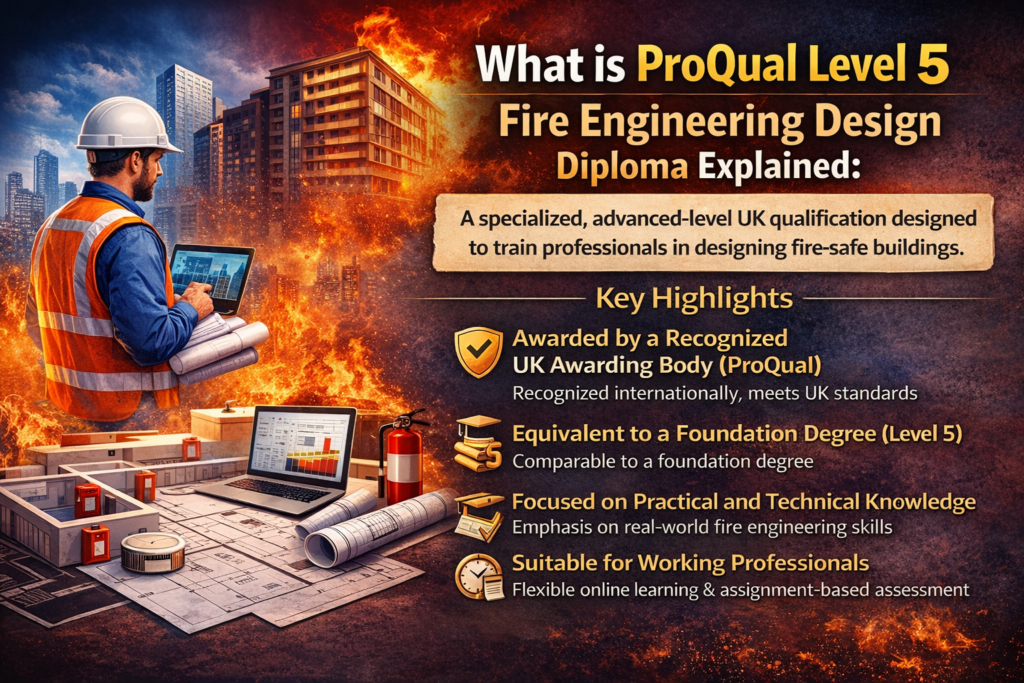
The ProQual Level 5 Fire Engineering Design Diploma is a specialized, advanced-level qualification developed to meet the growing need for highly skilled professionals in the fire safety and construction industries. It is regulated in the UK and designed to provide learners with in-depth knowledge of how to design buildings that are safe from fire hazards, while also complying with modern safety regulations.Understanding the essential principles of fire safety is key to becoming a successful professional, as explained in our detailed article on fire safety principles to protect lives and property.
Unlike basic fire safety training that focuses mainly on awareness and prevention, this diploma takes a more technical and engineering-based approach. It teaches learners how fire behaves in different environments, how building structures respond to fire, and how to design effective fire protection systems. This makes it particularly valuable for those involved in construction, engineering, and safety consultancy roles.
The course combines theoretical understanding with practical application, allowing learners to develop real-world skills that can be directly applied in professional settings. By completing this diploma, individuals gain the ability to analyze risks, design fire-safe structures, and contribute to safer building environments.
Key Highlights
Awarded by a Recognized UK Awarding Body (ProQual)
This diploma is issued by ProQual, a well-established UK awarding organization known for its industry-relevant qualifications. Being awarded by a recognized body ensures that the certification meets international standards and is accepted by employers across various countries.
This recognition adds credibility to your profile and increases your chances of securing job opportunities both locally and internationally.
Equivalent to a Foundation Degree (Level 5)
The qualification is set at Level 5, which means it is academically comparable to a foundation degree or Higher National Diploma (HND) in the UK education system.
This level indicates that the course goes beyond basic knowledge and focuses on:
- Advanced concepts
- Analytical thinking
- Problem-solving skills
It prepares learners for professional roles that require both technical expertise and decision-making abilities.
Focused on Practical and Technical Knowledge
One of the strongest aspects of this diploma is its practical approach. Instead of relying only on theoretical learning, the course emphasizes real-world applications such as:
- Designing fire protection systems in buildings
- Understanding fire dynamics and behavior
- Evaluating risks in complex structures
- Applying safety standards in construction projects
This ensures that learners are not just qualified on paper but are also capable of handling real industry challenges.
Suitable for Working Professionals
The course is designed with flexibility in mind, making it ideal for individuals who are already working in fields such as:
- Fire safety
- Construction
- Engineering
- Health and safety
Most training providers offer flexible study options, including online learning and assignment-based assessments. This allows professionals to upgrade their qualifications without interrupting their careers.
Why This Diploma is Different from Basic Fire Safety Courses
Many fire safety courses focus on general topics such as fire prevention, basic risk assessment, and emergency response. While these are important, they do not cover the technical aspects required for higher-level roles.
This diploma stands out because it focuses on fire engineering design, which includes:
- Planning fire-safe building layouts
- Integrating fire protection into architectural design
- Using engineering principles to control fire risks
- Ensuring compliance with advanced safety regulations
As a result, it prepares learners for more specialized and higher-paying positions in the industry.
Overall Value of the Qualification
In simple terms, the ProQual Level 5 Fire Engineering Design Diploma is not just a course—it is a professional development pathway. It equips learners with the knowledge, skills, and recognition needed to progress in the fire safety and engineering sectors.
By completing this qualification, individuals position themselves as competent professionals capable of handling complex fire safety challenges, making them highly valuable in today’s safety-conscious world.
What Does a Fire Engineering Designer Actually Do?
A fire engineering designer is a highly specialized professional responsible for making buildings safe from fire risks through intelligent design and engineering solutions. While many people associate fire safety with alarms and extinguishers, the real work begins much earlier—at the design and planning stage of a building.
This role is often overlooked in many blogs, but in reality, it is one of the most critical positions in modern construction and infrastructure development. Fire engineering designers work closely with architects, engineers, and safety authorities to ensure that every structure is built with fire safety integrated into its core design.
Their goal is not just to respond to fire incidents, but to prevent fires from spreading, protect lives, and minimize damage if a fire occurs.
Key Responsibilities Explained
| Responsibility | What It Means | Real-World Application |
|---|---|---|
| Designing Fire Protection Systems | Creating systems like sprinklers, alarms, and fire barriers to control fire | Installing fire alarms, sprinkler systems, and fire-resistant walls in buildings |
| Planning Evacuation Routes | Ensuring people can safely exit during emergencies | Designing emergency exits, staircases, and escape routes with proper signage |
| Fire Modeling & Simulations | Using software to predict fire behavior and risks | Analyzing how fire spreads in a building before construction |
| Ensuring Compliance | Making sure designs follow legal fire safety regulations | Following UK building codes and preparing safety approval documents |
| Advising Project Teams | Guiding architects and engineers on fire safety integration | Recommending materials, layouts, and safety systems in construction projects |
Below are the main responsibilities of a fire engineering designer, explained in a simple and practical way:
Designing Fire Protection Systems in Buildings
One of the primary duties is to design systems that can control or suppress fires effectively.
This includes:
- Fire sprinkler systems
- Fire alarms and detection systems
- Fire-resistant barriers and compartments
The designer ensures that these systems are properly placed and function efficiently in case of an emergency. The design must also align with the building’s structure and purpose (e.g., residential, commercial, industrial).
Planning Safe Evacuation Routes
A crucial part of fire safety design is ensuring that people can exit a building safely during a fire.
This involves:
- Designing clear and accessible escape routes
- Planning emergency exits and staircases
- Ensuring proper signage and lighting
The designer must consider worst-case scenarios, such as smoke-filled corridors or blocked exits, and ensure that evacuation remains possible under all conditions.
Conducting Fire Modeling and Simulations
Fire engineering designers use advanced tools and software to simulate how fire behaves in different environments.
This helps them:
- Predict how quickly a fire will spread
- Analyze smoke movement
- Identify high-risk areas within a building
These simulations allow designers to make informed decisions and improve safety measures before construction even begins.
Ensuring Compliance with Fire Safety Regulations
Every country has strict fire safety laws, especially in the UK. A fire engineering designer ensures that the building design complies with these regulations.
This includes:
- Following building codes and standards
- Meeting legal safety requirements
- Preparing documentation for approvals
Failure to comply can lead to legal issues, fines, or even project shutdowns, which makes this responsibility extremely important.
Advising Architects and Construction Teams
Fire engineering designers do not work in isolation. They collaborate closely with:
- Architects
- Structural engineers
- Construction managers
They provide expert advice on:
- Material selection
- Building layout
- Safety system integration
Their input ensures that fire safety is not an afterthought but a fundamental part of the building design.
Real-World Example
To better understand this role, let’s consider a practical example:
Designing a High-Rise Building
When a high-rise building is being planned, a fire engineering designer plays a key role in ensuring safety.
They will make sure that:
- Fire-resistant materials are used to slow down the spread of fire
- Smoke control systems (like ventilation and extraction systems) are installed to keep escape routes clear
- Emergency exits and staircases are strategically placed for quick evacuation
- Fire compartments are created to contain fire within specific areas
Without these measures, even a small fire could quickly turn into a major disaster.
Why This Role is So Important
The importance of a fire engineering designer cannot be overstated. Their work directly impacts:
- Human safety and survival
- Protection of property and assets
- Compliance with legal standards
- Overall building performance during emergencies
In simple terms, they help ensure that buildings are not just functional and attractive, but also safe and resilient in the face of fire hazards.
A fire engineering designer is not just a technical expert—they are a problem solver, safety planner, and risk management specialist. This role requires a deep understanding of engineering principles combined with a strong sense of responsibility.
This is what makes it both technically challenging and highly rewarding, especially for those looking to build a respected and high-paying career in fire engineering.h technical and highly responsible
Key Units & What You Will Learn
The ProQual Level 5 Fire Engineering Design Diploma is structured to provide a deep and practical understanding of fire safety from an engineering perspective. Instead of focusing only on basic awareness, this qualification covers advanced concepts that prepare learners to handle real-world challenges in building design and fire risk management.
Each unit is carefully designed to build your knowledge step by step—starting from how fire behaves, moving into building design, and finally ensuring compliance with legal standards.
Below is a detailed explanation of the key learning areas included in this diploma:
Fire Engineering Principles
This is the foundation of the entire course. Before designing fire-safe buildings, it is essential to understand how fire behaves and spreads.
Understanding Fire Dynamics
Fire dynamics explain how a fire starts, grows, and spreads in different environments. You will learn:
- The stages of fire development (ignition, growth, flashover, decay)
- How oxygen, fuel, and heat interact (fire triangle)
- How environmental conditions affect fire behavior
This knowledge helps you predict fire risks and design preventive measures effectively.
Heat Transfer and Fire Spread
Heat transfer is a key factor in how fires move through a building. You will study:
- Conduction (heat through solid materials)
- Convection (heat through air movement)
- Radiation (heat transfer without direct contact)
Understanding these concepts allows you to:
- Prevent rapid fire spread
- Select appropriate construction materials
- Improve building safety design
Building Design & Fire Safety
This unit focuses on integrating fire safety into the overall design of buildings rather than treating it as an afterthought.
Integration of Fire Safety in Construction
You will learn how to incorporate fire safety measures during the planning and design stage of construction projects.
This includes:
- Designing layouts that reduce fire risks
- Positioning fire exits strategically
- Ensuring accessibility for emergency services
The goal is to make fire safety a core part of the building design.
Structural Fire Protection
Structural fire protection ensures that a building can withstand fire for a certain period without collapsing.
You will study:
- Fire resistance of construction materials
- Load-bearing capacity during fire exposure
- Methods to strengthen structural elements
This is especially important in:
- High-rise buildings
- Industrial facilities
- Public infrastructure
Passive Fire Protection Systems
Passive fire protection (PFP) refers to built-in safety features that help contain fire and slow its spread without requiring active intervention.
Fire-Resistant Walls and Doors
You will learn about materials and systems designed to resist fire for a specific duration.
Examples include:
- Fire-rated walls
- Fire doors with automatic closing systems
- Fire-resistant glass
These elements help protect escape routes and prevent fire from spreading between areas.
Compartmentation Techniques
Compartmentation is a critical concept in fire safety design. It involves dividing a building into smaller sections to contain fire within a limited area.
You will understand:
- How to design fire compartments
- The importance of sealing gaps and openings
- How compartmentation slows fire and smoke spread
This significantly improves evacuation time and reduces damage.
Advanced Fire Risk Assessment
This unit develops your ability to identify, evaluate, and control fire risks in complex environments.Identifying hazards and applying risk mitigation strategies is a critical part of fire safety. You can explore this in detail in our comprehensive guide on fire safety, risk assessment, and emergency preparedness.
Identifying Hazards
You will learn how to detect potential fire hazards in different settings, such as:
- Electrical faults
- Flammable materials
- Poor storage practices
- Human errors
Early identification is key to preventing fire incidents.
Risk Mitigation Strategies
Once risks are identified, the next step is to control or eliminate them.
You will study:
- Risk evaluation methods
- Preventive measures
- Emergency planning
This helps you:
- Reduce the likelihood of fire
- Minimize impact if a fire occurs
This section is highly practical and directly applicable in real jobs.
Regulations & Compliance
Understanding legal requirements is essential for any fire engineering professional.
UK Fire Safety Laws
You will gain knowledge of key UK fire safety regulations, including:
- Fire Safety Order
- Building safety legislation
- Employer responsibilities
This ensures that your designs meet legal standards.
Building Codes and Standards
You will also learn about industry standards that guide fire safety practices.
This includes:
- Design codes for fire safety
- Compliance requirements for construction projects
- Inspection and approval processes
Following these standards is critical for project approval and professional credibility.
Why These Units Are Important
Each of these units plays a vital role in shaping you into a competent fire engineering professional. Together, they provide:
- A strong technical foundation
- Practical design skills
- Risk management expertise
- Legal and regulatory knowledge
By the end of this diploma, you will not only understand fire safety concepts but also be able to apply them in real-world scenarios. This combination of knowledge and practical skills is what makes the ProQual Level 5 Fire Engineering Design Diploma highly valuable in today’s competitive job market.
It prepares you to confidently design safer buildings, reduce fire risks, and contribute to protecting lives and property.
Who Should Take This Course?
The ProQual Level 5 Fire Engineering Design Diploma is designed for individuals who want to move beyond basic fire safety knowledge and step into more advanced, technical, and higher-paying roles. This qualification is especially valuable for professionals who are already working in related fields and want to upgrade their skills, gain international recognition, and unlock better career opportunities.
Below is a detailed explanation of who will benefit the most from this course:
Fire Safety Professionals Seeking Career Growth
If you are already working in fire safety—such as a fire warden, fire safety officer, or safety supervisor—this course can significantly enhance your career.
With this diploma, you can:
- Move from basic roles to advanced technical positions
- Gain deeper knowledge of fire engineering design
- Increase your earning potential
- Qualify for senior roles like fire engineer or consultant
This course helps you transition from operational roles to strategic and design-based roles.
Engineers and Construction Professionals
This diploma is highly beneficial for professionals working in construction and engineering fields, including:
- Civil engineers
- Structural engineers
- Architects
- Project managers
These professionals often deal with building design and infrastructure development. By gaining fire engineering knowledge, they can:
- Integrate fire safety into building designs
- Ensure compliance with safety regulations
- Improve project quality and safety standards
Adding fire engineering skills makes you more valuable and versatile in the construction industry.
Fire Risk Assessors
For individuals already working as fire risk assessors, this diploma provides an opportunity to advance to a higher level.
You will be able to:
- Move beyond basic risk assessments
- Understand complex fire behavior and design solutions
- Offer more comprehensive and professional services
This allows you to transition from assessment roles to design and consultancy roles.
Health & Safety Officers
Health and safety professionals are responsible for maintaining safe working environments. By completing this diploma, they can:
- Expand their expertise into fire engineering
- Improve workplace safety standards
- Take on more specialized responsibilities
This qualification helps safety officers stand out in a competitive job market.
Individuals Looking for International Career Opportunities
Fire engineering is a globally in-demand profession, especially in regions with strict safety regulations such as:
- United Kingdom
- Middle East (UAE, Saudi Arabia, Qatar)
- Europe
This diploma is recognized internationally, making it an excellent choice for those who want to:
- Work abroad
- Apply for international projects
- Build a global career in fire safety and engineering
It opens doors to high-paying, international job opportunities.
Who Should Avoid This Course?
While this diploma offers many benefits, it is not suitable for everyone. Understanding whether this course aligns with your background and goals is important before enrolling.
Complete Beginners with No Technical or Safety Background
This is an advanced-level qualification (Level 5), which means it requires some prior knowledge or experience.
If you:
- Have no background in fire safety, engineering, or construction
- Are completely new to the field
You may find the course challenging and difficult to follow.
In such cases, it is better to start with:
- Level 2 or Level 3 fire safety courses
- Basic health and safety training
Individuals Looking for Short or Basic Courses
This diploma is not a quick certification. It is a comprehensive program that requires time, effort, and commitment.
It may not be suitable if you:
- Want a short course for quick certification
- Are not ready to invest several months in learning
This course is designed for serious learners aiming for long-term career growth.
People Not Interested in Technical or Engineering Concepts
Fire engineering design involves technical subjects such as:
- Fire dynamics
- Building structures
- Engineering principles
If you are not comfortable with:
- Analytical thinking
- Technical learning
- Problem-solving
You may not fully benefit from this course.
Choosing the right course is essential for career success. The ProQual Level 5 Fire Engineering Design Diploma is ideal for individuals who are serious about building a professional career in fire safety and engineering.
If you have the right background, interest, and commitment, this qualification can help you achieve significant career growth, higher income, and international opportunities.
Entry Requirements
One of the key advantages of the ProQual Level 5 Fire Engineering Design Diploma is its flexible entry criteria. Unlike traditional academic programs that require strict qualifications, this diploma is designed to accommodate working professionals from different backgrounds, especially those already involved in fire safety, construction, or engineering.
However, since it is an advanced-level qualification, having some prior knowledge or experience is highly recommended to successfully understand and complete the course.
Who Can Qualify for This Diploma?
Below are the main pathways through which you can become eligible for this course:
Relevant Work Experience in Fire Safety
If you are currently working in the fire safety field, you are already in a strong position to enroll in this diploma.
This includes roles such as:
- Fire safety officer
- Fire warden or supervisor
- Fire risk assessor
- Safety inspector
Your practical experience helps you:
- Understand real-world fire risks
- Relate course concepts to actual situations
- Complete assignments more effectively
Even if you don’t have formal qualifications, experience can often be enough for enrollment.
Level 3 or Level 4 Qualification
Having a prior qualification in fire safety or a related field significantly strengthens your eligibility.
Examples include:
- Level 3 Certificate in Fire Safety
- Level 4 Fire Risk Assessment qualification
- Health and safety certifications
These qualifications ensure that you already understand:
- Basic fire safety principles
- Risk assessment methods
- Workplace safety practices
This diploma builds on that foundation and takes your knowledge to an advanced level.
Engineering or Construction Background
Professionals from engineering or construction fields are also ideal candidates for this course.
Relevant backgrounds include:
- Civil engineering
- Structural engineering
- Architecture
- Construction management
Since fire engineering design is closely linked to building structures, having this background helps you:
- Understand technical concepts easily
- Apply fire safety measures in design
- Integrate safety into construction projects
This makes the course highly relevant for technical professionals.
Flexible Assessment Pathways
Another major benefit of this qualification is its flexible approach to assessment and entry.
Many training providers offer:
- Recognition of Prior Learning (RPL)
- Experience-based enrollment
- Portfolio-based assessments
This means:
- You don’t always need formal exams
- Your work experience and practical knowledge are valued
- You can progress based on your existing skills
This flexibility makes the course accessible to a wider range of professionals.
Course Duration & Study Mode
Understanding the time commitment and study format is important before enrolling. This diploma is designed to be flexible and suitable for working individuals.
Course Duration
The duration of the course typically ranges from 6 to 12 months, depending on several factors:
- Your prior knowledge and experience
- The time you can dedicate to study
- The training provider’s structure
Fast-Track Option
If you already have strong experience or previous qualifications, you may complete the course more quickly through fast-track or RPL pathways.
Standard Pace
For most learners, completing the diploma within 6–12 months allows enough time to:
- Understand complex topics
- Complete assignments properly
- Apply knowledge in real-world scenarios
The flexible duration ensures that learners can study comfortably without pressure.
Study Mode
One of the biggest advantages of this diploma is its modern and flexible study approach.
Online Learning
Most providers offer fully online learning, which allows you to:
- Study from anywhere in the world
- Access learning materials anytime
- Learn at your own pace
This is especially beneficial for international students and working professionals.
Assignment-Based Assessment (No Exams)
Unlike traditional courses that rely on written exams, this diploma is usually assessed through assignments.
This includes:
- Case studies
- Practical reports
- Work-based projects
Benefits of this approach:
- Reduces exam pressure
- Focuses on real-world application
- Helps you build practical skills
This makes learning more practical and career-focused.
Flexible Schedule for Working Professionals
The course is specifically designed for individuals who are already working.
You can:
- Study in your free time
- Balance work and education
- Progress at your own speed
This flexibility ensures that you can upgrade your qualifications without leaving your job.
The entry requirements, duration, and study mode of the ProQual Level 5 Fire Engineering Design Diploma are designed to make advanced education accessible, practical, and flexible.
Whether you are an experienced professional or someone with relevant qualifications, this course provides a convenient pathway to gain a globally recognized certification and advance your career in fire engineering.
Career Opportunities After Completion
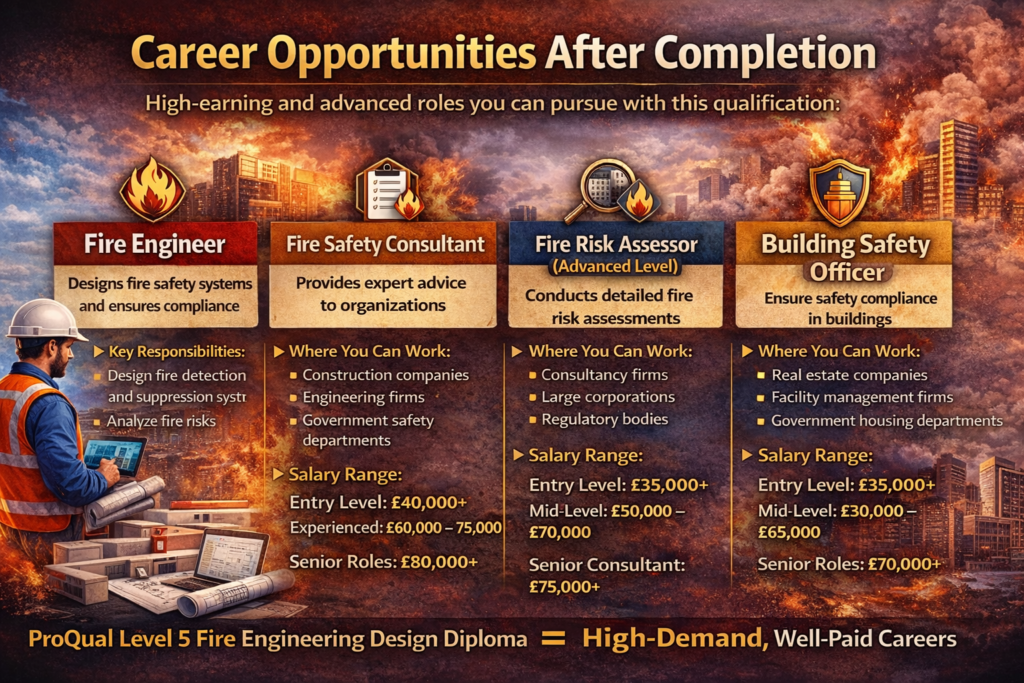
Completing the ProQual Level 5 Fire Engineering Design Diploma opens the door to a wide range of advanced and well-respected career opportunities. This qualification is designed to prepare you for technical, advisory, and leadership roles in the fire safety and construction industries.
With increasing global focus on safety regulations and risk management, professionals with fire engineering expertise are in high demand. Whether you want to work in the UK, the Middle East, or other international markets, this diploma provides the skills and credibility needed to secure high-level positions.
Below is a detailed explanation of the key career paths you can pursue after completing this qualification:
Fire Engineer
A Fire Engineer is one of the most advanced and rewarding career options available after completing this diploma. This role focuses on designing and implementing fire safety solutions in buildings and infrastructure projects.
Key Responsibilities:
- Designing fire detection and suppression systems
- Analyzing fire risks in building designs
- Ensuring compliance with fire safety regulations
- Conducting fire safety simulations and testing
- Working closely with architects and engineers
Where You Can Work:
- Construction companies
- Engineering firms
- Government safety departments
- Consultancy organizations
Salary Range:
- Entry Level: £40,000+
- Experienced: £60,000 – £75,000+
- Senior Roles: £80,000+
This role offers strong career growth and is considered one of the highest-paying positions in the fire safety industry.
Fire Safety Consultant
A Fire Safety Consultant provides expert advice to organizations on how to improve fire safety and comply with regulations. This role is ideal for individuals who enjoy analysis, planning, and advisory work.
Key Responsibilities:
- Advising clients on fire safety strategies
- Reviewing building designs and safety plans
- Conducting safety audits and inspections
- Recommending improvements and solutions
- Preparing detailed safety reports
Where You Can Work:
- Private consultancy firms
- Large organizations and corporations
- Government and regulatory bodies
- Independent consulting (freelancing)
Salary Range:
- Entry Level: £35,000+
- Mid-Level: £50,000 – £70,000
- Senior Consultant: £75,000+
This role offers flexibility, and many professionals choose to work as independent consultants, increasing their earning potential.
Fire Risk Assessor (Advanced Level)
After completing this diploma, you can work as an advanced-level Fire Risk Assessor, handling more complex and high-risk environments.
Key Responsibilities:
- Conducting detailed fire risk assessments
- Identifying hazards in buildings and workplaces
- Evaluating existing safety measures
- Recommending corrective actions
- Preparing official risk assessment reports
Where You Can Work:
- Commercial and residential sectors
- Industrial facilities
- Hospitals, schools, and public buildings
- Safety consultancy firms
Salary Range:
- Entry Level: £30,000+
- Experienced: £45,000 – £60,000
- Senior Assessor: £65,000+
This role is ideal for those who want to specialize in risk evaluation and safety compliance.
Building Safety Officer
A Building Safety Officer ensures that buildings meet all safety standards, including fire safety regulations. This role is particularly important in large residential and commercial developments.
Key Responsibilities:
- Monitoring building safety systems
- Ensuring compliance with fire and safety laws
- Conducting regular safety inspections
- Coordinating emergency preparedness plans
- Working with management and safety teams
Where You Can Work:
- Real estate companies
- Facility management firms
- Government housing departments
- Commercial property organizations
Salary Range:
- Entry Level: £35,000+
- Mid-Level: £50,000 – £65,000
- Senior Roles: £70,000+
This role provides stability and is essential for maintaining safe and compliant building environments.
Additional Career Opportunities
In addition to the main roles above, this diploma can also lead to other career paths such as:
- Fire Safety Trainer or Instructor
- Safety Manager
- Compliance Officer
- Project Safety Consultant
These roles allow you to diversify your career and explore different areas within the safety and engineering sectors.
Career Growth & Progression
One of the biggest advantages of this qualification is the clear path for career progression.
Typical Growth Path:
- Entry-Level Safety Role
- Fire Risk Assessor
- Fire Engineer / Consultant
- Senior Consultant / Manager
- Independent Expert or Business Owner
With experience and continuous learning, you can move into leadership or consultancy roles with very high income potential.
The ProQual Level 5 Fire Engineering Design Diploma is not just a qualification—it is a gateway to a wide range of professional opportunities. It equips you with the technical skills, practical knowledge, and industry recognition needed to succeed in a competitive job market.
Whether you aim to work in design, consultancy, risk assessment, or safety management, this diploma provides the foundation for a stable, respected, and high-paying career in fire engineering.
Salary Expectations (UK & International)
| Level / Region | Job Roles | Salary Range | Key Responsibilities |
|---|---|---|---|
| Entry Level (UK) | Junior Fire Engineer, Safety Officer, Assistant Risk Assessor | £30,000 – £40,000 | Assist senior staff, basic risk assessments, support fire safety planning |
| Mid-Level (UK) | Fire Engineer, Fire Safety Consultant, Senior Risk Assessor | £45,000 – £70,000 | Design systems, manage projects, provide expert advice |
| Senior Level (UK) | Senior Fire Engineer, Lead Consultant, Safety Manager | £80,000+ | Lead teams, manage large projects, strategic decision-making |
| Middle East | Fire Engineer, Consultant, Safety Specialist | High (Tax-Free + Benefits) | Work on mega projects, compliance, high-level safety design |
| Europe | Fire Engineer, Safety Consultant | Competitive (Varies by country) | Engineering design, regulatory compliance, consultancy work |
| Pakistan | Safety Officer, Fire Engineer | Growing Market | Risk assessment, safety planning, local consultancy |
Salary is one of the most important factors for anyone choosing a career path, and in fire engineering, the earning potential is strong and continues to grow due to increasing global demand for safety professionals.
The ProQual Level 5 Fire Engineering Design Diploma positions you for higher-paying roles because it focuses on advanced technical and design-based skills. Below is a clear and detailed breakdown of salary expectations at different levels and across different regions.
UK Salary Range
The United Kingdom offers some of the best opportunities in fire engineering due to strict safety regulations and continuous development in construction and infrastructure.
Entry-Level Salary (£30,000 – £40,000)
At the beginning of your career, you may start in roles such as:
- Junior Fire Engineer
- Assistant Fire Risk Assessor
- Safety Officer
At this stage, your responsibilities typically include:
- Assisting senior professionals
- Conducting basic risk assessments
- Supporting fire safety planning
This phase is focused on gaining practical experience and industry exposure.
Mid-Level Salary (£45,000 – £70,000)
With a few years of experience and a Level 5 qualification, you can move into more advanced roles such as:
- Fire Engineer
- Fire Safety Consultant
- Senior Risk Assessor
At this level, you will:
- Handle complex projects independently
- Design fire safety systems
- Provide expert advice to clients
This is where your skills and qualifications start translating into strong financial rewards.
Senior-Level Salary (£80,000+)
At the senior level, professionals take on leadership and strategic roles such as:
- Senior Fire Engineer
- Lead Consultant
- Safety Manager
Responsibilities include:
- Managing large-scale projects
- Leading teams
- Making high-level safety decisions
Experienced professionals can earn even higher, especially if they work as independent consultants or specialists.
International Opportunities & Salary Potential
Fire engineering is a globally in-demand profession, and salaries vary depending on region, experience, and industry demand.
Middle East (High Demand & Tax-Free Income)
Countries like UAE, Saudi Arabia, and Qatar have booming construction industries and strict safety requirements.
Key benefits:
- High demand for qualified professionals
- Attractive salary packages
- Tax-free income in many countries
- Additional benefits (accommodation, transport, etc.)
This region is ideal for professionals seeking high earnings and international exposure.
Europe (Growing Regulatory Environment)
European countries are continuously improving fire safety regulations, especially after recent safety reforms.
Opportunities include:
- Engineering firms
- Government projects
- Safety consultancy services
Salaries are competitive, and demand is steadily increasing due to stricter compliance requirements.
Pakistan (Emerging Market)
In Pakistan, awareness of fire safety is growing, especially in:
- Construction sector
- Industrial facilities
- Commercial buildings
Although salaries may be lower compared to the UK or Middle East, the demand for qualified professionals is increasing.
This creates opportunities for:
- Career growth
- Local consultancy work
- Entry into international markets
Factors That Affect Your Salary
Your earning potential in fire engineering depends on several key factors:
- Level of qualification (Level 5 gives a strong advantage)
- Years of experience
- Industry (construction, oil & gas, consultancy, etc.)
- Location (UK, Middle East, Europe, etc.)
- Specialization (design, risk assessment, consultancy)
The more specialized and experienced you become, the higher your earning potential.
Career Path Roadmap (Step-by-Step Growth Plan)
Understanding the career progression pathway is essential for long-term success. This roadmap shows how you can grow from a beginner to an expert in fire engineering.
Step 1: Level 3 Fire Safety Qualification
This is the starting point for most individuals entering the field.
At this stage, you learn:
- Basic fire safety principles
- Fire prevention techniques
- Emergency procedures
Suitable for beginners and entry-level roles.
Step 2: Level 4 Fire Risk Assessment
After gaining basic knowledge, the next step is to specialize in fire risk assessment.
You will:
- Learn how to identify fire hazards
- Conduct risk assessments
- Recommend safety improvements
This level prepares you for roles like Fire Risk Assessor.
Step 3: Level 5 Fire Engineering Design Diploma
This is the advanced stage where you move into technical and design-based roles.
You will:
- Design fire-safe buildings
- Apply engineering principles
- Handle complex safety challenges
This qualification opens doors to high-level and high-paying careers.
Step 4: Senior Fire Engineer / Consultant
With experience and expertise, you can progress to senior positions.
At this level, you:
- Lead major projects
- Manage teams
- Work as an independent consultant
This stage offers maximum earning potential and professional recognition.
Why This Career Roadmap is Important
Most blogs do not clearly explain the career journey, but this roadmap helps you:
- Understand where to start
- Plan your career step by step
- Set realistic goals
- Stay motivated for long-term growth
It gives you a clear vision of your future in fire engineering.
The combination of strong salary potential and a clear career path makes fire engineering one of the most attractive professions in the safety and construction industries.
With the ProQual Level 5 Fire Engineering Design Diploma, you are not just gaining a qualification—you are building a pathway toward a stable, respected, and financially rewarding career on a global scale.
Comparison Section
When choosing the right qualification or career path in fire safety, many learners get confused between different options. This is because terms like fire engineering design, fire risk assessment, and different qualification levels (Level 3, Level 5) are often used interchangeably—but they actually serve very different purposes.
This comparison section is extremely important because it helps you clearly understand the differences and make the right decision based on your career goals. It also adds strong SEO value, as many users search for comparisons before enrolling in a course.
Level 5 Fire Engineering Design vs Fire Risk Assessment
Although both fields are part of fire safety, they focus on completely different aspects of the industry.
Core Difference
- Fire Engineering Design is about creating safe buildings using engineering principles.
- Fire Risk Assessment is about evaluating existing buildings to identify and reduce fire risks.
In simple terms:
- One is design-focused (proactive approach)
- The other is inspection-focused (reactive approach)
Comparison
| Feature | Fire Engineering Design | Fire Risk Assessment |
|---|---|---|
| Focus | Designing fire-safe structures | Identifying and evaluating risks |
| Level | Advanced (Level 5) | Intermediate (Level 3–4) |
| Nature of Work | Technical & engineering-based | Inspection & reporting |
| Stage of Work | Before/during construction | After building is completed |
| Skills Required | Engineering knowledge, design skills | Observation, analysis |
| Career Roles | Fire Engineer, Design Consultant | Fire Risk Assessor |
| Salary Potential | High | Moderate |
Fire Engineering Design
This field focuses on designing buildings that are safe from fire hazards right from the beginning.
Key Characteristics:
- Involves technical and engineering calculations
- Requires understanding of building structures
- Uses fire modeling and simulation tools
- Works closely with architects and engineers
This is a high-level and specialized career path with strong earning potential.
Fire Risk Assessment
This field focuses on evaluating existing buildings to ensure they meet safety standards.
Key Characteristics:
- Conducting site inspections
- Identifying fire hazards
- Recommending improvements
- Preparing safety reports
This is a practical and important role, but less technical compared to fire engineering design.
Which One Should You Choose?
- Choose Fire Engineering Design if you want:
- A technical and engineering-based career
- Higher salary and advanced roles
- Involvement in building design and construction
- Choose Fire Risk Assessment if you prefer:
- Inspection and evaluation work
- Less technical responsibilities
- Entry to mid-level roles
Level 5 vs Level 3 Fire Safety (Qualification Comparison)
Another common confusion is between different qualification levels. Understanding this difference helps you choose the right starting point and career direction.
Core Difference
- Level 3 is a basic/intermediate qualification for beginners
- Level 5 is an advanced qualification for professionals
Think of it like this:
Comparison
| Feature | Level 3 Fire Safety | Level 5 Fire Engineering Design |
|---|---|---|
| Difficulty | Basic to intermediate | Advanced |
| Knowledge Level | Fundamental concepts | In-depth technical knowledge |
| Career Level | Entry-level roles | Professional & senior roles |
| Skill Type | General safety awareness | Engineering & design skills |
| Study Depth | Short and simple | Detailed and comprehensive |
| Salary Potential | Lower | Higher |
| Career Growth | Limited | High growth opportunities |
Level 3 Fire Safety
This is the starting point for most individuals entering the fire safety field.
What You Learn:
- Basic fire prevention
- Emergency procedures
- Workplace safety
Career Opportunities:
- Fire warden
- Safety assistant
- Entry-level safety roles
Ideal for beginners with no prior experience.
Level 5 Fire Engineering Design
This is an advanced qualification designed for professionals aiming for higher-level roles.
What You Learn:
- Fire engineering principles
- Building design and safety integration
- Advanced risk management
Career Opportunities:
- Fire engineer
- Fire safety consultant
- Senior safety roles
Ideal for individuals who want to build a long-term, high-paying career.
Comparison Insight
Understanding these differences helps you make a smarter career decision.
- If you are just starting → begin with Level 3
- If you want to specialize and earn more → move to Level 5
- If you prefer inspections → choose Fire Risk Assessment
- If you want technical expertise → choose Fire Engineering Design
This comparison clearly shows that while all these paths are part of the fire safety industry, they serve different purposes and career goals.
The ProQual Level 5 Fire Engineering Design Diploma stands out as the most advanced and career-focused option, offering higher earning potential, global opportunities, and long-term professional growth.
Conclusion
The ProQual Level 5 Fire Engineering Design Diploma is not just another certification—it is a powerful career investment that positions you at the forefront of a rapidly growing and highly specialized industry. As modern buildings become more complex and safety regulations continue to tighten worldwide, the need for skilled fire engineering professionals is increasing significantly. This diploma provides you with the advanced knowledge, practical skills, and professional recognition required to meet these industry demands with confidence.
One of the biggest strengths of this qualification is its ability to open doors to diverse and high-level career opportunities. From designing fire-safe buildings to working as a consultant or risk specialist, the diploma prepares you for roles that are both technically challenging and financially rewarding. In addition, its international recognition allows you to explore job opportunities not only in the UK but also in regions like the Middle East and Europe, where demand for qualified professionals is consistently high.
In simple terms, this diploma offers a clear pathway toward long-term career growth, stability, and professional respect. If you are serious about advancing in the fire safety or engineering field, gaining specialized expertise, and securing a future-proof career, the ProQual Level 5 Fire Engineering Design Diploma can be the stepping stone that takes you to the next level.