
How to Get ProQual Level 5 Diploma in Fire Engineering Design: Requirements, Units & Career Opportunities
In today’s rapidly evolving built environment, fire safety is no longer just a regulatory requirement—it is a critical responsibility that directly impacts lives, assets, and business continuity. From high-rise buildings and industrial facilities to commercial complexes and public infrastructure, the risk of fire incidents has increased due to complex designs, electrical loads, and the use of diverse materials. As a result, industries such as construction, oil & gas, manufacturing, and facilities management are placing greater emphasis on advanced fire protection planning and system design.
To meet these growing challenges, organizations are actively seeking qualified professionals who not only understand fire risks but can also design effective, compliant, and reliable fire safety systems. This is where the ProQual Level 5 Diploma in Fire Engineering Design stands out as a valuable and career-defining qualification. It is designed to provide in-depth knowledge of fire behavior, risk assessment, and both passive and active fire protection systems, enabling learners to develop practical solutions for real-world safety scenarios.
This diploma is particularly beneficial for engineers, safety officers, and professionals aiming to specialize in fire engineering or move into higher-level roles within the safety and compliance sector. It not only enhances technical expertise but also improves career prospects by opening doors to international opportunities and high-demand job roles.
In this detailed guide, you will gain a complete understanding of how to obtain this qualification, including the entry requirements, course structure and units, enrollment process, and the wide range of career opportunities it offers. Whether you are starting your journey in fire safety or looking to advance your professional standing, this guide will provide clear and practical insights to help you make informed decisions.
What is ProQual Level 5 Diploma in Fire Engineering Design?
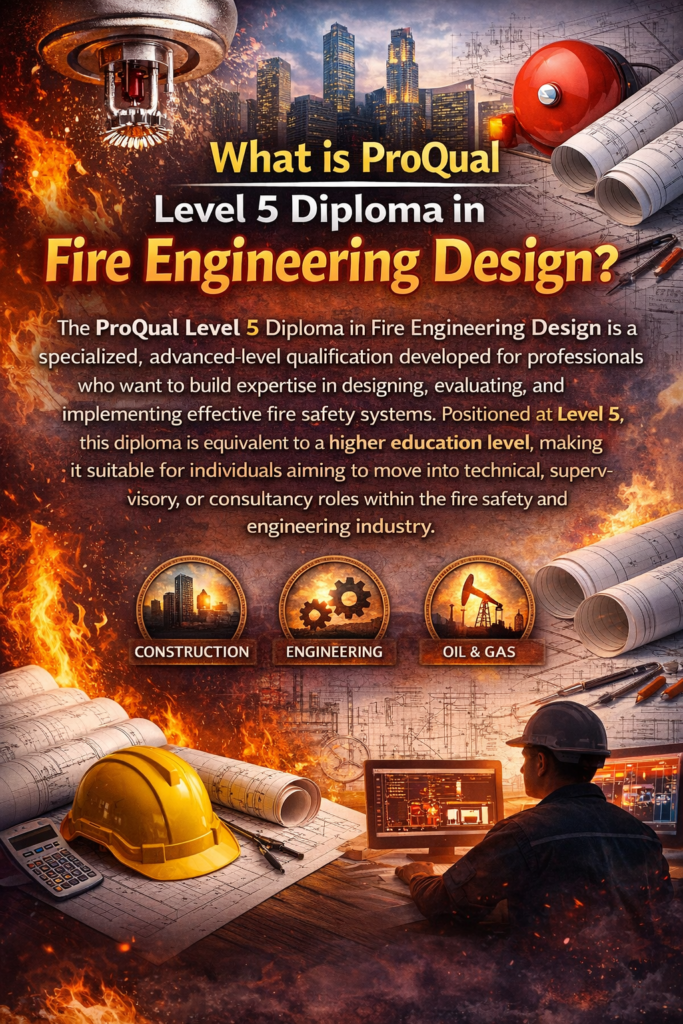
The ProQual Level 5 Diploma in Fire Engineering Design is a specialized, advanced-level qualification developed for professionals who want to build expertise in designing, evaluating, and implementing effective fire safety systems. Positioned at Level 5, this diploma is equivalent to a higher education level, making it suitable for individuals aiming to move into technical, supervisory, or consultancy roles within the fire safety and engineering industry.
This qualification is particularly relevant for those working in sectors such as construction, engineering, oil & gas, manufacturing, and facilities management, where fire risks must be carefully controlled and managed. It bridges the gap between basic fire safety knowledge and advanced engineering design skills, enabling learners to understand not only how fires occur but also how to prevent, control, and mitigate them through proper system design and compliance.
Unlike basic fire safety courses, this diploma focuses on real-world applications, ensuring that learners can apply their knowledge in practical scenarios such as building design, safety planning, and regulatory compliance.
Core Focus Areas of the Qualification
| Focus Area | What You Will Learn | Why It Matters |
|---|---|---|
| Fire Protection System Design | – Fire detection & alarm systems- Sprinkler and suppression system design- Smoke control & ventilation planning | – Early fire detection- Quick fire control/extinguishing- Reduces damage to life & property |
| Risk Assessment & Hazard Analysis | – Identifying fire hazards- Risk evaluation methods- Control and prevention techniques | – Prevents fire incidents- Improves workplace safety- Ensures regulatory compliance |
| Compliance with International Safety Standards | – Global fire safety codes- Building regulations- Legal responsibilities | – Avoids legal penalties- Ensures safe building design- Meets international standards |
| Passive Fire Protection Techniques | – Fire-resistant walls & doors- Compartmentation systems- Fireproof materials | – Slows fire spread- Protects building structure- Provides evacuation time |
| Active Fire Protection Techniques | – Fire alarms & detection systems- Sprinklers & extinguishers- Smoke control systems | – Detects fire early- Controls/extinguishes fire- Enhances emergency response |
This diploma is designed to develop a strong foundation in both theoretical knowledge and practical skills. Below are the key areas it focuses on:
Fire Protection System Design
One of the most important aspects of this qualification is learning how to design effective fire protection systems for different types of buildings and environments.
What You Will Learn:
- How fire detection and alarm systems work
- Designing sprinkler and suppression systems
- Planning smoke control and ventilation systems
Why It Matters:
Properly designed fire protection systems can:
- Detect fire at an early stage
- Control or extinguish fire quickly
- Minimize damage to property and human life
This knowledge is essential for engineers and safety professionals involved in building planning and infrastructure development.
Risk Assessment and Hazard Analysis
Understanding fire risks is the foundation of effective fire safety management. This part of the course teaches you how to identify potential hazards and evaluate their impact.
What You Will Learn:
- How to identify fire hazards in different environments
- Methods for assessing risk levels
- Techniques for implementing control measures
Practical Importance:
By mastering risk assessment, you will be able to:
- Prevent fire incidents before they occur
- Improve workplace safety
- Ensure compliance with safety regulations
Compliance with International Safety Standards
Fire safety is governed by strict regulations and standards that vary across countries and industries. This qualification ensures you understand and apply these standards correctly.
Key Topics Covered:
- International fire safety codes and regulations
- Building safety requirements
- Legal responsibilities of organizations
Why This is Important:
Compliance ensures that:
- Buildings meet safety requirements
- Organizations avoid legal penalties
- Safety systems function effectively during emergencies
Passive and Active Fire Protection Techniques
The diploma provides a balanced understanding of both passive and active fire protection methods.
Passive Fire Protection:
These are built-in safety features that help contain fire and prevent its spread.
Examples include:
- Fire-resistant walls and doors
- Compartmentation systems
- Fireproof materials
Active Fire Protection:
These systems actively respond to fire incidents.
Examples include:
- Fire alarms and detection systems
- Sprinklers and extinguishers
- Smoke control systems
Why Both Matter:
A combination of passive and active protection ensures maximum safety by:
- Slowing down fire spread
- Allowing safe evacuation
- Supporting firefighting operations
Key Features of the Qualification
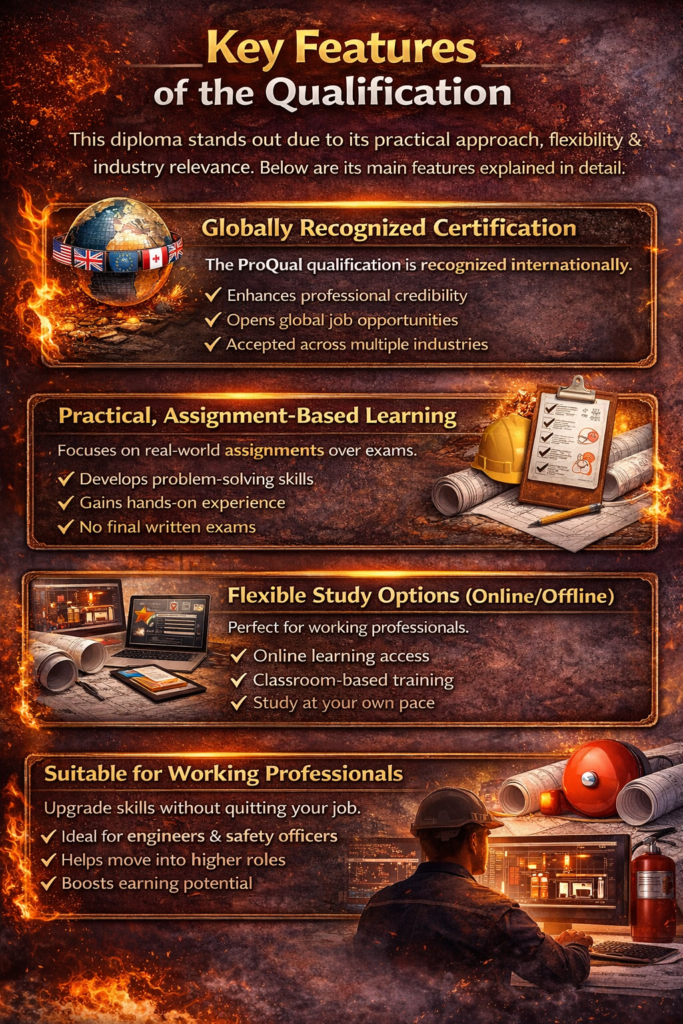
This diploma stands out due to its practical approach, flexibility, and industry relevance. Below are its main features explained in detail:
Globally Recognized Certification
The ProQual qualification is recognized internationally, making it valuable for professionals who want to work in different countries or multinational organizations.
Benefits:
- Enhances your professional credibility
- Opens doors to global job opportunities
- Accepted across multiple industries
Practical, Assignment-Based Learning
Unlike traditional courses that rely heavily on exams, this diploma focuses on practical learning through assignments.
What This Means:
- You will work on real-life scenarios
- Assessments are based on applied knowledge
- No pressure of final written exams
Advantage:
This approach helps you:
- Develop problem-solving skills
- Gain hands-on experience
- Better understand real-world applications
Flexible Study Options (Online/Offline)
The course is designed to suit working professionals by offering flexible learning modes.
Options Available:
- Online learning (remote access)
- Classroom-based training
- Blended learning approach
Why This is Helpful:
- You can study at your own pace
- Balance work and education easily
- Access learning from anywhere
Suitable for Working Professionals
This diploma is ideal for individuals who are already working and want to upgrade their skills without leaving their jobs.
Who Benefits Most:
- Engineers and technicians
- Safety officers
- Construction professionals
Career Advantage:
It helps professionals:
- Move into higher roles
- Increase earning potential
- Gain specialized expertise
Industry-Relevant Curriculum
The course content is designed according to current industry needs and challenges.
What Makes It Relevant:
- Covers modern fire safety technologies
- Focuses on real-world applications
- Aligns with international standards
Outcome:
You gain skills that are directly applicable in:
- Construction projects
- Industrial safety management
- Engineering design roles
In simple terms, the ProQual Level 5 Diploma in Fire Engineering Design is not just a certification—it is a comprehensive program that prepares you to become a skilled fire engineering professional. It equips you with the knowledge, technical ability, and confidence required to design safe environments, ensure compliance, and contribute effectively to fire risk management.
By completing this qualification, you position yourself as a valuable asset in a high-demand industry where safety, expertise, and compliance are critical.
Why This Course is in High Demand
In today’s modern world, fire safety is no longer treated as a secondary concern—it has become a core requirement in every industry. As buildings become more complex and industries expand rapidly, the risks associated with fire hazards are also increasing. This has created a strong and continuous demand for skilled professionals who can design, assess, and implement effective fire safety systems.
The ProQual Level 5 Diploma in Fire Engineering Design directly addresses this need by preparing individuals with advanced knowledge and practical skills required in real-world environments. Let’s explore in detail why this course is in such high demand.
Increasing Complexity of Modern Buildings
Modern infrastructure is far more advanced than it was in the past. Today’s buildings include:
- High-rise towers
- Underground facilities
- Smart buildings with automated systems
- Large industrial plants
Why This Matters
These complex structures introduce new fire risks such as:
- Electrical overloads
- Limited evacuation routes
- Smoke spread through ventilation systems
Because of this complexity, organizations need qualified fire engineering professionals who can design systems that ensure safety in these challenging environments.
Strict Fire Safety Laws and Regulations
Governments and international bodies have introduced strict fire safety regulations to protect lives and property. Companies are legally required to comply with these standards.
Key Requirements Include:
- Installation of fire detection and alarm systems
- Proper emergency exits and evacuation plans
- Regular fire risk assessments
- Compliance with international safety codes
Impact on Demand
- Non-compliance can lead to heavy penalties
- Businesses must hire trained professionals
- Fire engineering expertise is now a legal necessity
This has significantly increased the demand for certified professionals with recognized qualifications.
Rapid Urbanization and Construction Growth
Urban development is happening at a massive scale, especially in developing countries and growing economies.
Key Trends:
- Expansion of cities
- Increase in residential and commercial projects
- Growth of mega infrastructure projects
Why It Creates Demand
Every new building or project requires:
- Fire safety planning
- System design and approval
- Ongoing safety inspections
This continuous construction boom ensures a steady demand for fire engineering experts.
Growing Awareness of Workplace Safety
Organizations are becoming more aware of the importance of health and safety in the workplace. Fire incidents can result in:
- Loss of human life
- Financial damage
- Legal consequences
- Reputation loss
What Companies Are Doing:
- Investing in fire safety systems
- Hiring qualified safety professionals
- Conducting regular risk assessments
This shift in mindset has increased the need for professionals with specialized fire safety knowledge.
Increased Demand for Certified Professionals
Employers today prefer candidates who hold recognized certifications rather than just experience.
Why Certification Matters:
- Proves technical knowledge and competency
- Ensures understanding of international standards
- Builds trust with employers and clients
Role of This Diploma
The ProQual Level 5 Diploma in Fire Engineering Design:
- Validates your expertise
- Enhances your professional credibility
- Makes you stand out in a competitive job market
Certified professionals are more likely to secure better job opportunities and higher salaries.
Industries Hiring Fire Engineering Professionals
The demand for fire engineering professionals is not limited to one sector—it spans across multiple industries.
Construction and Infrastructure
This is one of the largest employers of fire engineering professionals.
Responsibilities Include:
- Designing fire protection systems for buildings
- Ensuring compliance with building codes
- Supporting safe construction practices
Oil & Gas Sector
This industry involves high-risk environments where fire hazards are significant.
Key Roles:
- Risk assessment in hazardous areas
- Designing explosion and fire protection systems
- Ensuring safety compliance
Manufacturing Industries
Factories and production units often deal with flammable materials and heavy machinery.
Fire Safety Needs:
- Hazard identification
- Installation of fire suppression systems
- Emergency response planning
Facilities Management
Large commercial buildings, malls, and offices require ongoing fire safety management.
Tasks Include:
- Maintaining fire safety systems
- Conducting inspections
- Managing emergency procedures
Government and Regulatory Bodies
Public sector organizations also require fire safety experts.
Roles:
- Inspecting buildings
- Enforcing safety regulations
- Developing fire safety policies
Future Scope and Career Stability
Fire engineering is not a temporary trend—it is a long-term, growing field.
Why It Offers Stability:
- Safety will always be a priority
- Regulations will continue to evolve
- New technologies will require skilled professionals
This ensures consistent career growth and long-term job security.
The growing demand for fire engineering professionals is driven by a combination of factors including complex infrastructure, strict regulations, rapid urbanization, and increased safety awareness.
The ProQual Level 5 Diploma in Fire Engineering Design positions you perfectly to take advantage of these opportunities by equipping you with the skills, knowledge, and certification required to succeed in this high-demand field.
In simple terms, this course is not just relevant—it is essential for anyone looking to build a strong and future-proof career in fire safety engineering.
Requirements to Enroll
Before enrolling in the ProQual Level 5 Diploma in Fire Engineering Design, it is important to understand the eligibility criteria and whether this qualification is suitable for your background and career goals. While the course is designed to be accessible to a wide range of learners, having the right foundation will help you successfully complete the program and gain maximum benefit from it.
This section explains the requirements in detail and helps you determine if you are the right candidate for this diploma.
Basic Entry Requirements
Although this qualification is flexible and open to many professionals, there are certain recommended requirements that can make your learning experience smoother and more effective.
Level 3 Qualification or Equivalent
A Level 3 qualification (or equivalent) is generally considered the minimum educational requirement for enrolling in this diploma.
What Does This Mean?
Level 3 qualifications may include:
- Intermediate-level diplomas
- A-levels or equivalent certifications
- Technical or vocational qualifications
Why It Is Important
This diploma is an advanced-level course, so having prior academic knowledge ensures that you:
- Can understand technical concepts more easily
- Are prepared for assignment-based learning
- Can handle analytical and design-related tasks
If you don’t have a formal Level 3 qualification, relevant work experience may sometimes be considered as an alternative by training providers.
Basic Understanding of Fire Safety Concepts
While you don’t need to be an expert, having a basic understanding of fire safety is highly beneficial.
Examples of Basic Knowledge:
- What causes fires (fire triangle)
- Basic fire prevention methods
- Awareness of fire safety equipment
Why This Helps
Starting with foundational knowledge allows you to:
- Grasp advanced topics more quickly
- Understand real-world applications
- Perform better in assessments
Beginners can still enroll, but they may need to spend extra time learning basic concepts.
English Language Proficiency
Since the course materials, assignments, and assessments are typically conducted in English, a good command of the language is necessary.
Skills Required:
- Reading and understanding technical content
- Writing assignments clearly
- Communicating ideas effectively
Importance of English Skills:
- Helps in completing coursework successfully
- Ensures clear communication in professional environments
- Supports international career opportunities
Even moderate English skills are usually sufficient, as long as you can understand and explain concepts.
Relevant Work Experience (Preferred but Not Mandatory)
Having prior work experience in a related field can be an added advantage, but it is not always compulsory.
Relevant Experience May Include:
- Fire safety roles
- Construction or engineering work
- Health and safety positions
Benefits of Experience:
- Better understanding of practical scenarios
- Ability to relate theory with real-world situations
- Easier completion of assignments
If you are a beginner or fresh graduate, you can still enroll and build your knowledge from scratch.
Who Should Take This Course?
This diploma is designed for a wide range of individuals who want to enter or advance in the fire safety and engineering field. Below are the key groups who can benefit the most:
Fire Safety Officers
Professionals already working in fire safety roles can use this qualification to upgrade their skills.
Benefits for Them:
- Gain advanced technical knowledge
- Move into higher-level positions
- Improve career prospects and salary
Engineers and Technicians
Engineers working in construction, mechanical, or electrical fields can specialize in fire engineering.
Why It’s Useful:
- Adds a valuable specialization
- Expands career opportunities
- Enhances technical expertise
Health & Safety Professionals
Safety officers and HSE professionals can strengthen their knowledge in fire risk management.
Advantages:
- Broader understanding of workplace safety
- Ability to conduct fire risk assessments
- Increased demand in safety-related roles
Building Inspectors
Inspectors responsible for evaluating building safety can benefit from this course.
How It Helps:
- Better understanding of fire safety compliance
- Improved inspection skills
- Enhanced professional credibility
Fresh Graduates Interested in Safety Careers
This course is also suitable for individuals who are just starting their careers.
Why It’s a Good Choice:
- Provides a strong foundation in fire engineering
- Opens entry-level job opportunities
- Builds a pathway for career growth
Additional Considerations Before Enrolling
Before you enroll, it’s helpful to consider a few practical aspects:
Time Commitment
- You will need to dedicate time for studying and completing assignments
- Flexible learning allows you to study at your own pace
Learning Mode
- Choose between online, classroom, or blended learning
- Ensure you have access to necessary study resources
Career Goals
Ask yourself:
- Do you want to specialize in fire engineering?
- Are you looking for career advancement?
- Do you want international job opportunities?
If your answer is yes, this diploma is a strong fit for you.
The entry requirements for the ProQual Level 5 Diploma in Fire Engineering Design are designed to be flexible, making the course accessible to both experienced professionals and newcomers. Whether you come from an engineering background, safety field, or are just starting your career, this qualification provides a valuable opportunity to gain specialized knowledge and advance professionally.
In simple terms, if you have a basic educational foundation, an interest in fire safety, and a desire to grow in a high-demand field, you are well-suited to enroll in this course and build a successful career in fire engineering.
Units Explained in Detail
| Unit | Key Topics Covered | Skills You Will Gain | Why It Matters |
|---|---|---|---|
| Fire Safety Principles | Fire triangle, fire behavior, causes of fire, prevention strategies | Understanding fire behavior, hazard awareness, prevention planning | Forms the foundation of fire engineering and helps prevent fire incidents |
| Fire Engineering Design (Core Unit) | Fire alarms, smoke control, suppression systems | System design, technical planning, integration of fire systems | Enables you to design real-world fire protection systems |
| Building Regulations & Compliance | International standards, building codes, compliance procedures | Legal knowledge, compliance management, documentation skills | Ensures designs meet legal and safety requirements |
| Fire Risk Assessment | Hazard identification, risk evaluation, control measures | Risk analysis, safety planning, problem-solving | Helps prevent fire incidents and improve workplace safety |
| Passive & Active Fire Protection Systems | Fire-resistant structures, alarms, sprinklers, detection systems | System understanding, safety implementation | Provides complete fire protection strategy for buildings |
One of the biggest weaknesses in competing blogs is that they only list the units without properly explaining them. In reality, this section is the core of your blog because it shows the actual value of the qualification.
The ProQual Level 5 Diploma in Fire Engineering Design is structured to build your knowledge step by step—from basic fire science to advanced system design and compliance. Each unit plays a crucial role in preparing you for real-world fire safety challenges.
Let’s break down each unit in detail so readers can clearly understand what they will learn and how it applies in practice.
1. Fire Safety Principles
This unit forms the foundation of fire engineering knowledge. Before designing any system, you must understand how fire behaves, spreads, and can be controlled.To understand fire safety principles in detail, it is important to learn how fire behaves and how it can be controlled.
What You Will Learn
Fire Triangle and Fire Behavior
- The fire triangle (heat, fuel, oxygen) explains how fire starts
- How fire grows, spreads, and intensifies
- Different stages of fire (ignition, growth, fully developed, decay)
Causes of Fire Incidents
- Electrical faults and short circuits
- Flammable materials and improper storage
- Human errors and negligence
Fire Prevention Strategies
- Safe handling of hazardous materials
- Proper storage techniques
- Workplace safety practices
Why This Unit Matters
Understanding fire science is essential because:
- It helps you predict fire behavior in different environments
- You can design systems that prevent fire before it starts
- It forms the base for all advanced fire engineering concepts
Without this knowledge, designing effective fire safety systems is not possible.
2. Fire Engineering Design (Core Unit)
This is the most important and technical unit of the entire qualification. It focuses on how to design systems that detect, control, and extinguish fire.
Topics Covered
Fire Detection and Alarm Systems
- Types of detectors (smoke, heat, flame)
- Alarm system design and placement
- Early warning mechanisms
Smoke Control Systems
- Smoke extraction systems
- Ventilation design
- Preventing smoke spread in buildings
Fire Suppression Systems
- Sprinkler systems
- Gas-based suppression systems
- Water mist systems
Practical Application
In this unit, you will learn how to:
- Design complete fire protection systems for buildings
- Select appropriate systems based on risk level
- Integrate multiple safety systems into one design
This is the unit that transforms you from a learner into a professional fire system designer.
3. Building Regulations and Compliance
Fire safety is not just about design—it must also meet legal and regulatory standards. This unit ensures that your knowledge aligns with international safety requirements.
Key Areas Covered
International Fire Safety Standards
- Understanding global safety frameworks
- Applying best practices across industries
Building Codes and Regulations
- Fire safety requirements in building design
- Structural safety considerations
Compliance Procedures
- How to ensure systems meet legal requirements
- Documentation and approval processes
Why This Unit is Important
- Ensures your designs are legally compliant
- Helps avoid penalties and legal issues
- Builds trust with clients and employers
A fire system that is not compliant is considered unsafe and unacceptable, no matter how advanced it is.
4. Fire Risk Assessment
Fire risk assessment is a critical skill that every fire engineering professional must master. It focuses on identifying hazards and reducing risks before an incident occurs.
What You Will Learn
Hazard Identification
- Identifying fire hazards in buildings and workplaces
- Recognizing high-risk areas
Risk Evaluation
- Assessing the likelihood of fire incidents
- Understanding the severity of potential damage
Control Measures
- Implementing preventive strategies
- Reducing risks through safety systems
Real-World Importance
This unit enables you to:
- Conduct professional fire risk assessments
- Improve safety in workplaces and buildings
- Recommend effective control measures
Fire risk assessment is often a mandatory requirement in many industries.
5. Passive and Active Fire Protection Systems
This unit provides a complete understanding of the two main approaches to fire protection. Both are essential and work together to ensure safety.
Passive Fire Protection
Passive systems are built into the structure of a building and do not require activation.
Examples:
- Fire-resistant walls and ceilings
- Fire doors
- Compartmentation systems
Purpose:
- Contain fire within a specific area
- Slow down fire spread
- Provide time for evacuation
Active Fire Protection
Active systems respond automatically or manually during a fire incident.
Examples:
- Fire alarm systems
- Sprinkler systems
- Smoke detectors
Purpose:
- Detect fire early
- Control or extinguish fire
- Alert occupants
Why Both Systems Are Important
A complete fire safety strategy requires both:
- Passive systems limit fire spread
- Active systems detect and fight fire
Together, they provide maximum protection for life and property.
The units in the ProQual Level 5 Diploma in Fire Engineering Design are carefully designed to give you a complete skill set—from understanding fire behavior to designing advanced protection systems and ensuring legal compliance.
By the end of this qualification, you will be able to:
- Analyze fire risks effectively
- Design professional fire protection systems
- Ensure compliance with international standards
- Apply both theoretical and practical knowledge in real-world scenarios
This is what makes this diploma highly valuable and in demand across industries.
How to Get the Diploma (Step-by-Step Guide)
Many blogs briefly mention enrollment, but they don’t clearly explain the complete process from start to certification. This section gives you a practical, easy-to-follow roadmap so you know exactly what to do at each stage.
Whether you are a beginner or a working professional, following these steps will help you successfully obtain the ProQual Level 5 Diploma in Fire Engineering Design.
Overview of the Process
Getting this diploma is not complicated, but it requires the right approach. The journey typically includes:
- Checking your eligibility
- Selecting the right training provider
- Completing enrollment
- Studying and submitting assignments
- Final assessment and certification
Let’s break each step down in detail.
Step 1: Check Eligibility
Before starting the course, it is important to confirm that you meet the basic entry requirements.
What You Should Do
- Review your educational background (Level 3 or equivalent)
- Assess your understanding of basic fire safety concepts
- Ensure you can study and complete assignments in English
Why This Step Matters
- Helps you avoid enrollment issues later
- Ensures you are prepared for the course level
- Saves time and effort
If you are unsure about your eligibility, many institutes offer free consultation or guidance before enrollment.
Step 2: Choose a Training Provider
Selecting the right training provider is one of the most important decisions in your journey.
What to Look For
- Approved and recognized training center
- Experienced tutors and assessors
- Flexible learning options (online or classroom)
- Student support and guidance
Recommended Providers
You can consider institutes like ICTUKL or Inspire College of Technologies, which offer structured programs and professional support.
Important Tip
Always verify that the provider is offering a genuine ProQual qualification, not an unrecognized or low-quality course.
Step 3: Enroll in the Course
Once you have selected your training provider, the next step is to complete your registration.
Enrollment Process Includes
- Filling out an application form
- Submitting required documents (education, ID, etc.)
- Paying course fees (full or installment plans)
Common Documents Required
- Educational certificates
- CNIC/Passport copy
- Recent photograph
Why This Step is Important
- Confirms your admission
- Gives you access to learning materials
- Connects you with tutors and support systems
Step 4: Complete Learning & Assignments
This is the most important phase of your journey, where you actually gain knowledge and develop skills.
Study Course Materials
You will receive structured learning resources such as:
- Study guides
- Lecture notes
- Online sessions or recorded lectures
These materials are designed to help you understand both theory and practical applications.
Complete Assignments
Instead of traditional exams, this course focuses on assignment-based learning.
What You Will Do:
- Answer scenario-based questions
- Analyze fire safety situations
- Design solutions and write reports
Benefits:
- Develop real-world problem-solving skills
- Apply knowledge practically
- Learn at your own pace
Practical Assessments
Some providers may include practical tasks or case studies.
Examples:
- Fire risk assessment reports
- System design projects
- Safety planning exercises
These activities help you gain hands-on experience, which is highly valued in the industry.
Time Management Tip
- Create a study schedule
- Complete assignments on time
- Stay in regular contact with your tutor
Step 5: Assessment & Certification
After completing all required assignments and assessments, your work will be evaluated by qualified assessors.
Assessment Process
- Review of submitted assignments
- Feedback and corrections (if needed)
- Final verification by the awarding body
Certification
Once you successfully meet all requirements:
- You will receive the ProQual Level 5 Diploma in Fire Engineering Design
- Your qualification will be officially recognized
What This Means for You
- You become a certified fire engineering professional
- You can apply for advanced roles
- You gain credibility in the industry
Additional Tips for Success
To make the most of this process, keep the following tips in mind:
- Choose a reputable training provider
- Stay consistent with your studies
- Focus on understanding concepts, not just completing assignments
- Apply your learning to real-life situations
Getting the ProQual Level 5 Diploma in Fire Engineering Design is a structured and achievable process. By following the step-by-step approach—starting from eligibility to final certification—you can smoothly complete the journey and build a strong foundation in fire engineering.
With the right guidance, dedication, and effort, this diploma can open the door to high-demand career opportunities and long-term professional growth.
Course Duration & Assessment
Understanding how long the course takes and how you will be assessed is very important before enrolling. The ProQual Level 5 Diploma in Fire Engineering Design is designed to be flexible and practical, making it suitable for both full-time learners and working professionals.
Course Duration
Typical Duration
- The course usually takes 6 to 12 months to complete
- The exact duration depends on your learning pace, experience, and time availability
Flexible Learning Pace
One of the biggest advantages of this diploma is its flexibility.
What This Means:
- You are not bound to strict classroom schedules
- You can study alongside your job or other commitments
- You can complete the course faster if you dedicate more time
Example:
- A full-time learner may complete it in 6 months
- A working professional may take 9–12 months
Why Flexible Duration is Beneficial
- Allows better work-life balance
- Reduces pressure of deadlines
- Helps in deeper understanding of concepts
This flexibility makes the course accessible to a wide range of learners.
Assessment Method
Unlike traditional qualifications, this diploma does not rely on final written exams. Instead, it focuses on practical, assignment-based evaluation.
Assignment-Based Learning (No Exams)
How It Works:
- You will complete assignments for each unit
- Questions are based on real-life scenarios
- You will apply theoretical knowledge to practical situations
Benefits:
- No exam stress
- Better understanding of real-world applications
- Develops analytical and problem-solving skills
Practical Evaluations
Some parts of the course may include practical tasks or case studies.
Examples:
- Designing a fire protection system
- Conducting a fire risk assessment
- Analyzing safety issues in buildings
Why This is Important:
- Builds hands-on experience
- Prepares you for real job responsibilities
- Enhances your technical confidence
Portfolio Submission
At the end of your course, you may be required to submit a portfolio of your work.
What a Portfolio Includes:
- Completed assignments
- Project work
- Case studies
Purpose:
- Demonstrates your skills and knowledge
- Acts as proof of your competency
- Can be shown to employers
Final Evaluation
- Your assignments are reviewed by assessors
- Feedback is provided (if improvements are needed)
- Once approved, you qualify for certification
Career Opportunities & Salary
After completing the diploma, you gain access to a wide range of career opportunities across different industries. This qualification significantly improves your employability and earning potential.
Job Roles You Can Pursue
Fire Design Engineer
Role:
- Design fire protection systems for buildings
- Ensure compliance with safety standards
Importance:
This is one of the most technical and high-demand roles in fire engineering.
Fire Safety Consultant
Role:
- Provide expert advice on fire safety measures
- Help organizations improve safety systems
Advantage:
Offers opportunities to work independently or with consultancy firms.
Fire Risk Assessor
Role:
- Identify fire hazards
- Evaluate risks and recommend solutions
Demand:
Required in almost every industry due to legal compliance.
Health & Safety Officer
Role:
- Ensure workplace safety
- Implement fire safety policies
Benefit:
A versatile role with opportunities in multiple sectors.
Building Safety Inspector
Role:
- Inspect buildings for safety compliance
- Ensure fire systems meet regulations
Importance:
Critical role in maintaining public safety.
Salary Potential
Your salary depends on your experience, location, and industry. However, this diploma significantly increases your earning potential.
Salary Levels Explained
Entry-Level (0–2 Years Experience)
- Starting roles such as technician or junior engineer
- Moderate salary
- Opportunity to gain experience
Mid-Level (3–7 Years Experience)
- Roles like fire risk assessor or design engineer
- Higher salary
- More responsibilities
Senior-Level (8+ Years Experience)
- Roles such as consultant or safety manager
- Very high salary (especially internationally)
- Leadership and decision-making positions
International Opportunities
With this qualification, you can explore careers in:
- Middle East
- UK and Europe
- International construction projects
Salaries are significantly higher in global markets.
Career Roadmap (Step-by-Step Growth Path)
One of the most valuable aspects of this diploma is the clear career progression it offers. Below is a structured roadmap to help you understand your long-term growth.
Entry-Level Stage
Roles:
- Fire Safety Technician
- Assistant Engineer
Focus:
- Learning basic skills
- Supporting senior professionals
- Gaining practical experience
Mid-Level Stage
Roles:
- Fire Risk Assessor
- Fire Design Engineer
Focus:
- Handling independent projects
- Conducting assessments
- Designing fire systems
Senior-Level Stage
Roles:
- Fire Engineering Consultant
- Safety Manager
Focus:
- Leading teams
- Making strategic decisions
- Managing large-scale projects
Why This Roadmap is Important
- Helps you set clear career goals
- Shows progression opportunities
- Motivates long-term growth
With experience and continuous learning, you can move from entry-level to senior roles and achieve a highly rewarding career.
The ProQual Level 5 Diploma in Fire Engineering Design is not just about gaining a qualification—it is about building a long-term, successful career. With flexible duration, practical assessment methods, and strong career opportunities, this course provides everything you need to grow professionally.
From learning at your own pace to achieving high-level positions, this diploma offers a complete pathway to success in the fire engineering field.
Comparison with Other Fire Safety Courses
Choosing the right fire safety qualification is an important decision that can directly impact your career growth, salary potential, and professional opportunities. Many learners often compare the ProQual Level 5 Diploma in Fire Engineering Design with basic-level courses such as Level 3 Fire Safety certifications.
While both have their value, they are designed for different purposes and career stages. Below is a detailed comparison to help you clearly understand the differences and make an informed choice.
Detailed Comparison Table
| Feature | ProQual Level 5 Diploma in Fire Engineering Design | Level 3 Fire Safety Course |
|---|---|---|
| Level | Advanced (Higher education level) | Basic (Entry-level) |
| Knowledge Depth | In-depth technical and engineering knowledge | Basic awareness and fundamentals |
| Career Scope | Wide and high-level roles | Limited to entry-level positions |
| Salary Potential | High (especially with experience) | Moderate |
| Skills Developed | Design, risk assessment, compliance | Basic safety awareness |
| Industry Demand | Very high | Moderate |
| Professional Growth | Strong career progression | Limited growth |
Key Differences Explained
Level of Qualification
ProQual Level 5 Diploma
- Advanced-level qualification
- Equivalent to higher education level
- Focuses on technical and professional skills
Level 3 Course
- Basic-level qualification
- Suitable for beginners
- Focuses on general awareness
If you want to build a professional career, Level 5 is the better choice.
Depth of Knowledge
ProQual Level 5 Diploma
- Covers fire engineering design
- Includes risk assessment and compliance
- Teaches practical, real-world applications
Level 3 Course
- Covers basic fire safety concepts
- Focuses on prevention and awareness
- Limited technical depth
Level 5 provides specialized expertise, while Level 3 provides basic understanding.
Career Scope
ProQual Level 5 Diploma
- Opens doors to advanced roles such as:
- Fire Engineer
- Safety Consultant
- Risk Assessor
Level 3 Course
- Suitable for roles like:
- Fire Safety Assistant
- Basic safety staff
Level 5 offers better career growth and opportunities.
Salary Potential
ProQual Level 5 Diploma
- Higher salary due to specialized skills
- Strong earning potential in international markets
Level 3 Course
- Moderate salary
- Limited growth without further qualifications
Investing in Level 5 leads to better financial returns.
Skills Development
ProQual Level 5 Diploma
- Fire system design
- Risk analysis
- Compliance management
Level 3 Course
- Fire awareness
- Basic safety procedures
Level 5 builds technical and professional skills, not just awareness.
In simple terms:
- Level 3 Course → Good for beginners and basic knowledge
- ProQual Level 5 Diploma → Best for career growth and specialization
If your goal is to build a long-term, high-paying career, the Level 5 Diploma is the superior choice.
Benefits of This Qualification
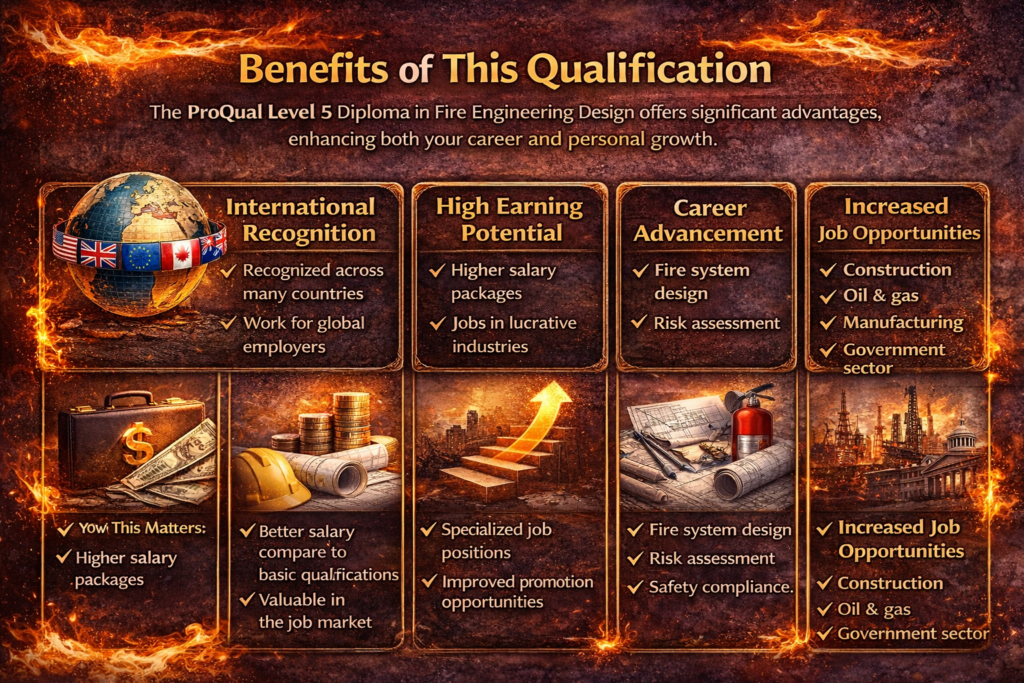
The ProQual Level 5 Diploma in Fire Engineering Design offers a wide range of professional and personal benefits. It is not just a certificate—it is a career-enhancing investment.
International Recognition
This qualification is recognized across multiple countries and industries.
Why This Matters:
- You can work internationally
- Accepted by global employers
- Enhances your professional credibility
High Earning Potential
With specialized skills and certification, you can access higher-paying roles.
Key Advantages:
- Better salary compared to basic qualifications
- Opportunities in high-paying industries
- Increased value in the job market
Career Advancement
This diploma helps you move forward in your career.
How It Supports Growth:
- Opens doors to senior roles
- Helps you transition into specialized positions
- Improves promotion opportunities
Specialized Technical Skills
You gain practical and advanced skills that are highly demanded.
Skills You Develop:
- Fire system design
- Risk assessment
- Safety compliance
These skills make you a valuable asset in any organization.
Increased Job Opportunities
With this qualification, you can work in multiple industries.
Opportunities Include:
- Construction
- Oil & gas
- Manufacturing
- Government sector
This increases your chances of employment and career flexibility.
Who Should Take This Course
This diploma is designed for a wide range of individuals who want to enter or grow in the fire safety and engineering field.
Engineers
Engineers from different fields can specialize in fire engineering.
Benefits:
- Add a valuable specialization
- Increase job opportunities
- Enhance technical expertise
Safety Professionals
Health and safety officers can expand their knowledge in fire safety.
Advantages:
- Broader skillset
- Ability to handle fire risk assessments
- Increased demand in the job market
Construction Experts
Professionals involved in construction and building projects can benefit greatly.
Why It Helps:
- Understand fire safety in building design
- Ensure compliance with regulations
- Improve project safety standards
Fresh Graduates
This course is also suitable for individuals starting their careers.
Why It’s a Good Choice:
- Provides a strong foundation
- Opens entry-level opportunities
- Supports long-term career growth
The ProQual Level 5 Diploma in Fire Engineering Design stands out as a superior qualification when compared to basic fire safety courses. It offers deeper knowledge, better career prospects, and higher earning potential.
Whether you are an experienced professional or a beginner, this course provides a clear pathway to success in a high-demand and rewarding industry.
Conclusion
The ProQual Level 5 Diploma in Fire Engineering Design is more than just a professional certification—it is a comprehensive pathway for individuals who want to build a strong, future-focused career in fire safety and engineering. As industries continue to grow and infrastructure becomes more complex, the importance of qualified fire engineering professionals is increasing significantly. This diploma equips you with the technical knowledge, practical skills, and industry understanding required to design effective fire protection systems, conduct risk assessments, and ensure compliance with international safety standards. Its flexible learning structure and assignment-based approach make it accessible to both beginners and experienced professionals, allowing you to gain real-world expertise without the pressure of traditional exams.
Moreover, the global recognition of this qualification opens doors to a wide range of career opportunities across industries such as construction, oil & gas, manufacturing, and facilities management. Whether your goal is to secure a high-paying job, advance into senior roles, or explore international career prospects, this diploma provides a solid foundation for long-term growth. It not only enhances your professional credibility but also positions you as a valuable asset in a highly demanded field where safety and compliance are critical.
In today’s competitive job market, having specialized skills and recognized qualifications is essential to stand out. Investing in the ProQual Level 5 Diploma in Fire Engineering Design can be a transformative step in your career journey, helping you achieve stability, professional recognition, and continuous growth in the ever-evolving field of fire safety engineering.