
ProQual Level 5 Diploma in Fire Engineering Design – Course Details, Fees, Eligibility & Career Scope
In today’s rapidly evolving construction and industrial landscape, fire safety is no longer just a regulatory requirement—it is a fundamental component of responsible design and risk management. Modern buildings are becoming more complex, incorporating advanced materials, innovative architectural styles, and high-density occupancy. As a result, the potential risks associated with fire incidents have also increased, making it essential to have highly trained professionals who can design, assess, and implement effective fire safety solutions. Governments and regulatory bodies across the world are continuously tightening safety standards, which has significantly increased the demand for qualified fire engineering specialists.
Fire safety plays a crucial role in modern infrastructure, and understanding the basics is equally important. To build a strong foundation, you can explore this detailed guide on fire safety essentials: prevention, protection and preparedness, which explains core safety concepts every professional should know.
The ProQual Level 5 Diploma in Fire Engineering Design is a professionally recognized qualification that addresses this growing need. It is specifically designed to provide learners with in-depth knowledge of fire safety principles, fire risk assessment techniques, and engineering design strategies. This course goes beyond basic theory by focusing on practical applications, enabling learners to understand how to design safer buildings, evaluate fire hazards, and ensure compliance with international safety standards. From understanding fire behavior to implementing advanced protection systems, this diploma prepares individuals to take on real-world challenges in the fire safety and engineering sector.
In addition to covering essential course details, this blog will guide you through important aspects such as eligibility criteria, course fees, learning outcomes, and career opportunities associated with this qualification. Whether you are starting your journey in fire safety or looking to advance your existing career, the ProQual Level 5 Diploma in Fire Engineering Design offers a clear pathway to professional growth, higher earning potential, and global career prospects in one of the most in-demand safety fields today.
Course Overview
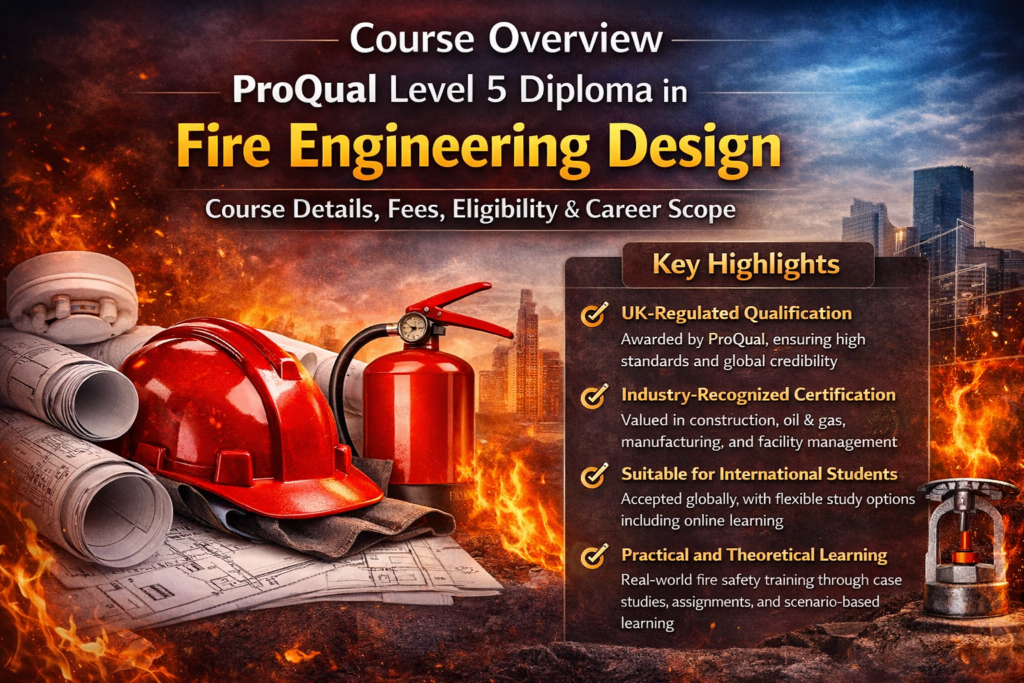
The ProQual Level 5 Diploma in Fire Engineering Design is an advanced and career-oriented qualification designed to develop professional expertise in fire safety, engineering design, and risk management. This course is not just about learning basic fire safety concepts—it provides a deeper understanding of how fires behave, how risks are identified and controlled, and how buildings can be designed to prevent and respond effectively to fire incidents.
In today’s world, where construction projects are becoming more complex and safety regulations are stricter than ever, organizations require skilled professionals who can ensure that buildings meet fire safety standards. This diploma equips learners with both theoretical knowledge and practical skills, enabling them to analyze fire hazards, design safety systems, and implement effective risk control measures in real-life situations.
The course is structured in a way that supports learners at different stages of their careers. Whether you are entering the fire safety field or looking to enhance your existing knowledge, this qualification provides a strong foundation as well as advanced insights into fire engineering practices.
Key Highlights
UK-Regulated Qualification
This diploma is awarded by ProQual, a recognized UK awarding body. Being UK-regulated means the course follows strict quality standards and is aligned with internationally accepted frameworks.
Why this matters:
- Ensures credibility and trust
- Widely accepted by employers globally
- Enhances your professional profile
Industry-Recognized Certification
The qualification is highly valued in industries such as construction, oil & gas, manufacturing, and facility management. Employers prefer candidates who hold recognized certifications because it proves they have the required knowledge and competencies.
Practical benefit:
- Increases job opportunities
- Gives you a competitive advantage
- Builds employer confidence in your skills
Suitable for International Students
One of the major advantages of this diploma is its global acceptance. It is not limited to the UK—students from countries like Pakistan, UAE, Saudi Arabia, and others can enroll and benefit from this qualification.
Why this is important:
- Opens international career opportunities
- Allows remote or online study options
- Recognized across multiple industries worldwide
Practical and Theoretical Learning
This course combines both classroom-based knowledge and real-world applications. Instead of focusing only on theory, it teaches how to apply concepts in actual scenarios such as building design, fire risk assessment, and safety planning.
What you will experience:
- Case studies and real-life examples
- Practical assignments
- Scenario-based learning
Outcome:
You become job-ready, not just academically qualified.
Career-Focused Curriculum
The entire course is designed with career development in mind. Each unit is aligned with industry requirements, ensuring that learners gain skills that are directly applicable in the workplace.
Key focus areas:
- Fire safety management
- Engineering design principles
- Risk assessment techniques
- Compliance with regulations
Result:
You are prepared for real job roles, not just exams.
Who Is This Diploma Designed For?
This qualification is ideal for a wide range of individuals, including:
Beginners in Fire Safety
If you are new to the field but have an interest in safety or engineering, this course provides a structured pathway to enter the industry.
Safety Professionals
Individuals already working in health and safety roles can upgrade their qualifications and specialize in fire engineering.
Engineers and Construction Professionals
Civil engineers, architects, and construction managers can benefit from learning how to integrate fire safety into building design.
Firefighters and Emergency Personnel
Professionals involved in emergency response can enhance their technical understanding of fire behavior and prevention strategies.
Facility and Building Managers
Those responsible for managing buildings can learn how to maintain compliance and ensure occupant safety.
Why This Course Is Important
Fire incidents can lead to devastating consequences, including loss of life, property damage, and legal liabilities. This course plays a crucial role in preparing professionals who can prevent such incidents and ensure safety at every level.
Key Importance Points:
- Helps in designing safer buildings
- Reduces fire-related risks
- Ensures compliance with legal standards
- Protects lives and assets
- Improves workplace safety culture
Overall Value of the Course
The ProQual Level 5 Diploma in Fire Engineering Design is more than just a certification—it is a career-building qualification. It provides learners with the confidence, competence, and credibility needed to succeed in the fire safety industry.
By completing this diploma, you position yourself as a skilled professional capable of handling complex fire safety challenges, making you a valuable asset to any organization.gineering, compliance, or consultancy roles.
Course Structure & Units
| Unit | Key Topics Covered | What You Will Learn | Why It Matters |
|---|---|---|---|
| Fire Safety Principles | Fire behavior, combustion, prevention | How fire starts, spreads, and can be controlled | Foundation of all fire engineering decisions |
| Fire Risk Assessment | Hazard identification, risk evaluation, safety planning | Identify risks and implement control measures | Prevents fire incidents in real environments |
| Fire Engineering Design | Building design, evacuation planning, system integration | Design fire-safe buildings and escape systems | Core skill for engineering and construction roles |
| Fire Protection Systems | Sprinklers, alarms, smoke control | Install and manage fire safety systems | Protects lives and property during emergencies |
| Regulations & Standards | UK laws, international standards, compliance | Ensure legal and safety compliance | Avoids penalties and ensures safe operations |
The ProQual Level 5 Diploma in Fire Engineering Design is carefully structured to provide a complete and in-depth understanding of fire safety, engineering design, and risk management. Unlike many basic courses that only provide theoretical knowledge, this diploma is divided into specialized units that focus on real-world applications and professional skills.
Each unit plays a vital role in building your expertise step by step. Instead of simply listing the topics, it is important to understand what each unit covers, why it is important, and how it is applied in practical situations. This approach not only improves learning but also prepares you for real industry challenges.
Fire Safety Principles
This unit forms the foundation of the entire course. Before you can design fire-safe buildings or assess risks, you must first understand how fire behaves and spreads.
What You Will Learn
Fire Behavior and Spread
You will learn how fire starts, develops, and spreads in different environments. This includes:
- How heat, fuel, and oxygen interact (fire triangle)
- How fire spreads through walls, ceilings, and ventilation systems
- The impact of building materials on fire growth
Explanation:
Understanding fire behavior helps you predict how quickly a fire can escalate and what measures are needed to control it.
Combustion Process
This topic explains the scientific process behind fire, including:
- Chemical reactions involved in burning
- Types of combustion (complete and incomplete)
- Smoke production and toxic gases
Explanation:
This knowledge is essential for identifying hazards and choosing the right fire prevention and control methods.
Fire Prevention Techniques
You will explore methods to prevent fire incidents, such as:
- Safe storage of flammable materials
- Electrical safety practices
- Workplace safety procedures
Why This Unit Matters:
It builds the core understanding required for all advanced fire safety and engineering decisions.
Fire Risk Assessment
This unit focuses on identifying potential fire hazards and taking steps to reduce or eliminate risks. It is one of the most practical and widely used skills in the fire safety industry.Fire risk assessment is one of the most important skills in this diploma. For a deeper understanding, you can read this fire safety and risk assessment practical guide, which provides real-world insights into identifying and managing fire hazards.
What You Will Learn
Hazard Identification
You will learn how to identify fire hazards in different environments, including:
- Electrical equipment
- Flammable substances
- Human-related risks (negligence, poor practices)
Explanation:
Recognizing hazards early is the first step in preventing fire incidents.
Risk Evaluation Methods
This includes techniques to assess how serious a risk is:
- Likelihood of fire occurrence
- Potential consequences
- Risk rating systems
Explanation:
This helps prioritize which risks need immediate attention.
Safety Planning
You will learn how to develop effective fire safety plans:
- Emergency response procedures
- Evacuation planning
- Fire safety documentation
Real-World Application:
Used in offices, factories, hospitals, and public buildings to ensure safety and compliance.
Fire Engineering Design
This is the core and most advanced unit of the diploma. It focuses on designing buildings and systems that are safe in case of fire.
What You Will Learn
Designing Fire-Safe Buildings
You will understand how to integrate fire safety into building design:
- Fire-resistant materials
- Structural fire protection
- Safe building layouts
Escape Routes and Evacuation Planning
This includes:
- Designing safe exit routes
- Emergency lighting systems
- Crowd management during evacuation
Explanation:
Proper evacuation design can save lives during emergencies.
Integration of Fire Protection Systems
You will learn how different systems work together:
- Alarm systems
- Suppression systems
- Smoke control systems
Why This Unit Is Important:
It prepares you to work on real construction and infrastructure projects where safety is critical.
Fire Protection Systems
This unit focuses on the equipment and systems used to detect, control, and extinguish fires.
What You Will Learn
Sprinkler Systems
- Types of sprinklers
- How they operate
- Installation requirements
Fire Alarm Systems
- Detection devices (smoke, heat detectors)
- Alarm signaling systems
- Maintenance and testing
Smoke Control Systems
- Ventilation systems
- Smoke extraction techniques
- Maintaining visibility during fire
Practical Benefit:
You will gain the skills needed to design, install, and maintain systems that actively protect buildings and occupants.
Regulations and Standards
This unit ensures that all your knowledge aligns with legal and professional requirements.
What You Will Learn
UK Fire Safety Laws
- Fire Safety Order
- Legal responsibilities of employers and building owners
International Safety Standards
- Global fire safety guidelines
- Best practices used worldwide
Compliance Procedures
- How to ensure buildings meet regulations
- Inspection and auditing processes
- Documentation and reporting
Why This Unit Matters:
Compliance is not optional—it is a legal requirement. This unit ensures you can work confidently within regulatory frameworks and avoid penalties.
Overall Learning Outcome of Course Structure
By completing all these units, you will develop a complete skill set that includes:
- Understanding fire science
- Identifying and controlling risks
- Designing safe buildings
- Implementing fire protection systems
- Ensuring legal compliance
Final Benefit:
You become a well-rounded fire engineering professional capable of handling both technical and practical challenges in the industry.egal penalties and ensure safety.
Eligibility Criteria
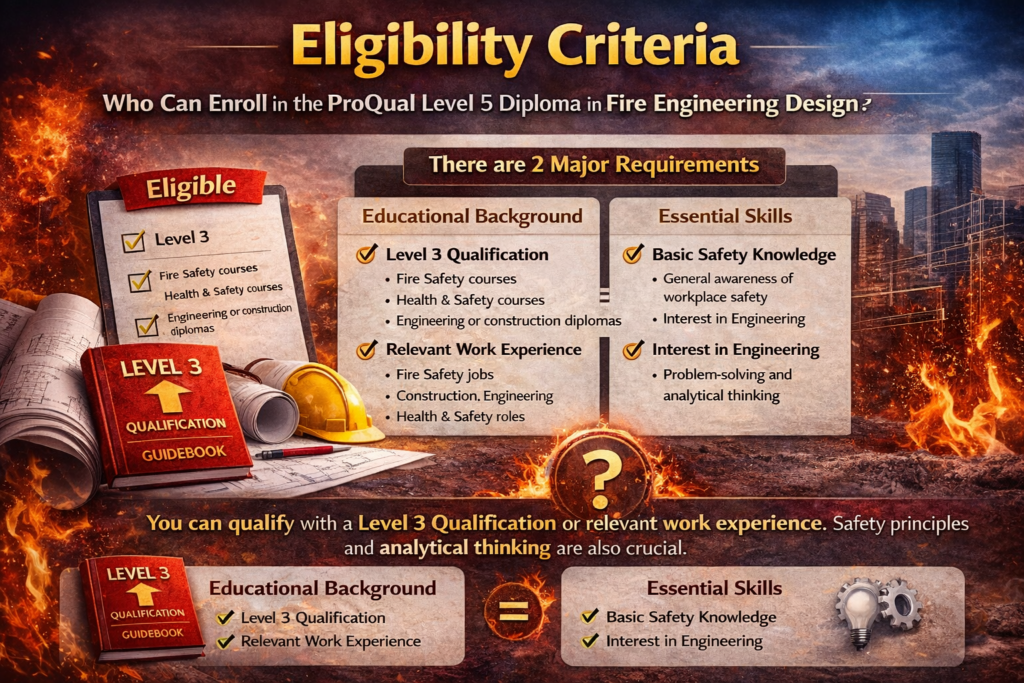
Before enrolling in the ProQual Level 5 Diploma in Fire Engineering Design, it is important to understand whether you meet the required eligibility criteria. This qualification is designed to be flexible and accessible, which means it does not strictly require a specific academic background. However, having certain educational qualifications, experience, and skills can make your learning journey much easier and more effective.
The eligibility requirements are generally divided into two main areas: educational background and essential skills. Let’s explore each of these in detail so you clearly understand what is expected.
Educational Requirements
The course is set at Level 5, which means it is an advanced qualification. Therefore, having some prior knowledge or experience in a related field is highly beneficial.
Level 3 Qualification (Preferred)
A Level 3 qualification is usually recommended as it provides the foundational knowledge needed for this advanced diploma.
Examples of Relevant Level 3 Qualifications:
- Fire Safety or Fire Marshal courses
- Health and Safety certifications
- Engineering or technical diplomas
- Construction-related qualifications
Explanation:
A Level 3 qualification helps you understand basic concepts such as safety procedures, hazard identification, and workplace practices. This makes it easier to grasp more advanced topics like fire engineering design and risk assessment covered in this diploma.
Why It Is Preferred (Not Mandatory):
- Provides a strong academic foundation
- Makes learning smoother and faster
- Reduces difficulty in understanding technical concepts
Relevant Work Experience (Alternative Pathway)
If you do not have a Level 3 qualification, you can still enroll if you have relevant work experience in a related field.
Examples of Acceptable Experience:
- Working in fire safety or firefighting
- Experience in construction or engineering projects
- Health and safety roles
- Facility or building management
Explanation:
Practical experience often provides real-world exposure to safety practices, hazards, and operational procedures. This can be just as valuable as formal education when studying this diploma.
Why Experience Is Important:
- Helps relate theory to real-life situations
- Improves understanding of risk assessment
- Builds confidence in applying safety measures
Skills Required
In addition to educational qualifications, certain skills are important to successfully complete this course and build a career in fire engineering.To further strengthen your knowledge, it is highly recommended to review this fire safety guide: key principles for prevention and risk control, which highlights essential strategies used in real-world fire safety management.
Basic Understanding of Safety Principles
You should have a general awareness of workplace safety concepts, such as:
- Identifying hazards
- Following safety procedures
- Understanding risk control measures
Explanation:
This course builds on basic safety knowledge. If you already understand how safety systems work, it will be easier to learn advanced fire safety strategies.
Interest in Engineering or Construction
A genuine interest in how buildings are designed and how systems work is highly beneficial.
Why This Matters:
- Fire engineering is closely linked to building design
- You will study layouts, materials, and safety systems
- Interest increases motivation and learning speed
Example:
If you are curious about how fire alarms, sprinklers, or evacuation systems are designed, this course will be highly engaging for you.
Analytical Thinking
Fire engineering involves problem-solving and decision-making. You need the ability to:
- Analyze risks
- Evaluate different scenarios
- Make informed safety decisions
Explanation:
For example, you may need to assess a building and decide:
- Where fire risks are highest
- What safety systems are required
- How to improve evacuation plans
Why This Skill Is Important:
Additional Recommended Qualities (Bonus Advantage)
Although not mandatory, the following qualities can further support your success:
Attention to Detail
Fire safety requires careful observation and accuracy.
Communication Skills
You may need to explain safety procedures and write reports.
Problem-Solving Ability
Helps in handling real-life fire safety challenges
Overall Eligibility Summary
To summarize, this diploma is designed to be flexible and inclusive:
- You can apply with a Level 3 qualification or relevant work experience
- Basic safety knowledge and interest in engineering are important
- Analytical thinking helps you succeed in the course
Final Insight:
Even if you are new to the field, as long as you are motivated and willing to learn, you can successfully complete this diploma and build a strong career in fire engineering.
Course Duration & Study Mode
Understanding the duration and study options of the ProQual Level 5 Diploma in Fire Engineering Design is essential before enrolling, especially for individuals who are managing work, studies, or other commitments. This course is designed with flexibility in mind, allowing learners from different backgrounds to complete it at their own pace.
Course Duration
The duration of this diploma typically ranges from 6 to 12 months, depending on several factors.
What Affects the Duration?
- Study pace:
Learners who study full-time can complete the course faster, while part-time learners may take longer. - Previous knowledge or experience:
If you already have a background in fire safety or engineering, you may progress more quickly. - Assessment completion:
The time taken to complete assignments and practical tasks also impacts the overall duration.
Flexible Completion Timeline
This course does not always follow a strict classroom schedule. Instead, it allows learners to:
- Study at their own pace
- Complete units step by step
- Submit assessments based on readiness
Why This Is Important:
- Ideal for working professionals
- Suitable for international students
- Reduces pressure compared to traditional courses
Study Modes
One of the biggest advantages of this diploma is the variety of study options available. Learners can choose a mode that best fits their lifestyle and learning preferences.
Online Learning
This is the most popular and flexible option.
Features:
- Access course materials digitally
- Study from anywhere in the world
- No need to attend physical classes
Benefits:
- Perfect for remote learners
- Saves travel time and costs
- Allows self-paced learning
Blended Learning
Blended learning combines online education with occasional in-person sessions.
Features:
- Online theory classes
- Practical sessions or workshops
- Tutor support
Benefits:
- Balanced learning experience
- Opportunity for practical exposure
- Direct interaction with instructors
Classroom-Based Learning
Some training providers offer traditional classroom-based sessions.
Features:
- Face-to-face teaching
- Structured schedule
- Immediate support from instructors
Benefits:
- Ideal for learners who prefer guided learning
- Better for hands-on training
- Encourages group discussion and collaboration
Overall Flexibility
The availability of multiple study modes makes this course highly adaptable.
Suitable for:
- Working professionals
- Students
- International learners
Key Advantage:
You can continue your job or other commitments while completing the diploma.
Course Fees (Approximate)
The cost of the ProQual Level 5 Diploma in Fire Engineering Design can vary depending on the training provider, location, and study mode. It is important to understand the fee structure before enrolling.
Estimated Fee Range (Detailed Breakdown)
| Region | Approximate Fees |
|---|---|
| UK | £1500 – £3000 |
| Pakistan | PKR 200,000 – 500,000 |
| UAE | AED 5,000 – 10,000 |
Why Fees Vary
Several factors influence the course fees:
- Training provider reputation
- Study mode (online or classroom)
- Additional support services
- Assessment and certification charges
Important Tip
Always choose an approved and recognized training provider.
Why this matters:
- Ensures authenticity of certification
- Provides quality learning resources
- Improves job acceptance globally
Skills You Will Gain
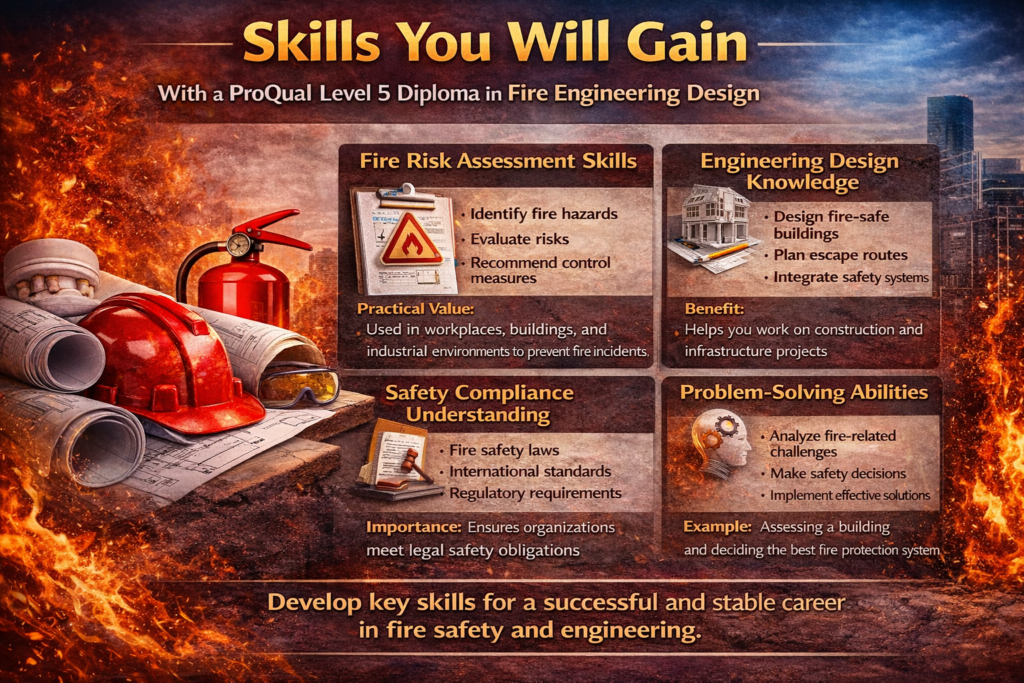
After completing this diploma, you will develop a wide range of professional and technical skills that are highly valued in the fire safety and engineering industry.
Fire Risk Assessment Skills
You will learn how to:
- Identify fire hazards
- Evaluate risks
- Recommend control measures
Practical Value:
Used in workplaces, buildings, and industrial environments to prevent fire incidents.
Engineering Design Knowledge
You will understand how to:
- Design fire-safe buildings
- Plan escape routes
- Integrate safety systems
Benefit:
Helps you work on construction and infrastructure projects.
Safety Compliance Understanding
You will gain knowledge of:
- Fire safety laws
- International standards
- Regulatory requirements
Importance:
Ensures organizations meet legal safety obligations.
Problem-Solving Abilities
You will develop the ability to:
- Analyze fire-related challenges
- Make safety decisions
- Implement effective solutions
Example:
Assessing a building and deciding the best fire protection system.
Technical Reporting Skills
You will learn how to:
- Prepare risk assessment reports
- Document safety procedures
- Communicate findings professionally
Why This Matters:
Reporting is a key responsibility in fire safety roles.
Career Opportunities After Completion
One of the strongest advantages of this diploma is the wide range of career opportunities it offers. Fire safety professionals are in high demand across multiple industries worldwide.
Job Roles
Fire Safety Officer
Responsible for ensuring safety procedures are followed in workplaces and buildings.
Key Responsibilities:
- Conduct inspections
- Train staff
- Implement safety policies
Fire Risk Assessor
Specializes in identifying and evaluating fire risks.
Role Includes:
- Site assessments
- Risk analysis
- Safety recommendations
Fire Protection Engineer
Focuses on designing systems to prevent and control fires.
Work Areas:
- Building design
- Fire suppression systems
- Safety engineering
Safety Consultant
Provides expert advice to organizations on safety practices.
Responsibilities:
- Develop safety strategies
- Ensure compliance
- Conduct audits
Building Safety Inspector
Ensures buildings meet fire safety standards and regulations.
Duties Include:
- Inspect structures
- Check compliance
- Report safety issues
Career Scope
This qualification allows you to work in industries such as:
- Construction
- Oil & Gas
- Manufacturing
- Facility Management
- Government and regulatory bodies
Final Insight
The combination of flexible study options, reasonable course fees, valuable skills, and strong career opportunities makes the ProQual Level 5 Diploma in Fire Engineering Design a highly attractive qualification.
By completing this course, you not only improve your knowledge but also position yourself for a stable, rewarding, and globally recognized career in fire safety and engineering.
Salary Expectations
One of the most important factors when choosing a professional qualification is the earning potential it offers. The ProQual Level 5 Diploma in Fire Engineering Design opens the door to well-paid roles across multiple countries, especially in industries where safety compliance is critical.
Salaries can vary depending on several factors such as experience, job role, location, and level of expertise. However, this qualification significantly increases your chances of earning a competitive salary in the fire safety and engineering field.
Average Salary by Country (Detailed Breakdown)
| Country | Average Salary |
|---|---|
| UK | £35,000 – £60,000 per year |
| UAE | AED 8,000 – 18,000 per month |
| Pakistan | PKR 80,000 – 250,000 per month |
United Kingdom (UK)
In the UK, fire engineering professionals are in high demand due to strict safety regulations and advanced construction projects.
Entry-Level:
- Around £30,000 – £35,000
Mid-Level:
- £40,000 – £50,000
Senior-Level:
- Up to £60,000 or more
Industries hiring:
- Construction companies
- Government safety departments
- Engineering consultancies
United Arab Emirates (UAE)
The UAE offers excellent salary packages, especially in cities with large infrastructure projects like Dubai and Abu Dhabi.
Entry-Level:
- AED 8,000 – 10,000/month
Mid-Level:
- AED 12,000 – 15,000/month
Senior-Level:
- AED 18,000+/month
Key sectors:
- Oil & Gas
- Construction
- Facility management
Pakistan
In Pakistan, the demand for qualified fire safety professionals is growing, particularly in industrial and construction sectors.
Entry-Level:
- PKR 80,000 – 120,000/month
Mid-Level:
- PKR 150,000 – 200,000/month
Senior-Level:
- PKR 250,000+/month
Opportunities in:
- Factories and industries
- Safety consultancy firms
- Multinational companies
Factors That Affect Salary
Your earning potential increases based on:
- Work experience
- Specialized skills (e.g., fire design, risk assessment)
- Certifications and qualifications
- Country and industry demand
Final Insight:
With experience and continuous learning, professionals can move into higher-paying roles such as consultants or senior engineers.
Who Should Enroll in This Course
The ProQual Level 5 Diploma in Fire Engineering Design is designed for a wide range of individuals, from beginners to experienced professionals. This flexibility makes it a highly accessible and valuable qualification.
Safety Professionals
Individuals already working in health and safety roles can specialize further in fire safety.
Benefits:
- Career advancement
- Higher salary potential
- Expanded expertise
Engineers and Technicians
Professionals in engineering fields can enhance their knowledge by integrating fire safety into design and operations.
Why it’s useful:
- Improves project safety
- Adds a valuable specialization
Construction Professionals
Architects, builders, and project managers can benefit greatly from this course.
Application:
- Designing fire-safe buildings
- Ensuring compliance with safety standards
Firefighters and Emergency Personnel
This course helps emergency responders understand fire from a technical and preventive perspective.
Benefit:
- Better risk assessment
- Improved response strategies
Beginners Interested in Fire Safety
Even if you are new to the field, this course provides a structured pathway to start a career in fire engineering.
Advantage:
- Entry into a high-demand industry
- Clear career progression
Comparison: Level 3 vs Level 5 vs NEBOSH
Choosing the right qualification can be confusing. This comparison helps you understand how the ProQual Level 5 Diploma stands out.
Detailed Comparison Table
| Feature | Level 3 | Level 5 | NEBOSH |
|---|---|---|---|
| Level | Basic | Advanced | Advanced |
| Focus | Fire Safety Basics | Fire Engineering Design | General Health & Safety |
| Career Scope | Limited | High | Very High |
| Technical Depth | Low | High | Medium |
Level 3 Qualification
Best for beginners
- Covers basic fire safety concepts
- Limited career growth
Level 5 Diploma (This Course)
Best for specialization
- Focuses on engineering design
- High career opportunities
- In-depth technical knowledge
Ideal for:
- Professionals aiming for advanced roles
NEBOSH Qualification
Best for general safety careers
- Broad health and safety coverage
- Not specialized in fire engineering
If your goal is to specialize in fire engineering and design, the Level 5 Diploma is the best choice. It provides deeper technical knowledge and better career prospects compared to basic qualifications.
Real-World Applications
One of the strongest advantages of this diploma is its practical relevance. The knowledge gained is not limited to theory—it is directly applicable in real-world situations.
Designing Fire-Safe Buildings
You will learn how to:
- Plan safe building layouts
- Use fire-resistant materials
- Design effective escape routes
Impact:
Helps protect lives and property during fire incidents.
Conducting Workplace Risk Assessments
You will be able to:
- Identify potential fire hazards
- Evaluate risks
- Recommend safety measures
Application:
Used in offices, factories, hospitals, and public buildings.
Implementing Fire Safety Systems
This includes:
- Installing fire alarms
- Designing sprinkler systems
- Managing smoke control systems
Benefit:
Ensures quick detection and control of fire incidents.
Ensuring Legal Compliance
You will understand how to:
- Follow fire safety regulations
- Meet international standards
- Prepare compliance reports
Importance:
Avoids legal penalties and ensures workplace safety.
Final Insight
The ProQual Level 5 Diploma in Fire Engineering Design is not just a qualification—it is a practical, career-focused program that prepares you for real industry challenges. From earning competitive salaries to working on critical safety projects, this diploma offers long-term professional value and growth.
Conclusion
The ProQual Level 5 Diploma in Fire Engineering Design stands out as a comprehensive and career-focused qualification for anyone aiming to enter or advance in the fire safety and engineering sector. In a world where building designs are becoming more complex and safety regulations are continuously evolving, the need for skilled professionals has never been greater. This diploma equips learners with a balanced combination of theoretical knowledge and practical expertise, enabling them to understand fire behavior, assess risks, design safety systems, and ensure compliance with international standards. As a result, it prepares individuals to handle real-world challenges with confidence and professionalism.
Another key advantage of this qualification is its strong impact on career growth and earning potential. Whether you are a beginner exploring new opportunities or an experienced professional looking to specialize, this diploma opens doors to a wide range of roles such as fire safety officer, fire risk assessor, and fire protection engineer. The global recognition of the qualification further enhances its value, allowing professionals to work in different countries and industries. With the increasing demand for fire safety experts in construction, oil & gas, and industrial sectors, this diploma provides a clear pathway to stable and well-paying careers.
Ultimately, choosing the ProQual Level 5 Diploma in Fire Engineering Design is not just about gaining a certificate—it is about building a meaningful and impactful career. By completing this course, you contribute to creating safer workplaces, protecting lives, and reducing fire-related risks in society. It empowers you with the skills and responsibility to make a real difference, making it a valuable investment for both your professional future and the safety of the communities you serve.