
Contact Us: +44 7441 396751 Reach us: info@inspirecollege.co.uk
Lesson No : 6 Explore sustainable development challenges in different sectors.
Sustainable development has become one of the defining priorities for governments, businesses, and communities as they respond to growing environmental degradation, climate change, resource scarcity, biodiversity loss, and increasing stakeholder expectations. Organisations across every economic sector are under pressure to achieve economic growth while protecting natural resources, reducing environmental impacts, promoting social equity, and complying with evolving environmental legislation. Environmental managers are therefore expected to lead sustainability initiatives that balance environmental protection with operational performance and long-term organisational resilience.
This learning outcome explores the sustainability challenges faced by key sectors, including agriculture, energy, industry, and transport, while examining the environmental, economic, and social implications of unsustainable practices. It also evaluates practical strategies that organisations can adopt to improve sustainability performance and analyses the influence of government regulation, market mechanisms, and consumer behaviour on organisational decision-making.
For environmental professionals, understanding sector-specific sustainability challenges extends beyond recognising environmental impacts. It requires the ability to evaluate complex interactions between regulatory compliance, environmental governance, Environmental Management Systems (EMS), Environmental Impact Assessment (EIA), climate change mitigation, carbon management, circular economy principles, environmental auditing, stakeholder engagement, and organisational strategy. Environmental managers must identify risks, assess opportunities for continual improvement, implement sustainable operational controls, monitor environmental performance, and ensure that sustainability objectives are integrated into business planning.
The relevance of this learning outcome spans numerous industries, including construction, manufacturing, agriculture, mining, oil and gas, transport and logistics, renewable energy, utilities, healthcare, infrastructure development, commercial facilities, and the public sector. Every sector presents unique environmental pressures while contributing differently to national and global sustainability goals. Environmental professionals must therefore apply evidence-based decision-making, professional judgement, and strategic leadership to develop solutions appropriate to their specific operational contexts.
The knowledge gained from this lesson supports the implementation of internationally recognised frameworks such as ISO 14001 Environmental Management Systems, ISO 50001 Energy Management Systems, ISO 14064 Greenhouse Gas Accounting, and broader Environmental, Social and Governance (ESG) principles. It also contributes to regulatory compliance, environmental performance improvement, risk reduction, enhanced organisational reputation, and long-term sustainable development.
Ultimately, sustainability is no longer viewed solely as an environmental responsibility. It has become a strategic business requirement that influences investment decisions, operational efficiency, organisational resilience, innovation, stakeholder confidence, and competitive advantage. Environmental managers play a central role in enabling organisations to transition from compliance-driven environmental management towards proactive sustainability leadership and continual environmental improvement.
Learning Outcomes
By the end of this lesson, learners will be able to:
- Identify major sustainability challenges affecting agriculture, energy, industry, transport, and other key economic sectors.
- Critically evaluate the environmental, economic, and social consequences of unsustainable sectoral practices.
- Recommend practical strategies for improving sustainability performance within different industries.
- Analyse the influence of government regulation, market mechanisms, and organisational governance on sustainable development.
- Evaluate the role of consumer behaviour in promoting sustainable production and consumption.
- Apply Environmental Management Systems and sustainability principles to sector-specific environmental challenges.
- Demonstrate professional judgement when evaluating sustainability risks, opportunities, and organisational performance.
Learning Objectives
Upon successful completion of this lesson, learners should be able to:
- Explain the relationship between sustainable development and environmental management.
- Assess sustainability challenges using environmental management principles.
- Evaluate environmental risks associated with different industrial sectors.
- Interpret sustainability issues using recognised environmental frameworks and international standards.
- Recommend evidence-based sustainability improvement strategies.
- Integrate EMS principles into organisational sustainability planning.
- Analyse compliance obligations affecting different sectors.
- Evaluate organisational responsibilities for environmental governance and sustainable resource management.
- Assess the role of innovation, technology, leadership, and stakeholder engagement in improving sustainability performance.
Environmental Management Context
Sustainable development requires organisations to create long-term value by integrating environmental protection, economic viability, and social responsibility into every stage of planning, decision-making, implementation, and continual improvement. Environmental management professionals are responsible for ensuring that environmental considerations are embedded within organisational governance rather than treated as isolated compliance activities.
Modern organisations operate within increasingly complex environmental environments characterised by stricter legislation, evolving stakeholder expectations, climate-related risks, resource constraints, and expanding ESG reporting requirements. Environmental managers must therefore adopt a systems-thinking approach that considers how operational activities interact with natural ecosystems, supply chains, communities, regulators, and markets.
Environmental Management Systems (EMS), particularly those aligned with ISO 14001, provide organisations with structured processes for identifying environmental aspects, evaluating impacts, establishing objectives, implementing operational controls, monitoring performance, conducting audits, and driving continual improvement. Sustainability challenges identified within different industrial sectors are commonly managed through EMS processes, ensuring environmental risks are systematically identified and addressed.
The Three Pillars of Sustainable Development
Sustainable development is commonly understood through three interconnected dimensions.
| Sustainability Dimension | Primary Focus | Organisational Considerations |
|---|---|---|
| Environmental Sustainability | Protecting ecosystems and natural resources | Pollution prevention, biodiversity conservation, climate action, resource efficiency |
| Economic Sustainability | Long-term organisational viability | Operational efficiency, innovation, investment, competitiveness |
| Social Sustainability | Human wellbeing and societal development | Employee welfare, community engagement, ethical governance, social equity |
Environmental managers must balance these three dimensions when evaluating strategic decisions. For example, replacing fossil fuels with renewable energy may reduce greenhouse gas emissions while simultaneously lowering operational costs over time and improving organisational reputation.
Environmental Governance and Organisational Leadership
Environmental governance refers to the systems through which organisations establish environmental policies, assign responsibilities, ensure accountability, and monitor environmental performance. Effective governance enables sustainability objectives to become integrated into corporate strategy rather than remaining operational initiatives.
Senior leadership is responsible for:
- Establishing environmental policy.
- Defining sustainability objectives.
- Allocating environmental resources.
- Supporting continual improvement.
- Promoting ethical environmental decision-making.
- Monitoring environmental performance.
- Ensuring legal compliance.
- Encouraging innovation.
Environmental managers translate these strategic commitments into operational actions by coordinating environmental programmes, conducting environmental assessments, managing risks, and engaging stakeholders.
International Standards Supporting Sustainability
Several internationally recognised standards support sustainable development across industries.
| Standard | Contribution to Sustainability |
|---|---|
| ISO 14001 | Environmental Management Systems |
| ISO 14064 | Greenhouse Gas Quantification and Reporting |
| ISO 50001 | Energy Management Systems |
| ISO 26000 | Social Responsibility Guidance |
| ISO 20400 | Sustainable Procurement |
| ISO 14040 | Life Cycle Assessment |
Together, these standards provide structured approaches for managing environmental impacts while improving organisational efficiency and supporting long-term sustainability objectives.
Environmental Legislation and Compliance
Environmental sustainability is increasingly driven by regulatory requirements designed to protect ecosystems and public health. Depending on jurisdiction and industry, organisations may be required to comply with legislation relating to:
- Air emissions
- Water pollution
- Waste management
- Hazardous substances
- Biodiversity protection
- Environmental permitting
- Climate reporting
- Carbon emissions
- Energy efficiency
- Environmental Impact Assessment (EIA)
Compliance should not be viewed as the final objective. Leading organisations move beyond minimum legal requirements by adopting voluntary sustainability commitments that improve environmental performance and strengthen stakeholder confidence.
The Role of Environmental Managers
Environmental managers fulfil multiple strategic and operational responsibilities, including:
- Identifying environmental aspects and impacts.
- Conducting environmental risk assessments.
- Developing sustainability objectives.
- Monitoring environmental KPIs.
- Managing environmental audits.
- Coordinating regulatory compliance.
- Supporting sustainable procurement.
- Leading resource efficiency programmes.
- Promoting environmental awareness.
- Advising senior management.
- Facilitating continual improvement.
Their work supports organisational resilience by reducing environmental liabilities while identifying opportunities for innovation and sustainable growth.
Environmental Risk Management
Environmental risks vary significantly across sectors but commonly include:
- Resource depletion
- Pollution incidents
- Climate-related disruptions
- Regulatory non-compliance
- Supply chain vulnerabilities
- Biodiversity degradation
- Water scarcity
- Waste generation
- Community impacts
- Reputational damage
Environmental managers apply structured risk assessment methodologies to prioritise these risks based on their likelihood and potential consequences.
Table: Example Environmental Risk Matrix
| Risk | Likelihood | Impact | Overall Priority |
|---|---|---|---|
| Water contamination | Medium | Very High | High |
| Air emissions exceed permit | Medium | High | High |
| Biodiversity disturbance | Low | High | Medium |
| Fuel spill | Medium | Very High | High |
| Excessive energy consumption | High | Medium | High |
The results of environmental risk assessments influence organisational planning, operational controls, monitoring programmes, emergency preparedness, and investment priorities.
Environmental Performance Measurement
Environmental performance should be measured using objective indicators that demonstrate continual improvement.
Common Environmental KPIs include:
- Carbon emissions per unit of production
- Energy consumption
- Water consumption
- Waste generation
- Recycling rates
- Renewable energy utilisation
- Compliance incidents
- Environmental audit findings
- Biodiversity enhancement projects
- Environmental complaints
- Environmental training completion rates
Monitoring these indicators enables organisations to evaluate whether sustainability objectives are being achieved while identifying areas requiring corrective action.
The Circular Economy
Traditional economic models typically follow a linear approach of “take, make, and dispose.” Sustainable organisations increasingly adopt circular economy principles that maximise resource efficiency and minimise waste generation.
Core circular economy strategies include:
- Designing products for durability.
- Reusing materials.
- Repairing equipment.
- Refurbishing products.
- Recycling materials.
- Recovering valuable resources.
- Reducing unnecessary consumption.
These approaches contribute to lower environmental impacts while improving long-term economic resilience.
1.Identify sustainability challenges in key sectors such as agriculture, energy, industry, and transport.
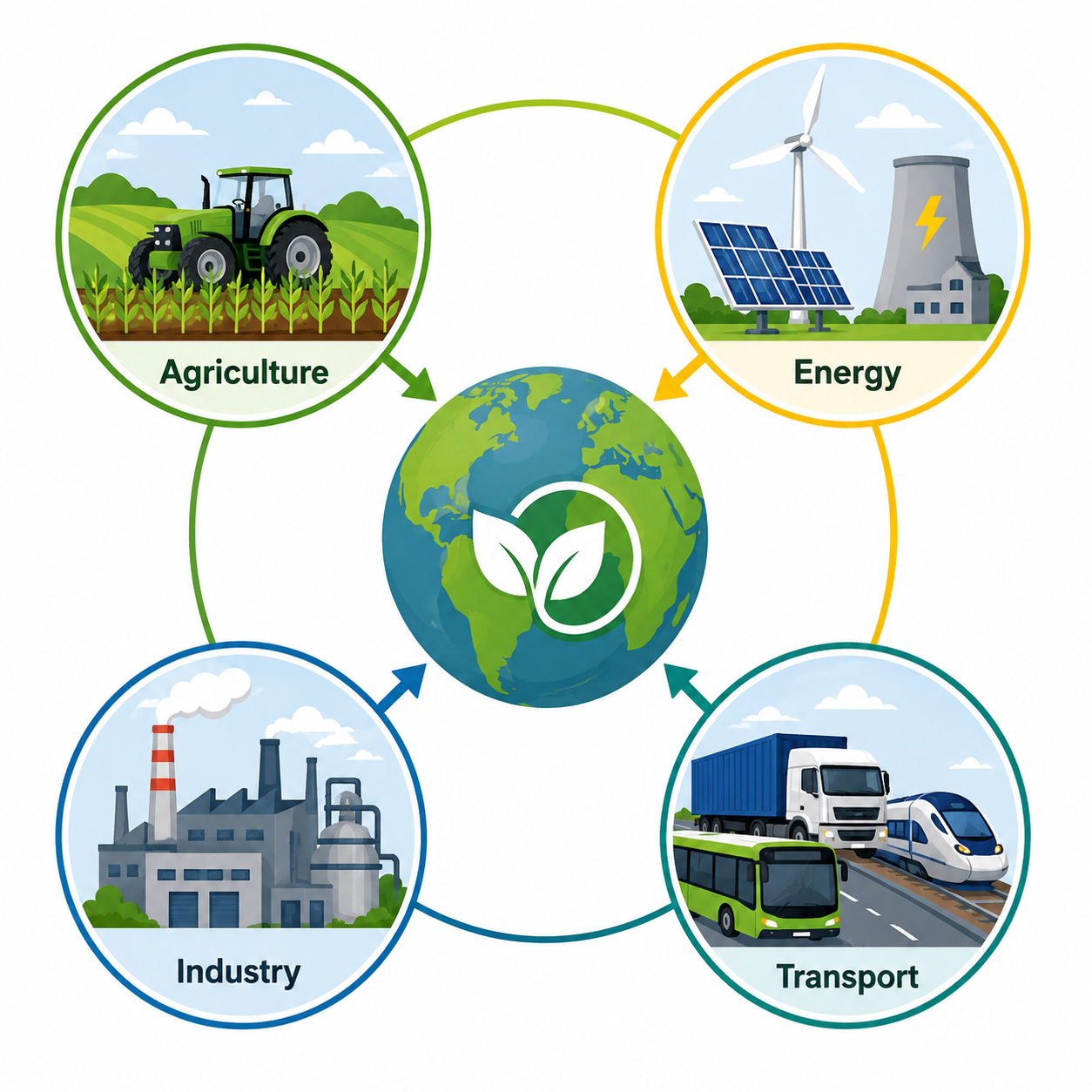 Identifying sustainability challenges across key economic sectors is fundamental to effective environmental management and sustainable development. Every industry interacts with the natural environment differently, consumes varying quantities of resources, and generates distinct environmental impacts. Consequently, environmental managers cannot adopt a single approach to sustainability; instead, they must understand the unique environmental pressures, regulatory obligations, stakeholder expectations, and operational risks associated with each sector.
The agriculture, energy, manufacturing, and transport sectors collectively support economic growth, employment, infrastructure development, food security, industrial production, and public wellbeing. At the same time, these sectors account for a significant proportion of global greenhouse gas emissions, natural resource consumption, biodiversity loss, waste generation, pollution, and ecosystem degradation. As populations increase, urbanisation expands, and industrial activity accelerates, sustainability challenges become more complex and interconnected.
Environmental professionals are therefore expected to move beyond simply recognising environmental problems. They must evaluate the root causes of sustainability challenges, understand their operational implications, identify opportunities for environmental improvement, and support organisations in implementing practical and measurable sustainability strategies.
From an Environmental Management System (EMS) perspective, identifying sustainability challenges represents the first stage of continual improvement. ISO 14001 requires organisations to determine the environmental aspects of their activities, products, and services, evaluate significant environmental impacts, understand organisational context, identify risks and opportunities, and establish objectives for improving environmental performance.
Environmental managers working across different sectors must also consider broader sustainability principles such as climate change mitigation, climate adaptation, pollution prevention, resource efficiency, biodiversity conservation, circular economy, stakeholder engagement, environmental governance, Environmental Impact Assessment (EIA), ESG performance, and compliance with environmental legislation.
Understanding sector-specific sustainability challenges enables organisations to make informed strategic decisions, reduce environmental risks, strengthen resilience, improve operational efficiency, and contribute positively to global sustainable development objectives.
Definition of Sustainability Challenges
Sustainability challenges are the environmental, economic, social, technological, and governance issues that hinder an organisation, industry, or society from achieving long-term sustainable development while balancing environmental protection, economic prosperity, and social wellbeing.
Within environmental management, sustainability challenges represent the obstacles that organisations must overcome to minimise environmental impacts while maintaining operational effectiveness and meeting legal, ethical, and stakeholder expectations.
These challenges may arise from:
- Excessive consumption of natural resources.
- Greenhouse gas emissions.
- Pollution of air, water, and land.
- Climate change impacts.
- Biodiversity loss.
- Unsustainable production and consumption patterns.
- Waste generation.
- Increasing environmental regulations.
- Technological limitations.
- Financial constraints.
- Supply chain pressures.
- Population growth.
- Urbanisation.
- Changing stakeholder expectations.
Environmental managers must identify these challenges through systematic environmental planning, environmental risk assessment, stakeholder consultation, legal compliance reviews, environmental auditing, and continual monitoring.
Rather than considering sustainability challenges as isolated environmental issues, modern organisations increasingly recognise them as strategic business risks capable of influencing operational continuity, financial performance, investor confidence, regulatory compliance, and organisational reputation.
Importance of Identifying Sustainability Challenges
Identifying sustainability challenges provides organisations with the information required to make informed environmental decisions before environmental problems become significant operational risks.
Environmental managers use this information to support strategic planning, investment decisions, environmental policy development, compliance management, and continual improvement.
The importance of identifying sustainability challenges can be understood from several professional perspectives.
Supporting Environmental Protection
Early identification of sustainability challenges enables organisations to reduce environmental degradation before irreversible impacts occur.
Examples include:
- Preventing pollution before contaminants enter rivers.
- Protecting habitats before construction begins.
- Reducing emissions before regulatory thresholds are exceeded.
- Conserving water before shortages occur.
- Preventing unnecessary waste generation through improved operational planning.
Preventative environmental management is generally more effective and less costly than environmental remediation after damage has occurred.
Improving Organisational Decision-Making
Environmental managers support executive leadership by providing evidence-based information regarding environmental risks and sustainability opportunities.
Identifying sustainability challenges allows organisations to:
- Prioritise environmental investments.
- Improve operational efficiency.
- Allocate resources effectively.
- Develop realistic sustainability objectives.
- Strengthen business resilience.
- Reduce long-term environmental liabilities.
Strategic decisions supported by reliable environmental information are more likely to deliver both environmental and commercial benefits.
Supporting Regulatory Compliance
Environmental legislation continues to evolve as governments strengthen environmental protection measures.
Identifying sustainability challenges enables organisations to:
- Understand legal obligations.
- Anticipate future regulatory changes.
- Maintain environmental permits.
- Reduce compliance risks.
- Prevent enforcement action.
- Improve environmental reporting.
Environmental managers therefore maintain legal registers and monitor legislative developments alongside operational environmental risks.
Strengthening ESG Performance
Investors increasingly evaluate Environmental, Social, and Governance (ESG) performance before making investment decisions.
Organisations capable of identifying sustainability challenges demonstrate stronger governance through:
- Transparent environmental reporting.
- Climate risk management.
- Responsible resource management.
- Sustainable procurement.
- Ethical environmental leadership.
This contributes to improved stakeholder confidence and long-term organisational resilience.
Enhancing Environmental Management Systems
Environmental Management Systems rely upon accurate identification of environmental aspects and sustainability challenges.
Without understanding sector-specific challenges, organisations cannot effectively:
- Establish environmental objectives.
- Monitor environmental performance.
- Conduct environmental audits.
- Implement corrective actions.
- Achieve continual improvement.
Consequently, identifying sustainability challenges forms the foundation of effective EMS implementation.
Objectives of Identifying Sustainability Challenges
Environmental managers identify sustainability challenges to support both organisational performance and environmental protection.
Key objectives include:
- Protect natural ecosystems and biodiversity.
- Improve resource efficiency.
- Reduce greenhouse gas emissions.
- Prevent pollution.
- Strengthen legal compliance.
- Improve environmental performance.
- Reduce environmental risks.
- Support climate change adaptation.
- Promote sustainable resource management.
- Improve organisational resilience.
- Enhance stakeholder confidence.
- Support continual environmental improvement.
These objectives should be integrated into organisational environmental policies, strategic plans, and operational procedures.
Key Principles for Identifying Sustainability Challenges
Effective identification of sustainability challenges is guided by several fundamental environmental management principles.
Systems Thinking
Environmental managers must recognise that environmental systems are interconnected.
For example:
- Agricultural water use affects river ecosystems.
- Industrial emissions contribute to climate change.
- Climate change influences agricultural productivity.
- Transport emissions affect urban air quality.
- Energy production influences manufacturing performance.
Decisions made within one sector frequently create consequences for other industries and ecosystems.
Systems thinking encourages organisations to evaluate sustainability challenges holistically rather than focusing only on individual environmental impacts.
Life Cycle Thinking
Environmental impacts occur throughout the entire life cycle of products and services.
Environmental managers therefore evaluate:
- Raw material extraction.
- Manufacturing.
- Packaging.
- Transportation.
- Product use.
- End-of-life disposal.
- Recycling opportunities.
Life Cycle Assessment (LCA) supports organisations in identifying opportunities to reduce environmental impacts across the complete product life cycle rather than concentrating solely on production processes.
Precautionary Principle
Where scientific uncertainty exists regarding potential environmental impacts, organisations should adopt precautionary measures rather than delaying action until environmental damage becomes evident.
For example, organisations may introduce pollution prevention technologies before legal limits are exceeded.
This principle supports proactive environmental management and long-term sustainability.
Polluter Pays Principle
Organisations responsible for environmental damage should bear the costs associated with preventing, controlling, and remediating pollution.
This principle encourages businesses to invest in pollution prevention rather than accepting environmental damage as an unavoidable operational cost.
Continual Improvement
Environmental sustainability is an ongoing process rather than a one-time achievement.
Environmental managers continually:
- Review environmental performance.
- Evaluate new environmental risks.
- Monitor sustainability indicators.
- Implement corrective actions.
- Improve operational controls.
- Strengthen organisational performance.
Continual improvement represents a central requirement of ISO 14001 Environmental Management Systems.
Agriculture: Sustainability Challenges
Agriculture is one of the most environmentally significant sectors because it directly supports food production, rural livelihoods, economic development, and global food security. However, it is also highly dependent on natural resources such as land, water, soil, biodiversity, and favourable climatic conditions. As global populations continue to grow, agricultural systems face increasing pressure to produce higher yields while reducing their environmental footprint.
Environmental managers working within agricultural organisations, government agencies, food supply chains, and agribusinesses must therefore balance productivity with long-term environmental sustainability. This requires a comprehensive understanding of the sector’s environmental impacts, regulatory obligations, and opportunities for sustainable resource management.
Major Sustainability Challenges in Agriculture
Agricultural sustainability challenges are complex because farming activities interact directly with ecosystems and natural processes. The following issues represent some of the most significant environmental concerns.
Soil Degradation
Healthy soil is the foundation of sustainable agriculture. However, intensive cultivation, overgrazing, excessive tillage, and poor land management practices can lead to soil degradation, reducing agricultural productivity and ecosystem resilience.
Key causes include:
- Continuous monoculture farming.
- Excessive use of chemical fertilisers.
- Soil erosion by wind and water.
- Compaction caused by heavy machinery.
- Loss of soil organic matter.
- Salinisation due to poor irrigation practices.
The consequences of soil degradation extend beyond reduced crop yields. Degraded soils store less carbon, retain less water, and become more vulnerable to erosion and desertification, increasing both environmental and economic risks.
Environmental managers can address soil degradation by promoting conservation tillage, crop rotation, cover cropping, organic soil amendments, and regenerative farming practices. Soil monitoring programmes, integrated within an EMS, enable organisations to track soil quality indicators and implement corrective actions where deterioration is identified.
Water Scarcity
Agriculture is one of the largest consumers of freshwater globally. Unsustainable irrigation practices, coupled with climate change and increasing demand for food production, place considerable pressure on water resources.
Common causes of water scarcity include:
- Over-abstraction of groundwater.
- Inefficient irrigation systems.
- Poor water storage infrastructure.
- Increased evaporation due to rising temperatures.
- Competition with industrial and domestic water users.
Water shortages not only threaten agricultural productivity but also affect ecosystems, local communities, and long-term food security.
Environmental managers play a critical role in implementing water stewardship strategies such as precision irrigation, rainwater harvesting, water recycling, and continuous monitoring of water consumption. These initiatives improve resource efficiency while supporting compliance with water management regulations and sustainability objectives.
Workplace Example: Sustainable Irrigation Management
A commercial fruit farm operating in a semi-arid region experienced declining groundwater levels and increasing irrigation costs. Following an environmental review, the farm’s Environmental Manager introduced a smart irrigation system using soil moisture sensors, weather forecasting data, and automated drip irrigation technology. Water consumption was monitored through the organisation’s Environmental Management System, with monthly performance reviews against established environmental KPIs.
Within two growing seasons, the farm achieved a significant reduction in water use while maintaining crop yields, improving compliance with regional water abstraction requirements, and enhancing resilience to drought conditions. This example demonstrates how identifying a key sustainability challenge—water scarcity—can lead to practical environmental improvements, operational cost savings, and strengthened long-term sustainability performance.
Loss of Biodiversity
Biodiversity refers to the variety of living organisms, including plants, animals, fungi, and microorganisms, together with the ecosystems in which they exist. Healthy biodiversity supports essential ecosystem services such as pollination, pest control, nutrient cycling, soil fertility, and water purification. Agricultural productivity is therefore closely linked to the health of surrounding ecosystems.
Modern agricultural expansion has become one of the leading causes of biodiversity loss worldwide. As demand for food, animal feed, and biofuel crops continues to increase, natural habitats are often converted into agricultural land, reducing ecosystem diversity and disrupting ecological balance.
Common causes of biodiversity loss include:
- Habitat destruction through land conversion.
- Monoculture farming practices.
- Excessive pesticide use affecting beneficial insects.
- Removal of hedgerows and natural vegetation.
- Wetland drainage for agricultural expansion.
- Overgrazing by livestock.
- Invasive species introduction.
The environmental consequences include:
- Declining populations of pollinators such as bees and butterflies.
- Reduced natural pest control.
- Loss of genetic diversity.
- Increased ecosystem vulnerability.
- Declining resilience to climate change.
- Reduced ecosystem services supporting agricultural production.
Environmental managers support biodiversity conservation by integrating biodiversity objectives into environmental management plans. Practical initiatives include habitat restoration, buffer zones around watercourses, conservation of native vegetation, agroforestry systems, wildlife corridors, and pollinator-friendly farming practices.
Many organisations now include biodiversity performance indicators within their Environmental Management Systems (EMS), enabling regular monitoring of habitat quality, species diversity, and conservation outcomes.
Greenhouse Gas Emissions
Agriculture contributes significantly to global greenhouse gas (GHG) emissions despite not being an energy-intensive industry in the traditional sense. Agricultural emissions arise primarily from biological processes rather than industrial combustion.
Major agricultural emission sources include:
- Methane emissions from livestock digestion.
- Methane released from rice cultivation.
- Nitrous oxide emissions from fertiliser application.
- Carbon dioxide emissions from agricultural machinery.
- Land-use change and deforestation.
- Crop residue burning.
Methane possesses a substantially higher global warming potential than carbon dioxide over shorter timeframes, making livestock management an important focus of climate mitigation strategies.
Environmental managers increasingly conduct greenhouse gas inventories to quantify emissions from farming activities. These inventories support carbon reduction strategies and enable organisations to establish measurable climate objectives aligned with national and international climate commitments.
Carbon management strategies within agriculture include:
- Precision fertiliser application.
- Improved livestock nutrition.
- Anaerobic digestion of organic waste.
- Renewable energy generation on farms.
- Carbon sequestration through regenerative agriculture.
- Reduced fuel consumption.
- Improved manure management.
These initiatives contribute to climate change mitigation while improving operational efficiency and reducing long-term environmental risks.
Chemical Pollution from Pesticides and Fertilisers
Modern agriculture frequently depends upon chemical inputs to maximise productivity. While pesticides and fertilisers improve crop yields, excessive or inappropriate application creates significant environmental challenges.
Common environmental risks include:
- Surface water contamination.
- Groundwater pollution.
- Nutrient enrichment of rivers and lakes.
- Toxic impacts on aquatic ecosystems.
- Soil contamination.
- Harm to pollinating insects.
- Human health concerns.
One of the most significant environmental consequences is eutrophication, where excessive nutrient runoff stimulates rapid algal growth within water bodies. As algae decompose, oxygen concentrations decline, resulting in fish mortality and ecosystem degradation.
Environmental managers reduce chemical pollution through:
- Integrated Pest Management (IPM).
- Precision application technologies.
- Nutrient management planning.
- Buffer strips adjacent to waterways.
- Soil nutrient monitoring.
- Regular calibration of application equipment.
- Farmer awareness programmes.
Environmental monitoring should include:
- Water quality assessments.
- Soil nutrient analysis.
- Pesticide residue monitoring.
- Surface runoff inspections.
- Compliance auditing.
These activities support both environmental protection and regulatory compliance.
Deforestation for Agricultural Expansion
Agricultural expansion remains one of the leading drivers of global deforestation, particularly in tropical regions.
Forests are frequently cleared to create land for:
- Livestock grazing.
- Commercial crop production.
- Palm oil plantations.
- Soybean cultivation.
- Timber extraction associated with agricultural development.
Deforestation contributes to numerous sustainability challenges, including:
- Carbon emissions.
- Habitat destruction.
- Loss of biodiversity.
- Increased soil erosion.
- Disruption of water cycles.
- Reduced ecosystem resilience.
- Increased flood risks.
Environmental managers encourage sustainable land management practices by promoting responsible land-use planning, sustainable sourcing policies, forest conservation initiatives, and certification schemes.
Organisations increasingly require suppliers to demonstrate responsible land management practices before entering procurement agreements.
Sustainable procurement has therefore become an important mechanism for reducing indirect environmental impacts across agricultural supply chains.
Declining Ecosystem Services
Agriculture depends heavily upon ecosystem services that are often taken for granted.
Examples include:
- Natural pollination.
- Soil formation.
- Water filtration.
- Nutrient cycling.
- Carbon storage.
- Biological pest control.
- Climate regulation.
Unsustainable agricultural practices gradually reduce the capacity of ecosystems to provide these essential services.
For example, excessive pesticide application may eliminate pollinating insects, reducing crop productivity despite increasing chemical inputs.
Similarly, soil degradation reduces water retention capacity, increasing irrigation requirements and production costs.
Environmental managers increasingly evaluate ecosystem services when planning agricultural developments to ensure that long-term environmental sustainability is not sacrificed for short-term productivity gains.
Agricultural Sustainability Through Environmental Management Systems
Environmental Management Systems provide a structured framework for identifying, managing, monitoring, and continually improving agricultural environmental performance.
Within agricultural organisations, EMS implementation commonly includes:
- Identification of environmental aspects.
- Evaluation of significant impacts.
- Legal compliance assessment.
- Environmental objective setting.
- Operational controls.
- Environmental monitoring.
- Internal auditing.
- Management review.
- Corrective actions.
- Continual improvement.
Environmental managers use environmental data collected through monitoring programmes to evaluate whether sustainability initiatives are achieving intended outcomes.
Examples of monitored indicators include:
- Water consumption per hectare.
- Soil organic matter.
- Fertiliser application efficiency.
- Greenhouse gas emissions.
- Biodiversity indicators.
- Waste generation.
- Fuel consumption.
- Environmental incidents.
The continual evaluation of these indicators enables evidence-based environmental decision-making.
Energy Sector
The energy sector underpins virtually every aspect of modern society. Electricity generation, heating, industrial production, transportation, healthcare, communications, and public services all depend upon reliable energy supplies. However, energy production remains one of the largest contributors to global environmental degradation and climate change.
Environmental managers operating within the energy sector must balance multiple priorities, including energy security, affordability, environmental protection, regulatory compliance, technological innovation, and decarbonisation.
The transition towards low-carbon energy systems represents one of the most significant sustainability transformations of the twenty-first century.
Major Sustainability Challenges in the Energy Sector
Carbon Emissions from Fossil Fuel Combustion
Coal, oil, and natural gas continue to supply a significant proportion of global energy demand despite rapid growth in renewable energy technologies.
Combustion of fossil fuels releases:
- Carbon dioxide.
- Methane.
- Nitrogen oxides.
- Sulphur dioxide.
- Particulate matter.
These emissions contribute directly to:
- Global warming.
- Ocean acidification.
- Air pollution.
- Human health impacts.
- Extreme weather events.
- Ecosystem degradation.
Environmental managers support decarbonisation through:
- Carbon accounting.
- Emissions monitoring.
- Renewable energy integration.
- Energy efficiency improvements.
- Carbon reduction planning.
- Carbon offset programmes where appropriate.
Many organisations now establish science-based emission reduction targets aligned with international climate commitments.
Climate Change Impacts on Energy Infrastructure
Climate change affects not only energy production but also the resilience of energy infrastructure itself.
Examples include:
- Flooding of power stations.
- Heatwaves reducing generation efficiency.
- Storm damage to electricity transmission networks.
- Water shortages affecting hydroelectric generation.
- Wildfires damaging electrical infrastructure.
- Coastal erosion threatening offshore facilities.
Environmental managers therefore incorporate climate adaptation into organisational risk management strategies.
Climate resilience planning often includes:
- Infrastructure redesign.
- Flood protection measures.
- Emergency preparedness planning.
- Diversified energy generation.
- Climate scenario analysis.
- Business continuity planning.
Educational Table: Comparison of Major Sustainability Challenges in Agriculture and Energy
| Sustainability Challenge | Agriculture | Energy Sector | Environmental Management Response |
|---|---|---|---|
| Resource Consumption | High demand for land and freshwater | High demand for fuel and water | Resource efficiency programmes, monitoring, conservation planning |
| Greenhouse Gas Emissions | Methane, nitrous oxide, land-use change | Carbon dioxide from fossil fuel combustion | Carbon management, renewable technologies, emissions monitoring |
| Biodiversity Impacts | Habitat loss, pesticide effects, deforestation | Habitat disturbance from extraction and infrastructure | Biodiversity action plans, habitat restoration, Environmental Impact Assessment |
| Pollution | Fertiliser runoff, pesticide contamination | Air emissions, wastewater, oil spills | Pollution prevention, operational controls, environmental monitoring |
| Climate Change Risks | Drought, flooding, changing growing conditions | Infrastructure vulnerability, energy security risks | Climate adaptation planning, risk assessment, resilience strategies |
| EMS Focus | Soil, water, biodiversity, chemical management | Carbon management, energy efficiency, emissions compliance |
Water Consumption for Power Generation
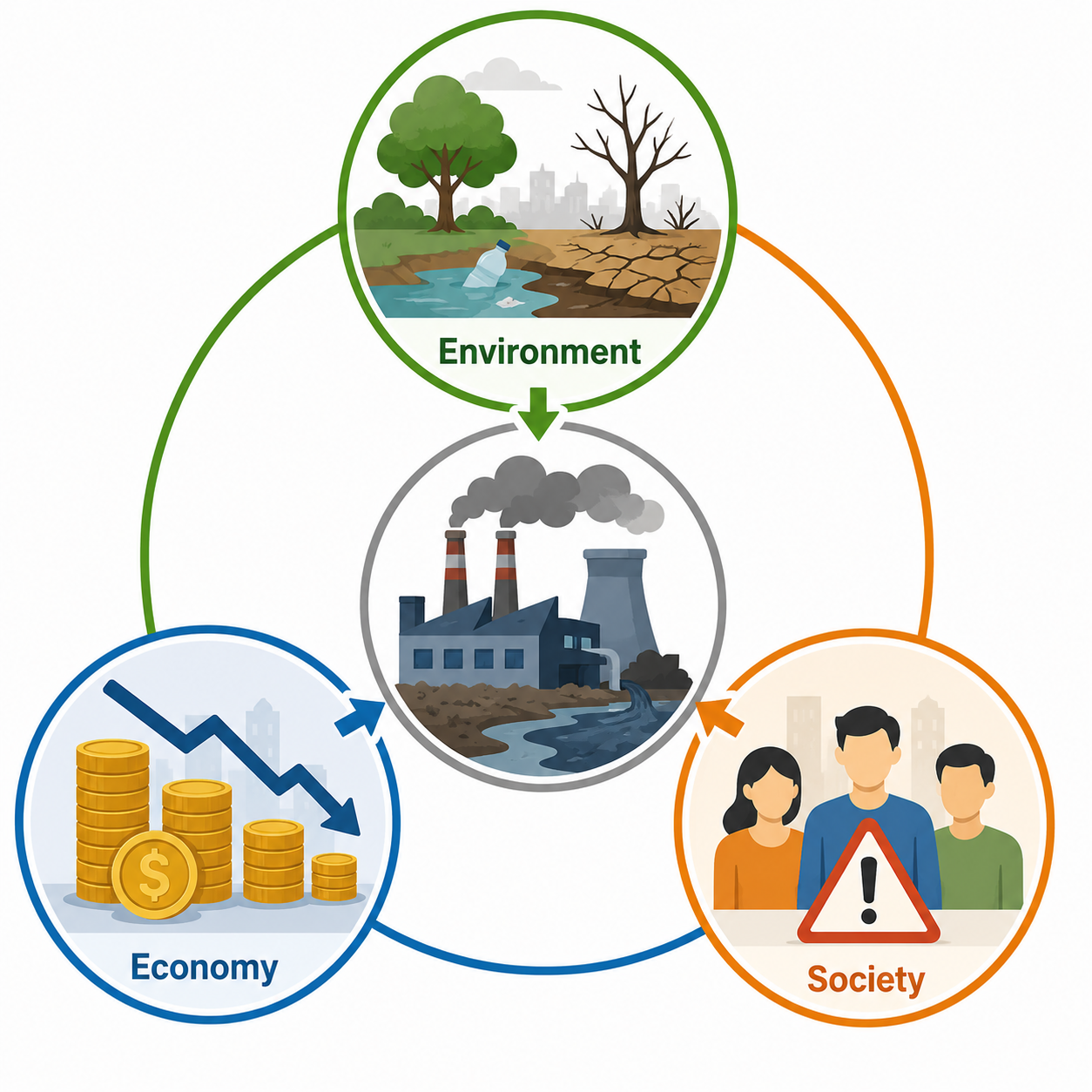 Evaluating the environmental, economic, and social implications of unsustainable practices is one of the most important responsibilities of environmental professionals. Organisations today operate in an increasingly complex environment where environmental degradation, climate change, resource scarcity, biodiversity loss, regulatory pressures, and stakeholder expectations are closely interconnected. Consequently, sustainability cannot be assessed solely by examining environmental impacts in isolation. Environmental managers must evaluate how unsustainable practices affect organisational performance, economic resilience, regulatory compliance, community wellbeing, and long-term sustainable development.
Water Pollution
Water pollution is a significant consequence of unsustainable industrial, agricultural, and urban activities. Contaminated water resources affect ecosystems, human health, food production, and economic development.
Common sources include:
- Industrial wastewater.
- Agricultural fertiliser runoff.
- Pesticide contamination.
- Oil spills.
- Untreated sewage.
- Mining effluents.
Environmental managers evaluate water quality using physical, chemical, and biological monitoring programmes while ensuring compliance with environmental discharge permits.
Water management strategies commonly include:
- Wastewater treatment.
- Pollution prevention.
- Spill response planning.
- Water recycling.
- Continuous monitoring.
- Catchment management approaches.
Workplace Example
A food processing facility observed increasing nutrient concentrations in wastewater discharged from its production process. Environmental monitoring identified excessive cleaning chemical use and inefficient wastewater treatment operations as the primary causes. Following a detailed environmental evaluation, the Environmental Manager introduced process optimisation measures, upgraded the treatment plant, implemented chemical dosing controls, and trained production staff on pollution prevention practices. Within twelve months, wastewater quality improved significantly, regulatory compliance was restored, operational costs were reduced, and the organisation strengthened its environmental performance under its ISO 14001 Environmental Management System.
Air Pollution
Air pollution is one of the most widespread environmental implications of unsustainable industrialisation, urbanisation, transport, and energy production. Pollutants released into the atmosphere not only affect environmental quality but also contribute to climate change, ecosystem degradation, and significant public health concerns.
Major sources of air pollution include:
- Fossil fuel combustion in power stations.
- Industrial manufacturing processes.
- Vehicle exhaust emissions.
- Construction activities.
- Mining operations.
- Agricultural burning.
- Waste incineration.
Common air pollutants include:
- Carbon dioxide (CO₂).
- Carbon monoxide (CO).
- Nitrogen oxides (NOₓ).
- Sulphur dioxide (SO₂).
- Particulate Matter (PM₂.₅ and PM₁₀).
- Volatile Organic Compounds (VOCs).
- Ground-level ozone.
The environmental implications of air pollution include:
- Climate change acceleration.
- Acid rain formation.
- Reduced agricultural productivity.
- Forest ecosystem degradation.
- Damage to freshwater ecosystems.
- Reduced visibility.
- Deterioration of building materials.
- Declining biodiversity.
Environmental managers evaluate air quality through:
- Continuous Emissions Monitoring Systems (CEMS).
- Stack emission testing.
- Ambient air quality monitoring.
- Dust monitoring programmes.
- Greenhouse gas inventories.
- Environmental compliance audits.
Practical mitigation strategies include:
- Installing air pollution control technologies.
- Switching to cleaner fuels.
- Improving combustion efficiency.
- Electrification of industrial processes.
- Renewable energy integration.
- Regular equipment maintenance.
- Process optimisation.
Within an Environmental Management System (EMS), air emissions are monitored through Environmental Performance Indicators (EPIs), enabling organisations to identify trends and implement corrective actions before legal limits are exceeded.
Marine Pollution
Marine ecosystems are increasingly threatened by unsustainable industrial activities, shipping, offshore energy production, agriculture, and poor waste management.
Sources of marine pollution include:
- Plastic waste.
- Oil spills.
- Agricultural nutrient runoff.
- Industrial wastewater.
- Untreated sewage.
- Chemical discharges.
- Microplastics.
- Shipping waste.
Marine pollution can result in:
- Coral reef degradation.
- Declining fish populations.
- Coastal habitat destruction.
- Reduced biodiversity.
- Food chain contamination.
- Economic losses for fisheries and tourism.
Environmental managers involved in coastal developments, ports, offshore energy projects, and marine industries implement environmental monitoring programmes that include:
- Water quality monitoring.
- Sediment sampling.
- Marine ecology surveys.
- Spill prevention systems.
- Emergency response planning.
- Waste management controls.
Environmental Impact Assessment (EIA) plays a critical role in identifying marine environmental risks before new developments commence.
Ecosystem Fragmentation
Unsustainable infrastructure development frequently divides natural habitats into isolated areas, reducing ecological connectivity and threatening biodiversity.
Common causes include:
- Highway construction.
- Urban expansion.
- Rail developments.
- Mining operations.
- Energy infrastructure.
- Industrial developments.
Environmental implications include:
- Reduced wildlife movement.
- Genetic isolation.
- Habitat loss.
- Increased wildlife mortality.
- Declining ecosystem resilience.
Environmental managers reduce fragmentation by incorporating:
- Wildlife corridors.
- Ecological bridges.
- Habitat restoration programmes.
- Sensitive land-use planning.
- Biodiversity management plans.
- Environmental offset strategies where appropriate.
These measures support both regulatory compliance and long-term ecosystem sustainability.
Resource Depletion
Unsustainable consumption of natural resources threatens the long-term availability of materials required for economic development and societal wellbeing.
Resources commonly affected include:
- Freshwater.
- Fossil fuels.
- Minerals.
- Forest products.
- Agricultural soils.
- Fisheries.
Resource depletion creates long-term environmental challenges including:
- Habitat degradation.
- Reduced ecosystem services.
- Increased extraction costs.
- Greater greenhouse gas emissions.
- Supply chain instability.
Environmental managers promote resource efficiency by implementing:
- Sustainable procurement.
- Circular economy strategies.
- Material efficiency programmes.
- Renewable resource utilisation.
- Recycling initiatives.
- Water conservation.
- Energy efficiency improvements.
These initiatives reduce operational costs while improving environmental performance.
Increased Waste Generation
Waste generation represents both an environmental and resource management challenge.
Unsustainable waste management contributes to:
- Land contamination.
- Groundwater pollution.
- Methane emissions.
- Marine litter.
- Increased landfill requirements.
- Resource loss.
Environmental managers apply the waste hierarchy by prioritising:
- Prevention.
- Reduction.
- Reuse.
- Recycling.
- Recovery.
- Disposal only as a final option.
Waste audits, material flow analysis, and circular economy assessments enable organisations to identify opportunities for reducing waste throughout production processes.
Declining Ecosystem Resilience
Healthy ecosystems possess the ability to recover naturally from environmental disturbances.
Unsustainable practices reduce this resilience by:
- Destroying habitats.
- Reducing biodiversity.
- Altering natural water cycles.
- Increasing pollution.
- Accelerating climate change.
Environmental managers evaluate ecosystem resilience using ecological indicators such as:
- Species diversity.
- Habitat condition.
- Water quality.
- Soil health.
- Carbon storage capacity.
Protecting ecosystem resilience strengthens climate adaptation while supporting long-term environmental sustainability.
Environmental Evaluation Using EIA, SEA and LCA
Environmental managers utilise internationally recognised assessment methodologies to evaluate environmental implications before projects, policies, or operational changes are implemented.
Environmental Impact Assessment (EIA)
Environmental Impact Assessment evaluates the potential environmental consequences of specific development projects before approval.
Typical stages include:
- Screening.
- Scoping.
- Baseline studies.
- Impact prediction.
- Mitigation planning.
- Public consultation.
- Environmental reporting.
- Monitoring.
EIA supports evidence-based environmental decision-making while reducing environmental risks.
Strategic Environmental Assessment (SEA)
Strategic Environmental Assessment evaluates environmental implications at a broader strategic level.
SEA commonly applies to:
- National development strategies.
- Regional plans.
- Infrastructure programmes.
- Energy policies.
- Transport strategies.
By identifying environmental implications early in strategic planning, SEA supports sustainable development while avoiding costly environmental problems during implementation.
Life Cycle Assessment (LCA)
Life Cycle Assessment evaluates environmental impacts throughout the complete life cycle of products or services.
Assessment stages include:
- Raw material extraction.
- Manufacturing.
- Distribution.
- Product use.
- End-of-life disposal.
- Recycling.
Environmental managers use LCA to identify environmental hotspots and prioritise opportunities for reducing impacts across supply chains.
Economic Implications of Unsustainable Practices
While environmental impacts are often immediately visible, the economic implications of unsustainable practices frequently emerge gradually. Organisations that ignore sustainability may initially reduce operating costs by avoiding environmental investments. However, these short-term savings are frequently outweighed by significant long-term financial liabilities.
Environmental managers therefore evaluate sustainability from a financial as well as an environmental perspective.
Regulatory Penalties
Failure to comply with environmental legislation may result in:
- Financial fines.
- Environmental restoration costs.
- Suspension of environmental permits.
- Legal proceedings.
- Increased regulatory inspections.
Environmental compliance therefore represents both a legal obligation and an important component of financial risk management.
Environmental Remediation Costs
Pollution incidents often require extensive environmental remediation.
Examples include:
- Soil remediation.
- Groundwater treatment.
- River restoration.
- Habitat reconstruction.
- Waste removal.
These activities frequently cost substantially more than preventive environmental management measures.
Environmental managers therefore prioritise pollution prevention rather than environmental remediation.
Carbon Pricing and Climate Policies
Many countries now introduce carbon pricing mechanisms that increase operational costs for carbon-intensive industries.
Examples include:
- Carbon taxes.
- Emissions trading schemes.
- Carbon reporting obligations.
- Climate disclosure requirements.
Environmental managers evaluate organisational carbon footprints and identify opportunities to reduce emissions before carbon-related financial liabilities increase.
Increasing Energy Costs
Organisations with inefficient equipment and outdated technologies often experience rising production costs due to increasing energy prices.
Environmental managers conduct:
- Energy audits.
- Equipment efficiency assessments.
- Renewable energy feasibility studies.
- Energy performance monitoring.
Energy management contributes simultaneously to cost reduction and environmental improvement.
Resource Scarcity
Unsustainable resource consumption increases long-term operational costs.
Examples include:
- Water shortages increasing production costs.
- Declining raw material availability.
- Higher transportation costs.
- Supply chain disruptions.
Environmental managers strengthen organisational resilience through resource efficiency programmes and sustainable procurement strategies.
Loss of Investor Confidence
Environmental, Social and Governance (ESG) performance increasingly influences investment decisions.
Investors commonly evaluate:
- Climate risk.
- Carbon emissions.
- Environmental compliance.
- Resource management.
- Sustainability reporting.
- Governance quality.
Poor environmental performance may reduce investment opportunities while increasing borrowing costs.
Organisational Example
A multinational cement manufacturer experienced rising energy costs, increasing carbon taxes, and declining investor confidence due to high greenhouse gas emissions. Environmental managers conducted a comprehensive sustainability evaluation, identifying inefficient kilns, excessive waste heat losses, and poor energy management practices.
The organisation responded by:
- Installing waste heat recovery systems.
- Improving kiln efficiency.
- Increasing the use of alternative fuels.
- Introducing carbon accounting.
- Expanding renewable electricity procurement.
- Strengthening environmental monitoring.
Within five years the organisation reduced operating costs, improved ESG ratings, strengthened regulatory compliance, reduced greenhouse gas emissions, and enhanced long-term financial resilience.
Social Implications of Unsustainable Practices
The social dimension of sustainability is often less visible than environmental degradation or financial losses; however, it is equally important when evaluating the long-term consequences of unsustainable practices. Organisations do not operate in isolation. Their activities directly influence employees, local communities, customers, suppliers, governments, and future generations. Environmental managers must therefore evaluate how environmental decisions affect human health, social equity, livelihoods, community wellbeing, and organisational reputation.
Unsustainable practices can undermine public confidence, damage relationships with stakeholders, increase social inequalities, and create conflicts between organisations and the communities in which they operate. Consequently, sustainability evaluation should extend beyond environmental compliance to include the broader social impacts of organisational activities.
Poor Public Health
Environmental pollution caused by unsustainable industrial activities has significant implications for public health.
Common contributors include:
- Air pollution from industrial emissions.
- Vehicle exhaust emissions.
- Contaminated drinking water.
- Hazardous chemical releases.
- Poor waste management.
- Noise pollution.
Potential health impacts include:
- Respiratory diseases.
- Cardiovascular illnesses.
- Waterborne diseases.
- Cancer risks associated with hazardous substances.
- Heat-related illnesses resulting from climate change.
- Reduced quality of life.
Environmental managers work collaboratively with occupational health specialists, public authorities, and environmental regulators to minimise these risks through pollution prevention programmes, environmental monitoring, emergency preparedness, and effective operational controls.
Occupational Health and Safety Risks
Unsustainable environmental practices frequently increase workplace risks.
Examples include:
- Exposure to hazardous chemicals.
- Poor indoor air quality.
- Inadequate waste handling.
- Unsafe storage of hazardous materials.
- Excessive workplace noise.
- Dust exposure.
Although occupational health and safety management operates alongside environmental management, both disciplines share common objectives relating to risk reduction and sustainable organisational performance.
Environmental managers contribute by:
- Conducting environmental risk assessments.
- Supporting safe chemical management.
- Implementing pollution control measures.
- Monitoring workplace environmental conditions.
- Coordinating emergency response planning.
Community Dissatisfaction
Communities increasingly expect organisations to operate responsibly and minimise environmental impacts.
Unsustainable practices may result in:
- Odour complaints.
- Increased traffic congestion.
- Visual impacts.
- Noise disturbances.
- Water pollution.
- Reduced recreational opportunities.
- Concerns regarding environmental safety.
Environmental managers engage with communities through:
- Public consultation.
- Stakeholder meetings.
- Environmental reporting.
- Complaint management systems.
- Community liaison programmes.
- Transparent communication.
Early engagement often prevents conflicts while strengthening organisational trust.
Environmental Injustice
Environmental injustice occurs when environmental burdens disproportionately affect vulnerable or disadvantaged populations.
Examples include:
- Industrial facilities located near low-income communities.
- Poor access to clean water.
- Unequal exposure to pollution.
- Limited participation in environmental decision-making.
Environmental managers must evaluate environmental equity during planning processes and ensure that sustainability decisions consider all stakeholder groups fairly.
Environmental Impact Assessment (EIA) and Social Impact Assessment (SIA) frequently examine these issues before major developments proceed.
Loss of Traditional Livelihoods
Environmental degradation may significantly affect communities dependent upon natural resources.
Examples include:
- Declining fisheries caused by marine pollution.
- Reduced agricultural productivity due to soil degradation.
- Loss of tourism following ecosystem damage.
- Forest-dependent communities affected by deforestation.
Environmental managers consider these socioeconomic impacts when evaluating development proposals and implementing biodiversity conservation strategies.
Food Insecurity
Unsustainable agricultural practices, climate change, and water scarcity threaten long-term food security.
Environmental implications include:
- Declining crop yields.
- Soil degradation.
- Reduced freshwater availability.
- Increased pest outbreaks.
- Greater vulnerability to extreme weather.
Environmental managers support food security through sustainable agriculture, water conservation, climate adaptation planning, and ecosystem restoration.
Social Conflict and Reduced Trust
Failure to manage environmental impacts responsibly may create conflicts between organisations and stakeholders.
Potential consequences include:
- Public protests.
- Legal challenges.
- Delayed projects.
- Loss of social licence to operate.
- Reduced investor confidence.
- Reputational damage.
Environmental managers strengthen stakeholder relationships through transparent environmental governance, effective communication, and evidence-based environmental reporting.
Balancing the Triple Bottom Line
Modern environmental management recognises that organisational success depends upon balancing environmental protection, economic prosperity, and social wellbeing. This concept is commonly known as the Triple Bottom Line.
Rather than focusing exclusively on financial performance, organisations evaluate how decisions influence environmental quality, long-term economic resilience, and societal wellbeing simultaneously.
Environmental managers use the Triple Bottom Line framework when evaluating sustainability investments, environmental programmes, operational changes, and strategic planning decisions.
Educational Table: Triple Bottom Line Evaluation
| Sustainability Dimension | Consequences of Unsustainable Practices | Desired Organisational Outcome |
|---|---|---|
| Environmental | Pollution, biodiversity loss, climate change, resource depletion, ecosystem degradation | Environmental protection, pollution prevention, resource efficiency, biodiversity conservation |
| Economic | Regulatory penalties, remediation costs, higher operating costs, resource scarcity, reduced investor confidence | Long-term profitability, operational resilience, sustainable investment, improved competitiveness |
| Social | Community dissatisfaction, public health impacts, occupational risks, social conflict, reduced stakeholder trust | Improved wellbeing, stakeholder confidence, ethical governance, social responsibility |
Environmental managers apply this framework to ensure improvements in one area do not unintentionally create negative consequences in another. For example, reducing production costs by ignoring pollution controls may improve short-term financial performance but significantly damage environmental quality and community trust.
Integrating Sustainability Evaluation into Environmental Management Systems
Environmental Management Systems (EMS) provide organisations with a structured framework for evaluating environmental performance and identifying opportunities for continual improvement.
ISO 14001 requires organisations to evaluate environmental performance systematically rather than relying on assumptions or isolated observations.
Key evaluation activities include:
- Environmental monitoring.
- Compliance evaluation.
- Internal environmental auditing.
- Performance indicator analysis.
- Management review.
- Corrective and preventive actions.
- Continual improvement planning.
Environmental managers use environmental data collected through monitoring programmes to determine whether sustainability objectives are being achieved and whether additional controls are required.
For example:
- Increasing water consumption may indicate process inefficiencies.
- Rising energy use may highlight equipment deterioration.
- Higher waste generation may indicate poor operational controls.
- Increasing carbon emissions may require revised decarbonisation strategies.
The integration of sustainability evaluation within EMS enables organisations to make proactive, evidence-based decisions while improving environmental performance over time.
Monitoring and Performance Evaluation
Environmental monitoring provides objective evidence regarding organisational sustainability performance.
Environmental managers establish Environmental Performance Indicators (EPIs) to evaluate progress towards sustainability objectives.
Common indicators include:
- Greenhouse gas emissions.
- Energy consumption.
- Water consumption.
- Waste generation.
- Recycling rates.
- Air emissions.
- Wastewater quality.
- Biodiversity indicators.
- Compliance incidents.
- Environmental complaints.
- Environmental audit findings.
Monitoring data should be:
- Accurate.
- Reliable.
- Consistent.
- Timely.
- Relevant.
- Verifiable.
Trend analysis enables organisations to identify emerging environmental risks before they develop into significant operational problems.
Regular performance reviews support:
- Strategic planning.
- Environmental investment decisions.
- Regulatory compliance.
- Stakeholder reporting.
- Continual improvement.
Legal and Regulatory Considerations
Environmental managers evaluate unsustainable practices within the context of applicable environmental legislation and regulatory obligations.
Typical legal requirements include:
- Environmental permitting.
- Waste management regulations.
- Air quality standards.
- Water discharge permits.
- Hazardous substance controls.
- Climate reporting obligations.
- Biodiversity conservation requirements.
- Environmental Impact Assessment regulations.
Compliance evaluation involves:
- Maintaining legal registers.
- Monitoring legislative changes.
- Conducting compliance audits.
- Investigating non-conformities.
- Implementing corrective actions.
- Reporting environmental performance.
Strong legal compliance reduces regulatory risks while supporting organisational reputation and stakeholder confidence.
Professional Judgement in Sustainability Evaluation
Effective sustainability evaluation requires considerably more than regulatory compliance.
Environmental managers must apply professional judgement by considering:
- Scientific evidence.
- Environmental monitoring data.
- Organisational objectives.
- Industry best practice.
- Climate risks.
- Stakeholder expectations.
- Financial considerations.
- Technological feasibility.
- Long-term sustainability objectives.
Evidence-based decision-making enables organisations to prioritise environmental investments where they generate the greatest environmental, social, and economic benefits.
Professional judgement is particularly important when balancing competing priorities such as production efficiency, environmental protection, operational costs, and stakeholder expectations.
Organisational Example
A multinational manufacturing organisation identified increasing waste generation, higher energy consumption, and growing community complaints regarding air emissions. Through its ISO 14001 Environmental Management System, the Environmental Manager conducted a comprehensive sustainability evaluation using environmental monitoring data, compliance audits, stakeholder feedback, and Life Cycle Assessment.
The evaluation revealed inefficient production processes, ageing equipment, and inadequate waste segregation practices.
The organisation implemented:
- Energy-efficient manufacturing technologies.
- Advanced emission control systems.
- Waste segregation and recycling programmes.
- Employee environmental awareness training.
- Continuous environmental monitoring.
- Enhanced stakeholder communication.
Within three years, the organisation achieved:
- Reduced greenhouse gas emissions.
- Lower energy consumption.
- Improved waste recovery rates.
- Increased regulatory compliance.
- Reduced operational costs.
- Improved ESG performance.
- Stronger community relationships.
This example demonstrates how evaluating environmental, economic, and social implications enables organisations to improve both sustainability performance and long-term business resilience.
Key Takeaways
- Evaluating unsustainable practices requires consideration of environmental, economic, and social implications simultaneously.
- Environmental degradation affects ecosystems, biodiversity, climate stability, natural resources, and long-term organisational resilience.
- Unsustainable practices often generate hidden financial costs through regulatory penalties, remediation expenses, resource scarcity, and reduced investor confidence.
- Social implications include public health impacts, community dissatisfaction, environmental injustice, occupational risks, and reduced stakeholder trust.
- The Triple Bottom Line framework enables balanced decision-making by integrating environmental protection, economic performance, and social responsibility.
- Environmental Management Systems provide structured processes for evaluating sustainability performance through monitoring, auditing, compliance evaluation, and continual improvement.
- Environmental Performance Indicators support evidence-based decision-making and proactive environmental management.
- Professional judgement is essential for balancing environmental, financial, regulatory, and stakeholder considerations.
- Effective sustainability evaluation strengthens governance, regulatory compliance, ESG performance, and long-term organisational success.
- Continual improvement ensures organisations remain resilient in response to evolving environmental challenges, legislation, and stakeholder expectations.
Evaluating the environmental, economic, and social implications of unsustainable practices is fundamental to effective environmental management and strategic organisational decision-making. Environmental professionals must move beyond identifying environmental impacts to critically assessing how operational activities influence ecosystems, financial performance, regulatory compliance, stakeholder relationships, and long-term sustainability. By applying recognised methodologies such as Environmental Impact Assessment, Life Cycle Assessment, environmental monitoring, auditing, and Environmental Management Systems, organisations can make informed decisions that reduce environmental risks while enhancing operational resilience.
A comprehensive evaluation process enables organisations to identify opportunities for pollution prevention, resource efficiency, carbon reduction, biodiversity conservation, and continual improvement. Integrating environmental, economic, and social considerations through the Triple Bottom Line approach supports balanced decision-making that creates lasting value for organisations, communities, and the environment. Ultimately, effective sustainability evaluation strengthens environmental governance, promotes responsible leadership, improves ESG performance, and equips organisations to achieve sustainable development while maintaining competitiveness and regulatory compliance in an increasingly complex global environment.
3.Suggest solutions or strategies to promote sustainable practices within these sectors.
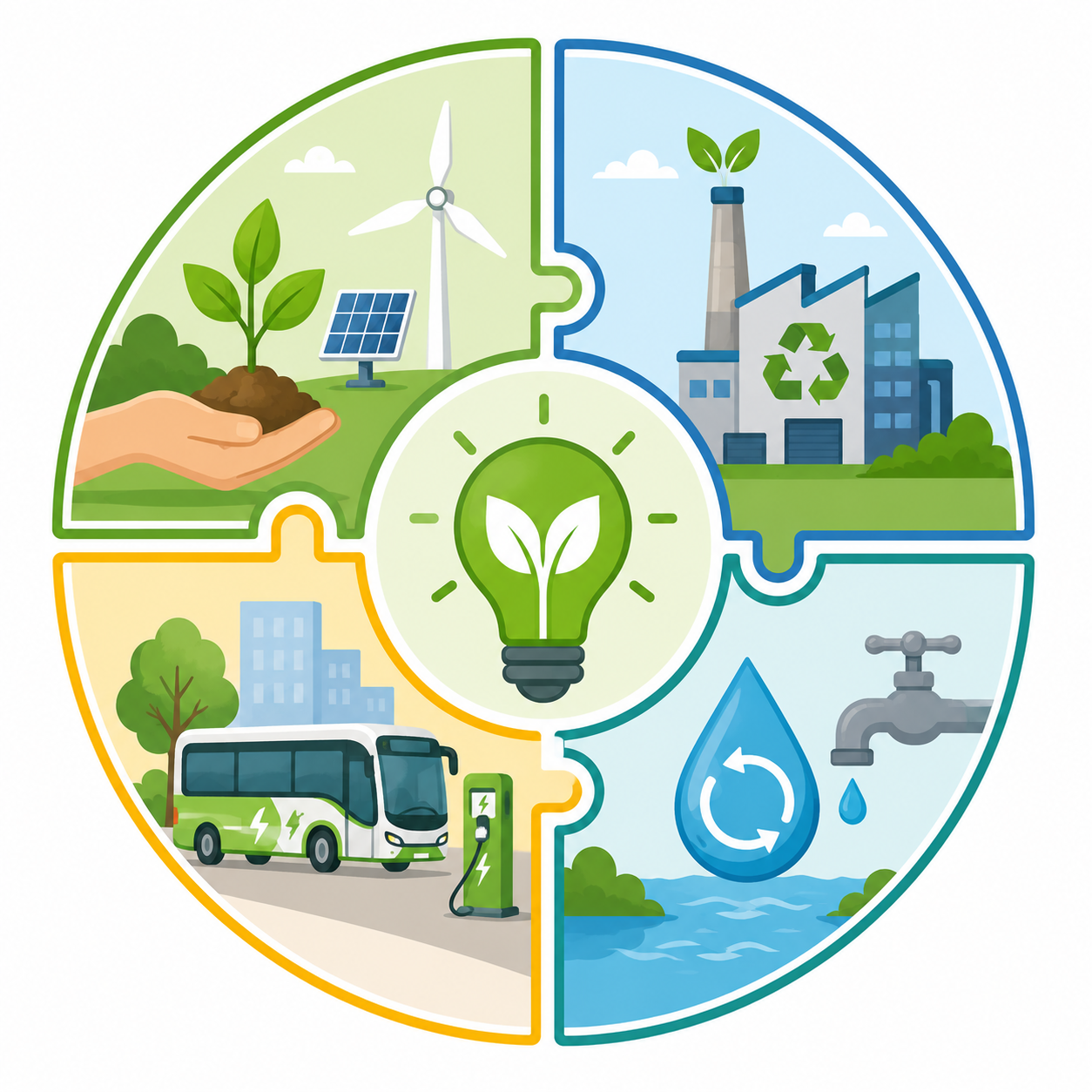
Promoting sustainable practices is one of the primary responsibilities of modern environmental managers. While identifying sustainability challenges and evaluating the consequences of unsustainable practices are essential stages of environmental management, organisations must ultimately develop and implement practical solutions that reduce environmental impacts while supporting economic growth and social wellbeing. Sustainable development cannot be achieved through regulatory compliance alone; it requires strategic planning, innovation, leadership commitment, stakeholder collaboration, and continual improvement across all organisational functions.
Organisations operating in sectors such as agriculture, manufacturing, energy, transport, construction, mining, healthcare, logistics, utilities, and infrastructure face increasing pressure from governments, regulators, investors, customers, and local communities to improve their environmental performance. Rising concerns regarding climate change, biodiversity loss, pollution, resource depletion, and environmental governance have shifted sustainability from a voluntary initiative to a strategic organisational priority.
Environmental managers play a critical role in identifying opportunities to improve environmental performance by integrating sustainability into operational planning, procurement, resource management, production systems, investment decisions, and corporate governance. Rather than implementing isolated environmental projects, organisations should embed sustainability into every stage of decision-making through Environmental Management Systems (EMS), sustainability policies, Environmental, Social and Governance (ESG) strategies, environmental risk management, and performance monitoring.
This assessment criterion explores practical strategies that organisations can implement to promote sustainability within agriculture, energy, industry, and transport. It also demonstrates how environmental professionals apply evidence-based decision-making, pollution prevention, resource efficiency, circular economy principles, climate action, and continual improvement to achieve long-term sustainable development.
Definition of Sustainable Practices
Sustainable practices are planned actions, operational methods, management systems, and organisational strategies designed to minimise environmental impacts while maintaining economic viability and supporting social wellbeing. These practices ensure that natural resources are managed responsibly so that present needs are met without compromising the ability of future generations to meet their own needs.
From an environmental management perspective, sustainable practices focus on preventing environmental degradation rather than simply responding to environmental problems after they occur. They encourage organisations to improve efficiency, reduce waste, conserve resources, lower greenhouse gas emissions, protect biodiversity, and strengthen organisational resilience.
Examples of sustainable practices include:
- Improving energy efficiency.
- Conserving water resources.
- Reducing greenhouse gas emissions.
- Preventing pollution at source.
- Implementing renewable energy technologies.
- Applying circular economy principles.
- Promoting sustainable procurement.
- Protecting biodiversity.
- Reducing waste generation.
- Recycling and resource recovery.
- Sustainable land management.
- Responsible supply chain management.
These practices contribute simultaneously to environmental protection, organisational performance, regulatory compliance, and long-term economic competitiveness.
Importance of Promoting Sustainable Practices
Sustainability has become a strategic business requirement rather than simply an environmental responsibility. Organisations that successfully integrate sustainable practices improve operational performance, reduce risks, strengthen stakeholder confidence, and enhance long-term resilience.
Environmental managers therefore promote sustainability not only to protect ecosystems but also to support organisational success.
Protecting Natural Resources
Natural resources form the foundation of all economic activity. Unsustainable consumption eventually leads to shortages, ecosystem degradation, declining biodiversity, and increased operational costs.
Sustainable practices help organisations to:
- Reduce raw material consumption.
- Improve water conservation.
- Protect forests and ecosystems.
- Maintain soil quality.
- Preserve biodiversity.
- Improve ecosystem resilience.
Responsible resource management ensures long-term environmental sustainability while reducing dependence on scarce natural resources.
Reducing Environmental Pollution
Pollution prevention represents one of the most cost-effective environmental management strategies.
Rather than treating pollution after it has occurred, sustainable practices seek to eliminate pollution at its source by improving operational efficiency and adopting cleaner technologies.
Examples include:
- Cleaner production processes.
- Low-emission equipment.
- Renewable energy systems.
- Waste minimisation programmes.
- Closed-loop manufacturing.
- Sustainable chemical management.
These approaches reduce environmental liabilities while improving regulatory compliance.
Supporting Climate Change Mitigation
Climate change presents one of the greatest environmental challenges facing organisations worldwide.
Sustainable practices contribute to climate mitigation by:
- Improving energy efficiency.
- Increasing renewable energy use.
- Reducing carbon emissions.
- Improving carbon sequestration.
- Supporting low-carbon technologies.
- Reducing transport emissions.
Environmental managers integrate carbon reduction strategies into Environmental Management Systems and corporate sustainability programmes.
Enhancing Organisational Competitiveness
Increasingly, sustainability influences purchasing decisions, investment opportunities, and market competitiveness.
Organisations implementing sustainable practices often achieve:
- Lower operating costs.
- Improved productivity.
- Enhanced corporate reputation.
- Greater investor confidence.
- Stronger customer loyalty.
- Improved ESG ratings.
- Better regulatory relationships.
Sustainability therefore creates competitive advantage while supporting responsible business growth.
Strengthening Regulatory Compliance
Environmental legislation continues to evolve in response to climate change, pollution, biodiversity loss, and resource scarcity.
Promoting sustainable practices assists organisations by:
- Reducing legal risks.
- Improving permit compliance.
- Preventing environmental incidents.
- Supporting environmental reporting.
- Strengthening audit performance.
- Demonstrating environmental due diligence.
Compliance achieved through proactive environmental management is generally more effective and less costly than responding to regulatory enforcement actions.
Objectives of Sustainability Strategies
Environmental managers implement sustainability strategies to achieve multiple environmental, economic, and organisational objectives.
The principal objectives include:
- Reducing environmental impacts.
- Conserving natural resources.
- Improving energy efficiency.
- Minimising waste generation.
- Preventing pollution.
- Supporting climate resilience.
- Protecting biodiversity.
- Strengthening environmental governance.
- Improving ESG performance.
- Enhancing operational efficiency.
- Supporting continual improvement.
- Promoting sustainable development.
These objectives should align with organisational environmental policies, strategic plans, and Environmental Management System objectives.
Principles of Effective Sustainability Strategies
Successful sustainability strategies are based on internationally recognised environmental management principles rather than isolated environmental initiatives.
Prevention Rather Than Remediation
Preventing environmental damage is considerably more effective than correcting environmental problems after they occur.
Environmental managers therefore prioritise:
- Pollution prevention.
- Cleaner production.
- Efficient process design.
- Waste reduction.
- Sustainable resource use.
Preventive environmental management reduces operational costs while improving environmental performance.
Resource Efficiency
Resource efficiency focuses on obtaining maximum value from natural resources while minimising waste and environmental impacts.
Resource efficiency initiatives commonly include:
- Efficient water management.
- Energy optimisation.
- Material recovery.
- Process efficiency improvements.
- Lean manufacturing.
- Sustainable procurement.
Improved resource efficiency benefits both environmental sustainability and organisational profitability.
Life Cycle Thinking
Environmental impacts should be considered throughout the entire life cycle of products and services.
Environmental managers evaluate:
- Raw material extraction.
- Manufacturing.
- Packaging.
- Transportation.
- Product use.
- Maintenance.
- End-of-life disposal.
- Recycling opportunities.
Life Cycle Assessment (LCA) supports evidence-based environmental decision-making by identifying environmental hotspots across the value chain.
Continual Improvement
Sustainability is an ongoing organisational journey rather than a single project.
Environmental managers continually:
- Monitor performance.
- Review objectives.
- Analyse environmental data.
- Conduct audits.
- Identify opportunities.
- Implement corrective actions.
- Improve operational controls.
Continual improvement is a core principle of ISO 14001 and ensures organisations remain responsive to changing environmental conditions.
Sector-Specific Sustainability Strategies – Agriculture
Agriculture provides food, fibre, bio-based materials, and livelihoods for billions of people worldwide. However, agricultural activities also place significant pressure on natural resources through land conversion, water consumption, greenhouse gas emissions, fertiliser use, pesticide application, and biodiversity loss.
Environmental managers play an essential role in promoting sustainable agricultural systems that balance productivity with environmental protection. Modern sustainable agriculture combines technological innovation, ecosystem management, resource efficiency, and environmental stewardship to ensure long-term food security while protecting natural ecosystems.
Precision Agriculture Using GPS and Sensor Technologies
Precision agriculture applies advanced technologies such as Global Positioning Systems (GPS), Geographic Information Systems (GIS), drones, remote sensing, artificial intelligence, and soil sensors to optimise farming operations.
Rather than applying water, fertilisers, and pesticides uniformly across entire fields, precision agriculture enables farmers to manage crops according to site-specific conditions.
Key benefits include:
- Reduced fertiliser consumption.
- Improved crop productivity.
- Lower pesticide use.
- Reduced greenhouse gas emissions.
- Better soil management.
- Improved water efficiency.
- Reduced operational costs.
- Enhanced environmental monitoring.
Environmental managers analyse data collected from sensors to identify variations in soil moisture, nutrient availability, crop health, and pest activity. This information supports evidence-based decision-making and improves environmental performance.
Efficient Irrigation Systems
Agriculture accounts for a substantial proportion of global freshwater consumption. Inefficient irrigation practices contribute to water scarcity, soil degradation, declining river flows, and increased energy use.
Sustainable irrigation strategies include:
- Drip irrigation.
- Micro-sprinkler systems.
- Automated irrigation controls.
- Rainwater harvesting.
- Soil moisture monitoring.
- Irrigation scheduling.
- Water recycling.
Environmental managers monitor irrigation performance using indicators such as:
- Water consumption per hectare.
- Irrigation efficiency.
- Crop water productivity.
- Groundwater abstraction rates.
- Water quality.
Improved irrigation management reduces water consumption while maintaining agricultural productivity.
Integrated Pest Management (IPM)
Integrated Pest Management combines biological, cultural, mechanical, and chemical methods to control pests while minimising environmental impacts.
Rather than relying exclusively on pesticides, IPM promotes balanced ecosystem management.
Key IPM techniques include:
- Biological pest control.
- Crop rotation.
- Pest monitoring.
- Resistant crop varieties.
- Mechanical weed removal.
- Targeted pesticide application.
- Habitat management for beneficial insects.
Environmental managers monitor pesticide usage, biodiversity indicators, and crop health to evaluate the effectiveness of IPM programmes.
Educational Table: Sustainable Agriculture Strategies and Their Environmental Benefits
| Sustainable Strategy | Purpose | Environmental Benefits | Role of the Environmental Manager |
|---|---|---|---|
| Precision Agriculture | Optimise use of inputs through GPS, sensors, and data analytics | Reduces fertiliser use, conserves water, lowers emissions, improves soil health | Analyse environmental data, monitor resource efficiency, evaluate environmental performance |
| Efficient Irrigation Systems | Improve water-use efficiency and reduce unnecessary abstraction | Conserves freshwater resources, protects aquatic ecosystems, reduces energy consumption | Monitor water consumption, assess irrigation efficiency, develop water stewardship plans |
| Integrated Pest Management (IPM) | Control pests using biological and integrated methods | Reduces pesticide pollution, protects biodiversity, improves ecosystem health | Evaluate pesticide use, monitor biodiversity, support environmentally responsible pest control |
| Regenerative Farming | Restore ecosystem functions and improve soil quality | Enhances carbon sequestration, improves soil fertility, increases climate resilience | Develop soil conservation programmes, monitor ecosystem recovery, integrate regenerative practices into sustainability plans |
| Crop Rotation and Diversification | Improve soil productivity and reduce pest pressure | Reduces soil degradation, improves nutrient cycling, strengthens biodiversity | Assess crop planning, monitor soil health, support sustainable land management |
Regenerative Farming Techniques
Regenerative agriculture is an ecosystem-based farming approach that aims to restore degraded land while enhancing long-term agricultural productivity. Unlike conventional farming systems that often rely heavily on synthetic inputs, regenerative farming seeks to improve the natural functions of soils, water systems, and biodiversity.
Core regenerative practices include:
- Conservation tillage.
- Cover cropping.
- Organic compost application.
- Crop diversification.
- Rotational grazing.
- Agroforestry.
- Reduced chemical inputs.
Environmental benefits include:
- Improved soil organic matter.
- Increased carbon sequestration.
- Enhanced biodiversity.
- Reduced erosion.
- Improved water retention.
- Greater resilience to drought and climate variability.
Environmental managers evaluate these practices through soil quality monitoring, biodiversity surveys, greenhouse gas assessments, and environmental performance indicators.
Workplace Example
A commercial agricultural enterprise experienced declining crop yields, increasing irrigation costs, and deteriorating soil quality due to intensive farming practices. The Environmental Manager conducted an environmental review under the organisation’s Environmental Management System and introduced precision agriculture technologies, drip irrigation, Integrated Pest Management, and regenerative farming techniques. Over three growing seasons, the farm achieved significant reductions in water consumption and chemical fertiliser use, improved soil organic carbon levels, increased biodiversity across field margins, and enhanced crop productivity. These improvements demonstrated how strategically implemented sustainability solutions can deliver environmental, operational, and economic benefits simultaneously.
Sector-Specific Sustainability Strategies – Energy
The energy sector is central to economic development, industrial growth, and modern living. However, it is also one of the largest contributors to greenhouse gas emissions, air pollution, resource depletion, and climate change. Environmental managers must therefore promote strategies that reduce environmental impacts while ensuring that energy remains reliable, affordable, and secure.
Sustainable energy management requires organisations to balance environmental protection with operational efficiency, technological innovation, regulatory compliance, and long-term energy security. Rather than relying solely on fossil fuels, organisations are increasingly transitioning towards cleaner energy systems supported by renewable technologies, energy efficiency measures, and carbon management programmes.
Expansion of Renewable Energy Generation
Renewable energy is one of the most effective long-term strategies for reducing greenhouse gas emissions and supporting sustainable development.
Common renewable energy technologies include:
- Solar photovoltaic systems.
- Wind power.
- Hydroelectric generation.
- Geothermal energy.
- Biomass energy.
- Tidal and wave energy.
The environmental benefits include:
- Reduced carbon emissions.
- Improved air quality.
- Reduced dependence on fossil fuels.
- Lower long-term operating costs.
- Increased energy security.
- Improved climate resilience.
Environmental managers contribute by:
- Conducting renewable energy feasibility studies.
- Evaluating environmental impacts.
- Coordinating Environmental Impact Assessments (EIA).
- Monitoring renewable energy performance.
- Supporting regulatory compliance.
- Reporting carbon reductions.
Renewable energy projects should also consider biodiversity conservation, land use planning, and stakeholder engagement to minimise unintended environmental impacts.
Carbon Capture, Utilisation and Storage (CCUS)
Many industries cannot eliminate carbon emissions immediately. Carbon Capture, Utilisation and Storage (CCUS) provides an important transitional strategy for reducing emissions from high-carbon sectors.
CCUS involves:
- Capturing carbon dioxide from industrial processes.
- Transporting captured carbon safely.
- Reusing carbon in industrial applications where appropriate.
- Storing carbon permanently in suitable geological formations.
Environmental managers evaluate:
- Carbon capture efficiency.
- Environmental risks.
- Energy requirements.
- Long-term storage integrity.
- Regulatory compliance.
- Environmental monitoring requirements.
CCUS supports national decarbonisation strategies while enabling industries to transition gradually towards lower-carbon operations.
Smart Electricity Grids
Traditional electricity networks are designed for one-way energy distribution. Modern smart grids use digital technologies to improve electricity generation, transmission, distribution, and consumption.
Key components include:
- Smart meters.
- Digital monitoring systems.
- Automated grid controls.
- Demand-response technologies.
- Renewable energy integration.
- Battery storage management.
Environmental benefits include:
- Improved energy efficiency.
- Reduced transmission losses.
- Better renewable energy utilisation.
- Lower greenhouse gas emissions.
- Improved system reliability.
Environmental managers use performance data generated by smart grids to optimise energy use and identify opportunities for continual improvement.
Energy Efficiency Programmes
The cleanest unit of energy is the energy that is never consumed. Energy efficiency therefore remains one of the most cost-effective sustainability strategies available.
Typical initiatives include:
- High-efficiency motors.
- LED lighting systems.
- Building energy management systems.
- Heat recovery technologies.
- Equipment optimisation.
- Preventive maintenance.
- Process automation.
Environmental managers monitor:
- Energy consumption.
- Energy intensity.
- Carbon emissions.
- Equipment performance.
- Operational efficiency.
Energy audits and performance reviews enable organisations to identify inefficiencies and implement targeted improvements.
Battery Energy Storage Systems
Renewable energy generation often varies depending on weather conditions. Battery Energy Storage Systems (BESS) improve grid reliability by storing excess electricity for later use.
Benefits include:
- Greater renewable energy utilisation.
- Reduced reliance on fossil fuel backup generation.
- Improved grid stability.
- Peak demand management.
- Reduced carbon emissions.
Environmental managers assess battery technologies by considering:
- Life cycle impacts.
- Resource availability.
- Recycling opportunities.
- Fire safety.
- End-of-life management.
Hydrogen Technologies
Green hydrogen produced using renewable electricity is emerging as an important low-carbon energy source.
Potential applications include:
- Heavy transport.
- Steel manufacturing.
- Chemical production.
- Energy storage.
- Industrial heating.
Environmental managers evaluate hydrogen projects through:
- Life Cycle Assessment (LCA).
- Environmental risk assessment.
- Water consumption analysis.
- Safety management.
- Carbon accounting.
Methane Emission Reduction
Methane has a significantly greater short-term warming effect than carbon dioxide.
Major methane sources include:
- Oil and gas operations.
- Coal mining.
- Agriculture.
- Waste management facilities.
Environmental managers reduce methane emissions through:
- Leak detection programmes.
- Equipment upgrades.
- Improved maintenance.
- Gas recovery systems.
- Continuous emissions monitoring.
Reducing methane emissions provides rapid climate benefits while improving operational efficiency.
Life Cycle Carbon Assessment
Organisations increasingly evaluate carbon emissions across the complete life cycle of energy systems.
Life cycle assessment considers emissions associated with:
- Raw material extraction.
- Equipment manufacturing.
- Construction.
- Operation.
- Maintenance.
- Decommissioning.
- Recycling.
Environmental managers use these assessments to compare alternative technologies and identify lower-carbon investment options.
Sector-Specific Sustainability Strategies – Industry
Manufacturing and industrial organisations consume substantial quantities of energy, raw materials, water, and chemicals. Consequently, improving industrial sustainability has become a priority for both environmental protection and business competitiveness.
Environmental managers support cleaner production systems that minimise waste, improve resource efficiency, and reduce environmental risks throughout manufacturing processes.
Cleaner Production Technologies
Cleaner production focuses on preventing pollution at its source rather than treating waste after it has been generated.
Strategies include:
- Process optimisation.
- Cleaner fuels.
- Low-emission technologies.
- Chemical substitution.
- Efficient production equipment.
- Digital process control.
Benefits include:
- Reduced emissions.
- Lower waste generation.
- Improved product quality.
- Reduced operating costs.
- Improved environmental compliance.
Environmental managers conduct environmental aspect evaluations to identify opportunities for cleaner production.
Industrial Symbiosis
Industrial symbiosis involves collaboration between neighbouring organisations to share resources and reduce waste.
Examples include:
- Sharing waste heat.
- Reusing industrial by-products.
- Shared wastewater treatment.
- Joint recycling facilities.
- Resource exchange partnerships.
This approach supports circular economy principles while improving resource efficiency.
Circular Economy Principles
A circular economy replaces the traditional “take-make-dispose” model with systems that retain materials in productive use for as long as possible.
Environmental managers promote:
- Product reuse.
- Repair.
- Refurbishment.
- Remanufacturing.
- Recycling.
- Material recovery.
Benefits include:
- Reduced landfill waste.
- Lower raw material consumption.
- Reduced greenhouse gas emissions.
- Improved resource productivity.
Lean Manufacturing
Lean manufacturing eliminates activities that do not add value while simultaneously improving environmental performance.
Environmental benefits include:
- Reduced energy consumption.
- Lower material waste.
- Reduced water use.
- Improved operational efficiency.
- Lower emissions.
Environmental managers integrate lean principles with Environmental Management Systems to achieve environmental and economic improvements simultaneously.
Sustainable Procurement
Procurement decisions significantly influence an organisation’s environmental footprint.
Environmental managers develop procurement policies that prioritise:
- Environmentally responsible suppliers.
- Recycled materials.
- Certified sustainable products.
- Low-carbon transport.
- Ethical sourcing.
- Reduced packaging.
Supplier environmental audits help organisations verify sustainability performance across supply chains.
Waste Minimisation Programmes
Waste minimisation focuses on preventing waste before it is generated.
Key strategies include:
- Process redesign.
- Material substitution.
- Improved inventory management.
- Product redesign.
- Employee awareness programmes.
- Resource recovery initiatives.
Environmental managers regularly analyse waste streams to identify improvement opportunities.
Water Recycling Systems
Industrial water recycling reduces freshwater demand while lowering wastewater generation.
Common applications include:
- Cooling water reuse.
- Process water recycling.
- Rainwater harvesting.
- Greywater systems.
- Closed-loop water systems.
Water stewardship contributes to both environmental protection and long-term business resilience.
Eco-Design Principles
Eco-design integrates environmental considerations into product development.
Environmental managers evaluate:
- Material selection.
- Energy efficiency.
- Product durability.
- Ease of repair.
- Recyclability.
- End-of-life recovery.
Products designed using life cycle thinking generally have lower environmental impacts throughout their lifespan.
Life Cycle Assessment (LCA)
LCA enables manufacturers to identify environmental impacts associated with every stage of a product’s life cycle.
Environmental managers use LCA findings to:
- Improve product design.
- Reduce emissions.
- Improve material efficiency.
- Select sustainable suppliers.
- Support environmental declarations.
Sector-Specific Sustainability Strategies – Transport
Transport supports global trade, economic development, and social connectivity but remains a significant contributor to greenhouse gas emissions, air pollution, and energy consumption.
Environmental managers promote sustainable transport systems that reduce environmental impacts while maintaining operational efficiency.
Fleet Electrification
Replacing conventional vehicles with electric alternatives significantly reduces operational emissions.
Benefits include:
- Lower greenhouse gas emissions.
- Reduced air pollution.
- Lower fuel costs.
- Reduced maintenance requirements.
- Improved urban air quality.
Environmental managers evaluate charging infrastructure, electricity sources, battery life cycles, and operational feasibility before implementation.
Low-Carbon Fuels
Alternative fuels support decarbonisation where electrification is not yet practical.
Examples include:
- Sustainable biofuels.
- Green hydrogen.
- Renewable natural gas.
- Synthetic fuels.
Environmental managers assess fuel sustainability using life cycle carbon assessments and environmental performance indicators.
Route Optimisation
Advanced logistics software enables organisations to reduce unnecessary vehicle movements.
Benefits include:
- Reduced fuel consumption.
- Lower emissions.
- Reduced traffic congestion.
- Improved delivery efficiency.
- Lower operating costs.
Environmental managers analyse transport data to identify opportunities for continuous improvement.
Sustainable Logistics Planning
Effective logistics planning integrates environmental considerations into transport operations.
Strategies include:
- Consolidated deliveries.
- Intermodal transport.
- Efficient warehouse locations.
- Load optimisation.
- Reverse logistics.
- Distribution network redesign.
These approaches reduce transport-related environmental impacts while improving supply chain resilience.
Intelligent Transport Systems
Digital transport technologies improve traffic management and operational efficiency.
Examples include:
- GPS fleet management.
- Real-time traffic monitoring.
- Smart traffic signals.
- Predictive maintenance systems.
- Vehicle telematics.
Environmental managers use digital data to monitor emissions, fuel efficiency, vehicle utilisation, and maintenance performance.
Driver Eco-Training
Driver behaviour significantly influences fuel consumption.
Training programmes encourage:
- Smooth acceleration.
- Reduced idling.
- Efficient braking.
- Speed management.
- Preventive vehicle inspections.
Improved driving behaviour lowers emissions while improving road safety.
Shared Transport Solutions
Car-sharing, ride-sharing, and public transport reduce the number of vehicles operating on road networks.
Benefits include:
- Lower emissions.
- Reduced congestion.
- Lower fuel consumption.
- Improved urban sustainability.
Environmental managers evaluate these initiatives within wider sustainable mobility strategies.
Sustainable Infrastructure Planning
Transport infrastructure should minimise environmental impacts throughout planning, construction, operation, and maintenance.
Environmental managers incorporate:
- Environmental Impact Assessment (EIA).
- Biodiversity protection.
- Sustainable drainage systems.
- Green infrastructure.
- Climate resilience planning.
- Low-carbon construction materials.
Infrastructure planning should consider long-term environmental performance rather than short-term construction costs.
Workplace Example
A regional logistics company experienced rising fuel costs, increasing greenhouse gas emissions, and customer pressure to improve sustainability performance. The Environmental Manager carried out a comprehensive environmental review under the organisation’s Environmental Management System. Based on the findings, the company introduced electric delivery vehicles for urban routes, implemented GPS-based route optimisation software, provided eco-driving training for all drivers, and installed solar photovoltaic panels at its distribution centres.
Environmental monitoring over a two-year period demonstrated measurable improvements, including reduced fuel consumption, lower transport-related carbon emissions, improved vehicle utilisation, fewer maintenance requirements, and increased customer satisfaction. The project also strengthened regulatory compliance and enhanced the organisation’s ESG performance.
Organisational Example
An international manufacturing organisation operating multiple production facilities developed a comprehensive sustainability strategy aligned with ISO 14001 and its corporate ESG objectives. Environmental managers coordinated energy efficiency programmes, water recycling systems, cleaner production technologies, sustainable procurement policies, waste minimisation initiatives, and Life Cycle Assessments for key products.
Performance was monitored using Environmental Performance Indicators (EPIs), including energy intensity, water consumption, waste recycling rates, greenhouse gas emissions, supplier sustainability scores, and compliance audit results. Within five years, the organisation achieved significant reductions in energy use, freshwater abstraction, landfill waste, and operational carbon emissions while improving profitability, investor confidence, regulatory compliance, and stakeholder trust.
Cross-Sector Sustainability Approaches
While individual sectors such as agriculture, energy, industry, and transport require sector-specific sustainability solutions, many environmental management strategies can be successfully implemented across multiple industries. These cross-sector approaches provide a consistent framework for improving environmental performance, reducing organisational risks, strengthening regulatory compliance, and supporting long-term sustainable development.
Environmental managers play a strategic role in integrating these approaches into organisational governance, business planning, operational management, and continual improvement programmes. Rather than treating sustainability as a stand-alone environmental initiative, organisations should embed sustainability principles throughout every stage of the business lifecycle.
Implementation of Environmental Management Systems (EMS)
An Environmental Management System (EMS) provides a structured framework for managing environmental responsibilities systematically. ISO 14001 is the internationally recognised standard for Environmental Management Systems and supports organisations in identifying environmental aspects, managing risks, improving environmental performance, and achieving continual improvement.
An effective EMS enables organisations to:
- Identify significant environmental aspects and impacts.
- Establish environmental objectives and targets.
- Monitor legal and regulatory compliance.
- Improve operational efficiency.
- Prevent pollution.
- Reduce environmental risks.
- Strengthen environmental governance.
- Support continual improvement.
Environmental managers coordinate the implementation and maintenance of the EMS by ensuring that environmental responsibilities are clearly defined, documented, communicated, and regularly reviewed.
Environmental Risk Assessment
Environmental risk assessment enables organisations to identify, analyse, and manage environmental risks before they result in environmental incidents or regulatory breaches.
Environmental managers evaluate risks associated with:
- Air emissions.
- Water pollution.
- Hazardous substances.
- Waste generation.
- Biodiversity impacts.
- Climate-related risks.
- Resource depletion.
- Supply chain activities.
- Operational emergencies.
Risk assessments assist organisations in prioritising resources and implementing appropriate preventive and corrective controls.
Climate Change Adaptation Planning
Climate change presents both environmental and business risks. Increasing temperatures, floods, droughts, storms, and changing weather patterns may disrupt operations, damage infrastructure, reduce productivity, and affect supply chains.
Environmental managers develop climate adaptation plans by:
- Identifying climate-related vulnerabilities.
- Assessing operational resilience.
- Strengthening emergency preparedness.
- Improving infrastructure resilience.
- Conserving water resources.
- Enhancing ecosystem protection.
- Supporting business continuity planning.
Adaptation planning ensures organisations remain resilient under changing environmental conditions.
Carbon Management Programmes
Carbon management focuses on measuring, reducing, and reporting greenhouse gas emissions throughout organisational activities.
Typical carbon management initiatives include:
- Carbon footprint assessments.
- Greenhouse gas inventories.
- Renewable energy adoption.
- Energy efficiency projects.
- Low-carbon transport.
- Carbon reduction targets.
- Carbon reporting.
- Net Zero transition planning.
Environmental managers monitor carbon performance using recognised reporting frameworks while ensuring compliance with applicable climate-related regulations and organisational commitments.
Renewable Energy Procurement
Many organisations reduce indirect greenhouse gas emissions by purchasing electricity generated from renewable sources.
Renewable procurement strategies include:
- Power Purchase Agreements (PPAs).
- Renewable electricity certificates.
- On-site renewable generation.
- Community renewable energy partnerships.
- Green electricity tariffs.
Environmental managers evaluate renewable procurement options by considering environmental performance, financial feasibility, supply reliability, and long-term sustainability objectives.
Sustainable Procurement Policies
Procurement decisions significantly influence an organisation’s environmental footprint beyond its own operational boundaries.
Sustainable procurement policies encourage organisations to purchase products and services that minimise environmental impacts throughout their life cycle.
Environmental managers evaluate suppliers based on:
- Environmental performance.
- Resource efficiency.
- Carbon emissions.
- Waste management.
- Ethical sourcing.
- Biodiversity protection.
- Environmental certifications.
- Compliance history.
Supplier engagement strengthens sustainability throughout the entire supply chain.
Environmental Training and Competence Development
The success of sustainability initiatives depends on employee awareness, competence, and participation.
Environmental managers coordinate training programmes covering topics such as:
- Environmental legislation.
- Pollution prevention.
- Waste segregation.
- Energy conservation.
- Water efficiency.
- Emergency preparedness.
- Environmental reporting.
- Sustainable procurement.
- Climate change awareness.
- Environmental responsibilities.
Regular training strengthens organisational environmental culture and improves operational performance.
Green Building Standards
Sustainable buildings reduce environmental impacts throughout construction, operation, maintenance, and eventual demolition.
Environmental managers support green building initiatives by promoting:
- Energy-efficient building design.
- Water-efficient technologies.
- Sustainable construction materials.
- Indoor environmental quality.
- Renewable energy systems.
- Waste minimisation.
- Climate-resilient infrastructure.
Green building standards contribute to lower operating costs and improved environmental performance.
Digital Environmental Monitoring
Digital technologies enable organisations to monitor environmental performance more accurately and efficiently.
Examples include:
- Internet of Things (IoT) sensors.
- Smart meters.
- Automated emissions monitoring.
- Satellite monitoring.
- Geographic Information Systems (GIS).
- Artificial Intelligence (AI) analytics.
- Cloud-based EMS platforms.
These technologies improve data accuracy, support predictive analysis, and facilitate evidence-based decision-making.
Environmental Reporting
Transparent environmental reporting demonstrates accountability and supports stakeholder confidence.
Environmental managers prepare reports covering:
- Environmental objectives.
- Carbon emissions.
- Energy consumption.
- Water use.
- Waste generation.
- Biodiversity initiatives.
- Environmental incidents.
- Compliance performance.
- ESG indicators.
Reporting strengthens organisational transparency while supporting investor confidence and regulatory compliance.
Biodiversity Enhancement
Protecting biodiversity has become an increasingly important component of corporate sustainability strategies.
Environmental managers implement biodiversity initiatives such as:
- Habitat restoration.
- Native species planting.
- Ecological monitoring.
- Pollinator conservation.
- Wetland restoration.
- Green infrastructure development.
- Invasive species management.
These programmes improve ecosystem resilience while supporting sustainable development objectives.
Water Stewardship
Water stewardship focuses on protecting freshwater resources while improving organisational water efficiency.
Environmental managers implement:
- Water efficiency programmes.
- Water recycling systems.
- Leak detection.
- Rainwater harvesting.
- Water quality monitoring.
- Catchment management partnerships.
Responsible water management strengthens both environmental sustainability and long-term operational resilience.
Circular Economy Implementation
The circular economy aims to maximise the value of materials and products by keeping them in productive use for as long as possible.
Environmental managers promote:
- Product redesign.
- Repair and refurbishment.
- Material recovery.
- Industrial symbiosis.
- Recycling.
- Waste-to-resource initiatives.
Circular economy strategies reduce resource extraction, waste generation, and greenhouse gas emissions while improving resource productivity.
Educational Table: Implementing Sustainability Through the PDCA Framework
| PDCA Stage | Key Sustainability Activities | Role of the Environmental Manager | Expected Outcomes |
|---|---|---|---|
| Plan | Identify environmental aspects, legal obligations, sustainability objectives, environmental risks, opportunities, and resource requirements | Conduct environmental reviews, establish objectives, perform risk assessments, develop sustainability action plans | Clear environmental strategy, measurable objectives, regulatory compliance planning |
| Do | Implement operational controls, environmental procedures, staff training, sustainable procurement, communication, pollution prevention programmes, and resource efficiency initiatives | Coordinate implementation, provide training, engage stakeholders, manage operational controls | Effective implementation of sustainability strategies and improved environmental performance |
| Check | Monitor Environmental Performance Indicators (EPIs), conduct internal audits, evaluate legal compliance, analyse environmental data, review objectives | Monitor environmental performance, conduct audits, evaluate compliance, report findings to management | Evidence-based performance evaluation and identification of improvement opportunities |
| Act | Implement corrective and preventive actions, review management decisions, revise objectives, strengthen controls, promote continual improvement | Lead management reviews, coordinate corrective actions, update environmental programmes, support organisational learning | Continual improvement, stronger EMS performance, enhanced sustainability outcomes |
Implementing Sustainability Through the Environmental Management System
The Environmental Management System transforms sustainability objectives into practical organisational actions. Rather than managing environmental issues reactively, the EMS enables organisations to establish systematic processes for planning, implementing, monitoring, reviewing, and continually improving environmental performance.
Environmental managers coordinate EMS implementation by:
- Establishing environmental policies.
- Identifying environmental aspects and impacts.
- Setting measurable sustainability objectives.
- Developing operational controls.
- Monitoring environmental performance.
- Conducting environmental audits.
- Evaluating legal compliance.
- Managing corrective and preventive actions.
- Facilitating management reviews.
- Promoting continual improvement.
Successful implementation requires active participation from senior management, operational teams, contractors, suppliers, and other stakeholders.
Monitoring and Performance Evaluation
Effective sustainability strategies require continuous measurement to determine whether objectives are being achieved.
Environmental managers establish Environmental Performance Indicators (EPIs) aligned with organisational sustainability objectives.
Common indicators include:
- Energy consumption.
- Water consumption.
- Greenhouse gas emissions.
- Carbon intensity.
- Waste generation.
- Recycling rates.
- Air emissions.
- Wastewater quality.
- Resource efficiency.
- Biodiversity indicators.
- Compliance incidents.
- Environmental complaints.
- Audit findings.
Performance monitoring enables organisations to:
- Measure progress objectively.
- Identify emerging environmental risks.
- Demonstrate regulatory compliance.
- Support ESG reporting.
- Inform management decisions.
- Drive continual improvement.
Environmental monitoring data should be accurate, reliable, timely, and regularly reviewed to ensure meaningful decision-making.
Roles and Responsibilities of Environmental Managers
Environmental managers play a leadership role in promoting sustainability throughout the organisation.
Their responsibilities include:
- Developing sustainability strategies.
- Implementing Environmental Management Systems.
- Conducting environmental risk assessments.
- Monitoring environmental performance.
- Coordinating environmental audits.
- Supporting legal compliance.
- Advising senior management.
- Engaging stakeholders.
- Delivering environmental training.
- Managing environmental reporting.
- Supporting climate action initiatives.
- Leading continual improvement programmes.
Environmental managers must combine technical expertise with strategic thinking, communication skills, and leadership capabilities to achieve successful sustainability outcomes.
Best Practices for Promoting Sustainable Practices
Organisations that achieve high levels of sustainability commonly adopt several recognised best practices.
These include:
- Integrating sustainability into corporate strategy.
- Securing leadership commitment.
- Establishing measurable environmental objectives.
- Applying life cycle thinking.
- Promoting pollution prevention.
- Investing in resource-efficient technologies.
- Encouraging employee participation.
- Engaging suppliers and stakeholders.
- Using digital environmental monitoring systems.
- Reviewing performance regularly.
- Supporting innovation and continual improvement.
These practices strengthen organisational resilience while improving environmental and financial performance.
Organisational Example
A multinational infrastructure company operating across construction, energy, and transport sectors developed an organisation-wide sustainability programme aligned with ISO 14001 and its Environmental, Social and Governance (ESG) commitments. The Environmental Management team implemented renewable energy procurement, sustainable procurement policies, biodiversity enhancement initiatives, digital environmental monitoring, carbon management programmes, and employee competence development.
Performance was monitored using Environmental Performance Indicators covering carbon emissions, water consumption, waste recovery, biodiversity enhancement, supplier sustainability performance, and environmental compliance. Annual management reviews identified further improvement opportunities, resulting in reduced operational costs, lower greenhouse gas emissions, enhanced regulatory compliance, stronger stakeholder confidence, and improved organisational resilience. The programme demonstrated how integrating sustainability across multiple sectors can deliver measurable environmental, economic, and social benefits.
Key Takeaways
- Sustainable practices must be integrated into organisational strategy rather than implemented as isolated environmental initiatives.
- Sector-specific sustainability strategies should address the unique environmental risks and operational characteristics of agriculture, energy, industry, and transport.
- Cross-sector approaches such as Environmental Management Systems, carbon management, sustainable procurement, circular economy principles, and biodiversity enhancement strengthen environmental performance across multiple industries.
- ISO 14001 provides a structured framework for planning, implementing, monitoring, and continually improving sustainability initiatives.
- The PDCA methodology supports systematic implementation and continual improvement of environmental management activities.
- Environmental monitoring and Environmental Performance Indicators provide objective evidence for evaluating sustainability performance and informing strategic decisions.
- Environmental managers play a critical leadership role by integrating sustainability into governance, operational management, stakeholder engagement, compliance, and organisational decision-making.
- Leadership commitment, employee competence, stakeholder collaboration, and evidence-based management are essential for successful sustainability implementation.
- Organisations that adopt proactive sustainability strategies improve regulatory compliance, operational efficiency, ESG performance, resilience, and long-term competitiveness.
- Continual improvement ensures sustainability strategies remain effective in responding to evolving environmental challenges, technological developments, and stakeholder expectations.
Promoting sustainable practices requires organisations to adopt a proactive, strategic, and integrated approach to environmental management. Rather than focusing solely on regulatory compliance, effective sustainability strategies address the root causes of environmental impacts through innovation, resource efficiency, pollution prevention, stakeholder engagement, and continual improvement. Sector-specific initiatives in agriculture, energy, industry, and transport, combined with cross-sector approaches such as Environmental Management Systems, carbon management, sustainable procurement, and circular economy principles, enable organisations to achieve meaningful environmental, economic, and social outcomes.
Environmental managers are instrumental in translating sustainability objectives into practical workplace actions through planning, implementation, monitoring, auditing, and performance evaluation. By applying the PDCA framework, integrating environmental considerations into organisational governance, and fostering a culture of continual improvement, organisations can strengthen resilience, reduce environmental risks, improve ESG performance, and create long-term value. Ultimately, the successful promotion of sustainable practices supports responsible environmental stewardship, enhances organisational competitiveness, and contributes significantly to achieving sustainable development goals across all sectors.
4.Analyse the role of government regulations and market forces in driving sustainability in various industries.
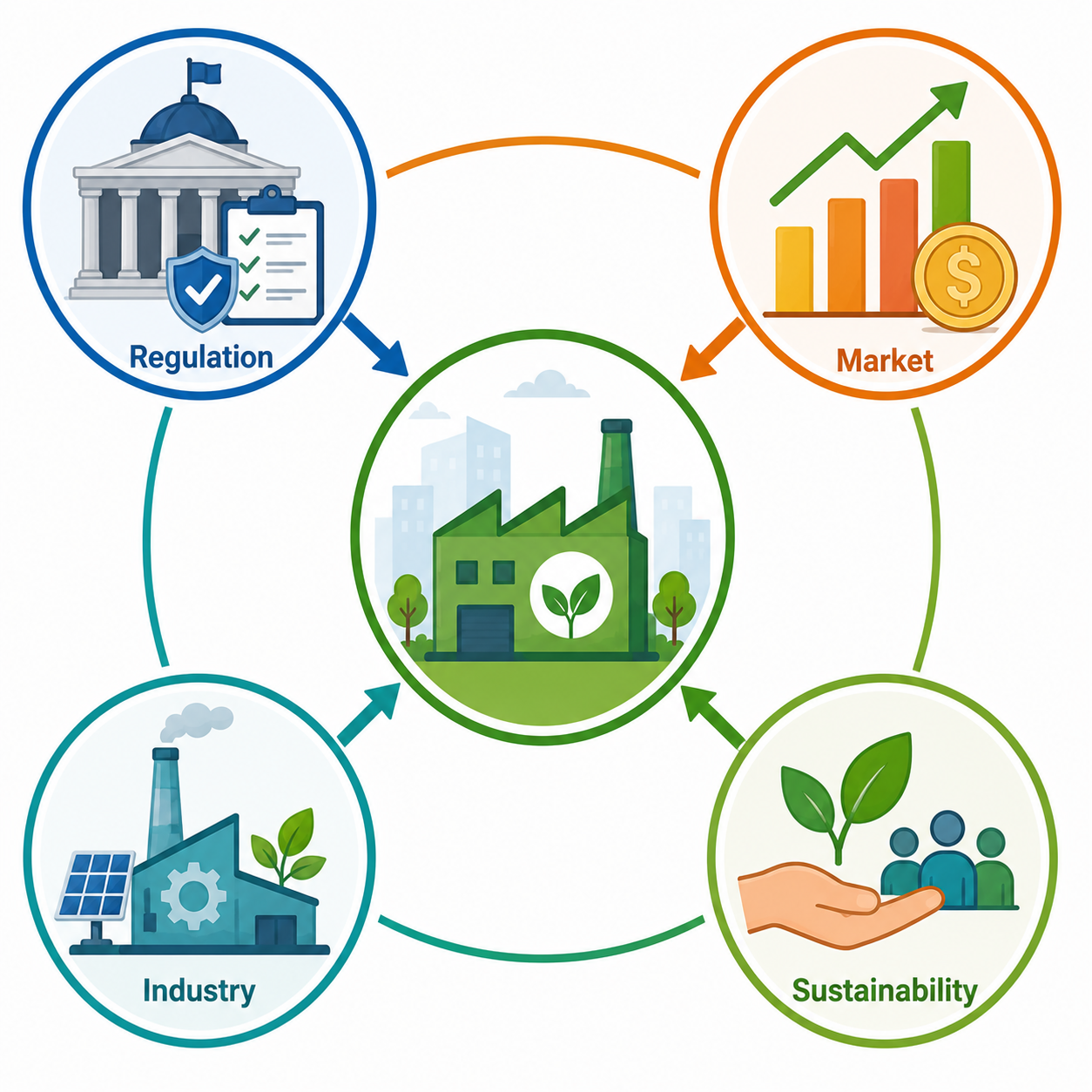 Environmental sustainability is no longer driven solely by organisational commitment or voluntary environmental initiatives. In today’s global economy, sustainability is increasingly shaped by two powerful external influences: government regulations and market forces. Governments establish legal frameworks that require organisations to minimise environmental impacts, while markets reward organisations that demonstrate strong environmental performance, innovation, transparency, and responsible corporate behaviour.
Across sectors such as agriculture, manufacturing, construction, mining, oil and gas, transport, healthcare, infrastructure, renewable energy, and commercial services, organisations are expected to operate in a manner that protects natural resources, prevents pollution, reduces greenhouse gas emissions, and supports sustainable development. Failure to meet these expectations can result in legal sanctions, financial losses, reputational damage, and reduced competitiveness.
Environmental managers play a strategic role in helping organisations understand and respond to these external drivers. They must interpret environmental legislation, ensure legal compliance, monitor regulatory developments, evaluate market expectations, and integrate sustainability into organisational decision-making through Environmental Management Systems (EMS). Rather than viewing regulations as obstacles, environmental professionals recognise them as mechanisms that encourage continual improvement, innovation, and responsible environmental governance.
This assessment criterion explores how government regulations establish mandatory environmental standards while market forces encourage organisations to exceed minimum compliance requirements through innovation, ESG performance, sustainable investment, and environmental leadership. Understanding the interaction between these drivers enables environmental managers to develop sustainability strategies that are legally compliant, commercially competitive, and environmentally responsible.
Definition of Government Regulations and Market Forces
Government regulations are legally enforceable rules, laws, policies, standards, and administrative requirements developed by public authorities to protect the environment, human health, and natural resources. These regulations establish the minimum environmental standards that organisations must meet during planning, construction, operation, and decommissioning activities.
Market forces refer to the economic and commercial factors that influence organisational behaviour through competition, consumer preferences, investor expectations, supply chain requirements, financial incentives, and international trade. Unlike government regulations, market forces are generally driven by stakeholder expectations rather than legal obligations. They encourage organisations to improve sustainability performance beyond minimum compliance in order to strengthen competitiveness and create long-term value.
Together, government regulations and market forces form a complementary framework that promotes sustainable development. Regulations establish the baseline for environmental protection, while market mechanisms encourage continuous innovation and environmental excellence.
Importance of Government Regulations and Market Forces in Sustainability
Environmental sustainability cannot be achieved through voluntary initiatives alone. Strong regulatory frameworks ensure that all organisations meet minimum environmental standards, while competitive market conditions motivate organisations to improve performance beyond legal compliance.
Understanding the importance of these external drivers enables environmental managers to make informed strategic decisions and support long-term organisational resilience.
Protecting the Environment
Government regulations establish legally binding controls that reduce environmental degradation by limiting pollution, protecting biodiversity, conserving water resources, and managing waste responsibly.
Examples include:
- Air emission standards.
- Water discharge permits.
- Waste management regulations.
- Protected habitat legislation.
- Chemical management controls.
- Climate change policies.
Without regulatory oversight, organisations may prioritise short-term financial gains over environmental protection, increasing the risk of pollution, habitat destruction, and resource depletion.
Creating a Level Playing Field
Environmental regulations ensure that organisations within the same industry operate under comparable environmental requirements.
This prevents organisations from gaining unfair competitive advantages by ignoring environmental responsibilities.
For example:
- Manufacturing facilities must comply with similar emission standards.
- Construction companies must meet common environmental permitting requirements.
- Waste management operators must follow consistent disposal regulations.
- Energy producers must comply with established environmental monitoring obligations.
A consistent regulatory framework encourages fair competition while maintaining environmental protection.
Supporting Sustainable Economic Development
Well-designed environmental regulations stimulate technological innovation rather than restricting economic growth.
Examples include:
- Investment in renewable energy technologies.
- Development of cleaner production methods.
- Increased resource efficiency.
- Circular economy innovation.
- Green infrastructure development.
Environmental managers support sustainable economic growth by identifying environmentally responsible solutions that also improve operational efficiency and organisational competitiveness.
Strengthening Public Confidence
Communities, investors, customers, and regulators increasingly expect organisations to demonstrate responsible environmental performance.
Strong regulatory compliance and transparent sustainability reporting strengthen:
- Public trust.
- Corporate reputation.
- Investor confidence.
- Customer loyalty.
- Stakeholder relationships.
Environmental managers therefore view environmental compliance as an important component of organisational governance and corporate responsibility.
Supporting Global Sustainability Goals
Government policies increasingly align with international environmental commitments addressing:
- Climate change.
- Biodiversity conservation.
- Sustainable resource management.
- Pollution prevention.
- Sustainable consumption.
- Renewable energy transition.
Organisations contribute to these broader objectives through effective environmental management and continual improvement.
Objectives of Government Regulations and Market Drivers
Government regulations and market forces share the common objective of encouraging organisations to operate sustainably while balancing environmental protection, economic development, and social responsibility.
Their primary objectives include:
- Protecting natural ecosystems.
- Preventing pollution.
- Conserving natural resources.
- Reducing greenhouse gas emissions.
- Improving environmental governance.
- Encouraging technological innovation.
- Strengthening legal compliance.
- Supporting climate resilience.
- Promoting sustainable investment.
- Encouraging responsible production and consumption.
- Enhancing transparency and accountability.
- Supporting continual environmental improvement.
Environmental managers integrate these objectives into organisational sustainability strategies and Environmental Management Systems.
Government Regulations as Drivers of Sustainability
Government regulation remains one of the strongest mechanisms for improving environmental performance across industries. Through legislation, environmental permits, technical standards, and regulatory oversight, governments establish mandatory requirements that organisations must incorporate into their operational and strategic planning.
Environmental managers ensure that these requirements are understood, implemented, monitored, and continually reviewed.
Environmental Legislation
Environmental legislation provides the legal foundation for environmental protection by establishing mandatory requirements governing organisational activities.
Environmental legislation typically addresses:
- Pollution prevention.
- Waste management.
- Air quality.
- Water quality.
- Biodiversity conservation.
- Hazardous substances.
- Environmental permitting.
- Climate change mitigation.
- Resource management.
- Environmental reporting.
Environmental managers maintain legal compliance by:
- Monitoring legislative developments.
- Maintaining legal registers.
- Interpreting regulatory requirements.
- Advising management.
- Conducting compliance audits.
- Implementing corrective actions.
Environmental legislation encourages organisations to adopt preventive environmental management rather than reacting to environmental incidents after they occur.
Environmental Permits
Many industrial activities require environmental permits before operations can begin.
Permits establish operational conditions designed to minimise environmental impacts.
Permit requirements may include:
- Maximum emission limits.
- Wastewater discharge conditions.
- Waste storage requirements.
- Monitoring obligations.
- Reporting requirements.
- Environmental inspections.
- Emergency preparedness measures.
Environmental managers are responsible for ensuring operational activities remain within permit conditions while maintaining accurate environmental records.
Failure to comply with permit conditions may result in enforcement action, financial penalties, or suspension of operations.
Carbon Pricing Mechanisms
Carbon pricing encourages organisations to reduce greenhouse gas emissions by assigning an economic value to carbon emissions.
Common mechanisms include:
- Carbon taxes.
- Emissions trading systems.
- Carbon credit programmes.
- Cap-and-trade schemes.
These approaches encourage organisations to:
- Improve energy efficiency.
- Invest in renewable energy.
- Reduce fossil fuel consumption.
- Develop low-carbon technologies.
- Improve carbon reporting.
Environmental managers evaluate carbon performance, develop emission reduction strategies, and support organisational decarbonisation programmes.
Emission Limits
Governments establish legally enforceable limits on pollutant emissions to protect environmental quality and public health.
Emission standards commonly apply to:
- Carbon dioxide.
- Nitrogen oxides.
- Sulphur dioxide.
- Particulate matter.
- Volatile Organic Compounds.
- Industrial dust.
- Heavy metals.
Environmental managers monitor emissions using:
- Continuous Emissions Monitoring Systems (CEMS).
- Stack testing.
- Ambient air quality monitoring.
- Environmental performance indicators.
- Internal environmental audits.
Compliance with emission limits reduces pollution while strengthening organisational environmental performance.
Waste Management Regulations
Waste legislation ensures that waste is managed safely while promoting resource efficiency and pollution prevention.
Regulatory requirements commonly include:
- Waste classification.
- Hazardous waste management.
- Duty of care responsibilities.
- Waste transportation controls.
- Recycling requirements.
- Record keeping.
- Licensed disposal facilities.
- Waste hierarchy implementation.
Environmental managers coordinate waste audits, monitor waste generation, evaluate recycling performance, and identify waste minimisation opportunities.
Effective waste management supports both environmental protection and circular economy objectives.
Environmental Impact Assessment (EIA) Requirements
Environmental Impact Assessment is a legally required planning tool for many significant developments.
EIA enables decision-makers to evaluate environmental consequences before projects receive approval.
The assessment typically considers:
- Air quality impacts.
- Water resources.
- Biodiversity.
- Landscape.
- Noise.
- Traffic.
- Climate change.
- Waste generation.
- Cultural heritage.
- Community impacts.
Environmental managers coordinate the EIA process by:
- Collecting baseline environmental data.
- Identifying significant impacts.
- Evaluating alternatives.
- Developing mitigation measures.
- Supporting stakeholder consultation.
- Preparing environmental documentation.
EIA promotes informed decision-making while reducing environmental risks during project development.
Educational Table: Government Regulations Driving Environmental Sustainability
| Government Regulation | Primary Purpose | Organisational Requirements | Role of the Environmental Manager |
|---|---|---|---|
| Environmental Legislation | Protect the environment through legally enforceable requirements | Maintain compliance with environmental laws and standards | Monitor legislation, maintain legal registers, conduct compliance evaluations |
| Environmental Permits | Control environmental impacts from regulated activities | Operate within permit conditions, maintain monitoring records, submit regulatory reports | Ensure permit compliance, coordinate inspections, manage reporting obligations |
| Carbon Pricing Mechanisms | Reduce greenhouse gas emissions through economic incentives | Measure carbon emissions, reduce energy use, improve carbon performance | Conduct carbon inventories, develop decarbonisation strategies, monitor emissions |
| Emission Limits | Protect air quality and public health | Monitor pollutant emissions and maintain compliance with legal thresholds | Operate monitoring systems, evaluate emission trends, implement corrective actions |
| Waste Management Regulations | Promote safe waste handling and resource efficiency | Apply the waste hierarchy, manage hazardous waste, maintain waste documentation | Conduct waste audits, improve recycling performance, support circular economy initiatives |
| Environmental Impact Assessment (EIA) | Assess environmental impacts before project approval | Identify environmental risks, evaluate mitigation measures, consult stakeholders | Coordinate EIA studies, support decision-making, develop environmental management plans |
Workplace Example
A large cement manufacturing company planned to expand its production facility to meet increasing market demand. Before construction could begin, the organisation was required to obtain environmental permits and complete an Environmental Impact Assessment in accordance with national environmental legislation. The Environmental Manager coordinated baseline environmental surveys, assessed potential impacts on air quality, water resources, biodiversity, and nearby communities, and developed mitigation measures including dust suppression systems, wastewater treatment upgrades, habitat restoration plans, and continuous emissions monitoring.
During project implementation, the Environmental Manager ensured compliance with permit conditions through regular inspections, environmental monitoring, and internal audits. As a result, the project proceeded without significant regulatory issues, environmental performance improved, and the organisation strengthened its relationship with regulators and local stakeholders.
Biodiversity Protection Laws
Biodiversity protection laws play a fundamental role in conserving ecosystems, protecting endangered species, and maintaining the ecological processes that support sustainable development. Governments establish legal frameworks to ensure that industrial development, infrastructure projects, agriculture, mining, forestry, and urban expansion do not cause irreversible damage to natural habitats.
Environmental managers must understand how biodiversity legislation influences organisational planning and operational activities. Before commencing new developments, organisations are often required to assess ecological impacts and implement measures to avoid, minimise, restore, or compensate for biodiversity loss.
Typical biodiversity protection measures include:
- Protection of endangered species.
- Conservation of protected habitats.
- Wetland preservation.
- Wildlife corridor protection.
- Restrictions on land clearance.
- Habitat restoration programmes.
- Biodiversity monitoring.
- Ecological offset requirements where applicable.
Environmental managers support compliance by:
- Conducting ecological surveys.
- Coordinating biodiversity assessments.
- Developing Biodiversity Action Plans (BAPs).
- Monitoring habitat quality.
- Managing invasive species.
- Reporting biodiversity performance.
- Working with ecological specialists and regulators.
Integrating biodiversity protection into Environmental Management Systems (EMS) helps organisations reduce environmental risks while supporting ecosystem resilience and long-term sustainability.
Water Quality Standards
Freshwater is a critical natural resource for industry, agriculture, public health, and ecosystem stability. Governments establish water quality standards to prevent pollution and protect rivers, lakes, groundwater, coastal waters, and drinking water supplies.
Water quality regulations typically control:
- Industrial wastewater discharges.
- Agricultural runoff.
- Chemical contamination.
- Sediment pollution.
- Thermal discharges.
- Nutrient loading.
- Oil pollution.
- Wastewater treatment performance.
Environmental managers ensure compliance by implementing comprehensive water management programmes.
Key responsibilities include:
- Monitoring wastewater quality.
- Sampling receiving water bodies.
- Maintaining treatment facilities.
- Managing spill prevention systems.
- Investigating pollution incidents.
- Reporting monitoring results.
- Improving water efficiency.
Water stewardship has become an important component of corporate sustainability strategies because water scarcity increasingly threatens operational continuity and supply chain resilience.
Climate Change Policies
Climate change policies encourage organisations to reduce greenhouse gas emissions while improving climate resilience.
Governments implement climate-related policies through:
- National carbon reduction targets.
- Climate adaptation strategies.
- Greenhouse gas reporting requirements.
- Energy efficiency regulations.
- Renewable energy policies.
- Low-carbon transport initiatives.
- Industrial decarbonisation programmes.
- Sustainable infrastructure planning.
Environmental managers support implementation by:
- Measuring organisational carbon footprints.
- Conducting greenhouse gas inventories.
- Developing decarbonisation roadmaps.
- Supporting renewable energy projects.
- Improving energy efficiency.
- Monitoring climate-related risks.
- Reporting carbon performance.
Climate policies encourage organisations to transition towards low-carbon business models while strengthening long-term resilience.
Renewable Energy Incentives
Many governments encourage renewable energy investment by providing financial and regulatory incentives.
Examples include:
- Tax incentives.
- Capital grants.
- Feed-in tariffs.
- Renewable energy certificates.
- Low-interest financing.
- Green investment programmes.
- Accelerated depreciation allowances.
- Public funding for research and innovation.
These incentives reduce investment risks while encouraging organisations to replace fossil fuels with cleaner energy technologies.
Environmental managers evaluate renewable energy opportunities through:
- Energy audits.
- Feasibility studies.
- Cost-benefit analysis.
- Environmental Impact Assessments.
- Carbon reduction modelling.
- Performance monitoring.
Renewable energy investments contribute to reduced emissions, lower operating costs, improved ESG performance, and greater energy security.
Consequences of Non-Compliance
Failure to comply with environmental regulations exposes organisations to significant legal, financial, operational, and reputational risks.
Environmental managers must understand that environmental compliance extends beyond avoiding penalties. Effective compliance protects organisational resilience, stakeholder confidence, and long-term sustainability.
Potential consequences include:
- Financial penalties and fines.
- Suspension or revocation of environmental permits.
- Criminal or civil legal proceedings.
- Environmental remediation costs.
- Increased insurance premiums.
- Operational shutdowns.
- Project delays.
- Loss of contracts.
- Reduced investor confidence.
- Reputational damage.
- Reduced public trust.
- Increased regulatory inspections.
In many industries, a single environmental incident can result in millions of pounds or dollars in direct and indirect costs.
Environmental managers minimise these risks through proactive environmental management rather than reactive crisis response.
Role of Environmental Managers in Regulatory Compliance
Environmental managers act as the link between organisational operations and environmental regulatory requirements.
They ensure environmental obligations are translated into practical workplace procedures and operational controls.
Key responsibilities include:
- Maintaining legal registers.
- Monitoring legislative changes.
- Conducting environmental compliance evaluations.
- Coordinating environmental audits.
- Reviewing environmental permits.
- Investigating environmental incidents.
- Implementing corrective and preventive actions.
- Delivering environmental training.
- Advising senior management.
- Preparing regulatory reports.
- Supporting regulatory inspections.
- Coordinating management reviews.
Environmental managers also foster a culture of environmental responsibility by encouraging employees to understand their legal obligations and contribute to continual environmental improvement.
Market Forces Driving Sustainability
Although government regulations establish minimum environmental standards, market forces increasingly motivate organisations to exceed legal requirements. Customers, investors, financial institutions, insurers, suppliers, and international markets now expect organisations to demonstrate responsible environmental performance.
Environmental managers therefore balance legal compliance with broader commercial expectations to strengthen organisational competitiveness.
Investor Expectations Regarding ESG Performance
Environmental, Social and Governance (ESG) performance has become an important consideration for investors.
Investors increasingly assess organisations based on:
- Carbon emissions.
- Climate risk management.
- Environmental governance.
- Resource efficiency.
- Biodiversity protection.
- Sustainability reporting.
- Regulatory compliance.
- Long-term environmental strategy.
Organisations with strong ESG performance often experience:
- Improved investment opportunities.
- Lower financing costs.
- Greater shareholder confidence.
- Improved long-term resilience.
Environmental managers contribute by developing ESG strategies, improving environmental performance indicators, and supporting sustainability reporting.
Customer Demand for Environmentally Responsible Products
Consumers increasingly prefer products and services that demonstrate responsible environmental performance.
Customer expectations commonly include:
- Sustainable packaging.
- Low-carbon products.
- Ethical sourcing.
- Environmentally friendly manufacturing.
- Recyclable materials.
- Reduced waste.
- Responsible supply chains.
Environmental managers work closely with procurement, production, and marketing teams to ensure environmental claims are supported by measurable evidence and verified environmental performance.
Sustainable Finance Initiatives
Banks and financial institutions increasingly incorporate sustainability into lending and investment decisions.
Examples include:
- Green bonds.
- Sustainability-linked loans.
- Climate investment funds.
- Environmental performance incentives.
- Sustainable infrastructure financing.
Environmental managers support access to sustainable finance by improving environmental performance, reducing organisational risks, and demonstrating robust environmental governance.
Green Procurement Requirements
Many public and private sector organisations require suppliers to demonstrate environmental responsibility before awarding contracts.
Green procurement criteria commonly include:
- Environmental Management Systems.
- ISO 14001 certification.
- Carbon reporting.
- Waste reduction programmes.
- Sustainable sourcing.
- Environmental compliance.
- Resource efficiency.
Environmental managers coordinate supplier environmental assessments and monitor sustainability performance throughout the supply chain.
Supply Chain Sustainability Standards
Environmental impacts frequently occur throughout the wider supply chain rather than solely within an organisation’s own operations.
Environmental managers encourage suppliers to improve sustainability through:
- Environmental audits.
- Supplier codes of conduct.
- Carbon reduction programmes.
- Responsible sourcing policies.
- Waste reduction initiatives.
- Sustainable logistics.
- Continuous performance monitoring.
Collaborative supply chain management improves overall environmental performance while reducing commercial risks.
Corporate Reputation
Environmental performance significantly influences organisational reputation.
A strong environmental reputation supports:
- Customer loyalty.
- Investor confidence.
- Employee engagement.
- Regulatory relationships.
- Market competitiveness.
- Community trust.
Conversely, poor environmental performance may attract negative media attention, damage stakeholder relationships, and reduce long-term profitability.
Environmental managers therefore promote transparency, continual improvement, and responsible environmental governance.
Insurance Requirements
Insurance providers increasingly assess environmental risks when determining insurance premiums and coverage conditions.
Organisations demonstrating strong environmental management often benefit from:
- Lower insurance costs.
- Improved risk ratings.
- Reduced environmental liabilities.
- Better business resilience.
Environmental managers support insurers by maintaining accurate environmental records, conducting risk assessments, and implementing preventive environmental controls.
International Trade Expectations
International markets increasingly require suppliers to demonstrate compliance with recognised environmental standards.
Global customers often request evidence of:
- Environmental Management Systems.
- ESG performance.
- Carbon reduction initiatives.
- Sustainable procurement.
- Responsible waste management.
- Environmental auditing.
- Regulatory compliance.
Environmental managers ensure organisations remain competitive by aligning environmental performance with international expectations.
Workplace Example
A multinational electronics manufacturer sought to supply products to international retailers with strict sustainability requirements. Although the organisation already complied with national environmental legislation, customers required additional evidence of environmental responsibility, including ISO 14001 certification, carbon reporting, responsible sourcing, waste reduction, and supplier sustainability assessments.
The Environmental Manager led a comprehensive improvement programme involving enhanced environmental monitoring, supply chain audits, renewable energy procurement, waste minimisation initiatives, and ESG reporting. As a result, the organisation secured long-term contracts with international retailers, strengthened investor confidence, improved operational efficiency, and significantly enhanced its environmental reputation.
Balancing Regulation and Innovation
Leading organisations recognise that compliance with environmental legislation represents the minimum acceptable standard rather than the ultimate objective of sustainability. While government regulations establish mandatory environmental requirements, organisations that rely solely on compliance often miss opportunities to improve operational efficiency, reduce long-term environmental risks, strengthen competitiveness, and create strategic value.
Environmental managers therefore encourage organisations to adopt an approach that combines regulatory compliance with continuous innovation. This enables businesses not only to satisfy legal obligations but also to anticipate future environmental challenges, respond to changing stakeholder expectations, and position themselves as sustainability leaders within their industries.
An effective balance between regulation and innovation provides several organisational advantages, including:
- Improved environmental performance.
- Greater operational efficiency.
- Increased resource productivity.
- Enhanced climate resilience.
- Reduced long-term operating costs.
- Improved ESG performance.
- Stronger investor confidence.
- Increased customer trust.
- Enhanced regulatory relationships.
- Greater competitive advantage.
Environmental managers achieve this balance by integrating environmental objectives into strategic planning, investment decisions, research and development, procurement, and organisational governance.
Voluntary Sustainability Initiatives
Many organisations voluntarily adopt sustainability programmes that extend beyond legal compliance. These initiatives demonstrate environmental leadership, improve corporate reputation, and prepare organisations for future regulatory developments.
Net Zero Commitments
Net Zero refers to achieving a balance between greenhouse gas emissions produced and emissions removed from the atmosphere.
Organisations develop Net Zero strategies by:
- Measuring organisational carbon footprints.
- Reducing operational emissions.
- Improving energy efficiency.
- Increasing renewable energy use.
- Electrifying transport fleets.
- Improving supply chain sustainability.
- Investing in carbon removal where appropriate.
Environmental managers coordinate carbon reduction programmes, monitor progress, and ensure alignment with organisational climate objectives.
Benefits include:
- Reduced climate risks.
- Improved ESG ratings.
- Lower energy costs.
- Greater investor confidence.
- Stronger market reputation.
Science-Based Emission Reduction Targets
Science-Based Targets (SBTs) establish greenhouse gas reduction objectives aligned with climate science and internationally recognised pathways for limiting global temperature increases.
Environmental managers contribute by:
- Conducting carbon inventories.
- Establishing measurable emission reduction targets.
- Monitoring greenhouse gas performance.
- Reporting progress transparently.
- Reviewing performance annually.
Science-based targets ensure carbon reduction programmes are evidence-based rather than arbitrary.
Environmental, Social and Governance (ESG) Reporting
ESG reporting enables organisations to communicate environmental, social, and governance performance to investors, regulators, customers, employees, and other stakeholders.
Environmental reporting commonly includes:
- Greenhouse gas emissions.
- Energy consumption.
- Water use.
- Waste generation.
- Recycling rates.
- Biodiversity initiatives.
- Environmental incidents.
- Climate risks.
- Environmental governance.
Environmental managers coordinate data collection, performance verification, and sustainability reporting to ensure information is accurate, transparent, and meaningful.
Carbon Neutrality Programmes
Carbon neutrality programmes seek to eliminate or offset operational greenhouse gas emissions.
Strategies may include:
- Renewable electricity procurement.
- Energy efficiency improvements.
- Low-carbon technologies.
- Sustainable transport.
- Carbon offset projects.
- Reforestation initiatives.
Environmental managers evaluate the effectiveness of carbon neutrality programmes through carbon accounting, environmental monitoring, and continual performance reviews.
Biodiversity Action Plans
Many organisations voluntarily develop Biodiversity Action Plans (BAPs) to protect ecosystems beyond minimum legal requirements.
Typical actions include:
- Habitat restoration.
- Native tree planting.
- Pollinator conservation.
- Wetland enhancement.
- Ecological monitoring.
- Species protection programmes.
- Invasive species management.
Environmental managers monitor biodiversity indicators and collaborate with ecological specialists to evaluate programme effectiveness.
Circular Economy Strategies
Circular economy strategies aim to eliminate waste by keeping products and materials in productive use for as long as possible.
Key initiatives include:
- Product redesign.
- Repair and refurbishment.
- Material recovery.
- Closed-loop manufacturing.
- Recycling systems.
- Industrial symbiosis.
- Sustainable packaging.
Environmental managers evaluate resource flows throughout product life cycles and identify opportunities to reduce waste while improving resource efficiency.
Sustainable Supply Chain Programmes
Environmental impacts frequently occur beyond an organisation’s own operations.
Sustainable supply chain programmes promote responsible environmental management throughout procurement, manufacturing, logistics, and product distribution.
Environmental managers implement:
- Supplier sustainability assessments.
- Environmental audits.
- Carbon reporting requirements.
- Responsible sourcing policies.
- Sustainable procurement standards.
- Supplier training programmes.
These programmes reduce environmental risks while strengthening supply chain resilience.
Educational Table: Voluntary Sustainability Initiatives and Organisational Benefits
| Voluntary Initiative | Primary Purpose | Role of the Environmental Manager | Organisational Benefits |
|---|---|---|---|
| Net Zero Commitment | Achieve long-term greenhouse gas reduction | Develop decarbonisation plans, monitor emissions, report progress | Lower carbon footprint, improved climate resilience, stronger ESG performance |
| Science-Based Targets | Align emission reductions with climate science | Conduct carbon inventories, establish measurable targets, review performance | Credible climate action, improved stakeholder confidence |
| ESG Reporting | Improve transparency and accountability | Coordinate environmental data, prepare sustainability reports, verify performance | Improved investor confidence, stronger governance, enhanced reputation |
| Biodiversity Action Plans | Protect and restore ecosystems | Conduct ecological monitoring, coordinate habitat restoration | Improved biodiversity, reduced environmental risks, stronger regulatory relationships |
| Circular Economy Strategies | Improve resource efficiency and minimise waste | Analyse material flows, support recycling, implement resource recovery programmes | Lower waste costs, improved resource productivity, enhanced sustainability performance |
| Sustainable Supply Chain Programmes | Improve environmental performance across suppliers | Conduct supplier audits, monitor sustainability performance, encourage continual improvement | Stronger supply chain resilience, improved procurement standards, reduced environmental risks |
Monitoring and Performance Evaluation
Effective sustainability initiatives require continuous monitoring to determine whether objectives are being achieved.
Environmental managers establish Environmental Performance Indicators (EPIs) to measure progress objectively.
Typical indicators include:
- Carbon emissions.
- Energy consumption.
- Renewable energy usage.
- Water consumption.
- Waste generation.
- Recycling rates.
- Air emissions.
- Biodiversity indicators.
- Compliance incidents.
- Environmental audit findings.
- Supplier sustainability performance.
- ESG performance indicators.
Performance data should be:
- Accurate.
- Reliable.
- Timely.
- Consistent.
- Verifiable.
- Relevant.
Environmental monitoring supports:
- Evidence-based decision-making.
- Regulatory compliance.
- Management review.
- Corrective and preventive actions.
- Continual improvement.
Monitoring also enables organisations to demonstrate measurable environmental improvements to regulators, investors, customers, and other stakeholders.
Best Practices for Responding to Regulations and Market Forces
Successful organisations integrate regulatory compliance and market expectations into strategic environmental management.
Recognised best practices include:
- Maintaining an up-to-date legal register.
- Conducting regular compliance evaluations.
- Implementing ISO 14001 Environmental Management Systems.
- Monitoring Environmental Performance Indicators.
- Integrating sustainability into business strategy.
- Engaging stakeholders throughout decision-making.
- Investing in environmental innovation.
- Promoting pollution prevention.
- Supporting sustainable procurement.
- Conducting regular environmental audits.
- Reviewing environmental risks periodically.
- Encouraging continual improvement.
These practices strengthen organisational resilience while supporting environmental protection and long-term competitiveness.
Organisational Example
A multinational infrastructure company operating in construction, transport, and renewable energy recognised that compliance with environmental legislation alone would not secure future business opportunities. Major clients required suppliers to demonstrate strong ESG performance, carbon reduction commitments, sustainable procurement practices, and ISO 14001 certification.
The Environmental Manager developed an integrated sustainability strategy that combined full regulatory compliance with voluntary environmental initiatives. The organisation introduced Net Zero targets, implemented renewable energy procurement, expanded biodiversity enhancement projects, strengthened supplier sustainability assessments, and improved environmental monitoring using digital technologies.
Performance was reviewed through regular environmental audits, compliance evaluations, Environmental Performance Indicators, and annual management reviews. Over a five-year period, the organisation achieved measurable reductions in greenhouse gas emissions, improved resource efficiency, enhanced ESG ratings, secured additional international contracts, strengthened investor confidence, and improved relationships with regulators and local communities.
This example demonstrates how balancing regulatory compliance with market-driven innovation creates both environmental and commercial value while supporting long-term organisational resilience.
Key Takeaways
- Government regulations establish mandatory environmental standards that organisations must integrate into operational and strategic decision-making.
- Environmental legislation, permits, carbon pricing, emission limits, environmental impact assessments, biodiversity protection laws, and climate policies collectively drive improved environmental performance.
- Market forces encourage organisations to exceed legal compliance through innovation, transparency, ESG performance, sustainable procurement, and responsible environmental governance.
- Environmental managers play a central role in interpreting legislation, maintaining compliance, monitoring environmental performance, and responding to changing stakeholder expectations.
- Voluntary initiatives such as Net Zero commitments, Science-Based Targets, ESG reporting, Biodiversity Action Plans, and Circular Economy strategies strengthen long-term organisational sustainability.
- Environmental Management Systems provide a structured framework for integrating regulatory requirements and market expectations into everyday organisational practice.
- Continuous monitoring using Environmental Performance Indicators supports evidence-based decision-making and continual improvement.
- Leadership commitment, stakeholder engagement, innovation, and proactive environmental management enable organisations to transform regulatory obligations into strategic business opportunities.
- Organisations that successfully balance regulation with innovation improve competitiveness, reduce environmental risks, strengthen resilience, and create long-term value for both society and the environment.
Government regulations and market forces are complementary drivers of sustainability that together shape how organisations manage their environmental responsibilities. Regulations establish the legal foundation for environmental protection by defining minimum standards for pollution control, resource management, climate action, and biodiversity conservation. At the same time, market forces encourage organisations to move beyond compliance by responding to investor expectations, customer preferences, sustainable finance requirements, and global supply chain standards. Environmental managers must understand both drivers and integrate them into strategic environmental management through Environmental Management Systems, environmental monitoring, auditing, performance evaluation, and continual improvement. By balancing regulatory compliance with innovation, organisations can reduce environmental risks, improve ESG performance, strengthen stakeholder confidence, and achieve sustainable long-term growth while contributing meaningfully to environmental protection and sustainable development.
5.Discuss the role of consumer behaviour in influencing sector-specific sustainability efforts.
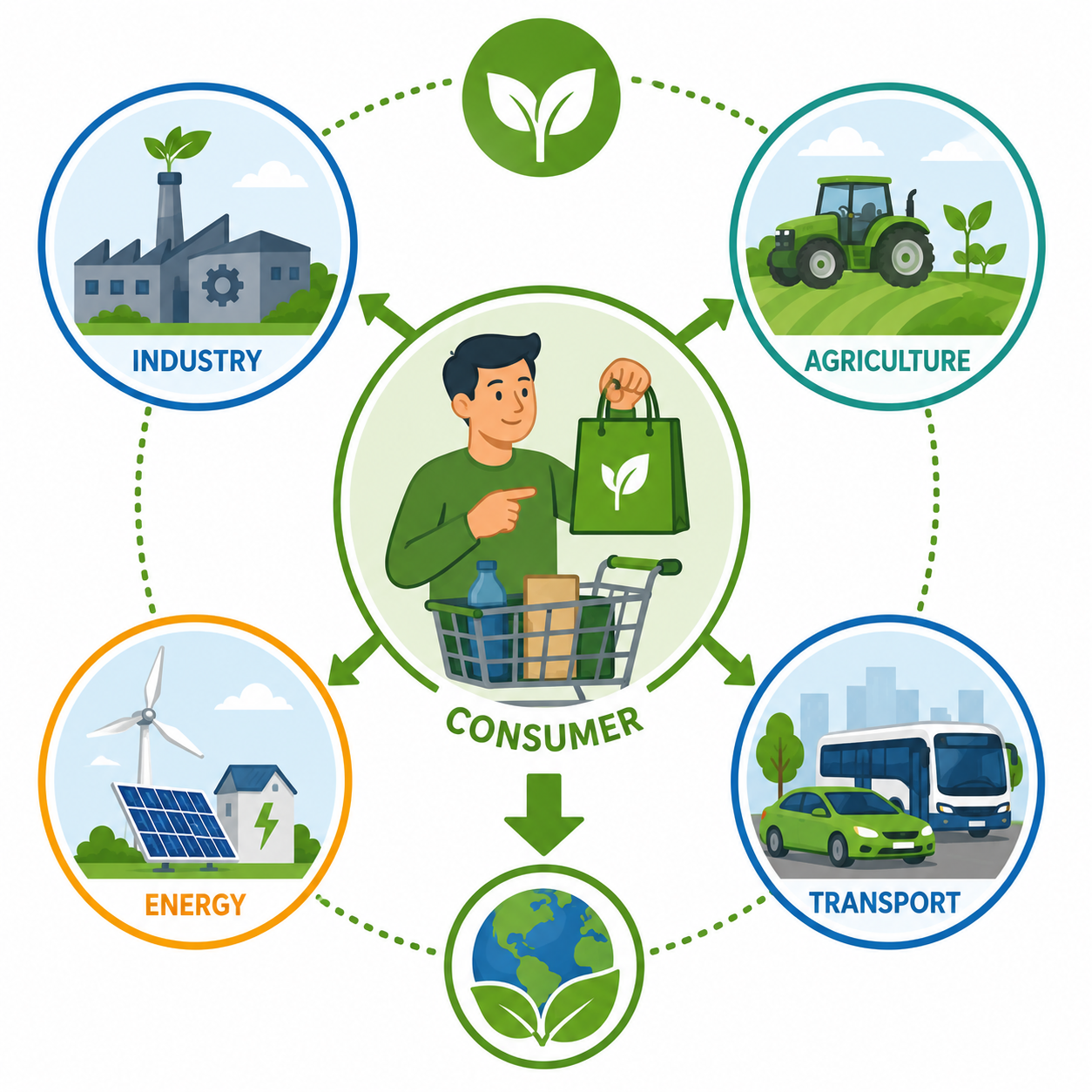 Consumer behaviour has become one of the most influential drivers of sustainability across modern industries. As environmental awareness continues to increase, consumers are no longer selecting products and services based solely on price and quality. Purchasing decisions are increasingly influenced by environmental performance, ethical business practices, product transparency, resource efficiency, climate change commitments, and corporate sustainability initiatives. This shift has transformed consumer behaviour into a powerful market force that encourages organisations to improve environmental performance and adopt more sustainable business models.
Organisations operating in sectors such as agriculture, energy, manufacturing, transport, construction, healthcare, and retail are responding to changing consumer expectations by redesigning products, reducing environmental impacts, strengthening supply chain sustainability, and investing in cleaner technologies. Consumers now expect organisations to demonstrate environmental responsibility through reduced carbon emissions, sustainable sourcing, recyclable packaging, renewable energy adoption, biodiversity protection, and transparent environmental reporting.
Environmental managers play a critical role in understanding these evolving expectations and integrating them into Environmental Management Systems (EMS). Working alongside marketing teams, operational managers, procurement specialists, and senior leadership, environmental professionals help organisations balance customer expectations, legal compliance, operational efficiency, and long-term sustainability objectives. Rather than viewing consumer behaviour as a marketing issue alone, organisations increasingly recognise it as a strategic driver that influences environmental planning, resource management, innovation, and continual improvement.
This assessment criterion examines how consumer behaviour influences sustainability efforts across different sectors, the role of environmental communication in building consumer trust, and how behavioural change encourages organisations to adopt more sustainable practices while supporting environmental protection and long-term organisational resilience.
Definition of Consumer Behaviour in Sustainability
Consumer behaviour refers to the attitudes, preferences, purchasing decisions, and consumption patterns that influence how individuals and organisations select, use, and dispose of products and services. Within the context of sustainability, consumer behaviour reflects the growing preference for products, services, and organisations that demonstrate environmental responsibility, social accountability, and ethical business practices.
Sustainable consumer behaviour includes decisions that minimise negative environmental impacts throughout a product’s life cycle, from raw material extraction and manufacturing to transportation, use, and end-of-life disposal. These decisions encourage organisations to improve environmental performance, adopt cleaner technologies, reduce waste, conserve resources, and communicate environmental performance transparently.
Unlike government regulations, which establish mandatory environmental requirements, consumer behaviour acts as a market-driven influence that rewards organisations demonstrating strong sustainability performance. Consequently, consumer expectations increasingly shape organisational strategies relating to product design, supply chain management, environmental governance, and innovation.
Importance of Consumer Behaviour in Driving Sustainability
Consumer behaviour has evolved into one of the strongest external influences on organisational sustainability strategies. Increasing public awareness of climate change, pollution, biodiversity loss, resource depletion, and environmental degradation has encouraged consumers to make purchasing decisions that support environmentally responsible businesses.
Understanding consumer behaviour enables organisations to anticipate market trends, strengthen customer relationships, improve competitiveness, and integrate sustainability into long-term business planning.
Encouraging Environmentally Responsible Business Practices
Consumers increasingly support organisations that demonstrate genuine commitment to sustainability.
Their purchasing decisions encourage organisations to:
- Reduce greenhouse gas emissions.
- Improve energy efficiency.
- Minimise waste generation.
- Use renewable energy.
- Reduce water consumption.
- Protect biodiversity.
- Improve recycling performance.
- Source materials responsibly.
Environmental managers help organisations identify opportunities to improve these areas while ensuring measurable environmental performance.
Driving Product and Service Innovation
Consumer demand encourages organisations to redesign products and services to minimise environmental impacts.
Examples include:
- Eco-friendly packaging.
- Low-carbon products.
- Energy-efficient appliances.
- Refillable product systems.
- Recyclable materials.
- Biodegradable alternatives.
- Sustainable construction materials.
Innovation improves environmental performance while creating commercial opportunities and strengthening market competitiveness.
Strengthening Corporate Reputation
Consumers increasingly associate environmental responsibility with organisational quality, integrity, and long-term reliability.
Strong environmental performance contributes to:
- Greater customer trust.
- Increased brand loyalty.
- Improved public perception.
- Enhanced stakeholder confidence.
- Competitive market advantage.
Environmental managers support these outcomes by ensuring sustainability claims are supported by robust environmental monitoring and verified environmental data.
Supporting the Circular Economy
Consumer demand for repairable, reusable, and recyclable products encourages organisations to move away from traditional linear production models.
Circular economy practices include:
- Product reuse.
- Recycling.
- Refurbishment.
- Material recovery.
- Sustainable packaging.
- Waste reduction.
- Product life extension.
Environmental managers evaluate resource flows throughout the product life cycle to improve resource efficiency and minimise waste generation.
Promoting Long-Term Sustainability
Changing consumer expectations encourage organisations to consider environmental performance as a long-term strategic objective rather than a short-term compliance exercise.
This supports:
- Sustainable investment.
- Environmental governance.
- Climate resilience.
- Resource conservation.
- Pollution prevention.
- Continual environmental improvement.
Objectives of Understanding Consumer Behaviour
Environmental managers analyse consumer behaviour to ensure sustainability strategies remain aligned with evolving stakeholder expectations and market developments.
The primary objectives include:
- Understanding changing environmental expectations.
- Supporting sustainable product development.
- Improving customer confidence.
- Reducing organisational environmental impacts.
- Encouraging resource efficiency.
- Supporting sustainable procurement.
- Promoting circular economy principles.
- Improving environmental transparency.
- Strengthening ESG performance.
- Supporting continual improvement.
- Enhancing long-term organisational resilience.
These objectives help organisations remain environmentally responsible while maintaining commercial competitiveness.
Consumer Influence Across Different Sectors
Consumer expectations vary between industries; however, their influence consistently encourages organisations to improve environmental performance and adopt more sustainable operating practices.
Environmental managers analyse consumer trends to identify opportunities for innovation, operational improvement, and environmental risk reduction.
Agriculture
Agriculture has experienced significant changes due to growing consumer awareness regarding food production, environmental protection, biodiversity, and ethical farming practices.
Consumers increasingly prefer:
- Organic products.
- Sustainably sourced food.
- Reduced pesticide use.
- Animal welfare standards.
- Fair trade products.
- Locally produced food.
- Reduced food miles.
- Environmentally friendly farming practices.
These preferences encourage agricultural organisations to improve sustainability throughout production systems.
Environmental managers support sustainable agriculture by:
- Promoting integrated pest management.
- Monitoring water consumption.
- Reducing chemical use.
- Protecting soil quality.
- Conserving biodiversity.
- Supporting regenerative farming practices.
- Monitoring environmental performance indicators.
Consumer demand for responsibly produced food has encouraged many agricultural businesses to obtain environmental certifications, improve supply chain transparency, and reduce environmental impacts throughout food production.
Energy Sector
The transition towards cleaner energy systems has been strongly influenced by changing consumer preferences.
Consumers increasingly support:
- Renewable electricity.
- Solar energy systems.
- Wind energy.
- Smart home technologies.
- Energy-efficient appliances.
- Electric vehicles.
- Battery storage systems.
- Low-carbon energy providers.
Growing demand for sustainable energy has accelerated investment in renewable energy infrastructure and energy-efficient technologies.
Environmental managers contribute by:
- Conducting energy audits.
- Supporting renewable energy projects.
- Monitoring greenhouse gas emissions.
- Improving energy efficiency.
- Evaluating environmental impacts.
- Supporting carbon reduction strategies.
Consumer demand has become an important driver of national energy transitions and organisational decarbonisation programmes.
Manufacturing
Manufacturing organisations increasingly redesign products and production systems to meet consumer expectations regarding environmental responsibility.
Consumers now demand:
- Recyclable packaging.
- Environmentally responsible products.
- Sustainable sourcing.
- Durable products.
- Products with lower carbon footprints.
- Minimal packaging.
- Circular economy solutions.
- Transparent environmental information.
Environmental managers respond by implementing:
- Cleaner production technologies.
- Sustainable procurement policies.
- Waste minimisation programmes.
- Resource efficiency initiatives.
- Product Life Cycle Assessments (LCA).
- Environmental Management Systems.
- Supplier sustainability programmes.
These improvements reduce environmental impacts while strengthening customer confidence and organisational competitiveness.
Educational Table: Consumer Behaviour and Sustainability Across Key Industries
| Industry Sector | Changing Consumer Expectations | Organisational Sustainability Response | Role of the Environmental Manager |
|---|---|---|---|
| Agriculture | Organic food, fair trade products, reduced pesticide use, responsible farming | Sustainable agriculture, biodiversity conservation, regenerative farming, reduced chemical inputs | Monitor environmental impacts, improve water efficiency, support sustainable farming practices |
| Energy | Renewable electricity, energy-efficient technologies, electric vehicles | Renewable energy investment, energy efficiency programmes, carbon reduction initiatives | Conduct energy audits, monitor emissions, support renewable energy implementation |
| Manufacturing | Recyclable packaging, durable products, sustainable sourcing, environmentally responsible production | Cleaner production, circular economy initiatives, sustainable procurement, waste reduction | Implement EMS, conduct Life Cycle Assessments, improve resource efficiency |
| Common Sustainability Outcome | Increased demand for environmentally responsible products and services | Greater investment in sustainability, innovation, environmental transparency, and continual improvement | Integrate consumer expectations into environmental planning, performance monitoring, and strategic decision-making |
Workplace Example
A regional food processing company noticed a significant increase in customer demand for environmentally responsible products. Market research indicated that consumers preferred food packaged in recyclable materials, sourced from sustainable farms, and produced using renewable energy. In response, the Environmental Manager conducted an environmental review through the organisation’s Environmental Management System (EMS) and identified opportunities to improve environmental performance.
The company introduced recyclable packaging, partnered with certified sustainable agricultural suppliers, upgraded production equipment to improve energy efficiency, and installed rooftop solar panels to reduce greenhouse gas emissions. Environmental Performance Indicators (EPIs) were established to monitor packaging waste, renewable energy usage, water consumption, and carbon emissions. Within two years, the organisation reduced packaging waste, lowered energy costs, strengthened customer loyalty, and enhanced its reputation as an environmentally responsible manufacturer.
Consumer Influence Across Different Sectors (Continued)
As environmental awareness continues to grow, consumer expectations are influencing sustainability efforts across a wider range of industries beyond agriculture, energy, and manufacturing. Organisations are increasingly recognising that environmentally conscious consumers evaluate not only the products they purchase but also the environmental performance of the organisations that produce and deliver them.
Environmental managers therefore analyse consumer trends alongside regulatory requirements and business objectives to ensure sustainability initiatives remain commercially relevant and environmentally effective.
Transport Sector
The transport sector contributes significantly to greenhouse gas emissions, air pollution, energy consumption, and urban congestion. As consumers become more environmentally conscious, their travel choices and delivery expectations are encouraging transport providers to adopt cleaner and more efficient solutions.
Consumers increasingly prefer:
- Public transport services.
- Low-emission vehicles.
- Electric vehicles (EVs).
- Hybrid vehicles.
- Shared mobility services.
- Cycling and walking infrastructure.
- Carbon-neutral delivery options.
- Sustainable logistics providers.
These preferences encourage transport organisations to modernise fleets, reduce emissions, and improve operational efficiency.
Environmental managers support these initiatives by:
- Conducting fleet environmental assessments.
- Monitoring fuel consumption.
- Implementing carbon management programmes.
- Supporting vehicle electrification.
- Optimising transport routes.
- Introducing eco-driving initiatives.
- Monitoring transport-related greenhouse gas emissions.
The growing popularity of sustainable transport also encourages organisations to invest in charging infrastructure, renewable electricity, intelligent transport systems, and low-carbon logistics networks.
Construction Sector
The construction industry has experienced increasing pressure from clients, investors, and building occupants to reduce environmental impacts throughout the project lifecycle.
Consumers and property developers increasingly expect:
- Energy-efficient buildings.
- Sustainable construction materials.
- Green building certifications.
- Low-carbon construction methods.
- Water-efficient buildings.
- Renewable energy integration.
- Waste minimisation during construction.
- Healthy indoor environments.
These expectations encourage construction companies to integrate sustainability into project planning, design, procurement, construction, and facility management.
Environmental managers contribute by:
- Conducting Environmental Impact Assessments (EIA).
- Supporting sustainable site management.
- Monitoring construction waste.
- Improving resource efficiency.
- Managing environmental risks.
- Protecting biodiversity during development.
- Monitoring compliance with environmental permits.
Consumer demand for sustainable buildings has accelerated investment in green construction technologies and environmentally responsible infrastructure development.
Healthcare Sector
Healthcare organisations are increasingly recognising that patients and communities expect medical services to operate responsibly while minimising environmental impacts.
Consumer expectations include:
- Safe waste management.
- Reduced plastic consumption.
- Energy-efficient healthcare facilities.
- Sustainable procurement.
- Reduced pharmaceutical pollution.
- Responsible water management.
- Environmentally responsible cleaning products.
- Low-carbon healthcare services.
Environmental managers support sustainable healthcare by:
- Improving clinical waste segregation.
- Monitoring hazardous waste.
- Reducing energy consumption.
- Supporting sustainable procurement.
- Managing water efficiency.
- Conducting environmental audits.
- Monitoring environmental performance indicators.
Healthcare sustainability contributes not only to environmental protection but also to improved public health outcomes.
Retail and Commercial Organisations
Retail businesses operate in highly competitive markets where consumer purchasing decisions strongly influence sustainability strategies.
Consumers increasingly favour retailers that demonstrate:
- Sustainable packaging.
- Ethical sourcing.
- Plastic reduction initiatives.
- Carbon-neutral operations.
- Transparent environmental reporting.
- Responsible supply chains.
- Recycling programmes.
- Sustainable product ranges.
Retail organisations respond by redesigning products, reducing unnecessary packaging, improving supply chain transparency, and investing in renewable energy.
Environmental managers assist by:
- Monitoring supplier sustainability.
- Conducting packaging reviews.
- Measuring carbon emissions.
- Implementing waste reduction programmes.
- Supporting circular economy initiatives.
- Monitoring ESG performance.
Consumer demand has transformed sustainability from a corporate responsibility initiative into an important competitive advantage within the retail sector.
Environmental Communication
Consumer behaviour is influenced not only by organisational environmental performance but also by how effectively organisations communicate their sustainability achievements. Transparent, accurate, and evidence-based communication enables consumers to make informed purchasing decisions while strengthening trust and organisational credibility.
Environmental managers play a key role in ensuring that environmental information is reliable, measurable, and supported by recognised reporting frameworks such as Environmental Management Systems (EMS), ISO 14001, and Environmental Performance Indicators (EPIs).
Sustainability Reports
Sustainability reports provide stakeholders with comprehensive information regarding an organisation’s environmental, social, and governance performance.
These reports commonly include:
- Carbon emissions.
- Energy consumption.
- Water usage.
- Waste generation.
- Recycling performance.
- Climate change initiatives.
- Biodiversity projects.
- Environmental objectives.
- Progress against sustainability targets.
Environmental managers coordinate environmental data collection, performance verification, and reporting to ensure transparency and accountability.
Well-prepared sustainability reports strengthen stakeholder confidence while supporting continual improvement.
Environmental Product Declarations (EPDs)
Environmental Product Declarations provide independently verified information regarding the environmental impacts of products throughout their life cycle.
EPDs typically include:
- Raw material impacts.
- Manufacturing emissions.
- Energy consumption.
- Water use.
- Waste generation.
- Carbon footprint.
- Recycling potential.
- End-of-life considerations.
Environmental managers use Life Cycle Assessment (LCA) methodologies to generate accurate product information that supports environmentally informed purchasing decisions.
Carbon Footprint Information
Consumers increasingly wish to understand the greenhouse gas emissions associated with products and services.
Carbon footprint information enables consumers to compare alternatives based on environmental performance.
Environmental managers support carbon reporting by:
- Conducting greenhouse gas inventories.
- Measuring Scope 1, Scope 2, and relevant Scope 3 emissions.
- Improving carbon accounting.
- Supporting carbon reduction strategies.
- Monitoring progress towards climate objectives.
Transparent carbon reporting strengthens organisational credibility while encouraging continual emission reductions.
Eco-Labels
Eco-labels provide consumers with simple and recognisable indicators that products satisfy specified environmental standards.
Eco-labels commonly indicate:
- Energy efficiency.
- Sustainable forestry.
- Organic production.
- Responsible fisheries.
- Recyclability.
- Reduced environmental impacts.
- Responsible sourcing.
Environmental managers ensure products continue to satisfy certification requirements through monitoring, auditing, and continual improvement.
ESG Reporting
Environmental, Social and Governance (ESG) reporting has become increasingly important for investors, customers, regulators, and financial institutions.
Environmental reporting commonly addresses:
- Climate risks.
- Carbon emissions.
- Resource efficiency.
- Waste reduction.
- Biodiversity.
- Environmental governance.
- Regulatory compliance.
- Environmental investments.
Environmental managers contribute by collecting accurate environmental data, monitoring performance, and supporting organisational transparency.
Responsible Environmental Marketing
Consumers increasingly scrutinise environmental marketing claims and expect organisations to communicate honestly and accurately.
Responsible environmental marketing should be:
- Evidence-based.
- Transparent.
- Verifiable.
- Accurate.
- Consistent.
- Supported by environmental monitoring.
Environmental managers review environmental claims to ensure they are supported by measurable environmental performance rather than misleading promotional statements.
Responsible communication protects organisational reputation while strengthening consumer trust.
Behavioural Change and Sustainability
Consumer education and increased environmental awareness encourage behavioural changes that reduce environmental pressures while motivating organisations to develop more sustainable products and services.
Environmental managers support behavioural change through awareness programmes, stakeholder engagement, environmental reporting, and sustainability initiatives.
Waste Reduction
Consumers increasingly seek products that generate less waste throughout their life cycle.
Behavioural changes include:
- Purchasing products with minimal packaging.
- Choosing reusable products.
- Avoiding single-use plastics.
- Supporting refill systems.
- Selecting durable products.
These behaviours encourage manufacturers to redesign packaging and improve resource efficiency.
Recycling
Public participation in recycling programmes significantly improves resource recovery.
Consumers increasingly:
- Separate recyclable materials.
- Return recyclable packaging.
- Participate in take-back schemes.
- Purchase recycled products.
Environmental managers support recycling by improving product design, labelling, and waste management systems.
Energy Conservation
Consumers contribute to sustainability by reducing household and workplace energy consumption.
Examples include:
- Using energy-efficient appliances.
- Installing LED lighting.
- Reducing unnecessary electricity use.
- Supporting renewable electricity.
- Improving home insulation.
Growing demand for energy-efficient technologies encourages further innovation within the energy sector.
Sustainable Purchasing
Consumers increasingly consider environmental impacts before making purchasing decisions.
Common purchasing considerations include:
- Product durability.
- Sustainable sourcing.
- Carbon footprint.
- Recyclability.
- Ethical production.
- Environmental certifications.
These expectations encourage organisations to integrate sustainability into product development and procurement strategies.
Reduced Food Waste
Food waste contributes significantly to greenhouse gas emissions and unnecessary resource consumption.
Consumers reduce food waste by:
- Planning purchases carefully.
- Storing food correctly.
- Reducing unnecessary disposal.
- Supporting food redistribution initiatives.
Reduced food waste improves food security while lowering environmental impacts.
Responsible Transport Choices
Consumers increasingly reduce transport emissions by:
- Using public transport.
- Cycling.
- Walking.
- Car sharing.
- Purchasing electric vehicles.
- Combining journeys efficiently.
These behaviours reduce air pollution, greenhouse gas emissions, and fuel consumption.
Water Conservation
Water scarcity has encouraged consumers to adopt more responsible water use practices.
Examples include:
- Installing water-efficient fixtures.
- Repairing leaks.
- Collecting rainwater.
- Reducing unnecessary water consumption.
- Purchasing water-efficient appliances.
Consumer demand for water-efficient products encourages innovation across manufacturing and construction industries.
Educational Workplace Example
A national supermarket chain observed increasing customer demand for environmentally responsible products and greater transparency regarding environmental performance. Consumer surveys indicated strong preferences for recyclable packaging, responsibly sourced products, reduced plastic use, and lower-carbon supply chains.
The Environmental Manager conducted a strategic review through the organisation’s Environmental Management System (EMS) and introduced several sustainability initiatives. These included replacing single-use plastic packaging with recyclable alternatives, improving supplier sustainability assessments, expanding locally sourced products, installing energy-efficient refrigeration systems, and publishing annual sustainability reports supported by independently verified environmental data.
Environmental Performance Indicators (EPIs) monitored packaging waste, energy consumption, recycling rates, supplier compliance, and greenhouse gas emissions. Within three years, the organisation achieved significant reductions in plastic waste and operational carbon emissions while strengthening customer loyalty, improving ESG performance, and enhancing its reputation as a responsible retailer.
Integrated Organisational Example
Organisation Background
A multinational food manufacturing company operates processing facilities across several regions, producing packaged food products for domestic and international markets. The organisation consumes significant quantities of electricity, natural gas, water, packaging materials, and raw agricultural products. It also generates greenhouse gas emissions, wastewater, food waste, and packaging waste throughout its operations.
In recent years, the organisation observed significant changes in consumer behaviour. Customers increasingly preferred products manufactured using renewable energy, environmentally friendly packaging, responsibly sourced ingredients, and transparent sustainability reporting. At the same time, investors strengthened Environmental, Social and Governance (ESG) expectations, while governments introduced stricter environmental regulations relating to carbon emissions, waste management, and resource efficiency.
Recognising that consumer expectations had become a major driver of business competitiveness, senior management integrated sustainability into the organisation’s long-term business strategy.
Environmental Objectives
The Environmental Management Team established measurable objectives to improve environmental performance while responding to consumer expectations.
The objectives included:
- Reduce greenhouse gas emissions by 40% within ten years.
- Decrease water consumption by 25%.
- Achieve zero waste to landfill.
- Improve energy efficiency across all production facilities.
- Increase recycled content within product packaging.
- Strengthen supplier sustainability performance.
- Improve biodiversity protection within operational sites.
- Increase renewable energy use throughout manufacturing operations.
These objectives were incorporated into the organisation’s Environmental Management System (EMS) and aligned with ISO 14001 continual improvement principles.
Environmental Risks
Environmental managers conducted environmental risk assessments to identify issues that could affect both environmental performance and customer confidence.
Key risks included:
- Climate-related supply chain disruptions.
- Increasing energy prices.
- Water scarcity.
- Regulatory non-compliance.
- Packaging waste.
- Carbon taxation.
- Biodiversity impacts.
- Reputational damage arising from environmental incidents.
- Supplier environmental performance failures.
Understanding these risks enabled the organisation to develop proactive mitigation strategies rather than responding only after problems occurred.
Stakeholder Engagement
Consumer expectations were considered alongside the interests of other stakeholders to ensure balanced environmental decision-making.
The organisation actively engaged:
- Government regulators.
- Local communities.
- Investors.
- Customers.
- Employees.
- Suppliers.
- Environmental Non-Governmental Organisations (NGOs).
- Industry associations.
Regular stakeholder engagement enabled the organisation to understand changing sustainability expectations and identify opportunities for continual improvement.
Environmental Planning
Environmental managers coordinated strategic planning through the Environmental Management System by conducting:
- Environmental aspect and impact evaluations.
- Climate-related risk assessments.
- Compliance reviews.
- Carbon footprint analysis.
- Water efficiency assessments.
- Waste audits.
- Stakeholder consultations.
- Sustainability objective setting.
- Environmental improvement planning.
Planning activities ensured sustainability initiatives were evidence-based, measurable, and aligned with both consumer expectations and organisational objectives.
Implementation
To achieve its sustainability objectives, the organisation introduced several practical initiatives.
These included:
- Installing rooftop solar photovoltaic systems.
- Upgrading manufacturing equipment to improve energy efficiency.
- Introducing water recycling technologies.
- Redesigning packaging to improve recyclability.
- Reducing virgin plastic use.
- Training employees on environmental responsibilities.
- Introducing supplier sustainability assessment programmes.
- Improving environmental monitoring systems.
- Expanding sustainable procurement policies.
- Increasing biodiversity enhancement around manufacturing facilities.
Environmental managers coordinated implementation while ensuring compliance with environmental legislation and organisational environmental policies.
Environmental Management Case Study
Case Study: Sustainable Transformation of a National Logistics Company
A national logistics company operating more than 2,000 delivery vehicles experienced increasing operational costs due to rising fuel prices while simultaneously facing stronger customer demand for environmentally responsible transport services.
Environmental audits identified several significant environmental aspects including:
- Excessive diesel consumption.
- High greenhouse gas emissions.
- Inefficient route planning.
- Vehicle idling.
- Ageing vehicle fleet.
- Poor energy efficiency at logistics centres.
Senior management recognised that improving environmental performance would strengthen competitiveness while meeting customer expectations.
The Environmental Management Team developed a sustainability programme aligned with ISO 14001 and organisational ESG objectives.
Key initiatives included:
- Fleet optimisation software.
- Driver eco-training.
- Progressive electrification of delivery vehicles.
- Installation of electric vehicle charging infrastructure.
- Procurement of renewable electricity.
- Carbon reporting systems.
- Environmental KPI dashboards.
- Sustainable procurement policies.
- Biodiversity enhancement projects at logistics centres.
- Improved waste segregation and recycling systems.
Government incentives reduced investment costs for electric vehicles, while growing customer demand for low-carbon delivery services strengthened the commercial case for sustainability investment.
Following implementation, environmental monitoring demonstrated significant improvements.
Measured outcomes included:
- 28% reduction in fuel consumption.
- 35% reduction in greenhouse gas emissions.
- Improved customer satisfaction.
- Lower operating costs.
- Improved environmental compliance.
- Stronger ESG performance.
- Increased investor confidence.
- Enhanced organisational reputation.
This case demonstrates how changing consumer behaviour can encourage organisations to invest in sustainability while simultaneously improving environmental and commercial performance.
Monitoring and Performance Evaluation
Effective sustainability initiatives require continuous monitoring to evaluate whether environmental objectives are being achieved and whether consumer expectations continue to be satisfied.
Environmental managers establish Environmental Performance Indicators (EPIs) to measure organisational progress.
Common indicators include:
- Carbon emissions.
- Energy consumption.
- Renewable energy percentage.
- Water consumption.
- Waste generation.
- Recycling rates.
- Sustainable packaging usage.
- Supplier sustainability performance.
- Customer sustainability satisfaction.
- Environmental audit findings.
- Regulatory compliance.
- Environmental incidents.
- Biodiversity performance.
Environmental monitoring supports:
- Evidence-based decision-making.
- Management reviews.
- Regulatory reporting.
- ESG reporting.
- Continuous improvement.
- Stakeholder confidence.
Performance information should be accurate, consistent, timely, and independently verifiable wherever possible.
Lessons Learned
Organisations that successfully respond to changing consumer behaviour typically identify several important lessons.
These include:
- Sustainability requires visible leadership commitment.
- Environmental decisions should be supported by reliable data.
- Consumer expectations evolve continuously and require regular monitoring.
- Environmental Management Systems provide structure for sustainability implementation.
- Regulatory compliance should support rather than replace strategic sustainability planning.
- Innovation strengthens both environmental and commercial performance.
- Stakeholder engagement improves environmental decision-making.
- Environmental performance should be monitored using measurable indicators.
- Supply chain sustainability is increasingly important.
- Continual improvement supports long-term competitiveness.
These lessons demonstrate that sustainability is an ongoing organisational journey rather than a single environmental initiative.
Professional Reflections
Environmental professionals increasingly operate in environments where consumer behaviour influences strategic business decisions as strongly as regulatory requirements.
Successful environmental managers must balance:
- Legal compliance.
- Consumer expectations.
- Operational efficiency.
- Financial constraints.
- Climate risks.
- Resource availability.
- Corporate sustainability objectives.
- Stakeholder interests.
- Long-term environmental resilience.
Professional judgement requires analysing environmental data, evaluating sustainability risks, understanding market trends, and integrating sustainability into organisational strategy.
Environmental managers therefore require strong technical knowledge together with leadership, communication, and strategic planning skills.
Best Practices
Organisations responding successfully to environmentally conscious consumers commonly implement the following best practices:
- Integrate sustainability into corporate strategy.
- Maintain an effective Environmental Management System (EMS).
- Align operations with ISO 14001 principles.
- Conduct regular environmental audits.
- Monitor Environmental Performance Indicators.
- Engage consumers through transparent communication.
- Support sustainable procurement.
- Encourage supplier sustainability.
- Invest in cleaner technologies.
- Promote circular economy principles.
- Verify environmental claims before publication.
- Review sustainability objectives annually.
- Encourage employee environmental awareness.
- Strengthen stakeholder engagement.
- Promote continual improvement.
These practices improve organisational resilience while supporting sustainable development.
Key Takeaways
- Consumer behaviour has become one of the most influential market drivers shaping organisational sustainability strategies across multiple industries.
- Environmentally conscious purchasing decisions encourage organisations to improve environmental performance, reduce resource consumption, minimise waste, and invest in cleaner technologies.
- Consumer expectations influence product design, sustainable sourcing, packaging, transport, energy use, environmental communication, and corporate governance.
- Environmental managers play a central role in integrating consumer expectations into Environmental Management Systems, environmental planning, monitoring, auditing, and continual improvement.
- Transparent communication through sustainability reports, Environmental Product Declarations, eco-labels, carbon footprint information, and ESG reporting strengthens consumer trust and organisational credibility.
- Behavioural changes such as recycling, waste reduction, energy conservation, sustainable purchasing, water conservation, and responsible transport choices contribute significantly to achieving sustainability objectives.
- Environmental Performance Indicators enable organisations to monitor progress, evaluate performance, and demonstrate measurable environmental improvements.
- Successful organisations combine regulatory compliance, consumer expectations, technological innovation, and strategic leadership to achieve long-term sustainability.
- Continuous stakeholder engagement, evidence-based decision-making, and verified environmental performance support resilience, competitiveness, and environmental stewardship.
Consumer behaviour has evolved into a powerful catalyst for sustainability, influencing organisational decisions across agriculture, energy, manufacturing, transport, construction, healthcare, retail, and many other sectors. Increasing environmental awareness has transformed purchasing behaviour, encouraging organisations to improve environmental performance, develop sustainable products and services, strengthen supply chain management, and communicate environmental achievements transparently. Environmental managers play a critical role in translating these expectations into practical workplace actions through Environmental Management Systems, environmental monitoring, auditing, performance evaluation, and continual improvement. Organisations that proactively respond to changing consumer preferences through innovation, transparent communication, and strategic environmental leadership are better positioned to improve ESG performance, strengthen stakeholder confidence, enhance competitiveness, and contribute meaningfully to sustainable development.
Conclusion
Sustainable development has become a strategic priority for organisations operating in every sector of the global economy. Environmental managers and sustainability professionals are expected to lead the transition from reactive compliance towards integrated environmental governance that delivers measurable environmental, economic, and social value. By understanding the sustainability challenges facing agriculture, energy, industry, transport, and other sectors, professionals can evaluate risks, identify opportunities, and implement practical solutions that support organisational resilience and responsible resource management.
The integration of Environmental Management Systems, international standards such as ISO 14001, environmental legislation, stakeholder engagement, and continual improvement enables organisations to embed sustainability into everyday operations and long-term strategic planning. Furthermore, recognising the influence of government policy, market forces, and consumer behaviour allows organisations to respond proactively to changing expectations while strengthening competitiveness and environmental performance.
Ultimately, effective environmental leadership requires professional judgement, evidence-based decision-making, and a commitment to continual improvement. Organisations that successfully integrate sustainability into governance, operations, and organisational culture are better positioned to achieve regulatory compliance, improve environmental performance, enhance stakeholder confidence, contribute to global sustainable development goals, and secure long-term organisational success.