
Six Sigma Methods & Belt Levels: Beginner’s Guide
In the modern business world, organizations face constant pressure to deliver high-quality products and services while reducing operational costs, minimizing errors, and improving customer satisfaction. To stay competitive in rapidly changing industries, companies need effective strategies that help them improve efficiency, streamline workflows, and maintain consistent performance. One of the most powerful and globally recognized methodologies used for achieving these goals is Six Sigma.
Six Sigma is a data-driven approach focused on process improvement, defect reduction, quality management, and operational excellence. It helps businesses identify weaknesses in their systems, eliminate unnecessary waste, reduce process variation, and create more reliable and efficient operations. Over the years, Six Sigma has become an essential business improvement methodology used by organizations of all sizes across industries such as manufacturing, healthcare, construction, information technology, finance, logistics, and education.
Leading global companies such as Motorola, Toyota, and General Electric have successfully implemented Six Sigma strategies to improve productivity, increase profitability, and achieve long-term business success. Its structured methods and analytical tools allow organizations to make informed decisions based on measurable data instead of assumptions, resulting in better performance and stronger customer trust.
One of the key reasons behind the popularity of Six Sigma is its organized framework of methodologies and certification belt levels. Techniques such as DMAIC, DMADV, and Lean Six Sigma help organizations solve existing operational problems, improve process quality, and design more efficient systems. At the same time, Six Sigma belt levels — including White Belt, Yellow Belt, Green Belt, Black Belt, and Master Black Belt — provide professionals with specialized skills in leadership, quality improvement, data analysis, and project management.
This comprehensive beginner’s guide explores everything you need to know about Six Sigma methods and belt levels. You will learn how Six Sigma works, the different methodologies used for process improvement, the responsibilities associated with each certification level, the most commonly used Six Sigma tools, industry applications, career opportunities, salary potential, benefits, challenges, and practical ways businesses use Six Sigma to achieve continuous improvement and operational excellence.
What Is Six Sigma?
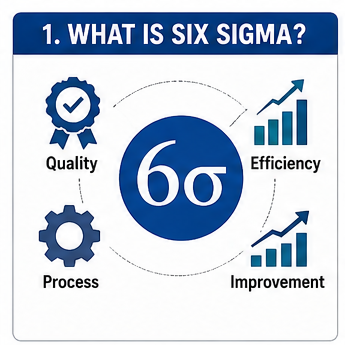
Six Sigma is one of the world’s most effective methodologies for improving quality, increasing operational efficiency, and reducing business errors. It is a structured, data-driven approach that helps organizations identify problems within their processes and develop effective solutions to improve performance. The main purpose of Six Sigma is to create smoother, faster, and more reliable business operations by minimizing defects, reducing waste, and improving consistency.
In simple words, Six Sigma helps businesses work smarter by using accurate data and proven improvement techniques instead of relying on assumptions or guesswork. Organizations use Six Sigma to improve products, services, customer experiences, and internal workflows. Whether it is a manufacturing company reducing production defects, a hospital improving patient care, or an IT company streamlining software development, Six Sigma provides a clear framework for continuous improvement.
The methodology focuses on identifying weaknesses in existing processes and eliminating anything that negatively affects quality or productivity. By improving process performance, businesses can save costs, improve customer trust, and achieve long-term growth.Six Sigma principles are also highly valuable in safety-focused industries where risk control, compliance, and operational efficiency are essential, including fire safety and building risk management.
Today, Six Sigma is widely used across industries such as:
- Manufacturing
- Healthcare
- Construction
- Information Technology
- Education
- Finance
- Logistics
- Telecommunications
Large global organizations such as Motorola, General Electric, and Toyota have successfully implemented Six Sigma to improve quality standards and business efficiency.
Understanding the Meaning of Six Sigma
The term “Six Sigma” comes from statistics and quality management principles. In statistics, “sigma” refers to the measurement of variation or deviation within a process.
A process operating at “Six Sigma” quality means the process produces extremely few defects or errors. The goal is to achieve near-perfect performance by minimizing variations that cause mistakes, delays, product failures, or customer dissatisfaction.
In practical business terms, Six Sigma aims to:
- Improve operational accuracy
- Maintain consistent quality
- Reduce process failures
- Increase productivity
- Improve customer satisfaction
The higher the sigma level, the lower the chances of defects occurring within a process.
Why Is Six Sigma Important?
In today’s highly competitive business environment, organizations must deliver high-quality products and services quickly and efficiently. Customers expect reliability, consistency, and value, while businesses aim to reduce operational costs and maximize profits.
Six Sigma helps organizations achieve these objectives by improving process quality and eliminating inefficiencies.
Without proper process management, businesses may face:
- Production defects
- Customer complaints
- Delays
- Increased operational costs
- Poor quality products
- Wasted resources
- Reduced profitability
Six Sigma provides a systematic approach to solving these problems using measurable data and analytical techniques.
Main Objectives of Six Sigma
The primary objective of Six Sigma is to improve overall business performance by reducing errors and improving operational efficiency. However, the methodology also focuses on several other important business goals.
Reducing Defects
One of the main goals of Six Sigma is defect reduction. A defect refers to any mistake, failure, or issue that prevents a product, service, or process from meeting customer expectations.
Examples of defects include:
- Manufacturing faults
- Software bugs
- Incorrect customer orders
- Delayed project delivery
- Medical errors
- Documentation mistakes
By identifying the root causes of these problems, Six Sigma helps organizations reduce defects and improve quality standards.
Eliminating Waste
Waste refers to any activity, process, or resource that does not add value to the final product or service.
Six Sigma helps organizations eliminate waste such as:
- Unnecessary movement
- Excess inventory
- Production delays
- Rework
- Overprocessing
- Idle time
Reducing waste improves operational speed and lowers business expenses.
Improving Process Consistency
Consistency is essential for maintaining product and service quality. Customers expect the same level of quality every time they interact with a business.
Six Sigma improves consistency by:
- Standardizing workflows
- Monitoring process performance
- Reducing process variation
- Creating reliable operational procedures
Consistent processes help organizations build stronger customer trust and brand reputation.
Enhancing Customer Satisfaction
Customer satisfaction is one of the most important success factors for any business. Poor quality products or delayed services can damage customer relationships and reduce brand loyalty.
Six Sigma improves customer satisfaction by:
- Delivering higher quality products
- Reducing service delays
- Improving reliability
- Meeting customer expectations consistently
Happy customers are more likely to return and recommend the business to others.
Increasing Profitability
Improved efficiency and reduced defects directly impact business profitability. When organizations reduce waste and improve operational performance, they can save money and increase revenue.
Six Sigma contributes to profitability by:
- Lowering operational costs
- Reducing product recalls
- Improving employee productivity
- Increasing customer retention
- Minimizing financial losses caused by errors
Many companies have saved millions of dollars through successful Six Sigma implementation.
How Does Six Sigma Work?
Six Sigma works through a structured process improvement framework that focuses on identifying problems, collecting data, analyzing root causes, implementing solutions, and monitoring results.
Instead of making decisions based on assumptions, Six Sigma relies on:
- Data analysis
- Performance measurements
- Statistical tools
- Process mapping
- Root cause analysis
This helps organizations make more accurate and effective business decisions.
The methodology encourages continuous improvement by constantly evaluating and improving processes over time.
Key Features of Six Sigma
Several important features make Six Sigma one of the most effective quality management methodologies in the world.
Data-Driven Decision Making
Six Sigma relies heavily on measurable data rather than opinions or assumptions. This helps organizations make objective and accurate decisions.
Structured Problem-Solving
The methodology follows step-by-step improvement processes such as DMAIC and DMADV to solve operational problems effectively.
Continuous Improvement
Six Sigma encourages businesses to continuously monitor and improve processes to maintain long-term success.
Customer-Focused Approach
Customer needs and expectations remain at the center of all Six Sigma improvement efforts.
Team Collaboration
Successful Six Sigma implementation requires cooperation between employees, managers, and leadership teams.
Difference Between Traditional Management and Six Sigma
Traditional management often focuses on short-term problem-solving, while Six Sigma emphasizes long-term process improvement using measurable data.
| Traditional Management | Six Sigma |
|---|---|
| Relies on assumptions | Uses measurable data |
| Reactive problem-solving | Proactive improvement |
| Short-term solutions | Long-term optimization |
| Limited process analysis | Detailed root cause analysis |
| Inconsistent improvements | Standardized improvements |
Real-World Example of Six Sigma
A manufacturing company producing electronic devices may experience high product defect rates. Without proper quality control, defective products can lead to customer complaints, product returns, and financial losses.
Using Six Sigma methodologies, the company can:
- Analyze production data
- Identify root causes of defects
- Improve manufacturing processes
- Standardize quality control procedures
- Monitor future performance
As a result, the company can reduce defects, improve product quality, and increase customer satisfaction.
Similarly, hospitals use Six Sigma to reduce medical errors, while logistics companies use it to improve delivery efficiency.
Why Businesses Prefer Six Sigma
Organizations worldwide prefer Six Sigma because it provides measurable and long-term business improvements.
Benefits include:
- Improved efficiency
- Better quality control
- Reduced operational costs
- Increased customer trust
- Higher employee productivity
- Better risk management
- Stronger competitive advantage
As industries continue evolving, Six Sigma remains one of the most valuable methodologies for achieving operational excellence and sustainable business growth.
History of Six Sigma
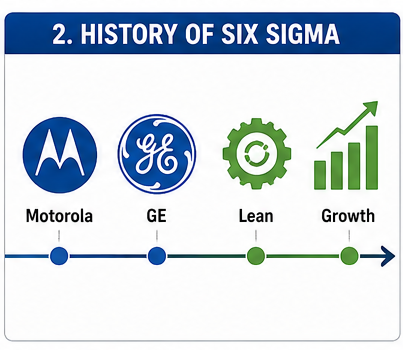
Six Sigma has become one of the most influential quality improvement methodologies in the modern business world. Today, organizations across industries use Six Sigma to improve efficiency, reduce defects, increase customer satisfaction, and strengthen overall business performance. However, the journey of Six Sigma began several decades ago when companies started searching for better ways to improve product quality and reduce operational errors.
The history of Six Sigma reflects how businesses evolved from traditional quality control systems to advanced data-driven process improvement strategies. Over time, Six Sigma transformed from a manufacturing quality initiative into a globally recognized business management methodology used in healthcare, construction, finance, IT, logistics, education, and many other industries.
Origin of Six Sigma
Six Sigma was first developed by Motorola during the 1980s. At that time, Motorola was facing serious quality-related challenges in its manufacturing processes. The company experienced high production defects, increasing operational costs, inconsistent product quality, and growing customer complaints.
To remain competitive in the global market, Motorola needed a structured system that could improve product reliability and reduce manufacturing errors.
Motorola engineers and quality experts developed Six Sigma as a statistical and process improvement methodology focused on minimizing defects and improving operational consistency.
The main goals of the original Six Sigma initiative were:
- Improve manufacturing quality
- Reduce production defects
- Increase customer satisfaction
- Lower operational costs
- Improve process efficiency
- Strengthen market competitiveness
The methodology proved highly successful, helping Motorola save billions of dollars through quality improvements and operational optimization.
Role of Bill Smith in Six Sigma Development
The concept of Six Sigma is largely credited to Bill Smith, an engineer at Motorola often referred to as the “Father of Six Sigma.”
Bill Smith recognized that traditional quality control systems mainly focused on detecting defects after production rather than preventing them during the process itself.
He believed organizations could significantly improve quality by:
- Identifying root causes of defects
- Reducing process variation
- Standardizing operations
- Using statistical analysis for decision-making
His ideas became the foundation of the Six Sigma methodology used today.
Motorola’s Success with Six Sigma
Motorola achieved remarkable improvements after implementing Six Sigma practices.
The company successfully:
- Reduced product defects
- Improved manufacturing consistency
- Increased operational efficiency
- Reduced production costs
- Improved customer satisfaction
As a result of these achievements, Motorola received the prestigious Malcolm Baldrige National Quality Award in 1988 for excellence in quality management.
This recognition helped bring global attention to Six Sigma and encouraged other companies to adopt similar quality improvement methodologies.
Expansion of Six Sigma Across Industries
After Motorola’s success, many major organizations started implementing Six Sigma to improve business performance.
One of the most influential companies in spreading Six Sigma worldwide was General Electric.
Under the leadership of Jack Welch during the 1990s, General Electric adopted Six Sigma on a large scale throughout the organization.
Jack Welch strongly believed that quality improvement and operational efficiency were essential for long-term business success.
General Electric used Six Sigma to:
- Improve operational processes
- Reduce waste
- Increase profitability
- Improve customer service
- Strengthen leadership performance
The implementation reportedly saved the company billions of dollars and significantly improved productivity across multiple business divisions.
Because of General Electric’s global influence, Six Sigma quickly gained popularity around the world.
Growth of Six Sigma Beyond Manufacturing
Although Six Sigma originally focused on manufacturing quality improvement, businesses soon realized its principles could be applied to many other industries.
Today, Six Sigma is widely used in:
Healthcare
Hospitals and healthcare organizations use Six Sigma to:
- Reduce medical errors
- Improve patient care
- Streamline hospital operations
- Improve patient safety
Information Technology
IT companies use Six Sigma to:
- Improve software quality
- Reduce system failures
- Improve project management
- Enhance technical support services
Construction
Construction firms use Six Sigma for:
- Project quality management
- Risk reduction
- Safety improvement
- Cost control
Finance
Financial institutions apply Six Sigma to:
- Improve customer service
- Reduce transaction errors
- Improve operational efficiency
- Enhance compliance management
Logistics and Supply Chain
Logistics companies use Six Sigma to:
- Improve delivery efficiency
- Reduce transportation delays
- Improve inventory management
- Optimize supply chain operations
Evolution of Lean Six Sigma
As Six Sigma continued growing, organizations started combining it with Lean manufacturing principles.
Lean methodology focuses on:
- Eliminating waste
- Improving workflow speed
- Increasing efficiency
- Reducing unnecessary activities
The combination of Lean and Six Sigma created Lean Six Sigma, a more powerful improvement system that focuses on both quality enhancement and operational efficiency.
Today, Lean Six Sigma is widely adopted by organizations seeking continuous improvement and business excellence.
Global Importance of Six Sigma Today
Today, Six Sigma is considered one of the most respected process improvement methodologies worldwide.
Organizations use it to:
- Improve quality standards
- Reduce business risks
- Increase productivity
- Improve customer satisfaction
- Strengthen profitability
- Achieve operational excellence
Six Sigma certifications are also highly valued in the global job market because they demonstrate strong analytical, leadership, and problem-solving skills.
Professionals with Six Sigma expertise are employed across industries such as:
- Manufacturing
- Healthcare
- Engineering
- Construction
- Information Technology
- Business Management
- Supply Chain Management
As businesses continue focusing on efficiency and customer satisfaction, Six Sigma remains highly relevant in modern industries.
Core Principles of Six Sigma
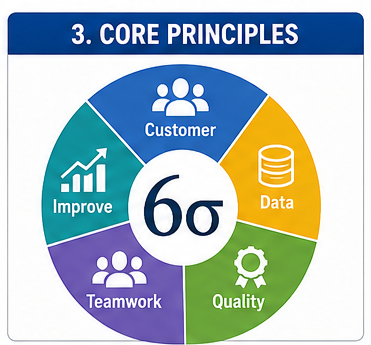
Six Sigma is built on several important principles that guide organizations in improving quality, reducing defects, and increasing operational efficiency. These principles form the foundation of the Six Sigma methodology and help businesses create reliable, customer-focused, and data-driven processes.
Understanding these principles is essential for organizations and professionals who want to successfully implement Six Sigma practices.
Focus on Customer Requirements
One of the most important principles of Six Sigma is customer focus. Every improvement effort within Six Sigma is designed to enhance customer satisfaction and deliver better value to customers.
Businesses must clearly understand:
- Customer expectations
- Product requirements
- Service quality standards
- Customer pain points
Six Sigma encourages organizations to continuously monitor customer feedback and improve processes to meet customer needs more effectively.
Customer-focused improvements help businesses:
- Increase customer loyalty
- Improve brand reputation
- Reduce complaints
- Enhance customer experiences
For example, an online shopping company may use Six Sigma to reduce delivery delays and improve customer satisfaction.
Use Data and Facts for Decision-Making
Six Sigma is strongly based on measurable data and factual analysis rather than assumptions or opinions.
Traditional business decisions are sometimes based on guesswork, past experiences, or personal judgment. However, Six Sigma uses:
- Data analysis
- Statistical measurements
- Performance tracking
- Process monitoring
This allows organizations to identify real operational problems and make accurate improvement decisions.
Data-driven decision-making helps businesses:
- Reduce uncertainty
- Improve accuracy
- Solve problems systematically
- Improve process reliability
For example, a manufacturing company may analyze defect data to identify the exact cause of production failures.
Eliminate Process Defects
Reducing defects is one of the main objectives of Six Sigma.
A defect refers to anything that prevents a product, service, or process from meeting customer expectations.
Common defects may include:
- Product failures
- Software errors
- Incorrect billing
- Delayed deliveries
- Communication mistakes
- Equipment breakdowns
Six Sigma helps organizations identify root causes of defects and eliminate them systematically.
This improves:
- Product quality
- Service reliability
- Operational consistency
- Customer satisfaction
Reducing defects also lowers operational costs because businesses spend less money correcting mistakes or replacing faulty products.
Reduce Process Variation
Process variation occurs when business operations produce inconsistent results.
For example:
- Products may vary in quality
- Delivery times may fluctuate
- Service performance may become inconsistent
High process variation can create customer dissatisfaction and reduce operational efficiency.
Six Sigma focuses on reducing variation by:
- Standardizing processes
- Monitoring performance
- Improving workflow consistency
- Using quality control systems
Consistent processes lead to more reliable business performance and improved customer trust.
Improve Processes Continuously
Continuous improvement is another key principle of Six Sigma.
Rather than making temporary improvements, Six Sigma encourages organizations to continuously monitor and improve their processes over time.
Continuous improvement helps businesses:
- Adapt to market changes
- Improve efficiency regularly
- Maintain competitive advantage
- Increase long-term profitability
Organizations using Six Sigma continuously evaluate their operations and identify new opportunities for improvement.
Encourage Team Collaboration
Successful Six Sigma implementation requires teamwork and collaboration across all levels of an organization.
Employees, managers, quality specialists, and leadership teams must work together to identify problems and implement solutions.
Team collaboration improves:
- Communication
- Problem-solving
- Innovation
- Employee engagement
Different departments often contribute valuable insights that help organizations improve overall operational performance.
For example:
- Production teams identify operational issues
- Quality teams analyze defects
- Managers coordinate improvement strategies
Collaborative efforts lead to stronger and more sustainable business improvements.
Focus on Process Improvement Instead of Blame
Six Sigma focuses on improving systems and processes rather than blaming individuals for mistakes.
Many business problems occur because of:
- Poor workflows
- Inefficient systems
- Lack of standardization
- Weak quality controls
Six Sigma encourages organizations to identify root causes and improve processes rather than criticize employees.
This creates:
- A positive work environment
- Better employee morale
- Stronger teamwork
- Improved organizational culture
Promote Proactive Problem-Solving
Traditional organizations often react to problems only after serious issues occur. Six Sigma promotes proactive problem-solving by identifying risks and weaknesses before they become major problems.
This helps businesses:
- Prevent future defects
- Reduce operational disruptions
- Improve planning
- Strengthen risk management
Proactive improvement strategies reduce long-term business losses and improve organizational stability.
Importance of Six Sigma Principles in Modern Business
The core principles of Six Sigma help organizations create efficient, reliable, and customer-focused operations.
By applying these principles, businesses can:
- Improve product and service quality
- Reduce operational costs
- Increase customer satisfaction
- Improve employee productivity
- Achieve sustainable growth
As industries continue evolving and competition increases globally, Six Sigma principles remain highly valuable for organizations seeking operational excellence and long-term success.work and effective communication.
Types of Six Sigma Methods
Six Sigma includes several powerful methodologies that help organizations improve business performance, reduce operational problems, enhance quality standards, and increase customer satisfaction. These methods provide structured frameworks that organizations use to solve process-related issues, eliminate defects, reduce waste, and improve operational efficiency.
Different Six Sigma methodologies are used for different business situations. Some methods are designed to improve existing processes, while others are used to create entirely new systems, products, or services. Choosing the correct methodology depends on the organization’s goals, operational challenges, and customer requirements.
The most commonly used Six Sigma methodologies include:
- DMAIC
- DMADV
- Lean Six Sigma
Each methodology plays an important role in helping organizations achieve continuous improvement and operational excellence.
DMAIC Methodology
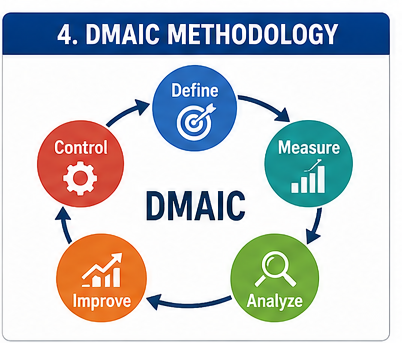
DMAIC is one of the most widely used Six Sigma methodologies for improving existing processes. It provides a structured and systematic approach for identifying problems, analyzing root causes, implementing solutions, and maintaining long-term improvements.
The word DMAIC represents five important phases:
- Define
- Measure
- Analyze
- Improve
- Control
DMAIC is commonly used when an existing process is underperforming, producing defects, creating delays, or causing customer dissatisfaction.
Organizations use DMAIC to:
- Improve process efficiency
- Reduce operational errors
- Improve product quality
- Eliminate process bottlenecks
- Increase customer satisfaction
- Reduce operational costs
DMAIC helps businesses solve problems using measurable data instead of assumptions or guesswork.
Purpose of DMAIC
The primary purpose of DMAIC is to improve existing business processes by identifying operational weaknesses and eliminating factors that negatively affect performance.
DMAIC focuses on:
- Understanding process problems
- Collecting accurate data
- Identifying root causes
- Implementing effective improvements
- Monitoring long-term results
The methodology creates a step-by-step improvement framework that organizations can follow systematically.
Define Phase
The Define phase is the first stage of DMAIC. In this phase, organizations clearly identify the problem, project objectives, process challenges, and customer expectations.
This stage helps businesses understand:
- What problem needs to be solved
- Why the issue is important
- How the issue affects customers
- What goals the project should achieve
The Define phase establishes the foundation for the entire improvement project.
Activities Performed During the Define Phase
Organizations usually perform several important tasks during this stage, including:
- Defining project scope
- Identifying customer requirements
- Creating project goals
- Understanding process limitations
- Identifying stakeholders
A clear definition of the problem helps teams remain focused throughout the improvement process.
Example of the Define Phase
A manufacturing company may discover increasing customer complaints regarding defective products. During the Define phase, the company identifies:
- The type of defects occurring
- Customer concerns
- Business losses caused by defects
- Improvement targets
This information helps the organization plan the improvement strategy.
Measure Phase
The Measure phase focuses on collecting process data and evaluating current performance levels.
Organizations gather measurable information to understand:
- Current process efficiency
- Defect rates
- Process variation
- Operational delays
- Performance gaps
Accurate data collection is extremely important because future improvement decisions depend on this information.
Objectives of the Measure Phase
The main goals of this stage include:
- Measuring current process performance
- Identifying performance indicators
- Collecting accurate operational data
- Establishing process benchmarks
Without reliable data, organizations cannot properly identify operational problems.
Tools Used in the Measure Phase
Several quality management tools may be used during this stage, including:
- Process mapping
- Check sheets
- Data collection forms
- Histograms
- Measurement systems analysis
These tools help organizations collect structured and reliable information.
Analyze Phase
The Analyze phase focuses on identifying the root causes of process problems and operational inefficiencies.
After collecting process data, organizations analyze the information to determine:
- Why defects occur
- What causes delays
- Which factors reduce quality
- Where inefficiencies exist
This phase is critical because solving the wrong problem can waste time and resources.
Importance of Root Cause Analysis
Instead of treating symptoms, Six Sigma focuses on identifying the actual source of problems.
Root cause analysis helps organizations:
- Prevent recurring issues
- Improve long-term performance
- Eliminate unnecessary costs
- Improve operational stability
Common Tools Used in the Analyze Phase
Organizations often use:
- Fishbone diagrams
- Pareto charts
- Root cause analysis
- Statistical analysis
- Cause-and-effect diagrams
These tools help teams identify the true reasons behind operational problems.
Improve Phase
The Improve phase involves developing and implementing solutions to improve process performance.
Once root causes are identified, organizations create strategies to:
- Eliminate defects
- Improve workflows
- Reduce delays
- Increase productivity
- Improve customer satisfaction
This phase focuses on testing and implementing process improvements.
Activities Performed During the Improve Phase
Organizations may:
- Redesign workflows
- Introduce automation
- Improve communication systems
- Train employees
- Standardize procedures
The goal is to create more efficient and reliable operational processes.
Example of the Improve Phase
A logistics company experiencing delayed deliveries may improve routing systems and optimize delivery schedules to reduce transportation delays.
Control Phase
The Control phase ensures that process improvements remain effective over time.
Without proper monitoring, processes may return to previous inefficient conditions. This phase helps organizations maintain long-term operational stability.
Objectives of the Control Phase
The Control phase aims to:
- Monitor process performance
- Maintain improvement results
- Prevent recurring defects
- Ensure process consistency
Organizations continuously evaluate performance to ensure sustainable improvement.
Control Methods Used in Six Sigma
Businesses may use:
- Performance monitoring systems
- Standard operating procedures
- Quality control charts
- Employee training programs
- Continuous audits
These methods help maintain operational improvements.
DMAIC Process Overview
The DMAIC process is a Six Sigma methodology used to improve existing business processes by reducing defects and increasing operational efficiency.
It follows five structured phases: Define, Measure, Analyze, Improve, and Control.
Benefits of DMAIC
DMAIC offers several important business advantages.
Reduces Operational Errors
DMAIC helps organizations identify weaknesses and eliminate recurring operational mistakes.
Improves Efficiency
Improved workflows and streamlined processes increase operational productivity.
Enhances Product and Service Quality
Reducing defects leads to better quality products and services.
Saves Business Costs
Organizations reduce waste, rework, and financial losses caused by inefficiencies.
Increases Customer Satisfaction
Improved quality and reliability strengthen customer trust and loyalty.
Supports Data-Driven Decisions
DMAIC uses measurable data to support accurate business decisions.
DMADV Methodology
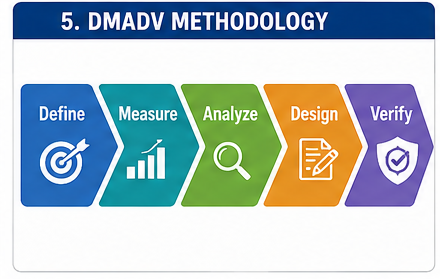
DMADV is another important Six Sigma methodology used for designing new products, services, or processes. Unlike DMAIC, which improves existing systems, DMADV focuses on creating entirely new and high-quality process designs.
The word DMADV stands for:
- Define
- Measure
- Analyze
- Design
- Verify
DMADV is commonly used when:
- Existing processes cannot meet customer expectations
- Organizations want innovative solutions
- Businesses need entirely new systems or products
- Existing processes are beyond improvement
Purpose of DMADV
The primary purpose of DMADV is to create new processes that meet customer requirements and quality standards from the beginning.
This methodology focuses on:
- Innovation
- Customer-focused design
- Long-term reliability
- Performance optimization
DMADV helps organizations avoid future quality problems by designing efficient systems from the start.
Define Phase in DMADV
Organizations identify:
- Customer needs
- Project goals
- Business objectives
- Product expectations
This stage ensures the new design aligns with customer requirements.
Measure Phase in DMADV
Businesses measure:
- Customer expectations
- Market requirements
- Technical specifications
- Performance standards
Accurate measurements help organizations create effective designs.
Analyze Phase in DMADV
Organizations analyze:
- Design alternatives
- Technical possibilities
- Risk factors
- Process capabilities
This stage helps businesses choose the best possible design solution.
Design Phase in DMADV
The Design phase focuses on creating the actual process, product, or service structure.
Organizations may:
- Develop prototypes
- Design workflows
- Create operational models
- Improve system architecture
The goal is to build an efficient and reliable process.
Verify Phase in DMADV
The Verify phase ensures the final design meets customer expectations and quality standards.
Organizations test:
- Process performance
- Product quality
- Operational reliability
- Customer satisfaction
Testing helps identify and correct weaknesses before full implementation.
DMADV Process Overview
DMADV is a Six Sigma methodology used to design new products, services, or processes that meet customer needs and quality standards.
When Is DMADV Used?
DMADV is highly useful in several business situations.
Existing Processes Cannot Meet Customer Expectations
Sometimes operational problems are too serious for minor improvements. In such cases, businesses create completely new systems.
A New Product or Service Is Needed
Organizations developing innovative products often use DMADV to ensure high-quality designs.
Businesses Want Innovative Process Designs
DMADV supports innovation by helping organizations build modern, efficient, and customer-focused systems.
High-Risk Industries Require Reliable Systems
Industries such as healthcare, aviation, and engineering often use DMADV to develop highly reliable operational processes.
Lean Six Sigma
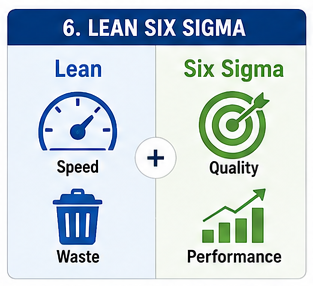
Lean Six Sigma combines Lean manufacturing principles with Six Sigma methodologies to create a powerful system for improving quality and efficiency simultaneously.
This approach focuses on:
- Eliminating waste
- Reducing defects
- Improving process speed
- Increasing operational efficiency
- Improving customer satisfaction
Lean Six Sigma helps organizations improve performance while minimizing unnecessary operational costs.
What Is Lean Methodology?
Lean methodology focuses primarily on eliminating waste and improving workflow efficiency.
Lean identifies activities that do not add value to customers and removes them from operational processes.
Main Focus Areas of Lean
Lean mainly focuses on:
- Eliminating unnecessary activities
- Reducing waiting times
- Improving workflow speed
- Increasing productivity
- Reducing excess inventory
The goal is to create faster and more efficient business operations.
What Does Six Sigma Focus On?
While Lean focuses on speed and waste reduction, Six Sigma focuses on:
- Reducing defects
- Improving consistency
- Standardizing operations
- Improving quality control
- Reducing process variation
Together, Lean and Six Sigma create a balanced improvement methodology.
Benefits of Lean Six Sigma
Lean Six Sigma offers several major business advantages.
Improves Operational Efficiency
Organizations improve workflows and reduce unnecessary operational delays.
Reduces Waste
Lean Six Sigma eliminates non-value-added activities and improves resource utilization.
Improves Product Quality
Six Sigma techniques reduce defects and improve process reliability.
Increases Customer Satisfaction
Faster delivery and better quality improve customer experiences.
Reduces Operational Costs
Improved efficiency and waste reduction lower overall business expenses.
Lean vs Six Sigma
Although Lean and Six Sigma are closely related, they focus on different improvement areas.
| Lean | Six Sigma |
|---|---|
| Focuses on waste reduction | Focuses on defect reduction |
| Improves workflow speed | Improves quality consistency |
| Eliminates non-value activities | Uses statistical analysis |
| Improves efficiency | Reduces process variation |
| Focuses on operational flow | Focuses on process accuracy |
| Increases productivity | Improves quality control |
Why Organizations Combine Lean and Six Sigma
Organizations combine Lean and Six Sigma because both methodologies complement each other effectively.
Lean improves operational speed, while Six Sigma improves quality and consistency.
Together, they help businesses:
- Improve productivity
- Reduce operational waste
- Increase efficiency
- Improve customer satisfaction
- Achieve long-term operational excellence
As competition continues increasing globally, Lean Six Sigma remains one of the most effective methodologies for achieving sustainable business improvement and operational success.
Six Sigma Belt Levels Explained
Six Sigma certifications are organized into different belt levels that represent a professional’s knowledge, skills, experience, and responsibilities in process improvement and quality management. These belt levels create a structured learning path that helps individuals gradually develop expertise in Six Sigma methodologies, leadership, problem-solving, and operational improvement.
The Six Sigma belt system is inspired by martial arts ranking systems, where each belt level represents increasing levels of knowledge and mastery. As professionals move from beginner-level certifications to advanced leadership roles, they gain deeper understanding of process analysis, quality control, statistical tools, project management, and business improvement strategies.
Six Sigma belt certifications are highly recognized worldwide because they help professionals:
- Improve analytical skills
- Develop leadership abilities
- Learn process improvement techniques
- Increase career opportunities
- Improve salary potential
- Strengthen problem-solving capabilities
Organizations also benefit from certified professionals because they help improve operational efficiency, reduce business costs, increase customer satisfaction, and maintain quality standards.
The main Six Sigma belt levels include:
- White Belt
- Yellow Belt
- Green Belt
- Black Belt
- Master Black Belt
Each certification level has different responsibilities, skill requirements, and career applications.
White Belt
The White Belt is the entry-level certification in Six Sigma. It provides a basic introduction to Six Sigma principles, methodologies, and quality improvement concepts.
White Belt professionals usually support process improvement projects and develop a general understanding of operational efficiency and quality management practices.
This certification is ideal for individuals who are new to Six Sigma and want to learn the fundamentals of process improvement.
Purpose of the White Belt Certification
The White Belt certification helps beginners understand:
- Basic Six Sigma concepts
- Process improvement principles
- Team collaboration methods
- Quality management fundamentals
- Problem-solving approaches
It provides a foundation for higher-level Six Sigma certifications.
Responsibilities of White Belt Professionals
White Belt holders usually perform supportive roles within improvement projects.
Their responsibilities may include:
- Understanding basic Six Sigma terminology
- Supporting project teams
- Participating in quality improvement discussions
- Assisting with simple operational tasks
- Learning organizational improvement processes
Although White Belt professionals are not responsible for leading projects, they contribute to organizational improvement efforts by supporting more experienced team members.
Skills Learned in White Belt Training
White Belt training usually introduces learners to:
- Basic process improvement concepts
- Introduction to Six Sigma methodologies
- Team communication skills
- Basic workflow understanding
- Customer-focused improvement principles
These skills help individuals understand how organizations improve operational quality and efficiency.
Best Candidates for White Belt Certification
White Belt certification is suitable for:
- Beginners
- Students
- Entry-level employees
- Administrative staff
- Professionals exploring Six Sigma careers
It is often the first step for individuals planning to pursue advanced Six Sigma certifications later.
Benefits of White Belt Certification
White Belt certification offers several advantages:
- Builds foundational knowledge
- Improves awareness of quality management
- Enhances career development opportunities
- Supports professional growth
- Prepares learners for higher certifications
It also helps employees understand organizational improvement initiatives more effectively.
Yellow Belt
Yellow Belt is the second level of Six Sigma certification. Professionals at this level have a stronger understanding of process improvement techniques and actively participate in Six Sigma projects.
Yellow Belts typically support Green Belts and Black Belts during improvement initiatives while handling smaller operational responsibilities.
This certification provides deeper knowledge of process analysis and problem-solving methodologies.
Purpose of Yellow Belt Certification
The Yellow Belt certification helps professionals:
- Understand Six Sigma tools
- Participate in process improvement projects
- Support quality management initiatives
- Improve operational workflows
- Contribute to team-based problem-solving
It develops practical knowledge of how Six Sigma projects operate within organizations
Responsibilities of Yellow Belt Professionals
Yellow Belt professionals usually:
- Support project teams
- Assist in data collection
- Participate in process mapping
- Help identify operational inefficiencies
- Contribute to quality improvement activities
They work closely with senior Six Sigma professionals to support improvement projects.
Skills Learned in Yellow Belt Training
Yellow Belt training focuses on developing practical improvement skills such as:
- Problem-solving techniques
- Basic data analysis
- Process mapping
- Root cause identification
- Workflow improvement methods
These skills help professionals contribute more effectively to organizational improvement efforts.
Importance of Problem-Solving Skills
Problem-solving is one of the most important skills taught in Yellow Belt certification.
Professionals learn how to:
- Identify operational issues
- Analyze workflow problems
- Suggest improvement solutions
- Support process optimization
Strong problem-solving abilities improve operational performance and productivity.
Best Candidates for Yellow Belt Certification
Yellow Belt certification is ideal for:
- Team members
- Junior supervisors
- Administrative professionals
- Process support staff
- Employees involved in operational activities
It is suitable for individuals who want active involvement in improvement projects.
Benefits of Yellow Belt Certification
Yellow Belt certification offers many career advantages:
- Improves analytical thinking
- Enhances teamwork abilities
- Develops operational knowledge
- Strengthens career progression opportunities
- Builds confidence in quality improvement projects
Many organizations value Yellow Belt professionals because they support continuous improvement initiatives effectively.
Green Belt
Green Belt is one of the most popular Six Sigma certifications because it provides advanced knowledge of process improvement and project management.
Green Belt professionals manage small to medium-sized Six Sigma projects and assist Black Belts with larger organizational improvement initiatives.
This certification focuses heavily on data analysis, process optimization, operational efficiency, and quality management.
Purpose of Green Belt Certification
Green Belt certification prepares professionals to:
- Lead process improvement projects
- Analyze operational data
- Improve workflow systems
- Reduce defects and inefficiencies
- Support organizational quality initiatives
It combines analytical skills with leadership responsibilities.
Responsibilities of Green Belt Professionals
Green Belt holders often perform important operational roles within organizations.
Their responsibilities may include:
- Conducting data analysis
- Leading process improvement projects
- Identifying operational inefficiencies
- Improving workflow performance
- Supporting quality management initiatives
- Collaborating with project teams
Green Belts help organizations improve productivity and reduce operational problems.
Skills Developed in Green Belt Training
Green Belt certification develops several advanced skills including:
- Statistical analysis
- Project management
- Process mapping
- Root cause analysis
- Quality control techniques
- Leadership abilities
These skills are highly valuable in modern business environments.
Industries That Commonly Use Green Belts
Green Belt professionals are employed in many industries.
Manufacturing Industry
Manufacturing companies use Green Belts to:
- Improve production efficiency
- Reduce product defects
- Improve quality control
- Optimize operational workflows
Healthcare Industry
Hospitals and healthcare organizations use Green Belts to:
- Improve patient care systems
- Reduce medical errors
- Improve operational efficiency
- Streamline healthcare processes
Information Technology Industry
IT companies use Green Belts for:
- Software process improvement
- Workflow optimization
- Technical quality management
- Operational efficiency
Construction Industry
Construction organizations use Green Belts to:
- Improve project management
- Enhance quality control
- Reduce project delays
- Improve safety systems
Finance Industry
Financial institutions use Green Belts to:
- Improve customer service
- Reduce transaction errors
- Optimize business processes
- Improve operational reliability
Benefits of Green Belt Certification
Green Belt certification provides major career advantages.
Benefits include:
- Increased leadership opportunities
- Better salary potential
- Improved analytical skills
- Stronger project management abilities
- Greater career flexibility
Many employers highly value Green Belt professionals because they contribute directly to business improvement initiatives.
Black Belt
Black Belt is an advanced Six Sigma certification level focused on leadership, strategic improvement, and advanced process analysis.
Black Belt professionals lead major organizational improvement projects and manage complex operational challenges.
They play an important role in helping organizations achieve long-term operational excellence and business transformation.
Purpose of Black Belt Certification
Black Belt certification prepares professionals to:
- Lead major improvement projects
- Manage cross-functional teams
- Conduct advanced data analysis
- Improve business strategies
- Support organizational transformation
Black Belts are considered highly skilled quality improvement leaders.
Responsibilities of Black Belt Professionals
Black Belt professionals are responsible for:
- Project leadership
- Strategic process improvement
- Team management
- Advanced statistical analysis
- Organizational problem-solving
- Process optimization
They often manage large-scale business improvement projects.
Skills Required for Black Belt Certification
Black Belt professionals require strong technical and leadership skills.
Important skills include:
- Leadership abilities
- Advanced data analysis
- Decision-making skills
- Project management
- Communication skills
- Strategic thinking
These skills help Black Belts successfully lead organizational change initiatives.
Importance of Leadership in Black Belt Roles
Leadership is one of the most critical aspects of Black Belt certification.
Black Belts often:
- Lead improvement teams
- Coordinate departments
- Manage organizational changes
- Train junior professionals
- Guide operational strategies
Strong leadership helps ensure successful project outcomes.
Benefits of Black Belt Certification
Black Belt certification offers significant professional benefits:
- Higher salary opportunities
- Leadership career advancement
- Increased industry recognition
- Advanced problem-solving expertise
- Greater organizational influence
Many organizations consider Black Belt professionals essential for strategic improvement projects.
Master Black Belt
Master Black Belt is the highest level of Six Sigma certification. Professionals at this level are recognized as experts in Six Sigma methodologies, leadership, quality management, and organizational transformation.
Master Black Belts usually oversee enterprise-wide improvement programs and mentor other Six Sigma professionals.
Purpose of Master Black Belt Certification
This certification prepares professionals to:
- Develop organizational improvement strategies
- Train and mentor Six Sigma professionals
- Lead business transformation initiatives
- Support executive leadership decisions
- Improve long-term operational performance
Master Black Belts play a major role in organizational development.
Responsibilities of Master Black Belt Professionals
Master Black Belts typically:
- Develop Six Sigma strategies
- Train Green Belts and Black Belts
- Lead organizational transformation
- Support executive management
- Monitor enterprise-wide improvement initiatives
They are often responsible for maintaining organizational quality standards.
Skills Required for Master Black Belt Roles
Master Black Belt professionals require:
- Advanced leadership abilities
- Expert-level statistical knowledge
- Strategic planning skills
- Training and mentoring expertise
- Business management capabilities
These professionals are considered organizational improvement experts.
Benefits of Master Black Belt Certification
Master Black Belt certification provides several major advantages:
- Executive leadership opportunities
- High salary potential
- Global professional recognition
- Strong consulting opportunities
- Expertise in organizational transformation
Many Master Black Belts work as senior consultants, executives, or quality management specialists.
Which Six Sigma Belt Should You Choose?
Choosing the right Six Sigma certification depends on several factors including:
- Career goals
- Industry requirements
- Professional experience
- Leadership responsibilities
- Interest in quality management
Each certification level serves different professional needs and career stages.
White Belt for Beginners
White Belt is ideal for individuals starting their Six Sigma journey and learning basic concepts.
Yellow Belt for Team Members
Yellow Belt is suitable for professionals who actively participate in improvement projects and support operational teams.
Green Belt for Supervisors and Analysts
Green Belt is best for professionals involved in project management, process improvement, and operational analysis.
Black Belt for Managers and Leaders
Black Belt is ideal for experienced professionals leading organizational improvement initiatives.
Master Black Belt for Experts and Consultants
Master Black Belt is designed for highly experienced professionals responsible for enterprise-wide transformation and strategic leadership.
Recommended Six Sigma Belt Levels by Career Stage
| Career Level | Recommended Belt |
|---|---|
| Students & Beginners | White Belt |
| Team Members | Yellow Belt |
| Supervisors & Analysts | Green Belt |
| Managers & Leaders | Black Belt |
| Consultants & Experts | Master Black Belt |
Importance of Choosing the Right Certification
Selecting the correct Six Sigma belt helps professionals:
- Build relevant skills
- Improve career opportunities
- Increase salary potential
- Strengthen leadership capabilities
- Gain industry recognition
As industries continue emphasizing quality improvement and operational excellence, Six Sigma certifications remain highly valuable for professionals across multiple business sectors.
Popular Six Sigma Tools
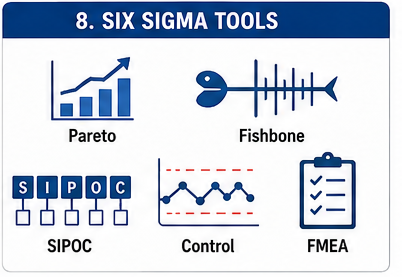
Six Sigma uses a wide range of quality management and process improvement tools that help organizations identify problems, analyze operational performance, reduce defects, and improve efficiency. These tools play a critical role in helping businesses collect accurate data, understand process weaknesses, identify root causes, and implement effective solutions.
Six Sigma tools are widely used in industries such as manufacturing, healthcare, construction, finance, logistics, and information technology because they provide structured methods for solving operational challenges and improving business performance.
The main purpose of Six Sigma tools is to:
- Improve process quality
- Reduce operational defects
- Increase efficiency
- Improve customer satisfaction
- Support data-driven decision-making
- Reduce waste and process variation
Different tools are used during different stages of Six Sigma projects depending on the organization’s goals and operational challenges.
Pareto Chart
The Pareto Chart is one of the most commonly used Six Sigma tools for identifying the most significant problems affecting a process.
This tool is based on the Pareto Principle, also known as the 80/20 rule, which states that a large percentage of problems are usually caused by a small number of factors.
For example:
- 80% of customer complaints may result from 20% of operational issues
- 80% of production defects may come from a few key causes
The Pareto Chart helps organizations prioritize the problems that have the greatest impact on business performance.
Purpose of a Pareto Chart
The main objective of a Pareto Chart is to help organizations focus on the most critical issues first instead of wasting time on minor problems.
It helps businesses:
- Identify major operational problems
- Prioritize improvement efforts
- Improve resource allocation
- Reduce defects more efficiently
- Improve decision-making
How a Pareto Chart Works
A Pareto Chart combines:
- Bar graphs
- Percentage lines
The bars show the frequency or impact of problems, while the line shows cumulative percentages.
This visual representation helps organizations easily identify which issues require immediate attention.
Example of Pareto Chart Usage
A manufacturing company experiencing product defects may use a Pareto Chart to determine:
- Which defect occurs most frequently
- Which issue causes the highest financial loss
- Which operational problem affects customer satisfaction the most
By focusing on the largest problem first, organizations can achieve faster improvements.
Benefits of Pareto Charts
Pareto Charts offer several advantages:
- Simplify problem identification
- Improve prioritization
- Support better decision-making
- Improve operational focus
- Save time and resources
Because of their simplicity and effectiveness, Pareto Charts are widely used in Six Sigma projects.
Fishbone Diagram
The Fishbone Diagram is another important Six Sigma tool used to identify the root causes of operational problems and process inefficiencies.
It is also known as:
- Cause-and-Effect Diagram
- Ishikawa Diagram
The diagram visually organizes possible causes of a problem into categories, helping teams analyze complex issues systematically.
The structure resembles the skeleton of a fish, which is why it is called a Fishbone Diagram.
Purpose of the Fishbone Diagram
The main purpose of this tool is to identify the actual root causes of a problem instead of only treating visible symptoms.
Organizations use Fishbone Diagrams to:
- Analyze operational issues
- Identify process weaknesses
- Improve problem-solving
- Reduce recurring defects
- Improve process efficiency
Categories Commonly Used in Fishbone Diagrams
Organizations often classify causes into categories such as:
- People
- Processes
- Machines
- Materials
- Environment
- Methods
These categories help teams investigate all possible contributing factors.
Example of Fishbone Diagram Usage
A hospital experiencing patient delays may use a Fishbone Diagram to identify possible causes such as:
- Staff shortages
- Poor scheduling
- Equipment issues
- Communication failures
- Administrative delays
This structured analysis helps organizations develop targeted solutions.
Benefits of Fishbone Diagrams
Fishbone Diagrams provide several advantages:
- Improve root cause analysis
- Encourage team collaboration
- Simplify complex problems
- Improve decision-making
- Prevent recurring issues
The tool is highly valuable for identifying operational inefficiencies and process failures.
SIPOC Diagram
The SIPOC Diagram is a high-level process mapping tool used in Six Sigma to provide a clear overview of business processes.
SIPOC stands for:
- Suppliers
- Inputs
- Process
- Outputs
- Customers
This tool helps organizations understand how a process operates from beginning to end.
Purpose of SIPOC Diagrams
The SIPOC Diagram helps organizations:
- Understand process flow
- Identify process components
- Improve workflow visibility
- Clarify operational relationships
- Improve communication among teams
It provides a structured overview of business operations before detailed process analysis begins.
Understanding the Components of SIPOC
Suppliers
Suppliers are the individuals, departments, or organizations that provide resources or information required for a process.
Examples include:
- Raw material vendors
- Service providers
- Internal departments
Inputs
Inputs are the materials, information, or resources needed for the process to function properly.
Examples include:
- Data
- Equipment
- Raw materials
- Customer requests
Process
The process refers to the series of steps used to complete a specific operational activity.
This section outlines how work flows within the organization.
Outputs
Outputs are the final products, services, or results produced by the process.
Examples include:
- Finished products
- Reports
- Customer services
- Deliveries
Customers
Customers are the individuals or organizations receiving the final output.
Customers may be:
- External buyers
- Internal departments
- Service users
Example of SIPOC Diagram Usage
A food delivery company may use SIPOC to map:
- Restaurants as suppliers
- Food orders as inputs
- Delivery operations as processes
- Delivered meals as outputs
- Customers receiving the orders
This helps improve workflow understanding and operational efficiency.
Benefits of SIPOC Diagrams
SIPOC Diagrams offer many benefits:
- Improve process understanding
- Enhance workflow visibility
- Improve team communication
- Support process improvement planning
- Identify operational gaps
Control Charts
Control Charts are statistical tools used to monitor process stability and performance over time.
Organizations use Control Charts to determine whether operational processes are functioning consistently or experiencing unusual variations.
Purpose of Control Charts
Control Charts help organizations:
- Monitor process performance
- Detect operational instability
- Identify unusual process variation
- Maintain quality standards
- Improve process reliability
They are essential for maintaining long-term operational consistency.
How Control Charts Work
Control Charts display process data over time using:
- Upper control limits
- Lower control limits
- Average performance lines
If data points move outside control limits, it may indicate process problems requiring corrective action.
Example of Control Chart Usage
A manufacturing company may monitor:
- Product dimensions
- Production speed
- Equipment performance
- Defect rates
This helps identify abnormal operational changes quickly.
Benefits of Control Charts
Control Charts provide several advantages:
- Improve process monitoring
- Detect problems early
- Reduce operational risks
- Improve quality control
- Support continuous improvement
Failure Mode and Effects Analysis (FMEA)
Failure Mode and Effects Analysis, commonly called FMEA, is a preventive risk management tool used to identify possible failures before they occur.
FMEA helps organizations evaluate:
- Potential operational risks
- Process weaknesses
- Failure causes
- Failure consequences
The goal is to reduce risks and improve process reliability.
Purpose of FMEA
FMEA helps businesses:
- Prevent future failures
- Improve operational safety
- Reduce financial risks
- Improve process reliability
- Enhance quality management
It supports proactive problem prevention instead of reactive problem-solving.
How FMEA Works
Organizations identify:
- Possible failures
- Causes of failures
- Effects of failures
- Risk severity
- Probability of occurrence
Teams then prioritize high-risk issues and implement preventive actions.
Example of FMEA Usage
An automotive manufacturer may use FMEA to identify:
- Potential engine failures
- Brake system weaknesses
- Electrical system risks
- Safety hazards
This helps improve vehicle reliability and customer safety.
Benefits of FMEA
FMEA offers several important advantages:
- Improves risk management
- Prevents operational failures
- Improves product reliability
- Reduces maintenance costs
- Enhances safety standards
Industries Using Six Sigma
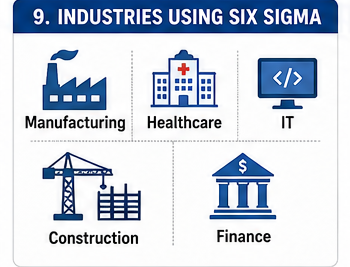
Six Sigma is widely used across multiple industries because its methodologies improve quality, efficiency, customer satisfaction, and operational reliability.
Organizations in different sectors apply Six Sigma principles to solve operational problems and improve overall business performance.
Manufacturing Industry
Manufacturing was one of the first industries to adopt Six Sigma methodologies.
Manufacturing companies use Six Sigma to:
- Improve production quality
- Reduce product defects
- Improve equipment efficiency
- Reduce production costs
- Improve supply chain operations
Companies such as Motorola and Toyota successfully use Six Sigma for operational excellence.
Healthcare Industry
Healthcare organizations use Six Sigma to improve patient care and reduce medical errors.
Applications include:
- Improving hospital workflows
- Reducing patient waiting times
- Improving patient safety
- Improving medical record accuracy
- Reducing treatment errors
Six Sigma helps healthcare providers improve both efficiency and patient satisfaction.
Construction Industry
Construction companies use Six Sigma to improve project management and operational safety.
Applications include:
- Improving quality control
- Reducing project delays
- Improving workplace safety
- Improving resource management
- Enhancing construction efficiency
Six Sigma supports better project planning and risk management in construction operations.
Information Technology Industry
IT organizations use Six Sigma to improve software development and technical services.
Applications include:
- Reducing software defects
- Improving system reliability
- Improving customer support
- Optimizing IT workflows
- Improving cybersecurity processes
Six Sigma helps IT companies improve operational performance and service quality.
Education Industry
Educational institutions use Six Sigma to improve administrative and academic processes.
Applications include:
- Improving student services
- Streamlining admissions processes
- Improving communication systems
- Enhancing operational efficiency
- Improving learning support systems
Six Sigma supports continuous improvement in educational management.
Finance Industry
Financial institutions use Six Sigma to improve customer service and reduce operational risks.
Applications include:
- Improving transaction accuracy
- Reducing processing delays
- Improving compliance management
- Enhancing customer experiences
- Optimizing operational workflows
Six Sigma helps financial organizations improve efficiency and reliability.
Real-World Examples of Six Sigma
Several globally recognized companies have successfully implemented Six Sigma methodologies to improve operational performance and business growth.
Motorola
Motorola developed Six Sigma during the 1980s to improve manufacturing quality and reduce production defects.
The company achieved major improvements in:
- Product quality
- Operational efficiency
- Customer satisfaction
- Cost reduction
Motorola’s success helped make Six Sigma globally recognized.
General Electric
General Electric adopted Six Sigma under the leadership of Jack Welch.
The company reportedly saved billions of dollars by:
- Improving operational processes
- Reducing waste
- Improving quality management
- Increasing productivity
General Electric played a major role in spreading Six Sigma worldwide.
Toyota
Toyota uses Lean Six Sigma principles to improve manufacturing efficiency and quality control.
The company focuses on:
- Eliminating waste
- Improving production flow
- Reducing operational defects
- Improving customer satisfaction
Toyota’s operational excellence is often considered a global benchmark.
Benefits of Six Sigma
Organizations implement Six Sigma because of its many operational and business advantages.
Improved Quality
Six Sigma reduces defects and improves product and service consistency.
Improved quality helps organizations:
- Build customer trust
- Improve brand reputation
- Reduce customer complaints
Cost Reduction
Organizations save money by:
- Reducing waste
- Improving efficiency
- Reducing operational failures
- Eliminating unnecessary processes
This improves overall profitability.
Higher Customer Satisfaction
Better products and services improve customer experiences and increase loyalty.
Satisfied customers are more likely to:
- Return for future business
- Recommend the company
- Build long-term relationships
Increased Productivity
Efficient workflows improve employee performance and operational speed.
This helps organizations:
- Complete work faster
- Improve resource utilization
- Increase output levels
Better Decision-Making
Six Sigma relies on measurable data and analysis.
This helps organizations:
Challenges of Six Sigma
Although Six Sigma offers many advantages, organizations may also face certain implementation challenges.
High Training Costs
Advanced Six Sigma training and certification programs can be expensive for organizations and individuals.
Resistance to Change
Employees sometimes resist new operational systems and improvement methodologies.
Change management is important for successful implementation.
Complex Statistical Tools
Some Six Sigma techniques require advanced analytical and statistical knowledge.
Professionals often need specialized training to use these tools effectively.
Time-Consuming Implementation
Large-scale process improvement projects may take considerable time to complete.
Organizations must remain committed to long-term improvement efforts.
Six Sigma Certification Process
The Six Sigma certification process helps professionals develop practical knowledge and operational improvement skills.
Most certification programs include:
- Training courses
- Project work
- Examinations
- Practical implementation
Many organizations now offer:
- Online certifications
- Classroom training
- Hybrid learning programs
Certification helps professionals improve their career opportunities and industry recognition.
Career Opportunities in Six Sigma
Certified Six Sigma professionals are highly valued across industries worldwide.
Organizations seek skilled professionals who can improve quality, efficiency, and operational performance.
Popular Job Roles in Six Sigma
Common career opportunities include:
- Quality Manager
- Process Improvement Specialist
- Operations Manager
- Business Analyst
- Lean Six Sigma Consultant
- Quality Assurance Manager
These professionals help organizations improve business performance and operational excellence.
Six Sigma Salary Expectations
Salary levels vary depending on:
- Certification level
- Industry
- Experience
- Geographic location
- Leadership responsibilities
Professionals with advanced certifications usually receive higher salaries and leadership opportunities.
| Certification Level | Average Career Level |
|---|---|
| Yellow Belt | Entry-Level |
| Green Belt | Mid-Level |
| Black Belt | Senior-Level |
| Master Black Belt | Executive-Level |
Tips to Succeed in Six Sigma
Success in Six Sigma requires continuous learning, practical experience, and strong analytical skills.
Learn the Fundamentals
Understanding basic process improvement principles creates a strong foundation for advanced learning.
Practice Problem-Solving
Real-world practice improves:
- Analytical thinking
- Decision-making
- Operational understanding
Develop Leadership Skills
Leadership is essential for managing improvement projects and guiding operational teams.
Gain Industry Experience
Practical experience improves the value of Six Sigma certifications and strengthens professional expertise.
Continue Learning
Continuous learning helps professionals stay updated with:
- New technologies
- Process improvement trends
- Industry standards
Future of Six Sigma
As organizations continue focusing on efficiency, quality management, and operational excellence, Six Sigma remains highly valuable in modern industries.
Emerging technologies are further strengthening Six Sigma applications worldwide.
Artificial Intelligence
Artificial Intelligence helps organizations improve:
- Predictive analysis
- Process automation
- Operational decision-making
Automation
Automation improves workflow efficiency and reduces manual operational errors.
Data Analytics
Advanced data analytics helps organizations identify operational trends and improvement opportunities more accurately.
Smart Manufacturing
Smart manufacturing technologies improve:
- Production monitoring
- Equipment performance
- Operational efficiency
- Quality control systems
Growing Importance of Six Sigma
As global competition continues increasing, organizations require reliable methodologies for improving quality, efficiency, and customer satisfaction.
Six Sigma remains one of the most effective systems for achieving:
- Operational excellence
- Continuous improvement
- Business growth
- Long-term organizational success
Conclusion
Six Sigma has become one of the most trusted and effective methodologies for improving quality, reducing operational defects, increasing efficiency, and achieving long-term business success. From manufacturing and healthcare to construction, finance, education, and information technology, organizations across the world use Six Sigma principles to improve productivity, strengthen quality control, and deliver better customer experiences. Its structured and data-driven approach helps businesses identify operational weaknesses, eliminate waste, improve workflows, and maintain consistent performance in highly competitive industries.
One of the greatest strengths of Six Sigma is its combination of proven methodologies and professional certification levels. Techniques such as DMAIC, DMADV, and Lean Six Sigma provide organizations with systematic frameworks for solving business problems, improving existing processes, and designing efficient operational systems. At the same time, Six Sigma belt certifications — including White Belt, Yellow Belt, Green Belt, Black Belt, and Master Black Belt — help professionals develop valuable skills in leadership, problem-solving, project management, process improvement, and data analysis. These certifications not only improve individual career opportunities but also help organizations build stronger and more efficient operational teams.
As businesses continue evolving in the modern digital era, the demand for skilled Six Sigma professionals is expected to grow significantly. Emerging technologies such as Artificial Intelligence, automation, smart manufacturing, and advanced data analytics are further enhancing the role of Six Sigma in modern industries. Organizations now require professionals who can improve efficiency, manage operational risks, optimize business processes, and support continuous improvement initiatives. Whether you are a beginner exploring Six Sigma fundamentals or an experienced professional pursuing advanced certifications, Six Sigma offers long-term career growth, global industry recognition, and valuable expertise that can contribute to both personal and organizational success.