
What Is Six Sigma? Complete Guide to Principles, Benefits, Certification & Career Growth
Six Sigma has become one of the most effective and globally recognized methodologies for improving business performance, product quality, and operational efficiency. In a world where organizations face increasing competition, rising customer expectations, and constant pressure to reduce costs, businesses need smart strategies that help them deliver consistent results while maintaining high standards. Six Sigma provides a powerful solution by helping organizations identify process weaknesses, reduce errors, eliminate waste, and improve overall productivity through structured and data-driven techniques.
Originally developed by Motorola in the 1980s and later popularized by major global companies such as General Electric, Toyota, and Amazon, Six Sigma has transformed the way businesses manage quality and process improvement. Today, it is widely used across multiple industries including manufacturing, healthcare, finance, logistics, construction, telecommunications, retail, and information technology. Organizations use Six Sigma not only to improve products and services but also to strengthen customer satisfaction, increase profitability, improve team performance, and achieve long-term business success.
At its core, Six Sigma focuses on reducing process variation and minimizing defects by using analytical methods, measurable data, and continuous improvement strategies. Instead of relying on assumptions or guesswork, Six Sigma encourages organizations to make informed decisions based on facts, performance metrics, and statistical analysis. This structured approach allows businesses to solve operational problems more effectively and maintain consistent quality standards in every stage of production or service delivery.
One of the major reasons behind the growing popularity of Six Sigma is its practical and result-oriented approach. Businesses implementing Six Sigma often experience:
- Improved operational efficiency
- Reduced production and operational costs
- Better customer experiences
- Increased employee productivity
- Faster problem-solving capabilities
- Higher product and service quality
- Stronger competitive advantage in the market
Six Sigma is also closely connected with career development and professional growth. Many employers actively seek professionals who understand process improvement, quality management, and business optimization techniques. As a result, Six Sigma certifications have become highly respected qualifications worldwide. Whether someone is a student, project manager, engineer, healthcare professional, operations manager, business analyst, or entrepreneur, learning Six Sigma can help develop valuable leadership, analytical, and decision-making skills that are highly demanded in modern industries.
Another important aspect of Six Sigma is its flexible certification structure. Professionals can progress through different certification levels such as White Belt, Yellow Belt, Green Belt, Black Belt, and Master Black Belt depending on their experience and career goals. Each level provides deeper knowledge of quality management tools, process improvement methods, and project leadership techniques, allowing individuals to expand their expertise and career opportunities.
In addition to certifications, Six Sigma is widely known for its DMAIC methodology, which stands for Define, Measure, Analyze, Improve, and Control. This step-by-step framework helps organizations identify problems, analyze root causes, implement effective solutions, and maintain long-term improvements. Combined with tools such as Pareto Charts, Fishbone Diagrams, Control Charts, and Value Stream Mapping, Six Sigma creates a complete system for achieving operational excellence and sustainable growth.
As industries continue moving toward automation, artificial intelligence, digital transformation, and data-driven operations, the importance of Six Sigma continues to grow rapidly. Organizations now use Six Sigma principles alongside modern technologies to improve efficiency, strengthen quality assurance systems, and remain competitive in evolving global markets.
This complete guide to Six Sigma will help you understand everything about this powerful methodology, including its history, principles, certification levels, DMAIC process, benefits, tools, career opportunities, salary potential, real-world applications, challenges, and future trends. Whether you are completely new to Six Sigma or looking to advance your professional knowledge, this guide will provide a detailed understanding of how Six Sigma helps businesses and individuals achieve continuous improvement and long-term success.
What Is Six Sigma?
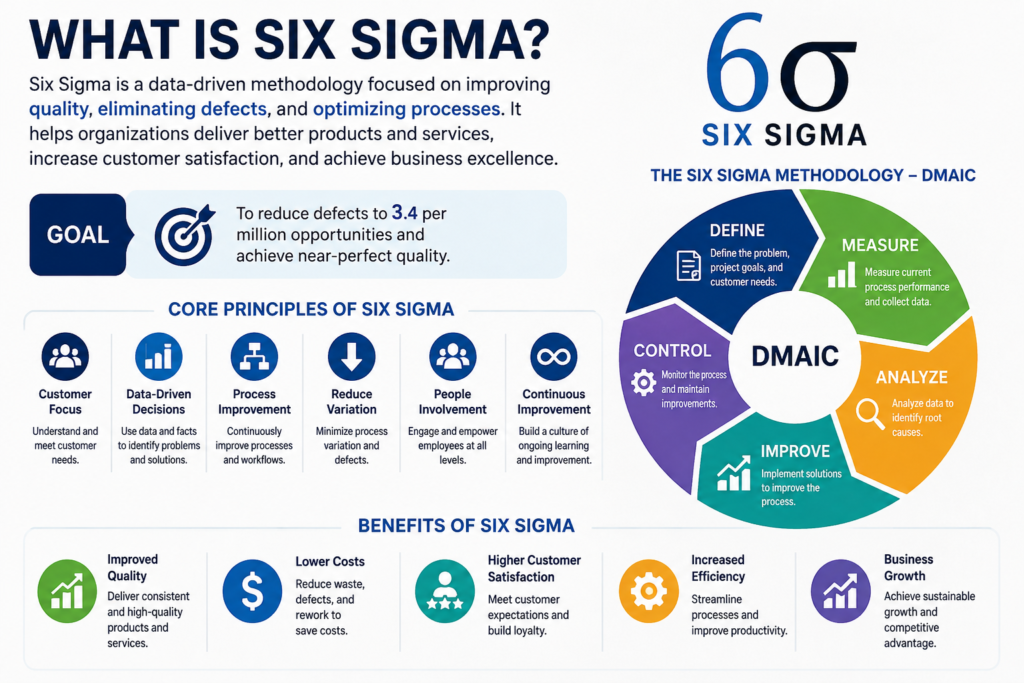
Six Sigma is a modern business improvement methodology that helps organizations improve quality, reduce mistakes, increase efficiency, and deliver better results to customers. It is a structured and data-driven approach used by companies to identify problems within business processes and develop effective solutions that improve overall performance.
In simple words, Six Sigma helps businesses work smarter by removing errors, reducing waste, and improving consistency in products and services. It focuses on making processes more reliable so that organizations can achieve better productivity, lower operational costs, and higher customer satisfaction.
Six Sigma is widely used across many industries such as manufacturing, healthcare, construction, finance, retail, logistics, education, and information technology. From producing high-quality products in factories to improving patient care in hospitals, Six Sigma helps organizations achieve continuous improvement and operational excellence.
Unlike traditional management methods that often rely on assumptions or trial-and-error approaches, Six Sigma uses measurable data, statistical analysis, and proven improvement techniques to solve problems. This makes it one of the most effective quality management systems used in modern businesses today.
Meaning of Six Sigma
The term “Six Sigma” comes from statistics and quality control measurements. In statistics, “Sigma” refers to the measurement of variation or deviation within a process. The higher the Sigma level, the fewer defects or errors exist in the process.
A Six Sigma process aims to achieve an extremely high level of quality by reducing defects to only:
- 3.4 defects per million opportunities
This means the process operates with near-perfect accuracy and consistency.
For example:
- A manufacturing company using Six Sigma produces fewer defective products.
- A hospital using Six Sigma reduces patient treatment errors.
- A delivery company using Six Sigma improves delivery accuracy and timing.
- A software company using Six Sigma reduces technical bugs and system failures.
The main purpose of Six Sigma is to make business operations smoother, faster, safer, and more efficient while maintaining high-quality standards.
Main Objective of Six Sigma
The primary objective of Six Sigma is to improve business performance by reducing errors and process variations. Every business process contains some level of variation, which may lead to:
- product defects
- service delays
- customer complaints
- increased operational costs
- wasted resources
- inconsistent quality
Six Sigma helps organizations identify these problems and improve processes systematically.
The methodology mainly focuses on:
- improving process quality
- reducing waste
- increasing efficiency
- improving customer satisfaction
- lowering operational expenses
- enhancing business productivity
Organizations implementing Six Sigma aim to create reliable systems that consistently produce high-quality results.
Why Six Sigma Is Important
In today’s highly competitive business environment, customers expect:
- better quality
- faster services
- lower prices
- reliable performance
Businesses that fail to meet these expectations may lose customers and face financial losses. Six Sigma helps organizations stay competitive by improving overall operational performance.
Some important reasons why Six Sigma is important include:
Improving Product and Service Quality
Six Sigma helps companies identify weaknesses in products and services and improve them continuously.
Reducing Errors and Defects
By analyzing processes carefully, organizations can minimize mistakes and improve accuracy.
Lowering Operational Costs
Reducing waste and inefficiencies helps businesses save money and increase profitability.
Increasing Customer Satisfaction
Better quality products and services lead to happier customers and stronger business relationships.
Improving Employee Productivity
Efficient processes help employees complete tasks more effectively and with fewer delays.
Supporting Better Decision-Making
Six Sigma uses real data and measurable results, helping managers make informed decisions.
Key Features of Six Sigma
Six Sigma contains several important features that make it different from traditional improvement methods.
Data-Driven Approach
Six Sigma relies on facts, data, and measurable information instead of assumptions or guesswork.
Businesses collect and analyze data to:
- identify problems
- measure performance
- find root causes
- monitor improvements
This allows organizations to make accurate and effective decisions.
Customer-Focused Methodology
Customer satisfaction is one of the core priorities of Six Sigma.
Organizations using Six Sigma focus on:
- understanding customer needs
- improving customer experiences
- delivering consistent quality
- reducing complaints
The goal is to provide products and services that meet or exceed customer expectations.
Continuous Improvement
Six Sigma is not a one-time improvement strategy. It promotes continuous monitoring and improvement of business processes.
Organizations regularly:
- review performance
- identify new improvement opportunities
- update procedures
- maintain quality standards
This helps businesses remain competitive and efficient over the long term.
Process Standardization
Six Sigma encourages businesses to create standardized processes that improve consistency and reduce variations.
Standardized processes help organizations:
- improve productivity
- reduce confusion
- increase efficiency
- maintain quality standards
How Six Sigma Works
Six Sigma works by identifying process problems, measuring performance, analyzing causes, implementing improvements, and monitoring results.
The methodology follows a structured improvement system known as DMAIC:
DMAIC stands for:
- Define
- Measure
- Analyze
- Improve
- Control
Each step helps organizations systematically improve business processes and maintain long-term performance improvements.
Define Phase
In this phase, organizations identify:
- the problem
- project goals
- customer expectations
- improvement objectives
The main purpose is to clearly understand what needs improvement.
Example:
A company receives frequent customer complaints about delayed deliveries.
Measure Phase
Organizations collect data to understand current process performance and identify inefficiencies.
Businesses may measure:
- delivery times
- defect rates
- customer complaints
- operational costs
- employee productivity
This helps create a clear picture of the current situation.
Analyze Phase
During the analysis stage, organizations identify the root causes of problems using analytical tools and techniques.
Businesses examine:
- process weaknesses
- operational bottlenecks
- communication issues
- quality problems
The goal is to discover why problems occur.
Improve Phase
Organizations implement solutions to eliminate process problems and improve efficiency.
Examples include:
- introducing automation systems
- improving employee training
- updating procedures
- improving communication systems
This stage focuses on creating better and more efficient workflows.
Control Phase
After improvements are implemented, businesses continuously monitor performance to ensure long-term success.
Organizations may use:
- performance reports
- quality monitoring systems
- regular audits
- process reviews
This helps maintain consistent improvements over time.
Main Goals of Six Sigma
Six Sigma helps organizations achieve several important business goals.
Reducing Defects
The methodology helps minimize product and service errors.
Improving Efficiency
Organizations improve workflow performance and productivity.
Increasing Profitability
Lower costs and better quality improve financial performance.
Enhancing Customer Experience
High-quality products and services improve customer trust and loyalty.
Improving Team Performance
Employees work more efficiently using structured processes.
Supporting Business Growth
Efficient operations help businesses expand successfully.
Industries That Use Six Sigma
Six Sigma is widely used in many industries around the world.
Manufacturing Industry
Manufacturers use Six Sigma to:
- reduce production defects
- improve product quality
- optimize supply chains
- reduce waste
Healthcare Industry
Hospitals and healthcare organizations use Six Sigma to:
- improve patient care
- reduce medical errors
- shorten waiting times
- improve operational efficiency
Information Technology Industry
IT companies use Six Sigma to:
- improve software quality
- reduce technical issues
- improve cybersecurity systems
- increase customer satisfaction
Financial Sector
Banks and financial organizations use Six Sigma to:
- improve transaction accuracy
- reduce fraud risks
- improve customer support
- streamline operations
Logistics and Supply Chain
Logistics companies use Six Sigma to:
- improve delivery performance
- reduce transportation delays
- improve warehouse management
- reduce operational costs
Benefits of Implementing Six Sigma
Businesses implementing Six Sigma often achieve significant long-term benefits.
Some major benefits include:
- improved product quality
- reduced operational costs
- better process efficiency
- improved customer satisfaction
- stronger competitive advantage
- increased profitability
- improved employee performance
- reduced waste and defects
- faster problem-solving capabilities
These benefits make Six Sigma one of the most valuable business improvement methodologies used worldwide.
Simple Example of Six Sigma
Imagine a restaurant receives frequent customer complaints because food orders are often delayed or incorrect.
Using Six Sigma, the restaurant:
- Identifies the problem
- Measures order processing times
- Analyzes causes of delays
- Improves kitchen operations
- Monitors performance regularly
As a result:
- delivery becomes faster
- order accuracy improves
- customers become happier
- operational costs decrease
This simple example shows how Six Sigma improves business performance through structured problem-solving and continuous improvement.
History of Six Sigma
Six Sigma has a long and influential history that transformed the way businesses improve quality, reduce defects, and manage operational performance. Today, Six Sigma is recognized worldwide as one of the most successful quality management and process improvement methodologies, but its journey began several decades ago when companies faced serious manufacturing and quality challenges.
The history of Six Sigma is closely connected with the evolution of modern business improvement systems. Large organizations were searching for ways to improve product quality, reduce production errors, lower operational costs, and increase customer satisfaction. Traditional management methods were often unable to solve complex quality problems effectively, which created the need for a more structured and data-driven improvement approach.
Six Sigma was developed to solve these challenges by focusing on measurable data, statistical analysis, and continuous improvement techniques. Over time, the methodology expanded from manufacturing into many other industries such as healthcare, information technology, finance, logistics, telecommunications, retail, and construction.
Understanding the history of Six Sigma helps explain why it became such an important methodology for modern organizations around the world.
Origin of Six Sigma
The Six Sigma methodology was first introduced during the 1980s by the American telecommunications company Motorola. At that time, Motorola faced serious quality-related problems in its manufacturing operations. The company was experiencing:
- high production defects
- inconsistent product quality
- customer complaints
- increased operational costs
- inefficient manufacturing processes
Motorola realized that improving quality was necessary to remain competitive in the global market. The company began searching for better ways to reduce defects and improve operational efficiency.
During this period, engineer Bill Smith developed the foundations of Six Sigma as a quality improvement methodology. His goal was to create a system that could measure defects, identify process weaknesses, and improve manufacturing consistency.
Bill Smith believed that many product defects were caused by process variations. He introduced statistical methods and data analysis techniques to help organizations reduce these variations and improve product quality.
This innovative approach later became known as Six Sigma.
Why Motorola Developed Six Sigma
Motorola created Six Sigma to solve several major business and manufacturing challenges.
During the 1980s, global competition in the electronics and manufacturing industries increased rapidly. Japanese companies were producing high-quality products at lower costs, creating pressure on American manufacturers like Motorola.
Motorola needed a solution that could:
- improve manufacturing quality
- reduce defective products
- lower production costs
- improve customer satisfaction
- increase operational efficiency
- strengthen market competitiveness
The company realized that traditional quality control methods were no longer enough. As a result, Motorola developed Six Sigma as a more advanced and structured improvement methodology.
The company focused on:
- collecting measurable data
- identifying root causes of problems
- reducing process variation
- improving process consistency
- implementing continuous improvements
These strategies helped Motorola dramatically improve product quality and reduce manufacturing defects.
Role of Bill Smith in Six Sigma Development
Bill Smith is widely recognized as the “Father of Six Sigma” because of his major contribution to developing the methodology.
Bill Smith introduced the concept that:
- process variation leads to defects
- improving processes reduces errors
- statistical analysis improves quality control
- continuous monitoring improves long-term performance
He worked closely with Motorola leadership to implement data-driven quality improvement strategies throughout the company.
His work helped organizations understand that improving processes is more effective than simply fixing problems after they occur.
Bill Smith’s ideas later became the foundation of modern Six Sigma methodologies used globally today.
Motorola’s Success with Six Sigma
Motorola achieved remarkable success after implementing Six Sigma practices.
The company experienced:
- significant reductions in product defects
- improved manufacturing efficiency
- lower operational costs
- higher customer satisfaction
- stronger market competitiveness
Motorola reportedly saved billions of dollars through process improvements and quality management initiatives.
The success of Six Sigma at Motorola attracted attention from businesses around the world. Other organizations realized that the methodology could help improve quality and operational performance in many industries beyond manufacturing.
As a result, Six Sigma began expanding globally.
Recognition of Six Sigma
Motorola’s achievements in quality improvement gained international recognition.
In 1988, Motorola received the prestigious:
- Malcolm Baldrige National Quality Award
This award recognized Motorola’s excellence in quality management and operational improvement.
The success of Motorola proved that Six Sigma was not just a theoretical concept but a practical business strategy capable of producing measurable financial and operational benefits.
This recognition helped increase the global popularity of Six Sigma.
Expansion of Six Sigma into Other Industries
After Motorola’s success, many large organizations started implementing Six Sigma methodologies within their operations.
One of the most important companies responsible for popularizing Six Sigma worldwide was:
- General Electric (GE)
Under the leadership of Jack Welch, General Electric adopted Six Sigma during the 1990s as a core business improvement strategy.
Jack Welch strongly believed that Six Sigma could:
- improve company performance
- reduce operational inefficiencies
- increase profitability
- improve customer satisfaction
- strengthen leadership development
General Electric invested heavily in Six Sigma training and implementation across all departments.
General Electric’s Contribution to Six Sigma
General Electric played a major role in transforming Six Sigma into a global business methodology.
The company:
- trained thousands of employees in Six Sigma
- integrated Six Sigma into company culture
- applied Six Sigma across multiple departments
- used Six Sigma to improve operational efficiency
General Electric reportedly saved billions of dollars by reducing waste, improving productivity, and optimizing business processes.
The company demonstrated that Six Sigma was not limited to manufacturing alone. It could also improve:
- customer service
- financial operations
- project management
- healthcare systems
- supply chain management
Because of General Electric’s success, many organizations around the world began adopting Six Sigma practices.
Global Growth of Six Sigma
During the late 1990s and early 2000s, Six Sigma became one of the world’s most popular business improvement methodologies.
Organizations across different sectors implemented Six Sigma to:
- improve product quality
- reduce operational costs
- enhance customer experiences
- improve efficiency
- support continuous improvement
Businesses realized that Six Sigma could provide:
- measurable results
- long-term cost savings
- stronger competitive advantage
- better process control
Today, Six Sigma is taught globally through:
- universities
- professional training institutes
- corporate programs
- online learning platforms
Millions of professionals worldwide have received Six Sigma certifications.
Evolution of Lean Six Sigma
Over time, organizations combined Six Sigma with Lean manufacturing principles to create:
- Lean Six Sigma
Lean methodology focuses on:
- reducing waste
- improving workflow speed
- increasing efficiency
Six Sigma focuses on:
- reducing defects
- improving quality
- minimizing process variation
The combination of both approaches created a powerful business improvement system that improves both quality and efficiency simultaneously.
Today, Lean Six Sigma is widely used in:
- manufacturing
- healthcare
- IT
- logistics
- finance
- construction
- retail
Modern Industries Using Six Sigma
Today, Six Sigma is used in many industries around the world because of its flexibility and effectiveness.
Manufacturing Industry
Manufacturing companies use Six Sigma to:
- improve product quality
- reduce production defects
- optimize supply chain operations
- reduce waste
- improve efficiency
Industries such as automotive, electronics, and aerospace heavily rely on Six Sigma practices.
Healthcare Industry
Hospitals and healthcare organizations use Six Sigma to:
- improve patient safety
- reduce medical errors
- shorten patient waiting times
- improve healthcare services
- increase operational efficiency
Healthcare providers use Six Sigma to improve both patient care and administrative processes.
Information Technology Industry
IT companies use Six Sigma to:
- reduce software defects
- improve cybersecurity systems
- improve technical support services
- enhance software development processes
The methodology helps improve service quality and customer satisfaction in technology-based industries.
Financial Services Industry
Banks and financial organizations use Six Sigma to:
- improve transaction accuracy
- reduce fraud risks
- streamline operations
- improve customer support
- reduce processing delays
Financial institutions use data-driven approaches to improve operational performance and customer experiences.
Logistics and Supply Chain Industry
Logistics companies implement Six Sigma to:
- improve delivery accuracy
- optimize transportation systems
- reduce delays
- improve warehouse management
- reduce operational costs
Efficient logistics operations help businesses improve customer satisfaction and profitability.
Retail Industry
Retail businesses use Six Sigma to:
- improve inventory management
- enhance customer experiences
- reduce operational inefficiencies
- improve supply chain performance
Retail companies focus on improving both customer service and operational productivity.
Telecommunications Industry
Telecommunication companies use Six Sigma to:
- improve network performance
- reduce service interruptions
- improve customer support
- optimize operational systems
The methodology helps telecommunications providers maintain reliable and high-quality services.
Importance of Six Sigma History
Understanding the history of Six Sigma is important because it shows how businesses evolved from traditional quality control methods to advanced data-driven improvement systems.
The history of Six Sigma demonstrates:
- the importance of continuous improvement
- the value of data-driven decision-making
- the benefits of reducing process variation
- the impact of quality management on business success
The methodology’s growth from Motorola to global industries proves that Six Sigma is one of the most effective systems for improving operational performance and achieving long-term business excellence.
Today, Six Sigma continues evolving alongside modern technologies such as:
- artificial intelligence
- automation
- big data analytics
- digital transformation
- smart manufacturing systems
As businesses continue facing increasing competition and customer expectations, Six Sigma remains a valuable methodology for achieving operational efficiency, quality improvement, and sustainable business growth.
Core Principles of Six Sigma
Six Sigma is built on a set of powerful principles that help organizations improve quality, reduce errors, increase efficiency, and achieve long-term business success. These principles form the foundation of Six Sigma and guide businesses in improving processes, solving operational problems, and delivering better products and services to customers.
The core principles of Six Sigma focus on understanding customer needs, making data-based decisions, improving workflows, reducing process variations, involving employees, and maintaining continuous improvement. These principles help organizations create stable, efficient, and high-performing business systems.Six Sigma principles also support better engineering design, operational planning, and safer process management across modern industries.
Companies around the world use these principles to:
- improve operational efficiency
- reduce waste and defects
- increase customer satisfaction
- strengthen product quality
- improve employee productivity
- lower operational costs
- achieve sustainable business growth
Understanding these core principles is important because they explain how Six Sigma helps organizations improve performance in a structured and measurable way.
Customer Focus
Customer focus is one of the most important principles of Six Sigma. Every business exists to serve customers, and customer satisfaction plays a major role in business success. Six Sigma helps organizations understand customer expectations and improve products and services according to customer needs.
The main goal of customer focus is to ensure that businesses consistently deliver high-quality products and services that meet or exceed customer expectations.
Organizations using Six Sigma carefully analyze:
- customer feedback
- customer complaints
- product performance
- service quality
- delivery times
- customer expectations
This information helps businesses identify areas that require improvement.
Why Customer Focus Is Important
Customers expect:
- reliable products
- fast services
- high quality
- accurate deliveries
- professional support
If businesses fail to meet these expectations, customers may become dissatisfied and choose competitors instead.
Customer-focused organizations often experience:
- higher customer loyalty
- improved business reputation
- increased sales
- stronger market position
- better customer retention
Six Sigma helps organizations maintain customer satisfaction by continuously improving quality and reducing problems.
Example of Customer Focus in Six Sigma
Imagine an online shopping company receives complaints about delayed deliveries and damaged products.
Using Six Sigma principles, the company may:
- analyze customer complaints
- identify delivery delays
- improve packaging systems
- optimize warehouse operations
- improve transportation management
As a result:
- delivery performance improves
- product damage decreases
- customer satisfaction increases
This shows how customer focus helps businesses improve services and strengthen relationships with customers.
Data-Driven Decision Making
Another important principle of Six Sigma is data-driven decision making. Unlike traditional management approaches that rely on assumptions or guesswork, Six Sigma uses measurable data and factual information to solve business problems.
Organizations collect and analyze data to:
- identify process problems
- measure performance
- understand customer behavior
- monitor improvements
- evaluate business efficiency
This allows businesses to make accurate and informed decisions.
Importance of Data in Six Sigma
Data plays a critical role in identifying:
- defects
- inefficiencies
- delays
- quality issues
- operational weaknesses
Without proper data, businesses may struggle to understand the real causes of problems.
Six Sigma encourages organizations to:
- collect reliable information
- measure process performance
- analyze trends
- use statistical tools
- monitor improvement results
This reduces decision-making errors and improves overall business performance.
Benefits of Data-Driven Decision Making
Using data-based decisions helps organizations:
- improve accuracy
- reduce risks
- solve problems faster
- improve productivity
- increase efficiency
- reduce operational costs
Businesses can make smarter decisions because they rely on measurable evidence instead of assumptions.
Example of Data-Driven Decision Making
A manufacturing company notices an increase in defective products.
Instead of guessing the cause, the company:
- collects production data
- analyzes defect rates
- identifies machine performance issues
- studies employee performance
- monitors quality measurements
The data reveals that one machine is producing inconsistent results.
The company repairs the machine, reducing defects and improving product quality.
This example shows how data analysis helps organizations solve problems effectively.
Process Improvement
Process improvement is another major principle of Six Sigma. Every organization operates through processes, including:
- manufacturing processes
- customer service systems
- supply chain operations
- administrative workflows
- financial procedures
If these processes are inefficient, businesses may experience:
- delays
- errors
- wasted resources
- increased costs
- poor customer satisfaction
Six Sigma helps organizations continuously improve these processes to increase efficiency and quality.
Goals of Process Improvement
The main goals of process improvement include:
- reducing inefficiencies
- improving workflow speed
- increasing productivity
- improving quality standards
- reducing operational costs
- eliminating unnecessary activities
Businesses aim to create smoother and more efficient operations.
How Six Sigma Improves Processes
Six Sigma uses structured methods such as:
- DMAIC methodology
- root cause analysis
- workflow analysis
- process mapping
- statistical monitoring
These techniques help organizations identify weak areas and implement effective solutions.
Example of Process Improvement
A hospital experiences long patient waiting times.
Using Six Sigma, the hospital:
- analyzes patient flow
- identifies delays in registration systems
- improves staff scheduling
- introduces digital appointment systems
As a result:
- waiting times decrease
- patient satisfaction improves
- operational efficiency increases
This demonstrates how process improvement creates better business performance.
Reducing Variation
Reducing variation is one of the central concepts of Six Sigma. Variation refers to inconsistencies or differences in process performance.
For example:
- product sizes may vary
- delivery times may change
- service quality may differ
- machine performance may become inconsistent
Too much variation can lead to:
- defects
- customer complaints
- operational inefficiencies
- quality issues
Six Sigma focuses on reducing these inconsistencies to create stable and predictable processes.
Why Reducing Variation Matters
Businesses need consistent performance to maintain:
- product quality
- customer trust
- operational reliability
- business efficiency
When processes become more consistent:
- defects decrease
- quality improves
- customer satisfaction increases
- operational performance becomes more predictable
Reducing variation helps organizations achieve better long-term results.
Methods Used to Reduce Variation
Six Sigma uses:
- statistical analysis
- quality monitoring
- process standardization
- performance measurement
- root cause analysis
These methods help organizations identify the causes of variation and eliminate them.
Example of Reducing Variation
A food manufacturing company notices that product packaging weights are inconsistent.
Using Six Sigma:
- the company measures weight variations
- analyzes machine performance
- calibrates equipment
- improves quality checks
As a result:
- product consistency improves
- customer complaints decrease
- production quality increases
This example shows how reducing variation improves reliability and customer satisfaction.
Employee Involvement
Employee involvement is another important principle of Six Sigma. Successful process improvement requires teamwork and active employee participation.
Employees understand daily operations better than anyone else because they work directly with processes and systems.
Six Sigma encourages organizations to involve employees in:
- problem-solving
- quality improvement
- process analysis
- decision-making
- performance monitoring
Employee participation increases the success of improvement projects.
Benefits of Employee Involvement
Organizations that involve employees often experience:
- improved teamwork
- higher employee motivation
- better communication
- stronger problem-solving capabilities
- increased productivity
Employees feel more valued when their ideas and contributions are recognized.
Training and Skill Development
Six Sigma also focuses heavily on employee training.
Organizations provide training in:
- quality management
- statistical analysis
- process improvement
- leadership skills
- problem-solving techniques
This helps employees develop professional skills and contribute effectively to improvement initiatives.
Example of Employee Involvement
A logistics company experiences delivery delays.
Instead of relying only on management decisions, the company asks employees for suggestions.
Employees identify:
- communication problems
- scheduling issues
- inefficient routing systems
The company implements employee recommendations, improving delivery performance and operational efficiency.
This example shows how employee involvement strengthens business improvement efforts.
Continuous Improvement
Continuous improvement is one of the most important long-term principles of Six Sigma. Businesses cannot rely on one-time improvements because markets, customer expectations, and technologies constantly change.
Organizations must continuously:
- monitor performance
- identify new problems
- improve systems
- update procedures
- maintain quality standards
Continuous improvement helps businesses remain competitive and efficient.
Importance of Continuous Improvement
Continuous improvement helps organizations:
- maintain high-quality standards
- improve customer satisfaction
- adapt to changing market conditions
- improve operational efficiency
- remain competitive
Businesses that stop improving may eventually lose customers and market share.
How Six Sigma Supports Continuous Improvement
Six Sigma promotes:
- regular performance reviews
- data monitoring
- process evaluations
- quality audits
- employee feedback systems
These activities help organizations identify improvement opportunities continuously.
Example of Continuous Improvement
A software company regularly reviews customer feedback to identify technical problems.
The company continuously:
- updates software systems
- fixes bugs
- improves security features
- enhances user experience
As a result:
- customer satisfaction increases
- system reliability improves
- business performance strengthens
This example demonstrates how continuous improvement supports long-term business success.
Importance of Core Principles in Six Sigma
The core principles of Six Sigma work together to create efficient, reliable, and customer-focused business systems.
These principles help organizations:
- improve quality
- reduce defects
- increase productivity
- lower costs
- improve customer satisfaction
- strengthen teamwork
- support business growth
Businesses implementing these principles often achieve better operational performance and stronger competitive advantages.
The success of Six Sigma largely depends on how effectively organizations apply these principles throughout their operations. When businesses focus on customers, use data-driven decisions, improve processes, reduce variation, involve employees, and maintain continuous improvement, they create stronger and more successful organizations.
Understanding the DMAIC Methodology
Six Sigma uses a structured problem-solving framework known as DMAIC to improve business processes, reduce defects, increase efficiency, and maintain consistent quality standards. DMAIC is considered the foundation of Six Sigma because it provides organizations with a clear, step-by-step approach for identifying problems, analyzing process weaknesses, implementing improvements, and maintaining long-term results.
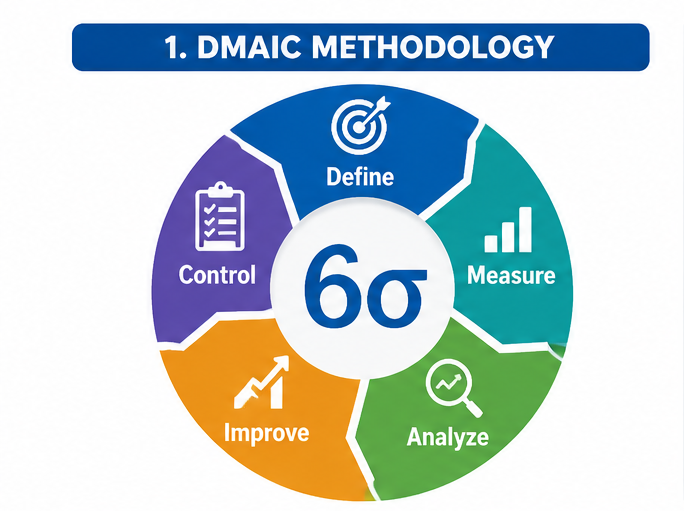
The DMAIC methodology is widely used in industries such as:
- manufacturing
- healthcare
- finance
- logistics
- construction
- retail
- information technology
- telecommunications
Organizations use DMAIC to solve operational challenges, improve customer satisfaction, reduce costs, and achieve better business performance.
Unlike random problem-solving approaches, DMAIC follows a logical and data-driven structure that helps businesses make accurate decisions based on measurable information and performance analysis.
What Does DMAIC Stand For?
DMAIC is an acronym that represents five important stages of process improvement:
- Define
- Measure
- Analyze
- Improve
- Control
Each stage focuses on a specific part of the improvement process and helps organizations move systematically from identifying problems to maintaining long-term solutions.
The DMAIC framework allows businesses to:
- understand operational problems
- collect accurate data
- identify root causes
- implement effective improvements
- monitor long-term performance
This structured approach reduces confusion and improves the success rate of improvement projects.
Importance of DMAIC in Six Sigma
DMAIC plays a major role in Six Sigma because it provides a systematic and organized method for process improvement.
Without a structured methodology, businesses may:
- misidentify problems
- waste resources
- implement ineffective solutions
- fail to achieve long-term improvements
DMAIC helps organizations avoid these issues by following a step-by-step improvement process.
The methodology supports:
- data-driven decision-making
- continuous improvement
- process standardization
- quality management
- operational efficiency
Businesses that properly implement DMAIC often experience:
- improved productivity
- lower operational costs
- reduced defects
- better customer satisfaction
- stronger process control
Overview of the DMAIC Process
The DMAIC methodology works like a roadmap for solving business problems.
The process begins by clearly identifying the problem and ends with maintaining long-term improvements.
The five stages work together to:
- identify process issues
- collect performance data
- discover root causes
- implement improvements
- monitor ongoing results
Each stage is equally important for achieving successful outcomes.
Define Phase
The Define phase is the first step of the DMAIC methodology. In this stage, organizations clearly identify the problem, project objectives, customer requirements, and expected outcomes.
The purpose of this stage is to fully understand:
- what the problem is
- why it matters
- who is affected
- what improvements are needed
Defining the problem correctly is extremely important because unclear objectives can lead to poor decision-making and unsuccessful improvement projects.
Objectives of the Define Phase
During this phase, organizations focus on:
- identifying business problems
- understanding customer expectations
- setting project goals
- defining improvement scope
- establishing project timelines
- identifying key stakeholders
This creates a strong foundation for the entire improvement process.
Questions Asked During the Define Phase
Businesses may ask questions such as:
- What problem needs to be solved?
- How does the problem affect customers?
- What are the project goals?
- Which departments are involved?
- What results are expected?
These questions help organizations clearly understand the situation before moving forward.
Tools Used in the Define Phase
Several tools are commonly used during the Define stage, including:
- project charters
- SIPOC diagrams
- customer feedback analysis
- process mapping
- stakeholder analysis
These tools help organizations organize information and define improvement goals effectively.
Example of the Define Phase
A delivery company receives frequent customer complaints about delayed shipments.
During the Define phase, the company:
- identifies delivery delays as the main problem
- sets goals to improve delivery speed
- analyzes customer complaints
- determines which departments are responsible
This stage helps the organization clearly understand the issue before collecting data.
Measure Phase
The Measure phase focuses on collecting data and evaluating current process performance.
Organizations gather measurable information to understand:
- how the process currently works
- how serious the problem is
- where inefficiencies exist
- how performance can be measured
This stage provides factual evidence about process performance.
Importance of the Measure Phase
Without accurate data, businesses may make incorrect assumptions about operational problems.
The Measure phase helps organizations:
- establish performance baselines
- identify performance gaps
- measure process efficiency
- monitor defect rates
- evaluate customer satisfaction
Data collected during this phase helps organizations make informed decisions later in the DMAIC process.
Types of Data Collected
Businesses may collect:
- defect rates
- delivery times
- customer complaints
- production speed
- operational costs
- error frequencies
- employee productivity data
The type of data depends on the problem being analyzed.
Tools Used in the Measure Phase
Common tools used during the Measure stage include:
- data collection sheets
- flowcharts
- histograms
- control charts
- process capability analysis
- performance measurement systems
These tools help organizations accurately measure current performance levels.
Example of the Measure Phase
The delivery company measures:
- average delivery times
- shipment delays
- warehouse processing times
- transportation efficiency
The collected data reveals that warehouse operations are causing significant delays.
This information helps the company better understand where the problem exists.
Analyze Phase
The Analyze phase focuses on identifying the root causes of process problems.
Instead of only treating symptoms, organizations investigate why problems occur in the first place.
This phase helps businesses discover:
- operational weaknesses
- communication gaps
- inefficient procedures
- equipment failures
- workflow bottlenecks
Understanding root causes allows organizations to implement effective long-term solutions.
Importance of Root Cause Analysis
Many organizations make the mistake of solving surface-level problems without identifying the actual cause.
For example:
- delayed deliveries may not be caused by drivers
- defective products may not be caused by employees
- customer complaints may result from process inefficiencies
The Analyze phase helps businesses identify the true source of problems.
Tools Used in the Analyze Phase
Several analytical tools are used during this stage, including:
- Fishbone Diagrams
- Pareto Charts
- 5 Whys Analysis
- root cause analysis
- scatter diagrams
- statistical analysis tools
These tools help organizations identify patterns and relationships within data.
Example of the Analyze Phase
The delivery company analyzes collected data and discovers:
- poor inventory tracking systems
- communication gaps between departments
- inefficient warehouse layouts
These issues are identified as the root causes of delayed deliveries.
This analysis allows the company to focus on solving the actual problems instead of temporary symptoms.
Improve Phase
The Improve phase involves implementing solutions to eliminate problems and improve process performance.
Once root causes are identified, organizations develop and apply improvement strategies designed to increase efficiency and reduce defects.
This stage focuses on creating practical and sustainable solutions.
Objectives of the Improve Phase
Organizations aim to:
- eliminate inefficiencies
- reduce defects
- improve workflow performance
- enhance productivity
- improve customer satisfaction
- optimize operational systems
Businesses often test multiple solutions before selecting the best approach.
Common Improvement Strategies
Organizations may implement:
- automation technologies
- employee training programs
- process redesigns
- updated software systems
- improved communication procedures
- workflow optimization
The chosen solutions depend on the nature of the problem.
Tools Used in the Improve Phase
Common tools include:
- brainstorming sessions
- pilot testing
- workflow redesign
- simulation analysis
- process optimization techniques
These tools help organizations improve operational performance effectively.
Example of the Improve Phase
The delivery company introduces:
- automated inventory management software
- employee training programs
- improved warehouse organization systems
- better communication procedures
As a result:
- warehouse efficiency improves
- shipment delays decrease
- customer satisfaction increases
This phase transforms analytical findings into practical improvements.
Control Phase
The Control phase is the final stage of the DMAIC methodology. After improvements are implemented, organizations must continuously monitor performance to ensure long-term success.
Without proper monitoring, processes may eventually return to old inefficient practices.
The Control phase helps businesses maintain stable and consistent performance.
Objectives of the Control Phase
Organizations focus on:
- monitoring process performance
- maintaining quality standards
- preventing future problems
- ensuring long-term improvements
- improving operational stability
Continuous monitoring helps businesses sustain successful outcomes.
Methods Used in the Control Phase
Organizations may use:
- performance dashboards
- control charts
- regular audits
- quality inspections
- employee performance reviews
- standard operating procedures
These systems help organizations track ongoing performance and identify new problems early.
Importance of Process Monitoring
Monitoring is important because:
- business conditions change over time
- customer expectations evolve
- operational risks may increase
- process variations may return
Continuous monitoring ensures that improvements remain effective over the long term.
Example of the Control Phase
The delivery company:
- reviews weekly delivery reports
- monitors warehouse performance
- tracks customer complaints
- conducts regular quality checks
As a result:
- delivery performance remains stable
- operational improvements continue
- customer satisfaction stays high
This stage ensures that improvements are maintained successfully.
Benefits of the DMAIC Methodology
The DMAIC methodology provides many important business benefits.
Organizations using DMAIC often achieve:
- reduced operational costs
- improved product quality
- better customer satisfaction
- improved efficiency
- fewer defects
- stronger decision-making
- higher productivity
- better process control
The methodology helps businesses solve problems systematically instead of relying on temporary fixes.
Real-World Applications of DMAIC
DMAIC is used in many industries to improve operational performance.
Manufacturing Industry
Manufacturers use DMAIC to:
- reduce production defects
- improve product consistency
- optimize manufacturing workflows
Healthcare Industry
Hospitals use DMAIC to:
- improve patient care
- reduce waiting times
- improve medical processes
Information Technology Industry
IT companies use DMAIC to:
- improve software performance
- reduce system failures
- improve technical support services
Financial Services Industry
Banks use DMAIC to:
- improve transaction accuracy
- reduce operational delays
- improve customer support systems
Why DMAIC Is Important for Business Success
DMAIC remains one of the most effective problem-solving methodologies because it provides a structured and measurable approach to process improvement.
The methodology helps businesses:
- solve complex problems
- improve operational efficiency
- maintain consistent quality
- improve customer experiences
- achieve long-term business growth
By following the DMAIC framework, organizations can create stable, efficient, and customer-focused operations that support continuous improvement and sustainable success. help ensure delivery targets are consistently achieved.
Six Sigma Belt Levels Explained
Six Sigma certifications are divided into different belt levels that represent a professional’s knowledge, skills, experience, and responsibilities in process improvement and quality management. These belt levels follow a structured learning path that allows individuals to gradually develop expertise in Six Sigma methodologies, analytical techniques, leadership skills, and business improvement strategies.

The Six Sigma belt system is inspired by martial arts ranking systems, where each belt level represents a higher stage of learning and mastery. As professionals move from beginner-level certifications to advanced levels, they gain deeper knowledge of:
- process improvement
- statistical analysis
- problem-solving
- quality management
- leadership techniques
- project management
Organizations worldwide use Six Sigma certifications to identify professionals who can successfully manage improvement projects and help businesses achieve operational excellence.
The five main Six Sigma belt levels are:
- White Belt
- Yellow Belt
- Green Belt
- Black Belt
- Master Black Belt
Each certification level has different learning objectives, responsibilities, and career opportunities.
Importance of Six Sigma Belt Certifications
Six Sigma belt certifications are highly valued because they help professionals develop practical business improvement skills that are useful in many industries.
Certified professionals can help organizations:
- reduce operational costs
- improve efficiency
- reduce defects
- improve product quality
- increase customer satisfaction
- strengthen process control
- improve team productivity
These certifications are recognized globally and can improve career opportunities in industries such as:
- manufacturing
- healthcare
- construction
- finance
- logistics
- retail
- information technology
- telecommunications
Many employers prefer hiring professionals with Six Sigma certifications because they demonstrate strong analytical and problem-solving abilities.
White Belt Certification
The White Belt is the beginner-level certification in Six Sigma. It provides a basic introduction to Six Sigma concepts, terminology, and improvement methodologies.
This certification is ideal for individuals who are completely new to Six Sigma and want to understand how process improvement systems work.
What White Belt Professionals Learn
White Belt professionals learn:
- basic Six Sigma concepts
- introduction to process improvement
- understanding of defects and variation
- overview of DMAIC methodology
- importance of quality management
- customer-focused improvement principles
The training usually focuses on foundational knowledge rather than advanced technical analysis.
Role of White Belt Professionals
White Belt professionals mainly support improvement teams and participate in organizational improvement initiatives.
Their responsibilities may include:
- understanding improvement goals
- supporting team discussions
- participating in basic process improvement activities
- assisting project teams
Although White Belt holders do not usually lead projects, they play an important supporting role within organizations.
Who Should Take White Belt Certification?
This certification is suitable for:
- students
- entry-level employees
- administrative staff
- customer service employees
- professionals exploring Six Sigma careers
It is considered the best starting point for beginners.
Benefits of White Belt Certification
Benefits include:
- basic understanding of Six Sigma
- improved awareness of quality management
- introduction to process improvement concepts
- preparation for higher-level certifications
The certification helps individuals build a strong foundation for future learning.
Yellow Belt Certification
The Yellow Belt certification is the next step after White Belt and provides a deeper understanding of Six Sigma methodologies and tools.
Yellow Belt professionals actively participate in improvement projects and support higher-level belt holders such as Green Belts and Black Belts.
What Yellow Belt Professionals Learn
Yellow Belt training covers:
- DMAIC methodology
- process mapping
- root cause analysis
- basic statistical tools
- problem-solving techniques
- teamwork and communication skills
Professionals gain practical knowledge that helps them contribute more effectively to improvement projects.
Responsibilities of Yellow Belt Professionals
Yellow Belt holders often:
- assist project teams
- collect process data
- analyze basic performance metrics
- support process improvement activities
- participate in quality improvement discussions
They work closely with senior Six Sigma professionals during projects.
Industries Using Yellow Belt Professionals
Yellow Belt certifications are useful in:
- manufacturing
- healthcare
- retail
- logistics
- finance
- customer service operations
Organizations use Yellow Belt professionals to support continuous improvement initiatives.
Benefits of Yellow Belt Certification
Benefits include:
- stronger problem-solving skills
- better understanding of process improvement
- improved teamwork capabilities
- increased career opportunities
- practical business improvement knowledge
This certification helps professionals become more valuable within organizations.
Green Belt Certification
The Green Belt certification is one of the most popular and widely recognized Six Sigma certifications. Green Belt professionals have advanced knowledge of process improvement and can independently manage smaller improvement projects.
They play a major role in analyzing business processes and implementing improvement strategies.
What Green Belt Professionals Learn
Green Belt training includes:
- advanced DMAIC methodology
- statistical analysis techniques
- data interpretation
- root cause analysis
- quality improvement tools
- project management principles
Professionals develop both technical and leadership skills.
Responsibilities of Green Belt Professionals
Green Belt holders often:
- lead small improvement projects
- analyze operational data
- identify process inefficiencies
- implement improvement strategies
- monitor process performance
They work under the guidance of Black Belts while managing their own projects.
Skills Developed at Green Belt Level
Green Belt professionals develop:
- analytical thinking
- decision-making skills
- leadership abilities
- communication skills
- project management capabilities
These skills improve professional performance across many industries.
Career Opportunities for Green Belts
Green Belt certification can support careers such as:
- quality analyst
- operations supervisor
- project coordinator
- process improvement specialist
- production manager
- business analyst
Many organizations consider Green Belt certification valuable for mid-level management roles.
Black Belt Certification
The Black Belt certification is an advanced-level Six Sigma qualification designed for professionals who lead complex improvement projects and manage organizational process improvement initiatives.
Black Belt professionals are considered experts in Six Sigma methodologies and analytical techniques.
What Black Belt Professionals Learn
Black Belt training includes:
- advanced statistical analysis
- leadership strategies
- complex problem-solving
- project management
- organizational improvement methods
- advanced quality management systems
Training at this level is highly detailed and technical.
Responsibilities of Black Belt Professionals
Black Belt holders are responsible for:
- leading major improvement projects
- managing project teams
- mentoring Green Belt professionals
- analyzing business performance
- improving operational systems
- reducing process variation
They often work directly with senior management to improve organizational performance.
Importance of Black Belt Professionals
Organizations rely on Black Belt professionals to:
- reduce operational costs
- improve productivity
- solve complex business problems
- increase customer satisfaction
- improve process efficiency
Their expertise helps organizations achieve measurable business improvements.
Career Opportunities for Black Belts
Black Belt certification supports careers such as:
- operations manager
- quality manager
- process improvement consultant
- business excellence manager
- project manager
- Lean Six Sigma consultant
Black Belt professionals often earn higher salaries because of their advanced expertise.
Master Black Belt Certification
The Master Black Belt is the highest level of Six Sigma certification. Professionals at this level are considered strategic leaders and experts in organizational process improvement.
They focus on developing business strategies, mentoring professionals, and leading large-scale improvement programs.
What Master Black Belt Professionals Learn
Master Black Belt training includes:
- advanced leadership development
- organizational strategy planning
- advanced statistical methodologies
- coaching and mentoring techniques
- enterprise-wide process improvement systems
This certification focuses heavily on strategic business improvement.
Responsibilities of Master Black Belt Professionals
Master Black Belt holders typically:
- mentor Black Belt professionals
- develop improvement strategies
- oversee organizational projects
- train employees
- improve company-wide systems
- advise executive leadership
They play a major role in long-term business planning and operational excellence.
Skills of Master Black Belt Professionals
Professionals at this level possess:
- expert analytical skills
- leadership expertise
- strategic planning abilities
- advanced problem-solving capabilities
- organizational management skills
Their knowledge helps organizations improve performance at every level.
Career Opportunities for Master Black Belts
Career roles may include:
- director of operational excellence
- senior quality consultant
- business transformation leader
- continuous improvement director
- enterprise process improvement manager
These professionals often work in senior leadership positions.
Lean Six Sigma vs Six Sigma
Many people confuse Lean Six Sigma and Six Sigma because both methodologies focus on improving business performance. Although they are closely related, they have different objectives, approaches, and improvement strategies.
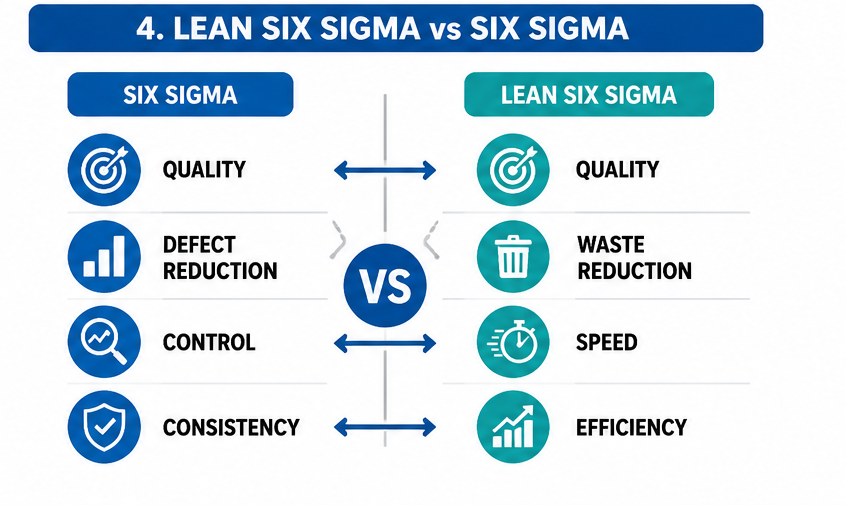
Understanding the difference between Lean Six Sigma and Six Sigma helps organizations choose the most suitable improvement system for their operational needs.
What Is Six Sigma?
Six Sigma mainly focuses on:
- reducing defects
- minimizing process variation
- improving quality
- improving process consistency
It uses:
- statistical analysis
- data-driven decision-making
- DMAIC methodology
- quality management tools
The primary goal is to improve process accuracy and reduce errors.
What Is Lean Six Sigma?
Lean Six Sigma combines:
- Lean methodology
- Six Sigma principles
Lean focuses on:
- eliminating waste
- improving workflow speed
- increasing operational efficiency
Six Sigma focuses on:
- reducing defects
- improving quality
- minimizing variation
By combining both systems, Lean Six Sigma improves both efficiency and quality simultaneously.
Main Differences Between Lean Six Sigma and Six Sigma
| Feature | Six Sigma | Lean Six Sigma |
|---|---|---|
| Main Focus | Reducing defects | Reducing waste and defects |
| Primary Goal | Improve quality | Improve speed and quality |
| Main Approach | Statistical analysis | Lean + Six Sigma methods |
| Key Objective | Reduce process variation | Improve efficiency and quality |
| Common Tools | DMAIC, Control Charts | DMAIC, Kaizen, Value Stream Mapping |
| Industries | Manufacturing, healthcare | All industries |
| Workflow Focus | Process consistency | Process speed and efficiency |
Benefits of Lean Six Sigma
Lean Six Sigma provides several important benefits, including:
- improved workflow efficiency
- reduced operational waste
- lower production costs
- faster delivery times
- improved customer satisfaction
- better quality control
- stronger operational performance
Organizations implementing Lean Six Sigma often achieve both productivity improvements and quality enhancements.
Industries Using Lean Six Sigma
Lean Six Sigma is widely used in:
- manufacturing
- healthcare
- logistics
- retail
- construction
- finance
- information technology
- supply chain management
The flexibility of Lean Six Sigma makes it useful across many sectors.
Which Certification Should You Choose?
The choice between Six Sigma and Lean Six Sigma depends on career goals and organizational needs.
Choose Six Sigma if you want to focus on:
- quality management
- statistical analysis
- defect reduction
- process consistency
Choose Lean Six Sigma if you want to focus on:
- waste reduction
- operational efficiency
- workflow optimization
- quality improvement
Many professionals choose Lean Six Sigma because it combines the strengths of both methodologies.
Importance of Six Sigma Certifications in Career Growth
Six Sigma certifications are valuable because they improve:
- leadership skills
- analytical thinking
- project management abilities
- problem-solving capabilities
- career opportunities
Certified professionals are highly respected in modern industries because organizations constantly seek employees who can improve efficiency, reduce costs, and strengthen operational performance.
As businesses continue focusing on quality improvement and operational excellence, Six Sigma and Lean Six Sigma certifications remain highly valuable qualifications for long-term career growth and professional success.inciples with Six Sigma techniques to improve both efficiency and quality.
Benefits of Six Sigma
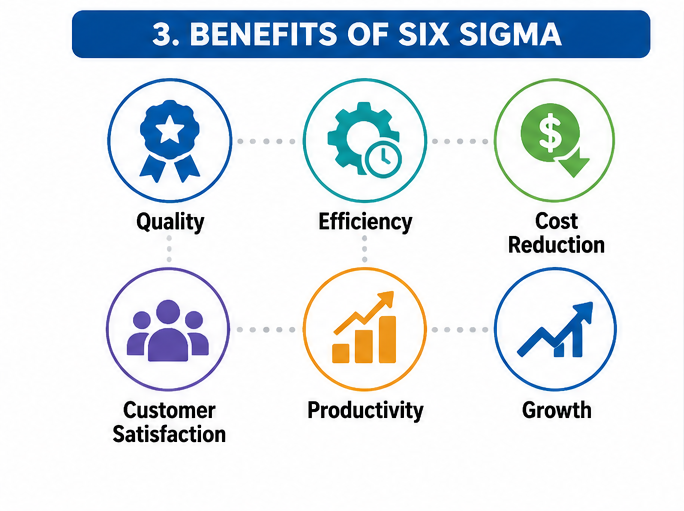
Six Sigma has become one of the most valuable business improvement systems because it provides a wide range of benefits for organizations, employees, and customers. Companies around the world use Six Sigma to improve quality, reduce operational problems, increase efficiency, lower costs, and strengthen customer satisfaction.
In today’s highly competitive business environment, organizations must continuously improve their products, services, and internal operations to remain successful. Businesses that fail to improve may experience:
- poor product quality
- customer dissatisfaction
- operational inefficiencies
- financial losses
- reduced market competitiveness
Six Sigma helps organizations solve these challenges through structured problem-solving methods, data-driven decision-making, and continuous improvement strategies.Six Sigma supports better workplace safety by improving operational processes, reducing hazards, and creating safer and more organized working environments.
The benefits of Six Sigma are not limited to large manufacturing companies only. Organizations in healthcare, finance, retail, logistics, construction, telecommunications, education, and information technology also use Six Sigma to improve business performance and achieve long-term growth.
One of the major strengths of Six Sigma is that it improves multiple areas of business operations at the same time. It not only improves product quality but also enhances employee performance, customer experiences, operational efficiency, and financial stability.
Improved Quality
One of the most important benefits of Six Sigma is improved quality. Quality is essential for every organization because customers expect products and services that are reliable, consistent, and free from defects.
Six Sigma helps organizations identify weaknesses in their processes and eliminate the causes of quality problems.
Businesses using Six Sigma can:
- reduce product defects
- improve service reliability
- maintain consistent quality standards
- improve production accuracy
- enhance operational performance
By reducing errors and inconsistencies, organizations can provide better products and services to customers.
Why Quality Improvement Is Important
Poor quality can create serious business problems, including:
- customer complaints
- product returns
- damaged reputation
- financial losses
- reduced customer trust
High-quality products and services help organizations:
- improve customer satisfaction
- strengthen brand reputation
- increase customer loyalty
- improve market competitiveness
Six Sigma focuses heavily on maintaining high-quality standards across all business operations.
How Six Sigma Improves Quality
Six Sigma improves quality by:
- analyzing operational data
- identifying process defects
- reducing process variation
- improving workflow consistency
- implementing quality control systems
The methodology helps organizations create stable and reliable processes that consistently deliver high-quality results.
Example of Quality Improvement
A manufacturing company notices that many products fail quality inspections due to inconsistent production measurements.
Using Six Sigma, the company:
- analyzes production data
- identifies machine calibration problems
- improves quality monitoring systems
- standardizes production procedures
As a result:
- defect rates decrease
- product consistency improves
- customer complaints reduce
This example shows how Six Sigma improves quality through process control and continuous improvement.
Increased Customer Satisfaction
Customer satisfaction is another major benefit of Six Sigma. Customers are more likely to remain loyal to businesses that consistently provide high-quality products and services.
Six Sigma helps organizations better understand customer expectations and improve customer experiences by reducing problems that negatively affect service quality.
Businesses implementing Six Sigma often improve:
- product reliability
- delivery performance
- customer service quality
- response times
- operational efficiency
These improvements lead to higher customer satisfaction levels.
Importance of Customer Satisfaction
Satisfied customers are important because they:
- return for repeat business
- recommend products and services to others
- strengthen company reputation
- increase long-term profitability
Dissatisfied customers may:
- stop purchasing products
- submit complaints
- leave negative reviews
- choose competitors
Six Sigma helps organizations reduce customer dissatisfaction by improving process performance and product quality.
How Six Sigma Improves Customer Experiences
Organizations using Six Sigma:
- analyze customer feedback
- identify customer complaints
- improve service processes
- reduce delays and errors
- improve communication systems
The methodology focuses on delivering consistent and reliable customer experiences.
Example of Customer Satisfaction Improvement
An online retail company receives complaints about late deliveries and damaged products.
Using Six Sigma, the company:
- analyzes delivery processes
- improves packaging systems
- optimizes warehouse operations
- improves inventory management
As a result:
- deliveries become faster
- damaged products decrease
- customer satisfaction increases
This demonstrates how Six Sigma strengthens customer experiences.
Reduced Costs
Reducing operational costs is one of the most valuable financial benefits of Six Sigma. Businesses often lose money because of:
- inefficient workflows
- defective products
- wasted materials
- production delays
- operational errors
Six Sigma helps organizations reduce these unnecessary expenses by improving process efficiency and eliminating waste.
How Operational Waste Increases Costs
Waste can appear in many forms, including:
- excess inventory
- rework and repairs
- unnecessary transportation
- production downtime
- inefficient resource usage
These inefficiencies increase operational costs and reduce profitability.
How Six Sigma Reduces Costs
Six Sigma reduces costs by:
- improving workflow efficiency
- reducing defects
- minimizing rework
- improving resource management
- optimizing operational systems
Organizations can produce better results using fewer resources.
Financial Benefits of Six Sigma
Companies implementing Six Sigma often experience:
- lower production costs
- reduced waste expenses
- improved profit margins
- higher operational efficiency
- better financial performance
Many global organizations have saved billions of dollars through Six Sigma initiatives.
Example of Cost Reduction
A logistics company experiences high transportation costs due to inefficient delivery routes.
Using Six Sigma:
- the company analyzes delivery data
- identifies inefficient routes
- improves route planning systems
- optimizes vehicle usage
As a result:
- fuel costs decrease
- delivery times improve
- operational expenses reduce
This example shows how Six Sigma helps organizations save money.
Higher Productivity
Six Sigma also improves employee productivity and operational performance. Efficient processes help employees complete tasks more effectively with fewer delays and interruptions.
Organizations using Six Sigma can:
- streamline workflows
- reduce unnecessary activities
- improve communication systems
- increase process efficiency
- improve resource utilization
These improvements help employees work more productively.
Why Productivity Matters
Higher productivity allows organizations to:
- increase output
- improve profitability
- meet customer demands faster
- improve operational efficiency
- strengthen business growth
Low productivity can lead to:
- missed deadlines
- higher costs
- customer dissatisfaction
- employee frustration
Six Sigma helps businesses improve operational performance by creating more efficient systems.
How Six Sigma Increases Productivity
The methodology improves productivity by:
- reducing workflow delays
- eliminating bottlenecks
- improving process organization
- automating repetitive tasks
- improving teamwork
Employees can focus more effectively on productive activities.
Example of Productivity Improvement
A hospital experiences long patient waiting times because of inefficient administrative procedures.
Using Six Sigma:
- the hospital analyzes patient flow
- improves scheduling systems
- reduces paperwork delays
- improves communication between departments
As a result:
- patient processing becomes faster
- employee productivity improves
- patient satisfaction increases
This example shows how Six Sigma improves efficiency and workflow performance.
Better Decision Making
Six Sigma promotes better decision-making by using measurable data and analytical techniques instead of assumptions or guesswork.
Businesses collect and analyze information to understand:
- process performance
- operational weaknesses
- customer behavior
- quality issues
- financial trends
This helps managers make informed and accurate business decisions.
Importance of Data-Driven Decisions
Poor decisions can lead to:
- financial losses
- operational inefficiencies
- customer dissatisfaction
- project failures
Data-driven decision-making improves:
- accuracy
- problem-solving
- operational planning
- business strategy development
Six Sigma ensures that decisions are supported by measurable evidence.
Tools Used for Better Decision Making
Six Sigma professionals use:
- statistical analysis
- performance reports
- control charts
- root cause analysis
- process monitoring systems
These tools help organizations identify trends and improve strategic planning.
Example of Better Decision Making
A retail company experiences declining sales but does not know the reason.
Using Six Sigma:
- the company analyzes customer purchasing data
- identifies inventory shortages
- studies customer feedback
- improves stock management systems
As a result:
- product availability improves
- customer satisfaction increases
- sales performance improves
This example demonstrates how data-driven decisions improve business performance.
Stronger Competitive Advantage
Six Sigma helps businesses gain a stronger competitive advantage by improving quality, efficiency, customer satisfaction, and operational performance.
Organizations that consistently deliver high-quality products and services are more likely to succeed in competitive markets.
Why Competitive Advantage Is Important
Businesses operate in markets where customers have many choices. Companies that fail to maintain quality and efficiency may lose customers to competitors.
A strong competitive advantage helps organizations:
- attract more customers
- increase market share
- improve profitability
- strengthen brand reputation
- achieve long-term growth
Six Sigma helps organizations improve their market position by improving overall business performance.
How Six Sigma Creates Competitive Advantage
Businesses using Six Sigma often:
- reduce operational errors
- improve customer experiences
- deliver products faster
- improve service quality
- reduce costs
These improvements help organizations outperform competitors.
Example of Competitive Advantage
Two companies manufacture similar electronic products.
One company uses Six Sigma to:
- improve product quality
- reduce defects
- improve customer support
- optimize production systems
As a result:
- customers prefer the higher-quality products
- sales increase
- company reputation strengthens
This example shows how Six Sigma supports competitive success.
Improved Employee Skills
Six Sigma also provides major benefits for employee development and professional growth.
Employees involved in Six Sigma projects develop valuable skills such as:
- leadership
- analytical thinking
- communication
- project management
- problem-solving
- teamwork
These skills improve employee performance and career opportunities.
Importance of Employee Development
Skilled employees help organizations:
- improve productivity
- solve problems effectively
- support innovation
- improve operational performance
Businesses with highly trained employees often perform more efficiently and competitively.
Training in Six Sigma
Six Sigma certifications provide training in:
- DMAIC methodology
- quality management
- process analysis
- statistical tools
- leadership development
- continuous improvement strategies
This training improves both technical and managerial capabilities.
Career Benefits for Employees
Professionals with Six Sigma certifications often receive:
- better job opportunities
- higher salaries
- leadership roles
- career advancement opportunities
- increased professional recognition
Many employers highly value Six Sigma-certified professionals because of their ability to improve business performance.
Example of Employee Skill Improvement
A company trains employees in Six Sigma methodologies.
Employees learn:
- process analysis techniques
- root cause analysis
- project management skills
- quality improvement strategies
As a result:
- employee confidence improves
- productivity increases
- teamwork becomes stronger
- operational performance improves
This example shows how Six Sigma supports workforce development.
Long-Term Benefits of Six Sigma
The benefits of Six Sigma extend beyond short-term operational improvements. Organizations that successfully implement Six Sigma often achieve long-term business success through:
- continuous improvement
- stronger quality control
- improved efficiency
- better customer relationships
- lower operational costs
- sustainable business growth
Six Sigma creates a culture of improvement where businesses continuously seek ways to improve performance and deliver greater value to customers.
As industries continue evolving through digital transformation, automation, and advanced technologies, the importance of Six Sigma continues to grow. Organizations worldwide rely on Six Sigma principles to maintain competitiveness, improve operational excellence, and achieve long-term organizational success.
Real-World Applications of Six Sigma
Six Sigma is widely used across many industries because of its ability to improve quality, reduce operational problems, increase efficiency, and strengthen customer satisfaction. Although Six Sigma was originally developed for manufacturing, it has now expanded into almost every major business sector around the world.
Modern organizations face continuous pressure to:
- reduce operational costs
- improve productivity
- deliver better customer experiences
- maintain high-quality standards
- increase profitability
- improve operational efficiency
Six Sigma helps organizations solve these challenges by using structured problem-solving methods, statistical analysis, and continuous improvement techniques.
One of the biggest advantages of Six Sigma is its flexibility. The methodology can be applied to:
- small businesses
- multinational corporations
- healthcare organizations
- government departments
- educational institutions
- service industries
- technology companies
Regardless of the industry, Six Sigma helps businesses identify process weaknesses, eliminate inefficiencies, and improve overall operational performance.
Today, companies around the world use Six Sigma to:
- improve product quality
- reduce defects
- optimize workflows
- improve customer service
- strengthen process control
- support long-term business growth
Understanding the real-world applications of Six Sigma helps demonstrate how valuable and practical the methodology is in modern industries.
Six Sigma in Manufacturing Industry
Manufacturing is one of the most common industries where Six Sigma is used extensively. Since Six Sigma was first developed at Motorola to improve manufacturing quality, the methodology remains highly important in production environments.
Manufacturing companies use Six Sigma to:
- reduce production defects
- improve product consistency
- improve production efficiency
- reduce waste
- lower manufacturing costs
- improve supply chain management
The goal is to produce high-quality products while reducing operational inefficiencies.
Reducing Production Defects
Production defects can create serious problems for manufacturers, including:
- product recalls
- customer complaints
- financial losses
- damaged brand reputation
- increased rework costs
Six Sigma helps manufacturers identify the root causes of defects and implement corrective actions.
Organizations analyze:
- machine performance
- production processes
- material quality
- employee procedures
- operational workflows
This helps reduce errors and improve product quality.
Improving Product Quality
Customers expect products that are:
- reliable
- durable
- safe
- consistent
Six Sigma helps manufacturers maintain consistent quality standards by reducing process variation and improving quality control systems.
Manufacturers use tools such as:
- control charts
- process monitoring
- root cause analysis
- statistical quality control
These tools help improve production accuracy and product reliability.
Optimizing Supply Chains
Efficient supply chain management is important for manufacturing success.
Six Sigma helps organizations:
- improve inventory management
- reduce delivery delays
- optimize transportation systems
- improve supplier performance
- reduce operational waste
Efficient supply chains improve production speed and reduce unnecessary expenses.
Example of Six Sigma in Manufacturing
An automobile manufacturing company experiences frequent defects in engine components.
Using Six Sigma, the company:
- analyzes production data
- identifies machine calibration issues
- improves quality inspection systems
- trains employees on updated procedures
As a result:
- defects decrease
- product quality improves
- customer complaints reduce
- production efficiency increases
This example shows how Six Sigma improves manufacturing operations.
Six Sigma in Healthcare Industry
Healthcare organizations use Six Sigma to improve patient care, reduce medical errors, and improve hospital efficiency.
Hospitals and healthcare providers face many operational challenges, including:
- long patient waiting times
- communication problems
- treatment delays
- administrative inefficiencies
- patient safety risks
Six Sigma helps healthcare organizations improve both medical and administrative processes.
Reducing Patient Waiting Times
Long waiting times can negatively affect:
- patient satisfaction
- treatment quality
- hospital efficiency
Hospitals use Six Sigma to analyze patient flow and improve scheduling systems.
Healthcare organizations may:
- optimize appointment scheduling
- improve registration systems
- streamline treatment procedures
- improve staff coordination
These improvements help reduce delays and improve patient experiences.
Improving Patient Safety
Patient safety is one of the most important priorities in healthcare.
Medical errors can lead to:
- incorrect treatments
- medication mistakes
- delayed diagnoses
- patient harm
Six Sigma helps hospitals reduce these risks by improving process consistency and quality control systems.
Healthcare providers use:
- standardized procedures
- performance monitoring
- error analysis
- root cause investigations
These strategies improve treatment accuracy and patient safety.
Enhancing Hospital Efficiency
Hospitals must manage:
- staff schedules
- medical equipment
- patient records
- treatment processes
- operational costs
Six Sigma helps healthcare organizations improve workflow efficiency and reduce operational waste.
This leads to:
- faster services
- improved patient care
- lower operational expenses
- better resource utilization
Example of Six Sigma in Healthcare
A hospital experiences overcrowded emergency departments and long patient waiting times.
Using Six Sigma, the hospital:
- studies patient flow patterns
- improves staff scheduling
- introduces digital registration systems
- optimizes treatment procedures
As a result:
- waiting times decrease
- patient satisfaction improves
- staff productivity increases
- hospital operations become more efficient
This example demonstrates how Six Sigma improves healthcare performance.
Six Sigma in Information Technology and Software Industry
The IT and software industry uses Six Sigma to improve software quality, reduce technical issues, and improve customer support services.
Technology companies must maintain:
- reliable systems
- secure networks
- high software performance
- efficient technical support
Six Sigma helps organizations improve these areas systematically.
Reducing Software Bugs
Software defects and technical errors can cause:
- system failures
- poor user experiences
- cybersecurity risks
- customer dissatisfaction
Six Sigma helps software companies identify coding issues, testing weaknesses, and process inefficiencies.
Organizations use:
- defect analysis
- software testing
- process monitoring
- quality assurance systems
These strategies improve software reliability.
Improving System Performance
IT companies use Six Sigma to improve:
- system speed
- application performance
- network reliability
- cybersecurity protection
Reducing technical issues improves customer satisfaction and operational stability.
Enhancing Customer Support
Customer support is important in the technology industry because users often require technical assistance.
Six Sigma helps companies:
- improve response times
- reduce support ticket delays
- improve communication systems
- increase problem-resolution speed
Better customer support strengthens customer trust and loyalty.
Example of Six Sigma in IT
A software company receives frequent complaints about system crashes and slow application performance.
Using Six Sigma, the company:
- analyzes software performance data
- identifies coding inefficiencies
- improves testing procedures
- upgrades server infrastructure
As a result:
- software performance improves
- technical issues decrease
- customer satisfaction increases
This example highlights how Six Sigma supports IT quality improvement.
Six Sigma in Finance Industry
Financial institutions use Six Sigma to improve transaction accuracy, reduce fraud risks, and improve customer service.
Banks and financial organizations process large amounts of sensitive financial data daily. Errors or delays can create major financial and operational risks.
Six Sigma helps improve:
- operational accuracy
- transaction processing
- risk management
- customer experiences
Improving Transaction Accuracy
Financial errors can lead to:
- customer dissatisfaction
- compliance violations
- financial losses
- operational disruptions
Six Sigma helps organizations improve process accuracy and reduce transaction mistakes.
Financial institutions analyze:
- transaction data
- processing systems
- workflow efficiency
- error rates
This improves operational reliability.
Reducing Fraud Risks
Fraud prevention is a major priority for financial organizations.
Six Sigma helps companies:
- improve monitoring systems
- analyze suspicious activities
- strengthen internal controls
- improve security procedures
Reducing fraud risks protects both organizations and customers.
Enhancing Customer Service
Customers expect:
- fast services
- accurate transactions
- reliable banking systems
- professional support
Six Sigma helps financial institutions improve:
- customer support systems
- service response times
- digital banking services
- complaint resolution procedures
This improves customer satisfaction and trust.
Example of Six Sigma in Finance
A bank experiences delays in loan approval processes.
Using Six Sigma, the bank:
- analyzes workflow inefficiencies
- improves document processing systems
- automates approval procedures
- improves communication between departments
As a result:
- loan approvals become faster
- operational efficiency improves
- customer satisfaction increases
This example shows how Six Sigma improves financial operations.
Six Sigma in Logistics and Supply Chain Industry
Logistics companies use Six Sigma to improve delivery performance, reduce transportation costs, and optimize warehouse operations.
Efficient logistics systems are important because customers expect:
- fast deliveries
- accurate shipments
- reliable transportation services
Six Sigma helps organizations improve operational performance across the supply chain.
Improving Delivery Times
Delivery delays can negatively affect:
- customer satisfaction
- company reputation
- operational costs
Six Sigma helps logistics companies analyze transportation systems and identify process inefficiencies.
Organizations improve:
- route planning
- vehicle scheduling
- inventory management
- shipment tracking systems
These improvements reduce delays and improve delivery accuracy.
Reducing Transportation Costs
Transportation expenses are a major operational cost for logistics companies.
Six Sigma helps organizations:
- optimize fuel usage
- improve vehicle efficiency
- reduce unnecessary transportation
- improve route planning
These strategies reduce operational expenses and improve profitability.
Optimizing Warehouse Operations
Warehouse inefficiencies can lead to:
- shipment delays
- inventory errors
- damaged products
- increased labor costs
Six Sigma helps organizations improve:
- inventory tracking
- warehouse layouts
- order processing systems
- employee workflows
Efficient warehouses improve overall supply chain performance.
Example of Six Sigma in Logistics
A delivery company experiences frequent shipment delays and rising transportation costs.
Using Six Sigma, the company:
- analyzes delivery routes
- improves warehouse organization
- upgrades shipment tracking systems
- optimizes transportation schedules
As a result:
- deliveries become faster
- fuel costs decrease
- customer satisfaction improves
- operational efficiency increases
This example demonstrates how Six Sigma improves logistics operations.
Importance of Six Sigma Across Industries
The real-world applications of Six Sigma show that the methodology is highly flexible and effective across different business sectors.
Organizations implementing Six Sigma often achieve:
- better operational efficiency
- improved quality standards
- reduced defects
- lower operational costs
- improved customer experiences
- stronger competitive advantage
The methodology helps businesses create more reliable, efficient, and customer-focused operations.
As industries continue adopting:
- automation
- artificial intelligence
- digital transformation
- advanced analytics
the importance of Six Sigma continues to grow. Businesses increasingly combine Six Sigma principles with modern technologies to improve decision-making, optimize operations, and achieve long-term business success.
Six Sigma Tools and Techniques
Six Sigma uses a wide range of tools and techniques to identify operational problems, analyze business processes, reduce defects, improve efficiency, and support continuous improvement. These tools help organizations make data-driven decisions and solve problems in a structured and systematic way.
Six Sigma tools are designed to help businesses:
- identify process inefficiencies
- analyze root causes of problems
- improve workflow performance
- monitor operational stability
- reduce waste and defects
- improve customer satisfaction
- increase productivity
Organizations across industries such as manufacturing, healthcare, finance, logistics, retail, construction, and information technology use these tools to improve operational performance and maintain high-quality standards.
One of the major strengths of Six Sigma is that it combines:
- statistical analysis
- visual process mapping
- root cause investigation
- performance monitoring
- process improvement techniques
This combination allows businesses to better understand operational challenges and implement effective long-term solutions.
The tools used in Six Sigma help organizations answer important questions such as:
- What is causing the problem?
- Where are inefficiencies occurring?
- Which processes need improvement?
- How can defects be reduced?
- How can performance be monitored?
Understanding these tools is essential for professionals involved in quality management, process improvement, and operational excellence.
Importance of Six Sigma Tools and Techniques
Six Sigma tools play an important role in helping businesses improve decision-making and operational performance.
Without proper analytical tools, organizations may:
- misidentify problems
- waste resources
- implement ineffective solutions
- struggle with operational inefficiencies
Six Sigma tools provide measurable and visual methods for analyzing business performance and identifying improvement opportunities.
These tools help organizations:
- collect accurate data
- identify patterns
- monitor performance
- solve problems systematically
- improve process consistency
Businesses that effectively use Six Sigma tools often achieve:
- better product quality
- lower operational costs
- reduced defects
- improved customer experiences
- stronger operational control
Pareto Chart
The Pareto Chart is one of the most widely used tools in Six Sigma. It helps organizations identify the most significant causes of problems so they can focus on the issues that have the greatest impact on business performance.
The Pareto Chart is based on the:
- 80/20 Principle
This principle suggests that:
- 80% of problems are often caused by 20% of root causes
The chart visually displays problems in descending order of importance.
Purpose of Pareto Charts
Organizations use Pareto Charts to:
- identify major operational problems
- prioritize improvement efforts
- focus on high-impact issues
- improve decision-making
- allocate resources effectively
This helps businesses solve the most important problems first.
How Pareto Charts Work
The chart typically shows:
- types of problems on the horizontal axis
- frequency or impact on the vertical axis
Problems with the highest frequency appear first, allowing organizations to focus on the most serious issues.
Benefits of Pareto Charts
Pareto Charts help organizations:
- identify key operational weaknesses
- reduce wasted effort
- improve problem-solving efficiency
- focus on major performance issues
The tool simplifies complex operational data into an easy-to-understand visual format.
Example of Pareto Chart Usage
A customer service company receives different types of complaints:
- delayed responses
- billing errors
- technical issues
- communication problems
Using a Pareto Chart, the company discovers that most complaints are related to delayed responses.
The company then focuses on improving response times, significantly improving customer satisfaction.
This example shows how Pareto analysis helps businesses prioritize improvements effectively.
Fishbone Diagram
The Fishbone Diagram is another important Six Sigma tool used to identify the root causes of problems. It is also known as:
- Cause-and-Effect Diagram
- Ishikawa Diagram
The diagram visually organizes possible causes of a problem into categories, making it easier to analyze operational issues.
Purpose of Fishbone Diagrams
Organizations use Fishbone Diagrams to:
- identify root causes
- analyze process problems
- improve brainstorming sessions
- organize problem-solving discussions
- understand operational weaknesses
The tool encourages teams to investigate all possible causes of a problem.
Main Categories in Fishbone Diagrams
Common categories include:
- people
- processes
- machines
- materials
- environment
- management methods
These categories help organizations examine problems from multiple perspectives.
Benefits of Fishbone Diagrams
Fishbone Diagrams help businesses:
- improve root cause analysis
- strengthen teamwork
- organize ideas visually
- improve decision-making
- identify hidden process issues
The visual structure makes complex problems easier to understand.
Example of Fishbone Diagram Usage
A factory experiences frequent machine breakdowns.
Using a Fishbone Diagram, the company analyzes possible causes such as:
- poor maintenance
- employee training gaps
- outdated equipment
- low-quality materials
The analysis reveals poor maintenance scheduling as the main issue.
The company improves maintenance procedures, reducing equipment failures.
This example shows how Fishbone Diagrams support problem-solving and process improvement.
Control Charts
Control Charts are statistical tools used to monitor process stability and performance over time.
Organizations use Control Charts to determine whether processes are operating consistently or experiencing unusual variations.
These charts are highly important in industries where consistency and quality control are essential.
Purpose of Control Charts
Control Charts help organizations:
- monitor process performance
- identify operational variations
- detect abnormal changes
- maintain quality standards
- improve process stability
The tool helps businesses identify problems before they become serious.
How Control Charts Work
The chart displays:
- process performance data over time
- upper control limits
- lower control limits
- average process performance
If performance moves outside the control limits, it may indicate operational problems.
Benefits of Control Charts
Control Charts help businesses:
- reduce defects
- improve quality consistency
- detect problems early
- improve operational reliability
- support continuous improvement
The charts provide ongoing visibility into process performance.
Example of Control Chart Usage
A beverage company monitors bottle filling levels using Control Charts.
The company notices unusual variations in filling measurements.
After investigation, the company identifies equipment calibration problems and corrects them.
As a result:
- product consistency improves
- defects decrease
- customer complaints reduce
This example shows how Control Charts improve process stability.
SIPOC Diagram
The SIPOC Diagram is a process mapping tool used in Six Sigma to provide a high-level overview of business processes.
SIPOC stands for:
- Suppliers
- Inputs
- Process
- Outputs
- Customers
The diagram helps organizations understand how processes operate and how different components interact.
Purpose of SIPOC Diagrams
Organizations use SIPOC Diagrams to:
- understand process workflows
- identify process components
- improve communication
- analyze customer requirements
- support project planning
The tool provides a simple visual overview of complex business processes.
Components of SIPOC
Suppliers
Organizations or individuals providing resources or materials.
Inputs
Resources, information, or materials required for the process.
Process
The series of activities performed to create outputs.
Outputs
Products or services produced by the process.
Customers
Individuals or organizations receiving the outputs.
Benefits of SIPOC Diagrams
SIPOC Diagrams help organizations:
- improve process understanding
- identify process gaps
- improve workflow analysis
- strengthen communication
- support improvement planning
The tool is especially useful during the Define phase of DMAIC projects.
Example of SIPOC Diagram Usage
A restaurant creates a SIPOC Diagram to improve food delivery operations.
The diagram identifies:
- suppliers providing ingredients
- kitchen preparation processes
- delivery operations
- customer orders
The restaurant identifies delays within food preparation stages and improves workflow efficiency.
This example demonstrates how SIPOC Diagrams improve process visibility.
5 Whys Technique
The 5 Whys Technique is a simple but powerful problem-solving tool used to identify root causes by repeatedly asking:
- “Why?”
The method helps organizations move beyond surface-level symptoms and identify the actual cause of operational problems.
Purpose of the 5 Whys Technique
Organizations use this technique to:
- identify root causes
- solve recurring problems
- improve process understanding
- strengthen corrective actions
The goal is to discover why problems continue occurring.
How the 5 Whys Technique Works
The process involves:
- identifying the problem
- asking “Why?” the problem occurred
- repeating the question multiple times
- identifying the underlying root cause
The process usually continues until the true cause is discovered.
Benefits of the 5 Whys Technique
The technique helps organizations:
- simplify root cause analysis
- improve problem-solving
- reduce recurring issues
- improve decision-making
It is easy to use and does not require advanced statistical knowledge.
Example of 5 Whys Technique
Problem:
A machine stops working.
Why?
- The motor overheated.
Why?
- The lubrication system failed.
Why?
- Maintenance checks were missed.
Why?
- Maintenance schedules were not updated.
The root cause is poor maintenance scheduling.
The company improves maintenance systems, preventing future equipment failures.
This example shows how the 5 Whys Technique identifies deeper operational issues.
Histogram
A Histogram is a visual chart used to display process performance data and identify patterns or variations within processes.
It helps organizations understand:
- frequency distributions
- process consistency
- operational trends
- variation levels
Histograms simplify complex data into visual formats that are easier to analyze.
Purpose of Histograms
Organizations use Histograms to:
- analyze process performance
- identify data patterns
- monitor variation
- improve quality analysis
- support decision-making
The tool provides valuable insights into operational behavior.
Benefits of Histograms
Histograms help businesses:
- identify process inconsistencies
- improve data analysis
- support quality improvement
- improve performance monitoring
Visual data representation makes trends easier to understand.
Example of Histogram Usage
A manufacturing company measures product dimensions using Histograms.
The chart reveals that product sizes vary more than expected.
The company adjusts machine settings and improves quality controls.
As a result:
- product consistency improves
- defects decrease
- customer satisfaction increases
This example shows how Histograms improve quality monitoring.
Value Stream Mapping
Value Stream Mapping is a Lean Six Sigma tool used to analyze workflows and identify waste within business processes.
The tool visually maps:
- process steps
- information flow
- material movement
- operational delays
Organizations use Value Stream Mapping to improve efficiency and eliminate unnecessary activities.
Purpose of Value Stream Mapping
Organizations use this tool to:
- identify waste
- improve workflow efficiency
- reduce delays
- improve resource utilization
- optimize business processes
The goal is to create smoother and more efficient operations.
Types of Waste Identified
Value Stream Mapping helps identify:
- unnecessary transportation
- waiting times
- excess inventory
- inefficient processes
- overproduction
- unnecessary motion
Reducing these wastes improves operational performance.
Benefits of Value Stream Mapping
The tool helps organizations:
- improve efficiency
- reduce operational costs
- improve workflow speed
- strengthen process visibility
- improve customer satisfaction
Organizations can identify inefficiencies more easily through visual workflow analysis.
Example of Value Stream Mapping Usage
A warehouse company experiences shipment delays.
Using Value Stream Mapping, the company identifies:
- inefficient inventory storage
- unnecessary transportation steps
- slow order processing
The warehouse redesigns its layout and improves workflow systems.
As a result:
- shipment processing becomes faster
- operational efficiency improves
- delivery times decrease
This example demonstrates how Value Stream Mapping improves operational performance.
Importance of Six Sigma Tools and Techniques
Six Sigma tools and techniques are essential because they help organizations solve problems systematically and improve operational performance using measurable data and structured analysis.
These tools help businesses:
- reduce defects
- improve efficiency
- strengthen quality control
- improve customer satisfaction
- support continuous improvement
- improve decision-making
Organizations that effectively use Six Sigma tools often achieve stronger operational performance, improved profitability, and long-term business success.
As businesses continue adopting digital technologies, automation, and advanced analytics, Six Sigma tools remain highly valuable for improving modern operational systems and maintaining competitive advantage in global markets.
Six Sigma Certification Process
Six Sigma certifications are highly respected professional qualifications that help individuals develop expertise in quality management, process improvement, operational efficiency, and problem-solving. Organizations around the world value Six Sigma-certified professionals because they possess the knowledge and practical skills needed to improve business performance, reduce operational costs, and increase customer satisfaction.
The Six Sigma certification process involves several important stages that help individuals build both theoretical knowledge and practical experience. These certifications are available at different levels, ranging from beginner-level White Belts to advanced Master Black Belt certifications.
Professionals from many industries pursue Six Sigma certifications, including:
- manufacturing
- healthcare
- construction
- information technology
- logistics
- finance
- retail
- telecommunications
- project management
One of the major advantages of Six Sigma certifications is that they support both personal and professional development. Certified individuals improve their:
- analytical skills
- leadership abilities
- project management knowledge
- decision-making capabilities
- communication skills
- problem-solving expertise
The certification process is designed to ensure that professionals understand how to apply Six Sigma methodologies in real business environments.
Why Six Sigma Certification Is Important
Modern businesses constantly search for professionals who can:
- improve operational efficiency
- reduce defects
- solve business problems
- improve quality standards
- manage improvement projects
- increase customer satisfaction
Six Sigma certifications demonstrate that an individual has the knowledge and skills needed to support continuous improvement initiatives.
Certified professionals often receive:
- better career opportunities
- higher salaries
- leadership positions
- increased professional recognition
- stronger job security
Many organizations prefer hiring Six Sigma-certified employees because they can contribute directly to business improvement and operational success.
Step 1: Choose Your Belt Level
The first step in the Six Sigma certification process is selecting the appropriate certification level based on:
- experience
- education
- career goals
- professional background
Six Sigma certifications are divided into several belt levels, each representing different levels of expertise and responsibility.
The main certification levels include:
- White Belt
- Yellow Belt
- Green Belt
- Black Belt
- Master Black Belt
Choosing the correct level is important because each certification requires different levels of knowledge and practical experience.
White Belt Certification
White Belt certification is suitable for:
- beginners
- students
- entry-level employees
This level provides:
- basic understanding of Six Sigma concepts
- introduction to quality management
- overview of process improvement principles
It is ideal for individuals who are new to Six Sigma.
Yellow Belt Certification
Yellow Belt certification is suitable for professionals who:
- participate in improvement projects
- support project teams
- want deeper understanding of Six Sigma tools
This level introduces:
- DMAIC methodology
- basic process analysis
- root cause analysis
- teamwork techniques
Green Belt Certification
Green Belt certification is ideal for professionals who:
- manage small improvement projects
- analyze operational data
- work on quality improvement initiatives
Green Belt professionals develop:
- advanced analytical skills
- process improvement expertise
- project management abilities
Black Belt Certification
Black Belt certification is designed for professionals who:
- lead complex projects
- manage improvement teams
- implement organizational improvements
Black Belt training focuses heavily on:
- advanced statistical analysis
- leadership development
- project management
- strategic problem-solving
Master Black Belt Certification
Master Black Belt is the highest level of Six Sigma certification.
This level is suitable for professionals responsible for:
- organizational improvement strategies
- mentoring teams
- enterprise-wide quality management
Master Black Belt professionals act as strategic leaders within organizations.
How to Choose the Right Certification Level
Choosing the right certification depends on:
- current job role
- industry requirements
- future career goals
- management responsibilities
- experience level
Beginners usually start with:
- White Belt
- Yellow Belt
Experienced professionals often pursue:
- Green Belt
- Black Belt
Senior managers and improvement leaders may choose:
- Master Black Belt
Selecting the right certification helps professionals follow a structured career progression path.
Step 2: Complete Training
After selecting a belt level, the next step is completing Six Sigma training through an accredited training provider or educational institution.
Training programs teach:
- Six Sigma methodologies
- quality management principles
- statistical analysis techniques
- process improvement tools
- project management strategies
Training can be completed through:
- online learning programs
- classroom training
- corporate workshops
- university programs
Many organizations now offer flexible online training options for working professionals.
Importance of Accredited Training
Accredited training programs ensure that professionals receive:
- high-quality education
- industry-recognized certification
- practical learning experiences
- standardized training materials
Choosing a reputable training provider is important for career credibility and professional recognition.
Topics Covered in Six Sigma Training
Training programs usually include:
- DMAIC methodology
- process mapping
- root cause analysis
- statistical analysis
- quality control techniques
- project management
- leadership skills
- data interpretation
Advanced certification levels include deeper analytical and strategic concepts.
Benefits of Six Sigma Training
Training helps professionals:
- improve analytical thinking
- strengthen leadership abilities
- improve communication skills
- understand operational systems
- improve problem-solving capabilities
The knowledge gained through training can be applied directly within workplaces.
Step 3: Learn Six Sigma Tools and Techniques
A major part of Six Sigma certification involves learning analytical tools and improvement techniques.
These tools help professionals:
- analyze business processes
- identify operational problems
- reduce defects
- improve quality
- monitor performance
Understanding these tools is essential for successful process improvement.
Important Six Sigma Tools Learned During Certification
Professionals study several tools, including:
- Pareto Charts
- Fishbone Diagrams
- Control Charts
- SIPOC Diagrams
- Histograms
- 5 Whys Technique
- Value Stream Mapping
These tools support data-driven decision-making and structured problem-solving.
Learning the DMAIC Methodology
One of the most important areas of Six Sigma training is the DMAIC methodology.
DMAIC
DMAIC stands for:
- Define
- Measure
- Analyze
- Improve
- Control
Professionals learn how to:
- identify problems
- collect data
- analyze root causes
- implement improvements
- maintain long-term process stability
DMAIC is considered the foundation of Six Sigma process improvement.
Importance of Statistical Knowledge
Six Sigma uses statistical analysis to improve decision-making and process performance.
Professionals learn:
- data analysis techniques
- performance measurement
- process capability analysis
- variation analysis
- quality monitoring
Statistical tools help businesses make accurate and measurable improvements.
Step 4: Pass the Examination
Most Six Sigma certifications require candidates to pass an examination or assessment.
The exam tests:
- theoretical knowledge
- understanding of Six Sigma concepts
- problem-solving abilities
- analytical skills
- understanding of process improvement methodologies
Examinations help verify that professionals can apply Six Sigma techniques effectively.
Types of Six Sigma Exams
Certification exams may include:
- multiple-choice questions
- case studies
- scenario-based questions
- practical analysis exercises
Higher-level certifications usually involve more advanced analytical questions.
Preparation for Six Sigma Exams
Successful exam preparation often includes:
- reviewing training materials
- practicing sample questions
- studying DMAIC methodology
- understanding statistical concepts
- practicing process analysis
Consistent study and practical understanding improve examination performance.
Importance of Certification Exams
Certification exams help organizations identify professionals who:
- understand Six Sigma principles
- can manage improvement projects
- possess analytical capabilities
- can solve operational problems effectively
Passing the exam demonstrates professional competency and industry knowledge.
Step 5: Gain Practical Experience
Practical experience is one of the most important parts of the Six Sigma certification process.
Many advanced certifications require professionals to complete real-world projects demonstrating their ability to apply Six Sigma methodologies.
Practical experience helps professionals:
- improve technical skills
- strengthen leadership abilities
- understand real operational challenges
- apply analytical techniques effectively
Hands-on project experience improves both confidence and professional expertise.
Importance of Real-World Projects
Practical projects help professionals:
- apply theoretical knowledge
- improve process analysis skills
- solve operational problems
- improve communication and teamwork
- gain industry experience
Real-world experience is essential for developing professional competence.
Examples of Six Sigma Projects
Professionals may work on projects involving:
- reducing production defects
- improving delivery performance
- improving customer service
- reducing operational costs
- improving workflow efficiency
These projects demonstrate the practical value of Six Sigma methodologies.
Benefits of Practical Experience
Practical experience helps individuals:
- build stronger resumes
- improve leadership capabilities
- gain professional confidence
- strengthen career opportunities
Employers highly value candidates with real improvement project experience.
Career Opportunities in Six Sigma
Six Sigma certifications can open doors to many rewarding and high-paying career opportunities. Organizations across industries require professionals who can improve operational efficiency, reduce defects, and manage continuous improvement initiatives.
The growing importance of:
- quality management
- operational excellence
- process optimization
- customer satisfaction
has increased the demand for Six Sigma professionals worldwide.
Why Six Sigma Careers Are Growing
Businesses constantly seek professionals who can:
- reduce operational costs
- improve productivity
- solve complex business problems
- improve process quality
- support digital transformation
As a result, Six Sigma professionals are in high demand across multiple sectors.
Industries Hiring Six Sigma Professionals
Six Sigma-certified professionals work in:
- manufacturing
- healthcare
- information technology
- logistics
- finance
- retail
- telecommunications
- construction
- government organizations
The flexibility of Six Sigma makes it valuable in many career fields.
Popular Six Sigma Job Roles
Six Sigma certifications support a wide range of professional roles.
Quality Manager
Quality Managers are responsible for:
- maintaining quality standards
- monitoring process performance
- reducing operational defects
- improving customer satisfaction
They ensure organizations maintain consistent quality systems.
Process Improvement Specialist
Process Improvement Specialists focus on:
- identifying inefficiencies
- improving workflows
- reducing waste
- optimizing operational systems
Their role centers on improving organizational efficiency.
Operations Manager
Operations Managers oversee:
- daily business operations
- workflow management
- resource allocation
- performance improvement initiatives
Six Sigma knowledge helps them improve operational productivity.
Manufacturing Engineer
Manufacturing Engineers use Six Sigma to:
- improve production systems
- reduce manufacturing defects
- optimize equipment performance
- improve product quality
They play an important role in production efficiency.
Business Analyst
Business Analysts use data analysis and process improvement techniques to:
- improve decision-making
- analyze operational performance
- identify business opportunities
Six Sigma strengthens analytical and strategic thinking skills.
Project Manager
Project Managers use Six Sigma methodologies to:
- manage improvement projects
- reduce project risks
- improve efficiency
- ensure project success
The DMAIC framework supports structured project management.
Supply Chain Manager
Supply Chain Managers improve:
- inventory systems
- transportation efficiency
- supplier performance
- warehouse operations
Six Sigma helps optimize supply chain performance.
Lean Six Sigma Consultant
Lean Six Sigma Consultants advise organizations on:
- process improvement strategies
- quality management systems
- operational efficiency
- waste reduction
Consultants often work with multiple organizations across industries.
Average Six Sigma Salaries
Six Sigma-certified professionals often earn competitive salaries because organizations highly value their expertise in quality management and operational improvement.
Salary levels depend on:
- certification level
- industry
- work experience
- geographic location
- management responsibilities
Advanced certifications usually lead to higher salary opportunities.
Salary Levels by Certification
| Certification Level | Typical Salary Range |
|---|---|
| Yellow Belt | Entry-level salaries |
| Green Belt | Mid-level professional salaries |
| Black Belt | Senior professional salaries |
| Master Black Belt | Executive and leadership salaries |
Higher certifications generally provide stronger earning potential and leadership opportunities.
Factors Affecting Six Sigma Salaries
Several factors influence salary levels, including:
- years of experience
- industry demand
- technical expertise
- leadership responsibilities
- project management skills
Professionals with advanced certifications and strong practical experience often receive higher compensation packages.
Why Certified Professionals Earn Higher Salaries
Organizations highly value Six Sigma-certified professionals because they can:
- improve operational efficiency
- reduce business costs
- improve customer satisfaction
- increase productivity
- strengthen quality systems
Their ability to generate measurable business improvements increases their professional value.
Long-Term Career Benefits of Six Sigma Certification
Six Sigma certifications provide long-term career advantages, including:
- stronger job security
- leadership opportunities
- global career recognition
- higher salary potential
- improved professional credibility
- career advancement opportunities
As businesses continue focusing on quality improvement, automation, digital transformation, and operational efficiency, the demand for Six Sigma professionals continues to grow globally.
For professionals seeking long-term career growth and business leadership opportunities, Six Sigma certifications remain one of the most valuable qualifications in modern industries. higher salaries because organizations value their problem-solving and leadership skills.
Who Should Learn Six Sigma?
Six Sigma is suitable for a wide range of professionals, industries, and career levels because its principles can be applied to almost every type of business operation. Whether someone works in manufacturing, healthcare, information technology, finance, construction, logistics, or customer service, Six Sigma provides valuable skills that help improve efficiency, reduce errors, and strengthen operational performance.
One of the biggest advantages of Six Sigma is its flexibility. It is not limited to one specific industry or profession. Instead, it helps individuals develop practical skills in:
- problem-solving
- process improvement
- quality management
- data analysis
- project management
- leadership development
As businesses continue focusing on operational excellence, digital transformation, and customer satisfaction, the demand for professionals with Six Sigma knowledge continues to grow globally.
Learning Six Sigma can benefit:
- students starting their careers
- experienced managers
- technical professionals
- business owners
- operational teams
- organizational leaders
The methodology helps professionals improve both their technical abilities and professional career opportunities.
Why Professionals Choose Six Sigma
Professionals choose Six Sigma because it helps them:
- improve career opportunities
- increase earning potential
- strengthen leadership skills
- improve analytical thinking
- solve business problems effectively
- gain globally recognized certifications
Organizations value Six Sigma-certified professionals because they can help improve operational efficiency and support business growth.
Many professionals use Six Sigma certifications to:
- move into leadership roles
- improve promotion opportunities
- strengthen professional credibility
- improve workplace performance
The methodology is especially valuable for individuals involved in quality management, operations, customer service, production, project management, and process optimization.
Ideal Candidates for Six Sigma
Six Sigma can benefit professionals from many educational and professional backgrounds.
Students
Students can greatly benefit from learning Six Sigma early in their careers. Many industries now prefer graduates who possess practical business improvement and analytical skills.
Six Sigma helps students:
- understand business operations
- develop problem-solving abilities
- improve analytical thinking
- strengthen project management skills
- improve employability
Students with Six Sigma certifications often gain a competitive advantage in job markets because employers value candidates with quality management knowledge.
Benefits of Six Sigma for Students
Students learning Six Sigma can:
- improve career readiness
- strengthen resumes
- gain industry-recognized certifications
- improve communication and teamwork skills
The certification also prepares students for future leadership roles.
Engineers
Engineers commonly use Six Sigma to improve production systems, reduce defects, and optimize operational performance.
Engineering industries require:
- precision
- consistency
- quality control
- operational efficiency
Six Sigma helps engineers improve:
- manufacturing processes
- equipment performance
- quality assurance systems
- production workflows
Engineers use data-driven analysis to improve technical operations and reduce operational inefficiencies.
Why Engineers Benefit from Six Sigma
Six Sigma helps engineers:
- improve production accuracy
- reduce operational waste
- improve system reliability
- solve technical problems efficiently
The methodology is highly valuable in:
- mechanical engineering
- industrial engineering
- manufacturing engineering
- civil engineering
- automotive engineering
Project Managers
Project Managers use Six Sigma methodologies to improve project planning, reduce project risks, and improve operational efficiency.
Projects often face challenges such as:
- delays
- budget overruns
- communication issues
- operational inefficiencies
Six Sigma helps Project Managers:
- improve workflow organization
- reduce project risks
- improve team coordination
- strengthen decision-making
The DMAIC methodology supports structured project execution and performance improvement.
Skills Project Managers Gain
Project Managers learning Six Sigma improve:
- leadership abilities
- analytical thinking
- process management
- communication skills
- strategic planning
These skills improve project success rates and operational performance.
Healthcare Professionals
Healthcare professionals use Six Sigma to improve patient care, reduce medical errors, and improve hospital operations.
Hospitals and healthcare organizations face challenges such as:
- long waiting times
- treatment delays
- administrative inefficiencies
- patient safety risks
Six Sigma helps healthcare professionals improve:
- patient flow
- treatment quality
- operational efficiency
- healthcare service delivery
Benefits of Six Sigma in Healthcare
Healthcare professionals can use Six Sigma to:
- improve patient safety
- reduce operational errors
- improve communication systems
- improve resource management
The methodology supports both medical and administrative improvements.
IT Specialists
Information Technology professionals use Six Sigma to improve software quality, system reliability, cybersecurity, and technical support operations.
Technology industries require:
- high system performance
- operational stability
- fast problem-solving
- efficient workflows
Six Sigma helps IT specialists:
- reduce software defects
- improve network performance
- improve customer support systems
- optimize technical operations
Importance of Six Sigma in IT
IT professionals use Six Sigma to:
- improve software development
- reduce technical issues
- improve service quality
- strengthen cybersecurity systems
The methodology supports continuous improvement within technology environments.
Operations Managers
Operations Managers are responsible for maintaining efficient business operations and improving productivity.
Six Sigma helps Operations Managers:
- optimize workflows
- improve process efficiency
- reduce operational costs
- improve employee productivity
- strengthen quality control systems
The methodology provides structured tools for operational improvement and performance management.
Skills Developed by Operations Managers
Operations Managers improve:
- strategic planning
- leadership abilities
- process optimization skills
- resource management
- decision-making capabilities
These skills improve organizational efficiency and profitability.
Business Owners
Business Owners can use Six Sigma to improve:
- operational efficiency
- customer satisfaction
- profitability
- product quality
- workflow organization
Small businesses and large organizations alike benefit from process improvement and quality management systems.
Why Business Owners Learn Six Sigma
Business Owners use Six Sigma to:
- reduce operational waste
- improve customer experiences
- strengthen business reputation
- increase productivity
- improve financial performance
The methodology helps organizations achieve sustainable long-term growth.
Manufacturing Professionals
Manufacturing professionals frequently use Six Sigma because manufacturing operations require:
- quality control
- process consistency
- production efficiency
- waste reduction
Six Sigma helps manufacturing teams improve:
- production systems
- supply chain operations
- equipment performance
- product quality
The methodology supports efficient and reliable manufacturing operations
Benefits for Manufacturing Professionals
Manufacturing professionals can:
- reduce production defects
- improve operational workflows
- improve safety standards
- increase productivity
This improves overall manufacturing performance and customer satisfaction.
Challenges of Six Sigma
Although Six Sigma offers many benefits, organizations may also face certain challenges during implementation. Successful Six Sigma implementation requires:
- leadership support
- employee involvement
- proper training
- organizational commitment
Without proper planning and management, businesses may struggle to achieve expected results.
Understanding these challenges helps organizations prepare more effectively for implementation.
High Training Costs
One of the most common challenges of Six Sigma is the cost of training and certification.
Advanced certifications such as:
- Green Belt
- Black Belt
- Master Black Belt
often require significant financial investment.
Organizations may spend money on:
- training programs
- certification exams
- employee development
- project implementation
Small businesses may find these costs difficult initially.
Why Training Costs Can Be High
Advanced Six Sigma training includes:
- statistical analysis
- project management
- process improvement methodologies
- leadership development
These specialized skills require detailed professional training.
Long-Term Value of Training
Although training costs may be high initially, organizations often achieve long-term benefits such as:
- reduced operational costs
- improved efficiency
- increased profitability
- improved quality standards
The long-term financial savings often outweigh the initial investment.
Resistance to Change
Resistance to change is another major challenge during Six Sigma implementation.
Employees may resist:
- new procedures
- updated systems
- workflow changes
- additional responsibilities
Some employees may fear:
- increased workload
- job insecurity
- unfamiliar technologies
Resistance can slow improvement projects and reduce implementation success.
Why Employees Resist Change
Employees often become comfortable with existing systems and routines.
Changes may create:
- uncertainty
- confusion
- stress
- communication problems
Organizations must manage change carefully to maintain employee motivation and support.
How Organizations Overcome Resistance
Businesses can reduce resistance by:
- providing proper training
- improving communication
- involving employees in projects
- explaining project benefits
- offering leadership support
Employee involvement improves acceptance and teamwork.
Time-Consuming Implementation
Large Six Sigma projects often require significant time for:
- data collection
- process analysis
- improvement implementation
- performance monitoring
Complex organizational improvements may take months or even years to complete successfully.
Why Implementation Takes Time
Successful process improvement requires:
- detailed planning
- accurate data analysis
- testing solutions
- continuous monitoring
Rushing the process may lead to poor results or incomplete improvements.
Importance of Patience in Six Sigma
Organizations must understand that Six Sigma focuses on:
- long-term improvements
- sustainable solutions
- continuous performance optimization
Although implementation may take time, the long-term benefits are often substantial.
Complex Statistical Methods
Some Six Sigma tools involve advanced statistical analysis, which can be difficult for beginners or employees without technical backgrounds.
Advanced methodologies may include:
- statistical calculations
- data interpretation
- variation analysis
- process capability analysis
These concepts may require additional learning and practice.
Why Statistical Knowledge Is Important
Six Sigma relies heavily on measurable data and analytical decision-making.
Statistical methods help organizations:
- identify process variations
- measure performance
- monitor quality
- improve accuracy
Without proper understanding, professionals may struggle to apply advanced tools effectively.
How Organizations Simplify Learning
Businesses can support employees by:
- providing beginner-friendly training
- offering practical workshops
- using real-world examples
- providing mentorship programs
Gradual learning helps employees build confidence and analytical skills.
Future of Six Sigma in 2026 and Beyond
The future of Six Sigma remains highly promising as organizations continue focusing on:
- operational efficiency
- digital transformation
- quality management
- customer satisfaction
- data-driven decision-making
Modern industries are rapidly evolving through new technologies and automation systems, increasing the importance of process improvement methodologies like Six Sigma.
Businesses are increasingly combining Six Sigma with advanced digital technologies to improve operational performance and business intelligence.
AI-Powered Process Improvement
Artificial Intelligence (AI) is becoming an important part of modern Six Sigma systems.
AI helps organizations:
- analyze large amounts of data
- identify operational patterns
- predict process failures
- automate decision-making
Combining AI with Six Sigma improves:
- process accuracy
- operational efficiency
- predictive analytics
AI-powered systems support faster and smarter business improvements.
Data Analytics Integration
Modern businesses generate large amounts of operational data daily.
Six Sigma increasingly uses:
- big data analytics
- performance dashboards
- predictive analysis
- real-time monitoring systems
These technologies improve:
- decision-making
- quality monitoring
- operational planning
Data analytics strengthens the effectiveness of Six Sigma methodologies.
Automation Technologies
Automation technologies help organizations:
- reduce manual work
- improve productivity
- reduce operational errors
- improve consistency
Businesses combine Six Sigma with automation systems to improve workflow efficiency and reduce process variation.
Automation improves:
- manufacturing operations
- logistics systems
- customer service
- financial processes
Digital Transformation
Digital transformation is changing how organizations operate.
Businesses are using:
- cloud computing
- digital workflows
- smart technologies
- integrated software systems
Six Sigma supports digital transformation by improving process efficiency and system reliability.
Organizations use Six Sigma to ensure digital systems operate effectively and consistently.
Smart Manufacturing
Manufacturing industries are increasingly adopting:
- robotics
- Internet of Things (IoT)
- smart factories
- automated production systems
Six Sigma helps manufacturers maintain:
- product quality
- operational stability
- process consistency
The methodology supports efficient and intelligent manufacturing operations.
Healthcare Quality Improvement
Healthcare organizations continue using Six Sigma to improve:
- patient care
- operational efficiency
- treatment accuracy
- administrative systems
The growing demand for efficient healthcare systems increases the importance of Six Sigma within medical industries.
Why Six Sigma Is Important for Modern Businesses
Modern businesses operate in highly competitive environments where customers expect:
- better quality
- faster services
- lower costs
- reliable performance
Organizations must continuously improve to remain competitive and profitable.
Six Sigma helps businesses:
- improve customer satisfaction
- reduce operational costs
- increase profitability
- improve product quality
- strengthen business reputation
- improve employee performance
Companies implementing Six Sigma often achieve stronger operational performance and sustainable business growth.
Improving Customer Satisfaction
Six Sigma improves:
- service quality
- product reliability
- operational consistency
Satisfied customers are more likely to:
- remain loyal
- recommend businesses
- support long-term growth
Reducing Operational Costs
Organizations reduce expenses by:
- eliminating waste
- improving workflows
- reducing defects
- optimizing resources
Lower operational costs improve profitability and financial stability.
Increasing Profitability
Improved efficiency and quality often lead to:
- higher sales
- lower expenses
- increased customer retention
These factors improve long-term business profitability.
Building Strong Business Reputation
Organizations known for:
- quality
- reliability
- operational excellence
often gain stronger market reputations and customer trust.
Enhancing Employee Performance
Six Sigma improves:
- teamwork
- leadership skills
- analytical thinking
- productivity
Employees become more effective contributors to organizational success.
Tips to Succeed in Six Sigma
Success in Six Sigma requires continuous learning, practical experience, and strong analytical thinking.
Professionals can improve their success by following several important strategies.
Learn the Basics First
Beginners should first understand:
- core Six Sigma concepts
- DMAIC methodology
- process improvement principles
- quality management basics
A strong foundation improves future learning.
Practice Real Projects
Hands-on experience is extremely important in Six Sigma.
Working on real projects helps professionals:
- improve analytical skills
- strengthen problem-solving abilities
- understand operational systems
Practical learning improves professional confidence and expertise.
Develop Analytical Skills
Six Sigma relies heavily on:
- data analysis
- statistical thinking
- performance measurement
Strong analytical skills improve:
- decision-making
- root cause analysis
- operational improvement
Professionals should regularly practice interpreting data and solving problems.
Improve Communication Skills
Communication is essential because Six Sigma projects involve teamwork and collaboration.
Professionals should improve:
- leadership abilities
- presentation skills
- teamwork
- problem-solving discussions
Strong communication improves project success and organizational cooperation.
Continue Learning
Industries continuously evolve through:
- new technologies
- automation systems
- digital transformation
- advanced analytics
Professionals should stay updated with:
- industry trends
- modern improvement tools
- technological developments
Continuous learning helps professionals remain competitive and effective in modern business environments.
Long-Term Value of Six Sigma
The long-term value of Six Sigma continues growing as businesses increasingly focus on:
- operational excellence
- quality improvement
- efficiency optimization
- customer satisfaction
- digital innovation
Professionals with Six Sigma knowledge remain highly valuable because they can help organizations solve complex problems, improve operational systems, and achieve sustainable business growth.
As industries continue evolving in 2026 and beyond, Six Sigma will remain one of the most important methodologies for quality management, operational improvement, and long-term business success
Conclusion
Six Sigma has become one of the most effective and globally recognized methodologies for improving quality, reducing operational defects, increasing efficiency, and achieving long-term business success. Over the years, Six Sigma has transformed the way organizations manage processes, solve operational problems, and deliver value to customers. From manufacturing industries and healthcare organizations to finance, logistics, construction, retail, and information technology, businesses around the world rely on Six Sigma principles to improve productivity, reduce waste, strengthen customer satisfaction, and maintain competitive advantage in rapidly changing markets.
One of the biggest strengths of Six Sigma is its structured and data-driven approach to problem-solving. Instead of relying on assumptions or temporary solutions, the methodology focuses on identifying root causes, improving workflows, reducing process variation, and maintaining continuous improvement. Through powerful frameworks such as DMAIC and advanced analytical tools like Pareto Charts, Fishbone Diagrams, Control Charts, Histograms, and Value Stream Mapping, organizations can make smarter decisions and create more stable, efficient, and reliable operational systems. These improvements not only help businesses reduce costs and improve profitability but also strengthen customer trust and overall organizational performance.
Six Sigma also plays a major role in professional and career development. Professionals with Six Sigma certifications are highly valued because they possess important skills in leadership, analytical thinking, project management, communication, and operational improvement. Whether someone is a student, engineer, healthcare professional, project manager, business owner, or operations specialist, learning Six Sigma can open doors to better career opportunities, higher salaries, leadership positions, and long-term professional growth. As industries continue embracing automation, artificial intelligence, digital transformation, and advanced data analytics, the demand for Six Sigma professionals is expected to increase even further in the future.
In today’s highly competitive business environment, organizations must continuously improve to survive and grow successfully. Companies that fail to improve quality, efficiency, and customer experiences often struggle to remain competitive. Six Sigma provides businesses with a proven system for achieving operational excellence, improving performance, and supporting sustainable growth. By combining continuous improvement principles with modern technologies and data-driven decision-making, Six Sigma will continue to remain one of the most valuable methodologies for business success in 2026 and beyond.