
The Component Deconstruction & Analytical Framework
Introduction
In the vocational practice of community development, practitioners rarely encounter
problems labeled simply as “local” or “global.” Instead, they face complex situations
where a local housing shortage is driven by global investment trends, or where local
unemployment is triggered by international market shifts.
This Knowledge Providing Task equips you with the skill of Component
Deconstruction. You will learn to strip down a complex community narrative into its
core parts: the resources available, the stakeholders involved, and the factors
(Political, Economic, Social, etc.) driving the change. This is a critical competency for
conducting needs assessments and developing strategic interventions.
A. Knowledge Guide: Component Deconstruction
To effectively manage community projects, you must be able to read a situation and
separate the “noise” from the “drivers.”
1: The Structure: Breaking Down the Context
We can visualize a community development scenario using a vocational equation.
When you analyze a situation, look for these three elements:
The Vocational Equation:
Community Outcome = (Local Reality + Global Influence) × Policy Context
- Local Reality: The immediate, tangible assets or deficits (e.g., a community
centre, high youth unemployment in a specific borough). - Global Influence: The external pressure causing the change (e.g., global
inflation raising local food bank demand, international migration patterns). - Policy Context (UK): The specific laws or regulations enabling or restricting
action (e.g., The Localism Act 2011, The Equality Act 2010).
2: Influencing Factors: The PESTLE Framework
In this unit, we use PESTLE to categorize the “Global Influences” and “Local
Challenges.”
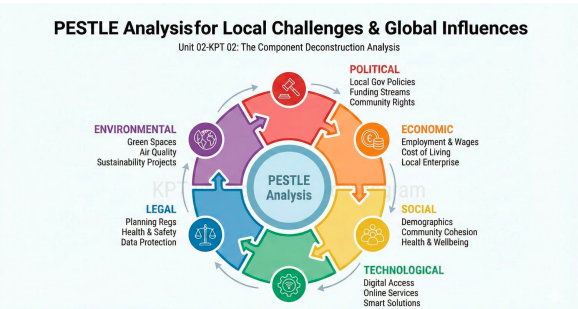
- Political (P): Government policy, funding cycles, and legislation.
o Vocational Example: Changes to the UK Shared Prosperity Fund affecting
local regeneration grants. - Economic (E): Market trends, cost of living, and employment rates.
o Vocational Example: The “Cost of Living Crisis” (Global/National issue)
causing fuel poverty in a specific council estate (Local challenge). - Social (S): Demographics, lifestyle changes, and cultural trends.
o Vocational Example: An aging population in a coastal town increasing
demand for adult social care. - Technological (T): Digital access and innovation.
o Vocational Example: The “Digital Divide” preventing low-income families
from accessing Universal Credit services online. - Legal (L): Specific UK Acts of Parliament.
o Vocational Example: Adhering to the Equality Act 2010 when designing
accessible community spaces. - Environmental (E): Climate change and sustainability.
o Vocational Example: Global climate targets influencing local “Low Traffic Neighborhood” (LTN) implementations.
3: Identification Skills: Spotting the Signals
As a practitioner, you need to scan reports and stakeholder emails to identify these
factors.
| If the text mentions… | It is likely a… | Vocational Insight |
| “Council budget cuts” or “Grant reduction” | Political / Economic | Suggests a need for alternative fundraising or social enterprise models. |
| “Supply chain issues” or “Import costs” | Global Economic | Indicates that a local project might be delayed by international logistics. |
| “Community Rights” or “Neighborhood Planning” | Legal (UK) | References the Localism Act 2011, giving power to local communities |
| “Digital exclusion” or “Broadband access” | Technological | A barrier to entry for employment and education programs. |
B. Learner Task Template
Task 2: Case Study Deconstruction
Instructions:
Read the short paragraph below about the “Milltown Heritage Project.” You must act
as the Community Development Officer. Your job is to identify the specific components
(Resources/Stakeholders) and the specific PESTLE factors hidden in the text.
Case Text:
“The Milltown revitalization project has stalled because the local textile factory closed,
moving operations to Southeast Asia to reduce costs, which has spiked unemployment in the borough. While the Town Council has offered a small venue for retraining,
residents are struggling to access the online retraining portal due to poor broadband
infrastructure. Furthermore, new UK carbon emission regulations require the old factory
site to undergo expensive environmental cleanup before any community reuse is
possible.”
Your Analysis:
1: Identify Components:
- List the main Resource mentioned in the text:
o [Learner types answer here – Expected: The venue for retraining / The old
factory site] - List the key Stakeholder/Group mentioned:
o [Learner types answer here – Expected: The Town Council / The
Residents / The Textile Company]
2: Analyse Factors (Local & Global):
- Which Global/Economic Factor is influencing this situation?
o [Learner types answer here – Expected: Globalization/Offshoring of
manufacturing to Southeast Asia] - Which Technological Factor is acting as a barrier (Local Challenge)?
o [Learner types answer here – Expected: Poor broadband infrastructure /
Digital exclusion] - Which Legal/Environmental Factor is mentioned (Policy)?
o [Learner types answer here – Expected: UK carbon emission regulations
requiring cleanup]
Learner Guidelines & Submission Requirements
Task Guidelines:
- Vocational Focus: When identifying factors, do not just list the word (e.g.,
“Economic”). Explain why it fits that category based on the text (e.g., “Economic –
because the text mentions moving operations to reduce costs”). - UK Context: Ensure any mention of regulations implies the UK framework
provided in the Knowledge Guide. - Conciseness: Bullet points are preferred. As a community worker, your reports
must be scannable and direct.
Submission Requirements:
Format: A single PDF document or input directly into the Learning Management
System (LMS).
- Word Count: Approximately 150-200 words for the analysis section.
- Grading Criteria:
o Accurate identification of the Global vs. Local influence.
o Correct categorization of PESTLE factors.
o Recognition of the specific resource constraint (the building/broadband).