
ProQual Level 6: QA/QC Knowledge Task
Table of Contents
Quality Diploma Introduction
The ProQual Level 6 Diploma in Quality Control and Quality Assurance (QA/QC) – Engineering is an advanced vocational pathway designed to validate the competency of engineering professionals operating at a senior, decision-making level. This qualification is fundamentally rooted in the practical application of complex quality management systems within the UK engineering sector, demanding high-level professional judgment and rigorous strategic oversight. The core focus remains strictly on authentic workplace competency rather than mere academic theory, ensuring that all practices align with established UK industrial standards and operational realities.
- Demonstrates applied engineering competency and complex decision-making capabilities.
- Focuses exclusively on the ProQual Level 6 operational expectations and vocational objectives.
- Requires seamless integration of strategic quality management within practical engineering environments.
- Ensures adherence to strict UK regulatory frameworks, including the Health and Safety at Work etc. Act 1974 and the Construction (Design and Management) Regulations 2015.
Task Purpose Overview
These Knowledge Application Tasks are strategically developed to assess your vocational capability in implementing quality management protocols across complex engineering scenarios. The primary objective is to evaluate your professional competency in isolating workplace challenges, executing root cause analysis, and deploying robust corrective measures using integrated higher-level thinking. By navigating these practical assessments, you will demonstrate your ability to bridge theoretical frameworks with tangible, high-stakes engineering operations without relying on isolated academic concepts.
- Objective: Validate professional judgment in real-world UK engineering quality scenarios.
- Objective: Confirm competency in drafting, reviewing, and applying distinct QA/QC documentation.
- Objective: Assess the ability to navigate complex non-compliance challenges and enforce rigorous corrective actions.
Concept Explainer Sheet
Understanding the dynamic relationship between quality frameworks and vocational engineering practices is critical for senior personnel. This explainer outlines the foundational principles governing the tasks below, emphasizing the transition from theoretical knowledge to applied, site-specific competency. Quality Assurance acts as the proactive system preventing defects through planned processes, while Quality Control serves as the reactive inspection mechanism identifying defects within the final engineering output. Together, they form a cohesive lifecycle governed strictly by UK compliance requirements.
- Proactive vs Reactive Dynamics: Aligning preventive QA strategies with rigorous QC inspection metrics.
- Regulatory Alignment: Strictly operating within UK mandates such as PUWER 1998 and LOLER 1998.
- Continuous Improvement Focus: Utilizing structural methodologies to enhance engineering output systematically over time.
- Risk Mitigation Integration: Embedding hazard identification directly into the daily operational quality framework.
Workplace Scenario Context
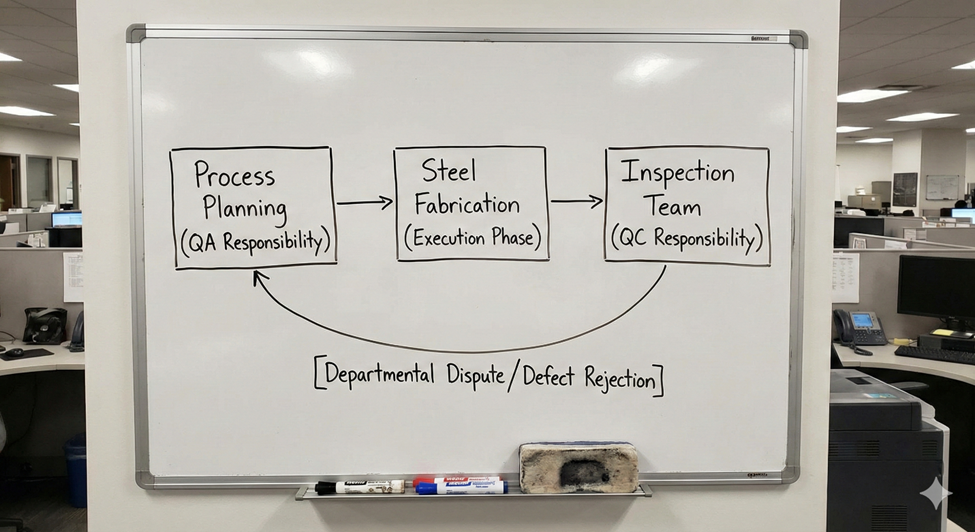
You are currently the senior authority overseeing a major structural steel fabrication project situated in a large manufacturing plant in Birmingham, where severe cross-departmental friction has completely halted the operational flow. The site inspection team is consistently rejecting finished steel components due to critical weld defects, leading to aggressive, ongoing disputes with the process planning department regarding the root origin of these failures. As the lead professional on site, you must urgently intervene to clarify the structural responsibilities of each department, ensuring that the entire manufacturing supply chain adheres strictly to the Provision and Use of Work Equipment Regulations 1998 (PUWER) and the Lifting Operations and Lifting Equipment Regulations 1998 (LOLER).
- Critical weld defects causing high rejection rates in structural steel components.
- Severe cross-departmental operational friction halting the manufacturing timeline.
- Urgent need for authoritative, senior-level intervention to restore production.
- Mandatory compliance enforcement regarding PUWER 1998 and LOLER 1998 mandates.
Learner Task Instructions
Based on the complex workplace scenario provided, you must execute a highly detailed written comparison detailing the distinct boundaries and functional intersections of Quality Assurance and Quality Control within this specific UK manufacturing plant. Your professional document must clearly articulate how the process planning department is expected to prevent these specific steel defects proactively, and precisely how the inspection team identifies them reactively using established criteria. This response must rely entirely on your professional judgment to permanently resolve the departmental dispute through clear, objective-driven operational definitions that field personnel can immediately understand and implement.
- Evidence Required: Written comparison of QC vs QA.
- Articulate the precise differences between proactive prevention and reactive inspection methodologies.
- Resolve the specific cross-departmental dispute using clear, authoritative vocational guidance.
- Maintain a strict focus on workplace competency, complex decision-making, and professional judgment.
Final Submission Guidelines
Your finalized submission must strictly reflect the authoritative operational standards of a senior UK engineering environment and must be presented as a formal, highly professional workplace directive. It is absolutely critical that your document relies solely on the single requested piece of evidence, entirely avoiding the inclusion of academic theories, irrelevant data, or references to unapproved external frameworks or awarding bodies. All applied solutions within your submission must demonstrate clear, complex decision-making and must guarantee absolute, verifiable compliance with UK industrial laws and site-specific operational mandates.
- Submit a formal, authoritative workplace operational directive suitable for field use.
- Utilize strictly one single evidence type as mandated by the task requirements.
- Ensure total, unwavering compliance with current UK engineering legislation.
- Avoid academic, theoretical padding and focus purely on objective vocational outcomes.