
ProQual Level 6: QA/QC Case Study Task
Table of Contents
Introduction to Quality Task
You are stepping into a scenario that demands the mindset of a senior engineering professional. At this advanced stage of your vocational career, understanding the fundamental differences between proactive assurance and reactive control is merely the baseline. The real test of your competency lies in your ability to navigate complex, high-stakes engineering environments where systems break down, supply chains fail, and regulatory compliance is severely threatened. This knowledge provision task is designed to strip away academic safety nets and place you directly into a realistic, high-pressure industrial situation. You are required to evaluate failures not just as isolated incidents, but as systemic breakdowns within the overarching project lifecycle. Your analytical approach must demonstrate mature professional judgment, a deep understanding of structural integrity risks, and the capacity to enforce rigorous standards that protect both public safety and commercial viability. You will be expected to critically dissect the events leading up to a major non-compliance event, identifying the exact moments where preventative strategies collapsed. This requires a comprehensive evaluation of site practices, material sourcing protocols, and the overarching governance structures that dictate engineering operations within the United Kingdom.
Task Assessment Core Purpose
- To critically evaluate a realistic workplace failure and identify the precise breakdowns within the overarching preventative systems.
- To demonstrate advanced competency in distinguishing between strategic planning failures and operational inspection failures on a major construction site.
- To apply rigorous professional judgment in determining the legal and structural consequences of non-compliance within the United Kingdom engineering sector.
- To prove your ability to synthesize complex project data into a formal, legally robust document that highlights the impacts of compromised standards.
- To showcase your capacity to lead risk management interventions and mandate corrective actions that prevent catastrophic project delays.
- To transition your mindset from a theoretical understanding of quality standards to the practical, authoritative enforcement of those standards on site.
Core Concept Explainer Sheet
The distinction between strategic oversight and operational inspection is the cornerstone of engineering management. When managing large-scale infrastructure, professionals must seamlessly integrate both disciplines to ensure structural integrity and legal compliance. Quality assurance represents the proactive, systemic, and process-driven framework designed to prevent defects before they occur. It is the architectural blueprint of compliance, encompassing supplier audits, training matrixes, methodology reviews, and continuous improvement protocols. It asks whether the correct processes are fundamentally in place to guarantee a successful outcome.
- Strategic Planning: Establishing robust methodologies and supply chain vetting procedures long before materials arrive on site.
- Process Verification: Conducting regular audits of the management systems to ensure they remain effective and compliant with national standards.
- Risk Mitigation: Identifying potential failure points in the project lifecycle and engineering controls to neutralize those risks proactively.
- Continuous Improvement: Utilizing historical project data and near-miss reports to constantly refine and strengthen the preventative framework.
Conversely, quality control is the reactive, product-focused, and inspection-based execution of that framework. It represents the physical testing, the visual inspections, and the immediate validation of materials and workmanship against the specified standards. If assurance is the intention to build correctly, control is the hard evidence that the correct build has been achieved. When an engineering failure occurs, it is rarely just a control failure; it is almost always preceded by a deeper assurance failure, where the systems designed to support the inspector on the ground were fundamentally flawed.
UK Regulatory Compliance Framework
Navigating the engineering sector within the United Kingdom requires a masterful command of stringent statutory instruments and regulatory bodies. Your professional competency is directly tied to your ability to enforce the requirements of the Construction Design and Management Regulations two thousand and fifteen. These regulations legally mandate that risk must be managed and mitigated at every single stage of the project lifecycle, from initial concept design through to physical construction and eventual demolition. A failure in your preventative systems is not merely a commercial issue; it is a direct breach of these regulations, placing the principal contractor and client at severe legal risk. Furthermore, the introduction of the Building Safety Act two thousand and twenty-two has radically transformed the landscape of structural compliance. This act demands an unbroken golden thread of information, requiring meticulous traceability of all materials, design decisions, and inspection results.
As a senior professional overseeing these systems, you must ensure that all processes align with the stringent criteria set forth by the United Kingdom Accreditation Service. Material testing facilities must hold the correct accreditations, and all physical testing must comply with the relevant British Standards. When an incident occurs, regulatory bodies such as the Health and Safety Executive have the authority to halt works, issue massive financial penalties in the millions of pounds, and pursue criminal prosecutions against individuals who failed to exercise their professional duty of care. Your role is to construct a management framework that is completely bulletproof against regulatory scrutiny, ensuring that every piece of steel and every cubic meter of concrete can be legally and structurally justified.
Concrete Quality Failure Scenario
- A major commercial infrastructure project in central London is currently in the critical path phase of constructing the primary load-bearing foundation raft.
- The project specifications mandate a highly specialized, self-compacting concrete mix designed to withstand immense structural loads and severe environmental degradation.
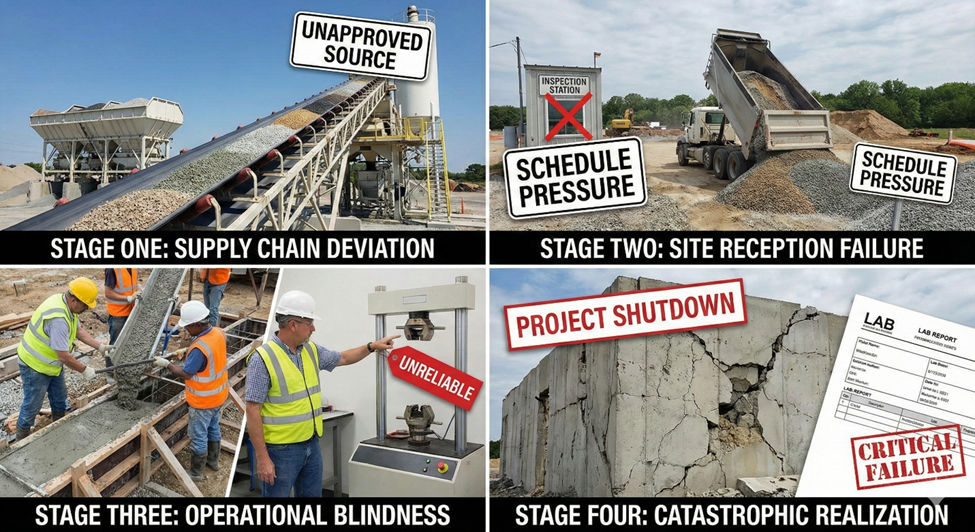
- During the fourth major continuous pour, site operatives notice significant variations in the workability and visual consistency of the supplied material arriving from the batching plant.
- Despite these visual warnings, the site management team, under extreme pressure to meet commercial deadlines, authorizes the continuation of the pour without halting for secondary verification.
- Seventy-two hours post-pour, initial early-age cylinder testing reveals that the material is comprehensively failing to achieve the mandated strength milestones required for this stage of curing.
- Simultaneously, massive thermal cracking begins to propagate across the surface of the raft, indicating a catastrophic failure in the heat of hydration management and fundamental mix design.
- The entire site is subjected to an immediate stop-work order, resulting in daily financial losses running into hundreds of thousands of pounds.
- Preliminary investigations suggest that the batching plant changed their aggregate supplier without notifying the principal contractor, and the site testing technicians failed to properly calibrate their slump testing equipment.
Incident Progression Flow Diagram
Understanding the sequence of events is critical for identifying exactly where the management framework collapsed. The failure was not a single event, but a compounding series of overlooked warnings and broken protocols.
Assessor Guided Professional Questions
Analyze the breakdown between the external batching plant and the principal contractor’s site management team. You must determine how a robust preventative framework should have intercepted the unapproved change in aggregate supply long before the delivery trucks ever reached the construction site. Consider the specific audit mechanisms and supply chain transparency protocols that were clearly absent or ignored in this scenario.
Evaluate the decision made by the site management team to continue the pour despite the visual inconsistencies in the material. Discuss the immense commercial pressures that often drive these dangerous decisions and explain how a mature engineering professional must enforce regulatory compliance over schedule demands. You must articulate the legal ramifications under United Kingdom health and safety legislation regarding the failure to halt works when quality is visibly compromised.
Examine the failure of the operational inspection testing equipment calibration. Detail the cascading impact that a single uncalibrated testing device can have on the structural integrity of an entire commercial project. Discuss the strict lifecycle management of testing equipment and how this operational failure represents a much deeper flaw in the overarching continuous improvement and verification strategy of the organization.
Learner Mandatory Task Evidence
- You must generate exactly one piece of formal evidence to satisfy this assessment requirement.
- The required evidence format is: Case studies highlighting non-compliance impacts.
- You must draft a comprehensive, highly detailed professional case study report based entirely on the Concrete Quality Failure Scenario provided above.
- Your case study must forensically analyze the financial, structural, and legal impacts of this specific non-compliance event.
- You must clearly separate the impacts caused by the preventative system failures from the impacts caused by the operational inspection failures.
- Your document must outline the specific UK regulatory breaches that occurred due to this non-compliance, referencing the relevant legislative frameworks mentioned in the guide.
- You must conclude your case study with a mandatory action plan detailing the immediate interventions required to rectify the structural failure and prevent a recurrence.
Final Task Submission Guidelines
Your final document must reflect the gravitas and precision expected of a senior professional operating at an advanced engineering level. The language used must be strictly vocational, utilizing correct industry terminology regarding structural integrity, systems management, and regulatory compliance. You must ensure that your writing is entirely objective, analytical, and devoid of colloquialisms.
- The document must be structured logically, mirroring the professional reports expected by corporate boards and regulatory inspectors.
- You must strictly adhere to the single requested evidence type; do not include additional policy documents, risk registers, or separate comparison charts.
- Ensure that every assertion made regarding legal compliance is strictly anchored to United Kingdom legislation.
- Before submission, thoroughly review your case study to guarantee that it heavily emphasizes competency, complex problem resolution, and executive-level decision making.