
What Is a Level 5 Diploma Equivalent To? Complete UK Qualification Guide for 2026
Table of Contents
A Level 5 Diploma is a recognised higher education qualification that provides learners with advanced knowledge, practical skills, and professional competence in a specific field of study. Positioned between Level 4 and Level 6 qualifications within the UK qualifications framework, it serves as an important stepping stone for individuals seeking career advancement, professional development, or progression to degree-level study.
As industries continue to evolve and employers increasingly seek qualified professionals with specialised expertise, Level 5 Diplomas have become a popular choice among learners who want to enhance their knowledge while developing practical workplace skills. These qualifications are designed to bridge the gap between foundational learning and advanced professional practice, enabling learners to apply theoretical concepts to real-world situations.
A Level 5 Diploma is particularly beneficial for individuals who want to strengthen their professional capabilities, improve their employability, and prepare for leadership or management responsibilities. Unlike entry-level qualifications, Level 5 study focuses on critical thinking, decision-making, problem-solving, and industry-specific knowledge that can contribute directly to workplace success.
Whether you are looking to progress in your current career, change industries, or continue your educational journey, understanding the value and opportunities associated with a Level 5 Diploma can help you make informed decisions about your future.
Understanding Level 5 Qualifications
The UK qualifications framework is designed to categorise qualifications according to their complexity, depth of learning, and expected outcomes. Each qualification level represents a different stage of educational achievement and professional competence.
Level 5 qualifications sit within higher education and are recognised for providing advanced knowledge and practical expertise. They are more challenging than Level 4 qualifications and require learners to demonstrate a deeper understanding of their chosen subject area. At this level, students are expected to analyse information critically, evaluate complex situations, and apply knowledge effectively within professional contexts.
One of the key purposes of Level 5 qualifications is to develop specialist skills that are directly relevant to industry requirements. As a result, these qualifications often combine academic learning with practical application, making them highly valuable for both career progression and further study.
Because Level 5 qualifications are recognised across various industries, they provide learners with a respected credential that demonstrates both knowledge and professional competence. This recognition makes them attractive to employers seeking candidates who possess advanced workplace skills and the ability to perform effectively in demanding professional environments.
What Is a Level 5 Diploma?
A Level 5 Diploma is an advanced qualification designed to equip learners with the knowledge, skills, and practical understanding required to succeed in a specific profession or industry. The qualification focuses on developing both academic and professional competencies, enabling learners to apply their learning directly within workplace settings.
Unlike introductory qualifications, a Level 5 Diploma requires learners to engage with more complex concepts, undertake independent research, and demonstrate a greater level of responsibility in their learning. This helps students develop confidence, professional judgement, and the ability to manage workplace challenges effectively.
Level 5 Diplomas are available in a wide variety of disciplines, including:
- Business Management
- Education and Training
- Health and Social Care
- Health and Safety
- Human Resource Management
- Information Technology
- Construction Management
- Project Management
- Logistics and Supply Chain Management
- Hospitality and Tourism
The flexibility and industry relevance of these qualifications make them suitable for both aspiring professionals and experienced individuals seeking to enhance their expertise.
What Is a Level 5 Diploma Equivalent To?
One of the most frequently asked questions about this qualification is: What is a Level 5 Diploma equivalent to?
A Level 5 Diploma is generally considered equivalent to the following qualifications:
- Foundation Degree
- Higher National Diploma (HND)
- Diploma of Higher Education (DipHE)
- Second Year of a Bachelor’s Degree
These qualifications are positioned at the same academic level within the UK qualifications framework and represent a similar level of knowledge, understanding, and professional competence.
Although the learning approaches and assessment methods may vary, all Level 5 qualifications require learners to demonstrate advanced subject knowledge, analytical thinking, and practical application of skills. This means that a Level 5 Diploma holds significant academic and professional value and can serve as a pathway to further study or career progression.
Level 5 Diploma Qualification Comparison
| Qualification | Academic Level | Typical Equivalent |
|---|---|---|
| Level 3 Diploma | Level 3 | A Levels |
| Level 4 Diploma | Level 4 | First Year of Higher Education |
| Level 5 Diploma | Level 5 | Foundation Degree or HND |
| Level 6 Diploma | Level 6 | Bachelor’s Degree |
| Level 7 Diploma | Level 7 | Master’s Degree Level |
This comparison helps learners understand where a Level 5 Diploma sits within the wider educational framework and how it relates to other recognised qualifications.
Key Features of a Level 5 Diploma
A Level 5 Diploma offers several important features that make it attractive to both learners and employers.
Advanced Subject Knowledge
The qualification enables learners to develop a comprehensive understanding of key concepts, theories, and practices within their chosen field. This advanced knowledge helps individuals perform more effectively in professional environments and supports informed decision-making.
Practical and Industry-Focused Learning
Level 5 Diplomas are designed with workplace relevance in mind. Learners are encouraged to apply theoretical concepts to real-world scenarios, helping them develop practical skills that can be used immediately within professional settings.
Leadership and Management Development
Many Level 5 programmes incorporate leadership and management principles, preparing learners to supervise teams, manage projects, and contribute to organisational success.
Flexible Learning Opportunities
The qualification can often be studied through flexible learning formats, allowing learners to balance their education with work and personal commitments.
Career-Focused Outcomes
A strong emphasis is placed on employability and professional competence, ensuring that learners develop skills that are relevant to current industry demands.
Progression Pathways
A Level 5 Diploma can provide progression opportunities into higher-level qualifications, professional certifications, and advanced career pathways.
Who Should Study a Level 5 Diploma?
A Level 5 Diploma is suitable for a wide range of learners and professionals.
It may be particularly beneficial for:
- Individuals seeking career advancement
- Professionals preparing for management positions
- Team leaders and supervisors
- Career changers entering a new industry
- Entrepreneurs seeking business knowledge
- Learners planning to progress to Level 6 qualifications
- Individuals wishing to gain specialist expertise
The qualification is especially valuable for those who want practical, career-focused learning that can be applied directly within the workplace.
What Skills Do You Gain from a Level 5 Diploma?
Leadership and Team Management
A Level 5 Diploma helps learners develop the leadership capabilities needed to guide teams, manage resources, and support organisational objectives. Students gain an understanding of effective management practices, employee motivation, and team performance improvement. These skills are highly valuable in supervisory and management roles across a variety of industries.

Problem-Solving Skills
The qualification encourages learners to analyse challenges, identify potential solutions, and implement effective strategies. Through practical assignments and real-world case studies, students learn how to approach workplace issues systematically and make informed decisions that contribute to organisational success.
Critical Thinking
Learners develop the ability to evaluate information objectively, question assumptions, and assess alternative viewpoints. Critical thinking skills support better decision-making and enable individuals to address complex professional challenges with confidence.
Communication Skills
Strong communication is essential in any profession. A Level 5 Diploma enhances written, verbal, and interpersonal com+
]5unication abilities, enabling learners to present information clearly, collaborate effectively, and build professional relationships.
Research and Analytical Skills
Students learn how to gather information, evaluate evidence, interpret data, and draw meaningful conclusions. These skills support strategic planning, problem-solving, and informed decision-making within professional environments.
Industry-Specific Expertise
The qualification provides specialised knowledge relevant to a particular sector, helping learners develop professional competence and a deeper understanding of industry practices, standards, and expectations.
Benefits of Studying a Level 5 Diploma
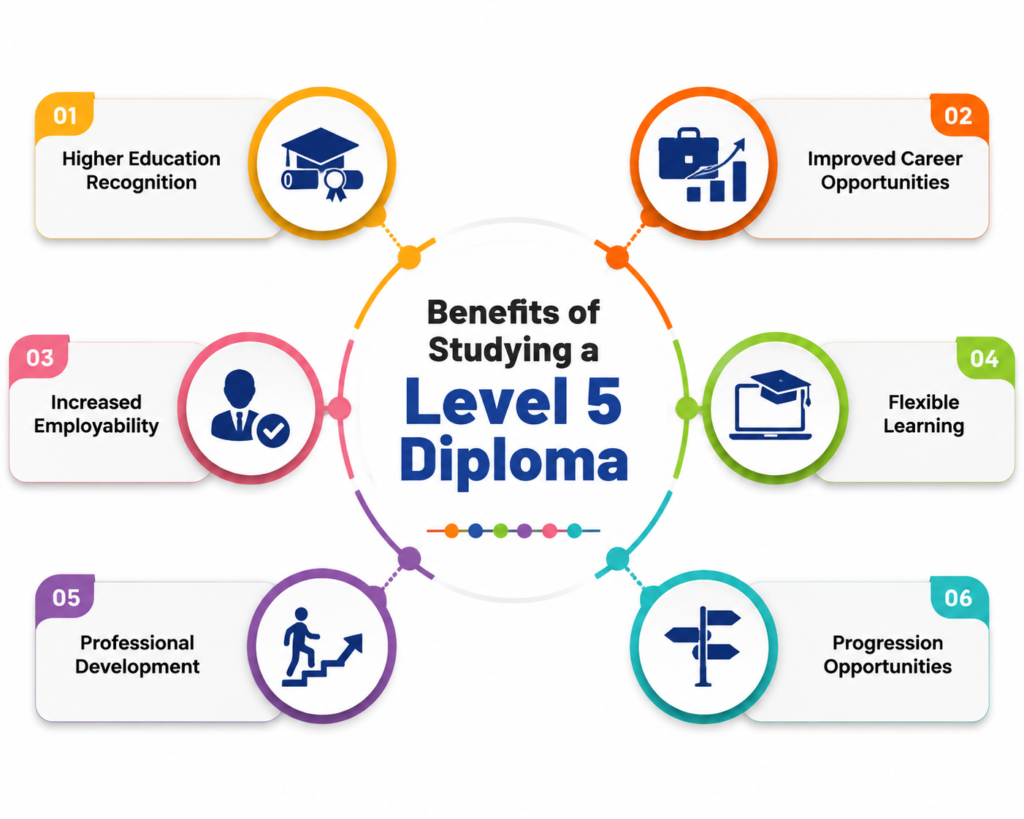
Higher Education Recognition
A Level 5 Diploma is recognised as a higher education qualification that demonstrates advanced knowledge, professional competence, and commitment to learning. This recognition enhances credibility and supports career progression.
Improved Career Opportunities
Many employers value Level 5 qualifications because they demonstrate advanced skills, industry knowledge, and the ability to perform effectively within professional roles. This can lead to greater employment opportunities and career advancement.
Increased Employability
The combination of practical skills and theoretical knowledge makes graduates more attractive to employers. The qualification demonstrates that learners possess both technical expertise and workplace competence.
Flexible Learning
Many learners choose a Level 5 Diploma because it offers flexibility and accessibility. This allows individuals to continue developing professionally while managing work and personal commitments.
Professional Development
The qualification supports continuous learning and helps professionals stay current with industry developments, best practices, and emerging trends.
Progression Opportunities
A Level 5 Diploma can provide access to higher-level qualifications, advanced professional training, and specialised career pathways.
Career Opportunities After a Level 5 Diploma
A Level 5 Diploma can open doors to a variety of professional opportunities across multiple industries.
Business and Management
Potential career roles include:
- Team Leader
- Operations Supervisor
- Business Development Executive
- Department Coordinator
- Office Manager
Health and Safety
Career opportunities may include:
- Health and Safety Officer
- Compliance Coordinator
- Safety Advisor
- Risk Assessment Officer
- Workplace Safety Administrator
Education and Training
Possible roles include:
- Trainer
- Learning and Development Coordinator
- Education Support Manager
- Training Consultant
- Programme Coordinator
Information Technology
Graduates may pursue careers such as:
- IT Support Manager
- Systems Administrator
- Technical Support Specialist
- Network Coordinator
- Digital Operations Officer
Construction and Project Management
Career opportunities may include:
- Site Supervisor
- Project Coordinator
- Construction Manager Assistant
- Contracts Administrator
- Operations Coordinator
Who Awards Level 5 Diplomas?
Level 5 Diplomas are awarded by recognised awarding organisations that develop qualifications in accordance with established educational standards and industry requirements. These organisations ensure that qualifications meet quality assurance requirements and provide learners with credible and recognised certification.
Some widely recognised awarding organisations include:
- OTHM Qualifications
- Qualifi
- ATHE
- ProQual
- NCC Education
These awarding organisations work closely with industry experts and subject specialists to develop qualifications that reflect current workplace practices and professional expectations.
Progression Routes After a Level 5 Diploma
A Level 5 Diploma not only provides valuable knowledge and professional skills but also creates a range of opportunities for further education and career advancement. Many learners use this qualification as a stepping stone to achieve higher academic credentials, gain specialist expertise, or progress into more senior professional roles. Below are some of the most common progression routes available after completing a Level 5 Diploma.
Level 6 Diploma
One of the most popular progression options is advancing to a Level 6 Diploma. This qualification builds upon the knowledge and skills developed at Level 5 and introduces more advanced concepts, strategic thinking, and professional practice. A Level 6 Diploma is generally recognised as being at the same academic level as a bachelor’s degree and can help learners strengthen their expertise within a specific field. Progressing to Level 6 can also improve career prospects by preparing individuals for senior-level responsibilities and leadership positions.
Bachelor’s Degree Top-Up
A Level 5 Diploma may provide learners with the opportunity to continue their academic journey through a bachelor’s degree top-up programme. These programmes are designed to build on existing knowledge and allow learners to achieve a full bachelor’s degree by completing additional study. This progression route is particularly beneficial for individuals who wish to gain a recognised degree qualification while making use of their previous academic achievements. A bachelor’s degree can further enhance employability, professional recognition, and future career opportunities.
Professional Certifications
Many learners choose to complement their Level 5 Diploma with industry-specific professional certifications. These certifications help demonstrate specialist knowledge, technical competence, and commitment to continuous professional development. Depending on the industry, professional certifications can improve career prospects, increase professional credibility, and help individuals stay up to date with current industry standards and best practices. Combining a Level 5 Diploma with recognised professional credentials can create a strong and competitive professional profile.
Advanced Career Development
For many professionals, a Level 5 Diploma serves as a foundation for career progression and long-term professional growth. The qualification develops leadership, management, communication, and problem-solving skills that are highly valued by employers. As a result, graduates may become eligible for supervisory, managerial, or specialist positions within their chosen industry. This progression can lead to increased responsibilities, greater earning potential, and enhanced opportunities for professional advancement throughout their careers.
Is a Level 5 Diploma Worth It?
For many learners, a Level 5 Diploma represents a valuable investment in their future. The qualification combines academic learning with practical workplace skills, helping individuals improve their employability, professional competence, and career prospects.
Because it is recognised within higher education and respected by employers, a Level 5 Diploma can support both immediate career development and long-term progression opportunities. Whether your goal is to gain specialist expertise, prepare for management responsibilities, or continue your educational journey, the qualification provides a strong foundation for future success.
Conclusion
A Level 5 Diploma is a respected higher education qualification that combines advanced learning, practical skills, and professional development. Positioned between Level 4 and Level 6 qualifications, it provides learners with specialist knowledge, industry-relevant expertise, and valuable progression opportunities.
Equivalent to qualifications such as a Foundation Degree, HND, and Diploma of Higher Education, a Level 5 Diploma offers both academic recognition and professional relevance. Whether you are seeking career advancement, increased employability, or progression to higher-level study, this qualification can help you achieve your personal and professional goals while building a strong foundation for long-term success.
Can a Level 5 Diploma Help Me Progress to a Level 6 Qualification?
Yes, a Level 5 Diploma can provide a progression pathway to Level 6 qualifications. Many learners choose to continue their studies at Level 6 to gain more advanced knowledge, strengthen their professional expertise, and achieve a qualification that is academically equivalent to a bachelor’s degree.
Is a Level 5 Diploma Suitable for Working Professionals?
A Level 5 Diploma is particularly suitable for working professionals who want to enhance their skills, improve their industry knowledge, and advance their careers. The qualification focuses on practical and professional development, making it highly relevant to real-world workplace requirements.
Why Choose a Level 5 Diploma in 2026?
A Level 5 Diploma remains a valuable qualification in 2026 because it equips learners with industry-relevant knowledge, professional skills, and recognised credentials that are highly sought after by employers. It can help individuals remain competitive in a changing job market while creating opportunities for further study and career progression.