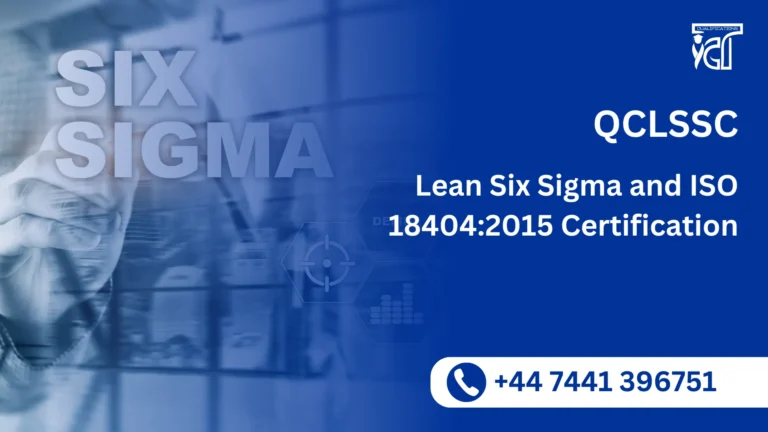
QCLSSC Six Sigma Green Belt Certification
Drive operational excellence and lead process improvement initiatives with the internationally recognized Six Sigma Green Belt Certification.

Course Level
Six Sigma
Course Type
Non-Ofqual
Awarding Body
QualCert
Duration
60–80 Hours
Study Mood
Online
Assessment
Assignments Based
Course Overview
What is this course
The QCLSSC Six Sigma Green Belt Certification is an internationally recognized and industry-standard certification designed for professionals seeking advanced expertise in process improvement, quality management, and operational excellence. Building on foundational Six Sigma knowledge, the Green Belt certification equips participants with the skills to lead process improvement projects and contribute to measurable business outcomes.
This certification focuses on advanced Six Sigma methodologies, statistical analysis, and problem-solving tools. Learners gain in-depth knowledge of the DMAIC (Define, Measure, Analyze, Improve, Control) framework, process mapping, root cause analysis, and performance measurement. Participants also learn to identify inefficiencies, implement improvements, and monitor results to ensure sustainable operational efficiency. The program emphasizes real-world applications, enabling professionals to drive continuous improvement initiatives and support organizational growth effectively.
Ideal for mid-level professionals, team leaders, and quality managers, this Green Belt Certification prepares learners for roles such as Process Improvement Lead, Quality Analyst, Operations Manager, or Project Coordinator. It also provides a pathway to the advanced Black Belt certification, offering international recognition and career advancement in industries like manufacturing, IT, healthcare, and services.
Course Content
Detailed Curriculum Structure
QCLSSC Six Sigma Green Belt Certification has 24 modules:
Who Should Attend
Target Audience and Participants
The QCLSSC Six Sigma Green Belt Certification is an internationally recognized course designed for professionals aiming to lead process improvement initiatives and enhance operational efficiency.
- Mid-level professionals and team leaders involved in process improvement projects
- Quality managers and analysts seeking to enhance operational and quality management skills
- Project coordinators and supervisors responsible for process monitoring and efficiency improvements
- Professionals aiming to analyze data, reduce defects, and implement business solutions
- Employees preparing for advanced Six Sigma certifications, including Black Belt
- Professionals across manufacturing, IT, healthcare, and service industries
- Individuals seeking to advance their career in quality management, process optimization, and operational excellence
This format ensures the course description is SEO-friendly, concise, and highly relevant for prospective learners globally.
Career & Learning Benefits
Skills, Knowledge & Opportunities You Will Earn
- Gain mastery of Six Sigma principles, DMAIC methodology, and quality management tools
- Develop skills to analyze processes, identify inefficiencies, and implement improvements
- Enhance ability to lead and manage Six Sigma projects within teams and organizations
- Strengthen problem-solving, decision-making, and data-driven analysis skills
- Improve operational efficiency, reduce defects, and ensure sustainable business improvements
- Expand career opportunities in manufacturing, IT, healthcare, service industries, and consultancy
- Achieve a globally recognized Green Belt certification aligned with international standards
- Prepare for progression to Black Belt certification for advanced leadership and strategic roles
Need More Information?
Frequently Asked Questions Explained
Enrollment Criteria
Minimum Eligibility Criteria for Enrollment
Lock In Your Spot
Get in Touch
+44 2035 764371
+44 7441 396751
info@ictqual.co.uk
www.inspirecollege.co.uk