
Inspection Photo & Diagram Task Guide
Table of Contents
Evidence Generation Focus & Rules
Targeted Evidence Category:
3. Practical Evidence
Specific Evidence Type:
Photographs of inspected fire doors and components, and/or annotated diagrams or sketches showing test results and defects. (Note: Do not submit checklists, reflective accounts, or written assignments for this specific KPT; focus entirely on generating visually rich, highly annotated photographic or diagrammatic evidence).
Critical Learner Instruction for Evidence Generation:
To complete the practical aspect of this task, you must use your Current Role/Designation, your Current Organization, and an active or recent project/facility you are working within. The final output must clearly display a “Prepared By / Provided By” statement where applicable. Maintain confidentiality at all times; any sensitive building information, personal data, company names, or identifiable details must be anonymised or removed prior to submission.
Part 1: Comprehensive Knowledge Guide – Visual Forensic Inspection
1. The Critical Role of Visual Evidence in Vocational Practice
In the field of passive fire protection, an inspector’s eyes are their primary diagnostic tool. Fire resisting doors are complex, highly regulated assemblies where a visual anomaly of merely a few millimeters can signify the difference between a compliant life-safety asset and a catastrophic failure.
Under the Regulatory Reform (Fire Safety) Order 2005 (FSO), the “Responsible Person” is legally obligated to maintain fire safety provisions. When you conduct an inspection, your visual findings—documented through photographs and diagrams—serve as the undeniable forensic proof of the door’s condition at a specific moment in time. This KPT focuses on developing your ability to move beyond merely “looking” at a door, training you to “interpret” visual data against strict UK standards, primarily BS 8214 and Approved Document B.
2. Assessor-Provided Scenarios: Observation, Interpretation, and Action
The following section presents three common visual scenarios encountered in various vocational environments (healthcare, industrial, and corporate). Study the textual descriptions of the visual evidence carefully.
Scenario A: The Altered Door (Healthcare/Residential Care Environment)
This is the core legislation. Article 17 states that the “Responsible Person” (usually the employer, facility manager, or landlord) must ensure that all fire safety equipment is subject to a suitable system of maintenance.
Visual Observation:
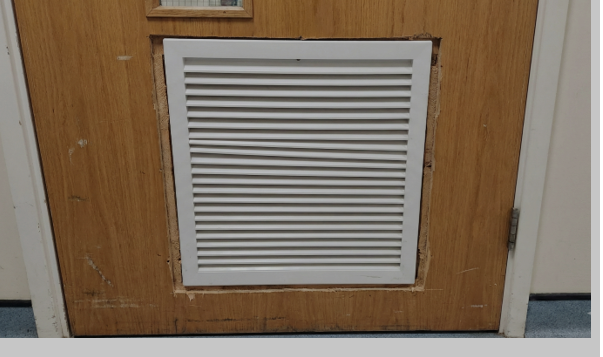
You are inspecting an FD30S cross-corridor door in a care home. The door leaf appears to be a standard solid timber core. However, a large (400mm x 400mm) plastic louvered ventilation grille has been retrofitted into the bottom half of the door. There is no intumescent material visible around or inside the grille. The edges of the cut-out timber are exposed and rough.
Interpretation (Regulatory & Standards):
Compartmentation Breach: A fire door’s primary function is to maintain compartmentation. By cutting a hole into the solid core and installing a standard plastic grille, the structural and fire-resisting integrity of the door has been completely compromised.
Thermal and Smoke Dynamics:
In the event of a fire, the plastic grille will melt within minutes (or seconds, depending on proximity to the fire load). This creates a massive aperture for fire and toxic cold smoke to pass through freely, entirely invalidating the FD30S rating.
Certification Void:
Field modifications that involve cutting into the core of a fire door immediately void its BWF-Certifier certification (or equivalent) unless the modification is strictly carried out according to the door manufacturer’s explicit fire test evidence using approved intumescent glazing or grille systems.
Corrective Action Required:
This is a Category 1 critical failure. The door leaf must be condemned immediately. A standard maintenance team cannot “patch” this hole with timber. The entire door leaf must be replaced with a certified, factory-prepared fire door. If ventilation is required for the HVAC system, a specialized, fully tested intumescent fire grille must be specified and installed by a competent person.
Scenario B: The Hardware Failure (Industrial/Warehouse Environment)
Visual Observation:
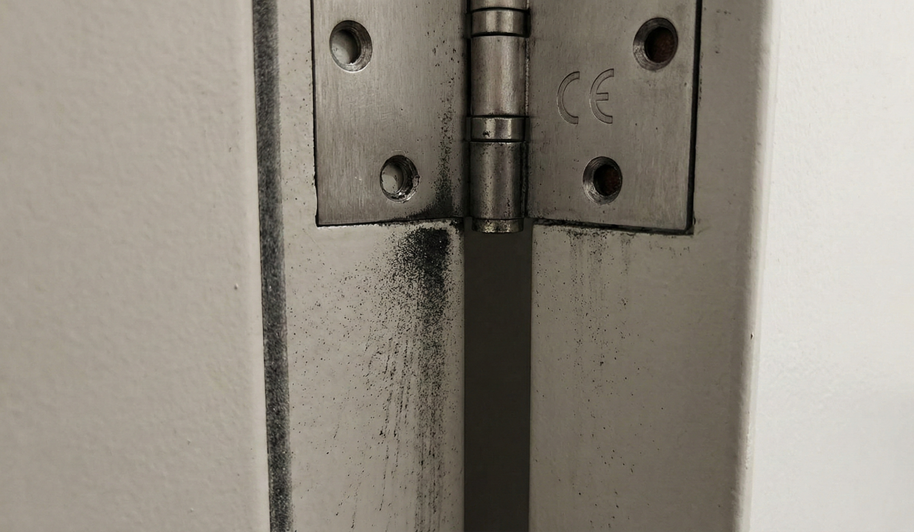
: You are inspecting heavy-duty FD60 double doors leading from a warehouse floor into an administrative block. Upon close visual inspection of the bottom hinge on the active leaf, you observe that two out of the four fixing screws are missing from the frame side. Furthermore, there is a visible trail of fine, black metallic dust leaking from the hinge knuckles and streaking down the door frame. The hinge is stamped with a CE mark, but you cannot see any intumescent pad behind the hinge blade.
Interpretation (Regulatory & Standards):
Mechanical Wear:
The black metallic dust is a classic visual indicator of severe mechanical wear and bearing failure. It means the metal components are grinding against each other. In an industrial environment with high traffic and heavy doors, the hinge is failing to support the load.
Fire Integrity Risk:
The missing screws are a critical compliance failure. During a fire, the extreme heat causes immense pressure and physical warping of the timber door leaf (thermal bowing). All approved fixings are required to hold the door securely in the frame against these forces.
Heat Transfer (BS 8214):
The lack of a visible intumescent pad behind the hinge blade is highly concerning. Metal hinges conduct heat rapidly into the combustible timber core. If the manufacturer’s installation instructions dictate the use of intumescent padding (which is standard for FD60 timber doors), its absence will lead to premature burn-through around the hinge, causing the door to drop out of the frame before the 60-minute mark.
Corrective Action Required:
The door fails inspection. The mechanical wear and missing screws mandate that the hinge must be replaced immediately. The remedial advice must specify that the door must be re-hung using three new, approved fire-rated hinges (e.g., BS EN 1935 Grade 13 minimum for heavy doors), complete with all correct gauge screws and specifically sized intumescent hinge pads fitted beneath both the frame and leaf blades.
Scenario C: The Gap & Seal Non-Compliance (Corporate Office Environment)
Visual Observation:
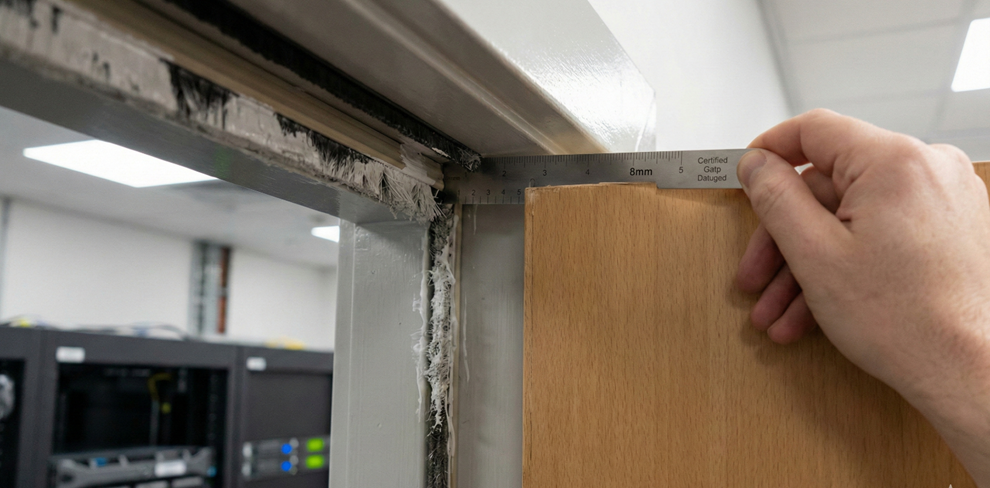
You are inspecting an FD30S door protecting a server room in a high-rise office. You insert your certified gap gauge at the top edge of the door leaf. The gauge clearly shows an 8mm gap between the door leaf and the frame head. You observe a combined intumescent and smoke seal (brush type) fitted into the frame reveal. However, the nylon brush is heavily matted down and covered in a thick layer of white gloss paint.
Interpretation (Regulatory & Standards):
The 3mm Rule:
British Standard 8214 sets strict tolerances for perimeter gaps, generally requiring them to be between 2mm and 4mm (aiming for 3mm). An 8mm gap is a severe non-compliance.
Intumescent Failure:
Intumescent material is designed to expand to a specific volume based on fire testing. If the gap is 8mm, the volume of the standard 15mm intumescent strip will likely be insufficient to completely bridge the void and seal the door against the immense pressure of a fire, leading to a failure of the fire barrier.
Smoke Control Breach:
The “S” rating dictates cold smoke restriction. The painted, matted brush seal is rigid and cannot make contact with the opposing door leaf. Even if the gap were correct, the painted seal would allow lethal toxic smoke to flood the escape route during the early, smoldering stages of a fire before enough heat is generated to activate the intumescent material.
Corrective Action Required:
This door fails on two critical fronts. First, the painted seals must be completely removed and replaced with new, continuous combined intumescent/smoke seals of the correct specification. Second, the 8mm gap must be rectified. This may require the door to be carefully re-hung, or the frame to be adjusted by a competent carpenter. Packing out hinges or adding non-certified timber strips to the door edge is not a compliant solution under BS 8214 unless explicitly supported by the door manufacturer’s fire test data.
Part 2: Learner Evidence Generation Task – Photographic & Diagrammatic Analysis
Objective:
To visually document, interpret, and resolve non-compliances on a real-world fire door assembly, demonstrating your practical ability to translate visual evidence into regulatory action.
Your Task:
You must now produce your own Annotated Photographic/Diagrammatic Inspection Report based on an actual fire resisting door within your current workplace, organization, or project.
Step 1: Identify and Capture Visual Evidence
- Locate a fire resisting door assembly on your site (preferably one exhibiting wear, minor defects, or complex installation factors).
- Capture clear, well-lit photographs of the following critical areas:
- A full wide-shot of the door assembly (both sides if possible).
- A close-up of at least one hinge assembly.
- A close-up of the perimeter gap with a gap gauge inserted to show the measurement.
- A close-up of the intumescent/smoke seals.
- A close-up of any specific defects or damages found.
- Alternative to Photography:If your workplace has strict security protocols prohibiting photography, you must produce highly detailed, professional, hand-drawn or CAD-generated diagrams/sketches accurately representing the door, its components, and any precise defects (e.g., sketching the hinge showing missing screws or sketching the gap measurement).
Step 2: Annotation and Interpretation
You must compile these images or diagrams into a single document and heavily annotate them. For every image, provide a text box containing:
- Visual Observation: Exactly what is shown in the image (e.g., “Image 3: Leading edge gap measured at 5mm using a certified gauge. Intumescent strip visible but damaged near the latch”).
- Regulatory Interpretation: How this specific visual finding relates to BS 8214, the Fire Safety Order, or Approved Document B (e.g., “Under BS 8214, the 5mm gap exceeds the standard 2-4mm tolerance. The damaged intumescent seal compromises the compartmentation, increasing the risk of premature fire breakthrough”).
- Pass/Fail Status: State whether this specific component passes or fails.
Step 3: Document Formatting and Submission
Ensure your final document meets the required submission guidelines:
- File Format: The document must be saved in PDF format.
- File Naming: Use a clear file-naming convention (e.g., UnitM_YourName_PhotoInterpretation.pdf).
- Authenticity Header: The first page of your document must clearly display:
- Prepared By: [Your Real Name]
- Signature and Date
- Designation: [Your Current Role]
- Organization: [Your Current Organization]
- Project Location: [Your Project Name/Location – anonymized if necessary]
- Final Summary: Conclude your document with a brief summary of the overall door status (Pass/Fail) and the immediate remedial actions required.
Ensure all evidence is authentic, relevant, and clearly aligned with the unit learning outcomes and complies with all ethical standards and workplace policies.