
Level 3 Fire Door Inspection: Mini Case Study Guide
Table of Contents
Evidence Generation Focus & Rules
Targeted Evidence Category:
4. Reporting Evidence Specific Evidence Type: Detailed inspection reports demonstrating compliance with regulations. (Note: Do not submit checklists, photographs, or written assignments for this specific KPT; focus entirely on generating a comprehensive inspection report).
Critical Learner Instruction for Evidence Generation:
To complete the practical aspect of this task, you must use your Current Role/Designation, your Current Organization, and an active or recent project you are working on. The final output must clearly display a “Prepared By / Provided By” statement featuring your real-world professional details. Maintain confidentiality by anonymizing sensitive building information or client data if necessary, aligning with workplace data protection policies.
Part 1: Comprehensive Knowledge Guide
1. Introduction to Fire Door Inspections in the Workplace
Fire resisting doors are critical, life-saving assets within any building’s passive fire protection strategy. They are not merely functional barriers; they are highly engineered safety devices designed to compartmentalize a building, restricting the spread of fire and toxic smoke to protect escape routes and give occupants critical time to evacuate. As an inspector, your competency directly impacts life safety. This guide covers the essential technical, procedural, and regulatory knowledge required to inspect and test fire door installations across various environments—including commercial offices, healthcare facilities, industrial plants, and residential care homes.
2. UK Regulations and Standards
Competent inspection requires a strict adherence to UK laws and British Standards. You must be able to contextualize these regulations to interpret why an installation passes or fails:
- The Regulatory Reform (Fire Safety) Order 2005 (FSO): This is the foundational UK legislation for fire safety in non-domestic premises. Article 17 requires that all fire safety provisions (including fire doors) are maintained in an efficient state, in efficient working order, and in good repair. Failure to do so is a criminal offense.
- Building Regulations 2010 – Approved Document B (Fire Safety): Dictates where fire doors are required, their required fire resistance rating (e.g., FD30, FD60), and requirements for smoke control (e.g., FD30S).
- BS 8214:2016: The code of practice for fire door assemblies. This is your primary technical benchmark for the specification, installation, and maintenance of timber-based fire doors. It provides the exact tolerances (e.g., gap sizes) required for compliance.
- BS 9999: The code of practice for fire safety in the design, management, and use of buildings.
3. The Competency-Based Inspection Procedure
A compliant inspection procedure is systematic and leaves no component unchecked. You must evaluate the door leaf, the frame, and all essential architectural ironmongery.
A. Visual and Physical Assessment
- Certification and Signage: Verify the presence of a certification plug (e.g., BWF-Certifier) or label on the top edge of the door. Ensure mandatory signage (e.g., “Fire Door Keep Shut”) is affixed correctly.
- Door Leaf and Frame: Inspect for physical damage, warping, or unauthorized modifications (such as unapproved ventilation grilles or large cut-outs). The leaf must sit flush within the frame without excessive bowing.
- Gaps (The 3mm Rule): Using a standard gap gauge, measure the perimeter gaps between the door leaf and the frame (top and sides). To comply with standard UK tolerances, the gap should consistently be between 2mm and 4mm (ideally 3mm). The threshold gap at the bottom depends on whether the door is designed to restrict cold smoke (typically a maximum of 3mm if a drop seal is fitted, or up to 8mm-10mm for fire-only doors, depending on manufacturer specifications).
B. Component Inspection
- Intumescent Seals and Cold Smoke Seals: These are non-negotiable. Inspect the perimeter of the frame or door edge. The seals must be continuous, undamaged, and correctly sized. If smoke seals are fitted (e.g., a nylon brush or rubber fin), they must make contact with the opposing surface to restrict smoke passage.
- Hinges: A standard fire door requires a minimum of three fire-rated hinges (typically CE marked and Grade 13). Inspect for missing screws, wear (black dust leaking from the hinge indicates severe wear), and ensure intumescent pads are fitted behind the hinge blades if required by the manufacturer’s data sheet.
- Closing Devices (Closers): The door must be self-closing. Disconnect any hold-open devices and open the door to various angles (e.g., 10 degrees and 90 degrees). The closer must smoothly and fully engage the latch without slamming violently or stalling before the frame.
C. Testing and Pass/Fail Criteria A fire door only “passes” if it meets all manufacturer and regulatory tolerances. A failure in one critical area (e.g., a missing 5cm chunk of intumescent seal, or a door that fails to latch from 10 degrees) results in an overall failure of the asset, requiring immediate remedial advice to the building owner.
Part 2: Mini Case Study – The “Westgate Commercial Hub” Incident
Background:
You have been called to the Westgate Commercial Hub, a busy multi-tenanted facility that houses administrative offices, a ground-floor retail space, and a subterranean parking garage. The facility manager, David, recently conducted an internal fire drill. During the drill, several employees complained that the heavy cross-corridor doors were difficult to open, and David noticed that several doors leading to the emergency stairwell did not close fully behind evacuating staff.
David has hired you to conduct a targeted inspection of the fire resisting door installations on the second floor, specifically focusing on the critical escape routes.
The On-Site Inspection Findings:
You arrive on-site and begin your systematic inspection procedure. You focus on two specific door assemblies that are representative of the floor’s overall condition.
- Door Assembly 01 (Cross-Corridor Compartmentation Door – rated FD60S):
- Visual: The door leaf is intact, but the mandatory “Fire Door Keep Clear” sign is missing.
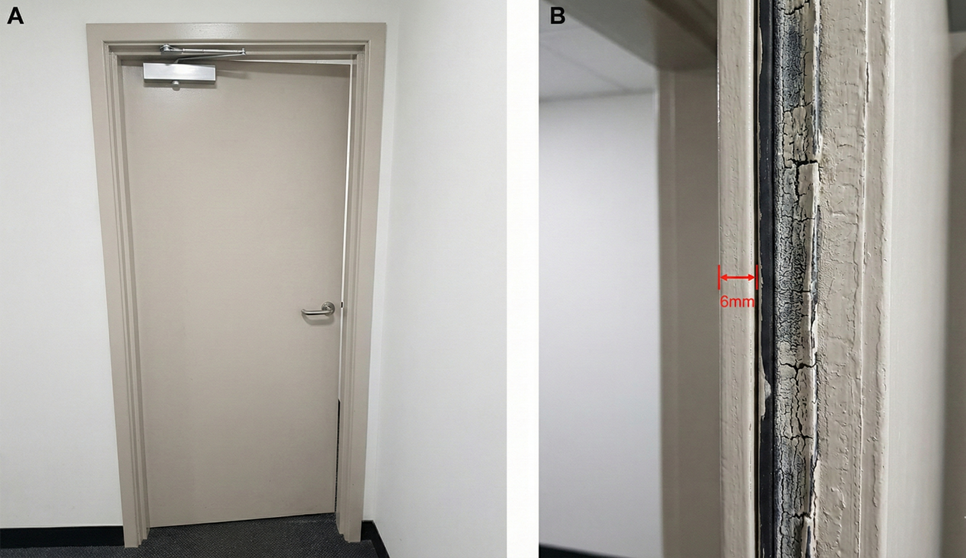
- Gaps: You use your gap gauge. The top and hinge-side gaps measure 3mm. However, the leading edge (lock side) gap measures 6mm due to poor installation and frame settlement.
- Seals: The combined intumescent and smoke seal down the leading edge has been painted over multiple times by maintenance staff, rendering the rubber smoke fin stiff and brittle.
- Functional Test: You open the door to 90 degrees and let it go. The overhead closer operates, but the door hits the frame and bounces back slightly. It fails to engage the latch. You try again from 15 degrees; it stalls completely and remains open by 2 inches.
- Door Assembly 02 (Stairwell Protection Door – rated FD30S):
- Visual: There is a 10cm x 10cm hole near the bottom of the door where a previous tenant had installed an unauthorized cable run, which has since been removed but not properly fire-stopped.
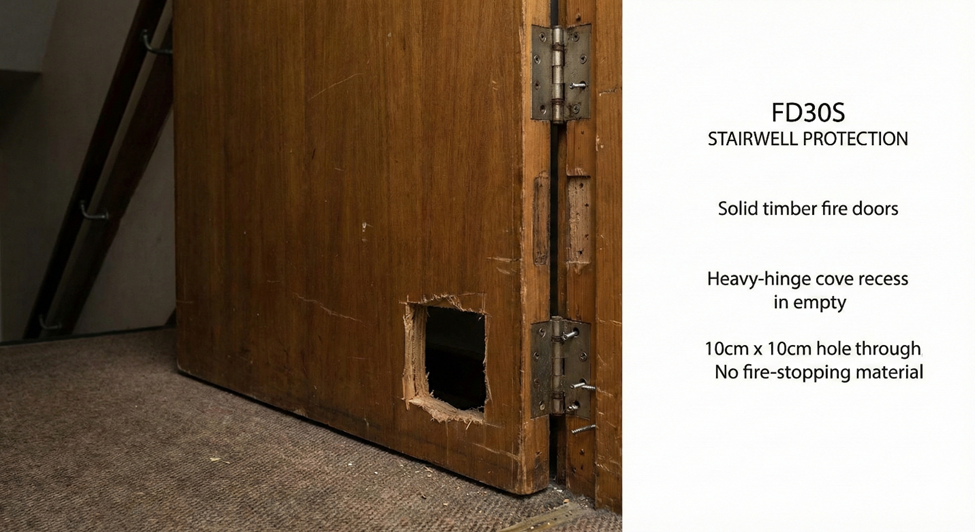
- Hinges: The door is heavy (solid timber core), but it is only hung on two hinges. The middle hinge has been completely removed, leaving an exposed recess in the wood. The remaining two hinges show signs of heavy stress, with stripped screws protruding from the frame.
- Functional Test: Because of the missing hinge and structural sagging, the door leaf is physically dragging on the floor covering (carpet). The self-closer cannot overcome the friction, and the door requires forceful manual pushing to close.
David asks you, “Can’t we just put a stronger closer on Door 02 to force it shut, and scrape the paint off the seals on Door 01? I have a tight maintenance budget this quarter.”
Part 3: Guided Questions & Evidence Generation Task
Instructions:
Review the case study above and answer the following analytical questions. Then, proceed to the Evidence Generation Task to produce your formal submission.
Analytical Questions (To build decision-making skills):
- Regulatory Analysis: Under the Regulatory Reform (Fire Safety) Order 2005, explain why David’s suggestion to “just put a stronger closer on” or “scrape the paint off” is legally and technically insufficient for Door 01 and Door 02. What are the specific liabilities if a fire occurs before proper remedial work is completed?
- Defect Interpretation (Door 01): Analyze the impact of the 6mm gap and the painted-over smoke seals. During the early stages of a fire (the smoldering phase), exactly how will these specific defects compromise the safety of the occupants in the Westgate Commercial Hub?
- Structural Assessment (Door 02): Explain the mechanical and fire-resistance implications of the missing middle hinge and the unauthorized 10cm hole. Why does this render the door an immediate “fail” according to BS 8214 standards?
Evidence Generation Task: The Detailed Inspection Report
Objective:
Produce a clear, concise, and accurate inspection report that demonstrates compliance with regulations.
Your Task:
Step away from the “Westgate” scenario. You must now generate a Detailed Inspection Report based on a real-world inspection of a fire door within your Current Organization and Project.
You must adopt your actual workplace persona for this task. The report must be a professional document suitable for presentation to a building owner or supervisor.
Your Detailed Inspection Report MUST include the following structured elements to meet the assessment criteria:
Document Header & Authenticity:
- Clearly state: “Prepared By: [Your Real Name]”.
- Include: [Your Current Designation/Role], [Your Current Organization], and [The Project Name/Location]. (Anonymize the specific building address if required by workplace policy).
- Date of Inspection.
Executive Summary:
A brief overview of the inspection scope (e.g., “Inspection of 5 cross-corridor fire resisting doors on Level 2 of the facility”).
Regulatory Framework:
A brief statement referencing the specific UK regulations and standards (e.g., BS 8214, Fire Safety Order) that informed your inspection methodology.
Specific Door Asset Log (Choose at least ONE real door from your workplace):
- Door Location / ID Reference.
- Expected Fire Rating (e.g., FD30, FD60S).
- Visual Inspection Details: Condition of the leaf, frame, and signage.
- Gap Measurements: Exact recorded measurements (Top, Leading Edge, Hinge Edge, Threshold).
Pass/Fail Determination:
A clear, unambiguous conclusion on whether the specific door passes or fails industry standards based on your findings.
Remedial Advice/Recommendations:
If defects or non-compliances were identified, provide clear, professional recommendations for repair or replacement (e.g., “Replace intumescent seals along the leading edge,” “Re-hang door using 3x Grade 13 fire-rated hinges”).
Submit this Detailed Inspection Report as your primary evidence for this Knowledge Provision Task. Ensure it is formatted professionally, saved as a PDF, and utilizes a clear file-naming convention such as UnitM_YourName_FireDoorInspectionReport.pdf.