
ProQual Level 4: Fire Risk Diagram Interpretation
Table of Contents
Part 1: Introduction to the Knowledge Providing Task
Targeted Evidence Type: Diagrams, charts, or mind maps created by the candidate
Welcome to this comprehensive Photo and Diagram Interpretation Task designed for the ProQual Level 4 Award in Advanced Fire Risk Assessment. The purpose of this induction and subsequent assessment is to ensure you gain a clear understanding of the qualification structure and advanced learning objectives.
In the vocational field of fire safety, theoretical knowledge is meaningless if you cannot visually identify hazards, interpret architectural defects, and observe non-compliances during a physical site inspection. Advanced technical knowledge, analytical thinking, and professional application are required to translate what you see into actionable, legally sound control measures.
This KPT steps away from traditional written scenarios. Instead, you will study assessor-provided site images and technical diagrams containing severe hazards within a high-risk building environment. Your task focuses strictly on observation, interpretation, and recommended corrective actions.
By critically evaluating potential fire hazards and assessing associated risks visually, you will enhance your real-site inspection awareness. To demonstrate your competency, you will produce a series of detailed diagrams, charts, and mind maps that deconstruct the visual evidence into regulatory breaches, fire behavior principles, and actionable solutions.
Part 2: Knowledge Guide – Visual Evidence Briefing
Guideline Overview:
You are acting as the lead Advanced Fire Risk Assessor inspecting “The Vertex,” a newly occupied 20-storey high-risk residential building in London. During your physical walk-around and review of the building’s Operation and Maintenance (O&M) manuals, you capture the following visual evidence.
Please study the textual descriptions and the associated imagery carefully.
Visual Evidence A: The Service Riser Compartmentation Breach
Context:
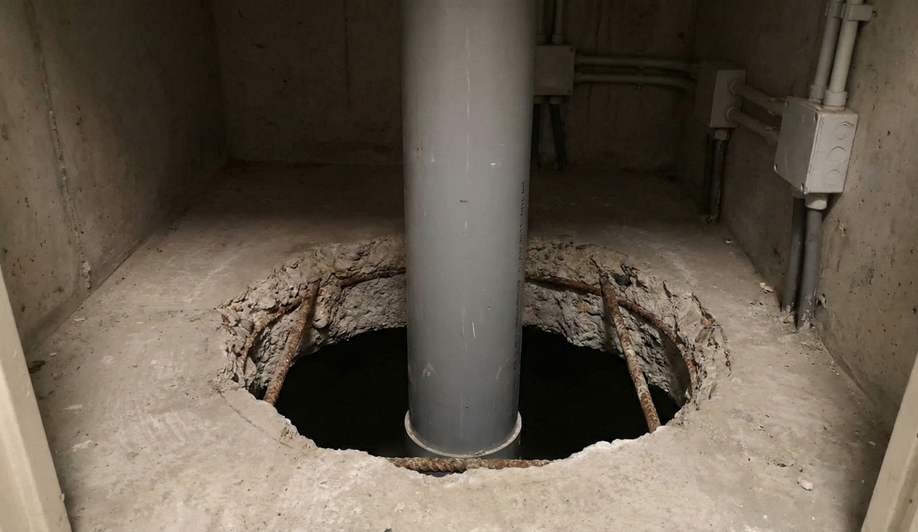
You open a locked electrical service riser cupboard on the 8th floor. This riser runs vertically through the entire height of the high-risk building. Observation Details: You observe a newly installed 110mm PVC drainage pipe cutting directly through the concrete floor slab (the compartment floor). There is a visible, unsealed 30mm annular gap around the entire circumference of the PVC pipe. No intumescent pipe collars, fire-resistant acoustic sealant, or fire batts have been installed. The concrete slab’s reinforcement is slightly exposed, indicating a rushed core-drilling job by recent contractors.
Visual Evidence B: The Compromised Escape Route
Context:
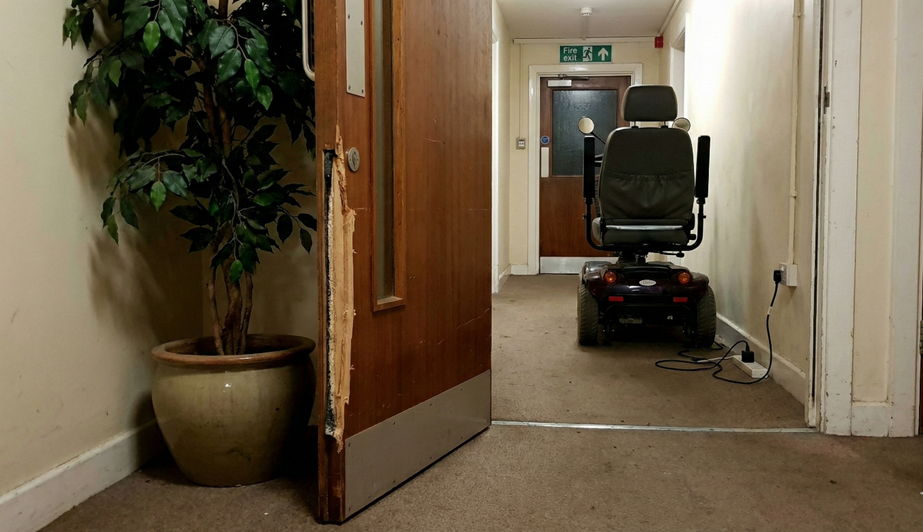
You are inspecting the primary communal escape corridor on the 4th floor, which leads directly to the single protected escape stairwell. Observation Details: The cross-corridor FD60S fire door is propped wide open by a heavy potted plant. Upon closer inspection of the door leaf, you see that the combined intumescent smoke seal running down the hinge side has been ripped away for approximately 40cm, leaving bare timber. Furthermore, the corridor itself is obstructed; a resident has parked a large motorized mobility scooter directly in the escape route, plugged into a wall socket via a daisy-chained extension lead.
Part 3: Learner Task – Diagrammatic Analysis and Interpretation
Task Instructions:
As an advanced assessor, you must interpret these visual defects and formulate a structured response. For this specific assessment, your evidence must be presented visually. You are required to create original diagrams, charts, or mind maps to answer the following four assignments.
Critical Instruction:
To meet the specific depth and grading criteria expected for your submissions, your explanatory text accompanying each of the four visual charts/diagrams must be exactly 350 words each. Furthermore, when citing reference materials, you must strictly exclude the use of “(n.d.)” in Harvard-style references if no date is available; simply omit the date entirely.
Assignment 1: Legislative Compliance Mapping (Chart)
Learning Outcome Focus: Understand legislation and guidance relevant to Advanced Fire Risk Assessment.
Task: Create a “Legislative Defect Mapping Chart.” In your chart, take the observations from Visual Evidence A and Visual Evidence B and directly map them to specific breaches of UK law.
- Requirements: Your chart and the accompanying 350-word commentary must identify how the propped-open door, the obstructed corridor, and the breached riser violate the Regulatory Reform (Fire Safety) Order 2005 (specifically looking at Articles 8, 14, and 17). Furthermore, explain how the undocumented structural breach in the service riser implicates the Accountable Person under the Building Safety Act 2022. Your analysis must clearly define who holds the legal liability for the resident’s mobility scooter blocking the common area.
Assignment 2: Principles of Fire and Smoke Spread (Mind Map)
Learning Outcome Focus: Understand the principles of fire risk assessment for high-risk buildings.
Task: Create a detailed “Fire Behavior Mind Map” based on Visual Evidence A (The Service Riser).
- Requirements: Place the “Unsealed 110mm PVC Pipe Penetration” at the center of your mind map. Branch out to explain the principles of how fire, heat, and toxic smoke will behave in this specific high-risk environment if a fire breaks out on the 8th floor. Your accompanying 350-word analysis must detail the concepts of the “stack effect” in high-rise buildings, the failure of compartmentation, and the specific mechanism of how a PVC pipe reacts to fire temperatures (melting/collapsing) compared to cast iron, further emphasizing why intumescent collars are a non-negotiable principle of passive fire protection.
Assignment 3: Formulating Control Measures (Action Plan Flowchart)
Learning Outcome Focus: Understand the control measured used to reduce the risk of and from fire.
Task: Create a “Corrective Action Flowchart” addressing the hazards in Visual Evidence B (The Compromised Escape Route).
- Requirements: Your flowchart must sequence the immediate, short-term, and long-term control measures required to resolve the mobility scooter obstruction and the damaged FD60S door. In your 350-word supporting text, justify these controls. How do you immediately secure the escape route while balancing the resident’s accessibility needs? Detail the exact repair specifications required for the fire door to reinstate its 60-minute integrity and smoke-stopping capabilities, ensuring you provide evidence-based recommendations to reduce risk and improve fire safety management systems.
Assignment 4: Knowledge Updating and Methodological Improvement (Process Diagram)
Learning Outcome Focus: Understand how to develop and update own knowledge of fire risk assessment.
Task: Create a “Continuous Improvement Process Diagram.”
- Requirements: Reflecting on how easily these severe defects could be missed by an untrained eye, diagram the process you will use to develop and update your own knowledge of fire risk assessment. In your 350-word commentary, explain how you will stay updated on contractor management, passive fire stopping standards, and resident engagement protocols. Mention specific UK industry resources you will monitor. Explain how this new knowledge will be practically integrated into your personal site-inspection checklists to ensure you never overlook a compromised service riser or damaged intumescent seal during future high-risk building assessments.
Part 4: Submission Guidelines and Assessment Protocols
To ensure your diagrams, charts, and accompanying commentary are processed efficiently and meet the quality assurance standards of Inspire College of Technologies UK Ltd (ICT Qual), you must strictly adhere to the following protocols:
1. Format and Uploading:
- All coursework and evidence must be submitted through the online dashboard in PDF or scanned format.
- If you draw your diagrams by hand, ensure they are scanned clearly at a high resolution. If you use digital charting software, export the final document as a locked PDF.
- File naming must follow a standard format (e.g., “Unit1_YourName_FireRiskAssessment_Diagrams”).
2. Document Integrity and Presentation:
- Ensure all documents are authentic, relevant, and properly organized.
- Each page of your submission must include “Prepared by/Provided by [Your Name & Signature]” either at the beginning or end.
- Use clear indexing and consistent labeling to enable smooth assessment review. Ensure your four required sections (Chart, Mind Map, Flowchart, Process Diagram) and their respective 350-word commentaries are clearly headed.
3. Feedback and Progression:
- Comprehensive and constructive feedback is provided for all assignments. Detailed feedback will be provided via the dashboard.
- Feedback includes identified strengths, areas requiring improvement, and recommendations for enhancing the quality of work.
- If your submission does not meet the necessary standard, constructive feedback is provided with an opportunity for resubmission.
- Learners may revise and resubmit coursework following initial feedback. Resubmissions are normally due within 7-10 working days, as communicated via the dashboard.
- Progression to the next unit is only permitted after feedback approval.
4. Support Channels:
- Academic and administrative support is available through the dashboard, email, or scheduled Zoom sessions.
- Learners are encouraged to request clarification on expectations, feedback, or assessment evidence requirements before submitting their final diagrams.