
Fire Safety Essentials: Prevention, Protection, and Preparedness
Fire remains one of the most destructive and unpredictable hazards, capable of impacting homes, workplaces, and public environments with little warning. What often begins as a minor oversight—such as faulty electrical wiring, unattended cooking, overheating equipment, or improper storage of flammable materials—can escalate within seconds into a rapidly spreading fire. Due to the speed at which flames, heat, and smoke develop, even a small incident can turn into a major emergency, threatening human life, disrupting operations, and causing extensive structural and financial damage.
Beyond the immediate physical destruction, fire incidents can have long-term consequences, including business interruption, loss of critical data, environmental harm, and emotional distress for those affected. In many cases, these incidents are preventable, which highlights the importance of adopting a proactive and well-structured approach to fire safety rather than relying solely on reactive measures.
To effectively manage and reduce these risks, it is essential to understand and implement the core principles of fire safety essentials—prevention, protection, and preparedness. These three pillars form a comprehensive and integrated safety framework. Prevention focuses on identifying potential hazards and eliminating conditions that could lead to a fire. Protection involves the use of systems and building features designed to detect, control, and limit the spread of fire, thereby reducing damage. Preparedness ensures that individuals are equipped with the knowledge, training, and procedures needed to respond quickly and safely in the event of an emergency.
When applied together, these elements create a strong and reliable defense against fire risks. They not only reduce the likelihood of incidents but also enhance the ability to control situations effectively and safeguard lives. Whether in residential settings, commercial facilities, or industrial environments, adopting these fire safety essentials is a critical step toward building a safer and more resilient environment.
WHAT IS FIRE SAFETY?
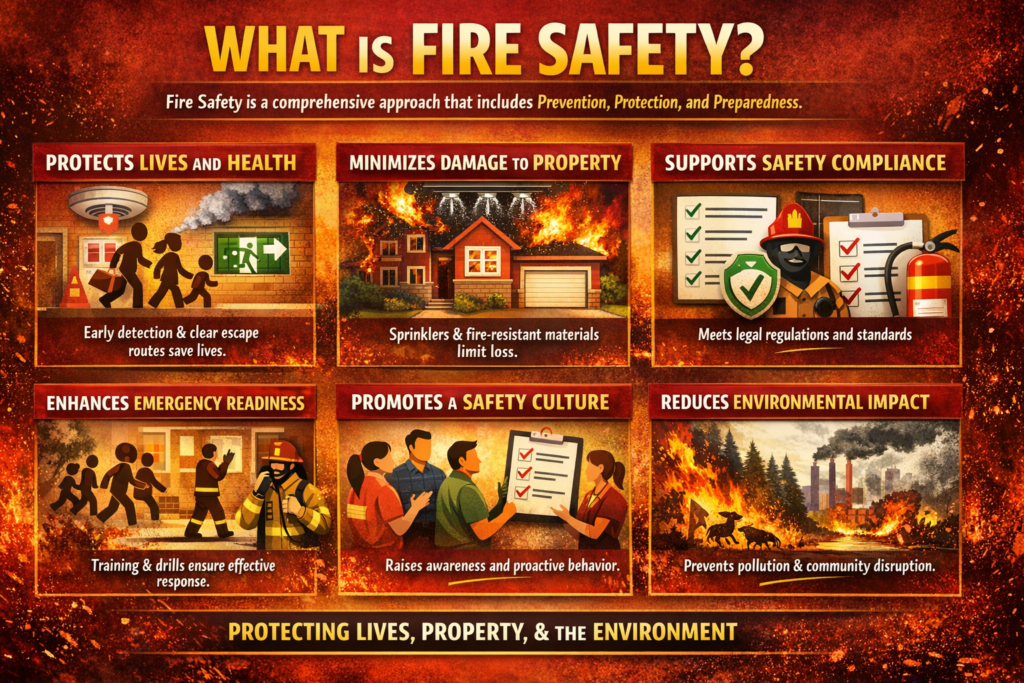
Fire safety is a comprehensive and systematic approach that combines prevention strategies, protective systems, and emergency response planning to reduce the likelihood of fire incidents and minimize their impact. It is not limited to firefighting alone; rather, it focuses on anticipating risks, controlling hazards, and ensuring readiness at every stage—from prevention to response and recovery.
At its core, fire safety integrates human behavior, engineering controls, and organizational policies. This includes identifying potential fire hazards, implementing safe practices, installing reliable detection and suppression systems, and ensuring that individuals are trained to respond effectively during emergencies. Fire safety also involves continuous monitoring, regular maintenance of equipment, and periodic reviews of safety procedures to ensure they remain effective.Fire safety is a comprehensive and systematic approach that combines prevention strategies, protective systems, and emergency response planning to reduce risks. To gain a deeper understanding of its principles and applications, you can explore this detailed guide on what is fire safety, which explains the concept in more detail.
A strong fire safety framework creates multiple layers of defense. Even if one control measure fails, others remain in place to reduce the severity of the situation. This layered approach is essential because fire can spread rapidly, and early intervention is critical in preventing catastrophic outcomes.
IMPORTANCE OF FIRE SAFETY
Fire safety plays a vital role in protecting individuals, organizations, and communities. Its importance extends beyond immediate protection and contributes to long-term safety, stability, and resilience.
Protects Lives and Health
The most critical purpose of fire safety is to safeguard human life and well-being. Fires produce extreme heat, dense smoke, and toxic gases such as carbon monoxide, which can quickly lead to unconsciousness or fatality if not addressed promptly.
- Early detection systems, such as smoke alarms, provide crucial time for evacuation
- Clearly defined escape routes help individuals exit safely without confusion
- Training and awareness enable people to react quickly and avoid panic
- Proper use of fire safety equipment can prevent injuries during initial response
In environments such as workplaces, hospitals, and schools, fire safety measures are especially important because they protect large numbers of people, including those who may require assistance during evacuation.
Minimizes Damage to Property and Assets
Fires can cause extensive structural damage and financial loss within a short period. Buildings, equipment, documents, and valuable assets can be destroyed if fire is not controlled quickly.
- Fire-resistant construction materials slow down fire spread
- Automatic sprinkler systems can suppress flames before they intensify
- Fire compartmentation helps contain fire within a limited area
- Quick response procedures reduce downtime and recovery costs
For businesses, effective fire safety measures also protect operational continuity by minimizing disruptions and preventing long-term financial setbacks.
Supports Compliance with Safety Regulations
Fire safety is a legal and regulatory requirement in most countries. Authorities establish fire safety standards to ensure that buildings and workplaces maintain safe conditions for occupants.
- Organizations are required to conduct regular fire risk assessments
- Fire safety equipment must be properly installed and maintained
- Employees must receive adequate training and instruction
- Emergency plans must be documented and regularly updated
Compliance not only helps avoid fines, legal action, or business closure but also demonstrates a commitment to safety and responsibility. It enhances the reputation of organizations and builds trust among employees, customers, and stakeholders.
Enhances Emergency Readiness and Response Efficiency
Preparedness is a key component of fire safety, ensuring that individuals and organizations can respond effectively and efficiently during emergencies. Without proper preparation, even small fires can lead to chaos and confusion.
- Fire drills allow people to practice evacuation procedures in a controlled environment
- Emergency response plans provide clear roles and responsibilities
- Training improves decision-making under pressure
- Communication systems ensure timely alerts and coordination
Preparedness reduces panic, shortens response time, and increases the chances of a safe and organized evacuation. It also enables emergency services to operate more effectively when they arrive on site.
Promotes a Culture of Safety and Awareness
An often-overlooked benefit of fire safety is its role in creating a strong safety culture within organizations and communities.
- Encourages individuals to take responsibility for safety practices
- Increases awareness of potential hazards in daily activities
- Promotes proactive behavior rather than reactive responses
- Supports continuous improvement through regular reviews and updates
When fire safety becomes part of everyday thinking, risks are identified earlier, and preventive actions are taken more consistently.
Reduces Environmental and Social Impact
Fires not only affect people and property but can also have serious environmental and social consequences.
- Release of harmful gases and pollutants into the air
- Damage to surrounding ecosystems and infrastructure
- Displacement of individuals and disruption of communities
By preventing fires and controlling them effectively, fire safety helps reduce these broader impacts and supports sustainable living environments.
1. FIRE PREVENTION
Fire prevention is the most important part of fire safety because it focuses on stopping fires before they start. Instead of dealing with damage after a fire occurs, prevention is about removing risks, controlling hazards, and maintaining safe practices in everyday life.
To understand this better, remember this simple concept:
A fire needs three elements to start:
- Heat
- Fuel
- Oxygen
If you remove or control any one of these, fire cannot start or spread easily. Fire prevention is all about managing these elements through awareness and safety measures.
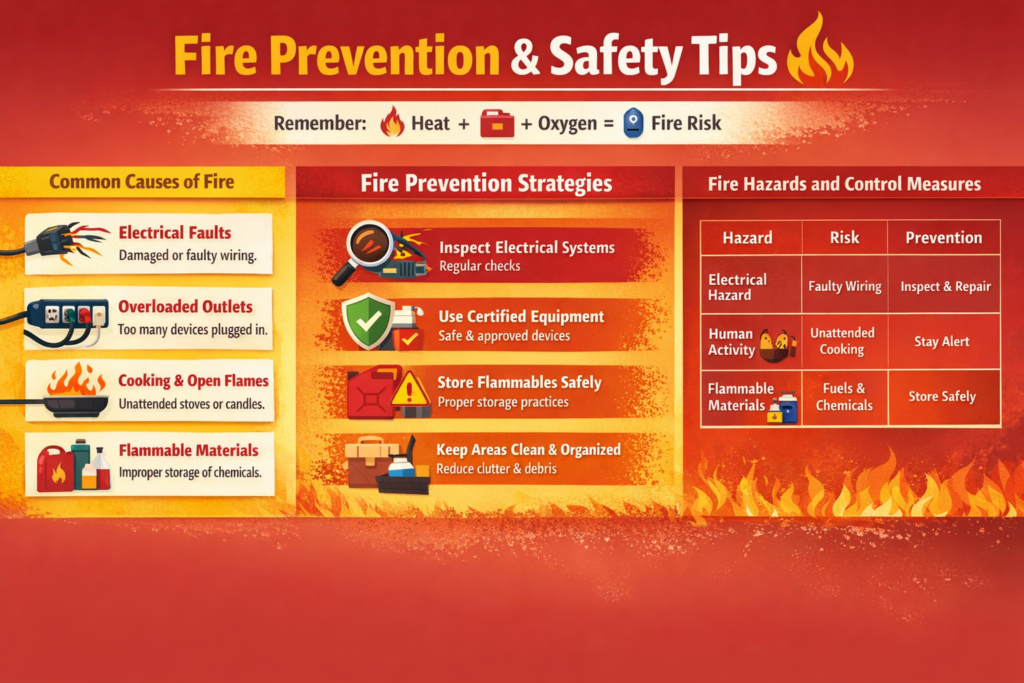
The table below summarizes common fire hazards, their risks, and how to prevent them effectively:
| Hazard Type | Example | Why It Is Dangerous | Preventive Action |
|---|---|---|---|
| Electrical Hazard | Faulty wiring | Can cause sparks, overheating, and short circuits | Regular inspection and timely repair |
| Overloading | Multiple devices on one outlet | Leads to overheating and potential ignition | Avoid overloading and distribute load properly |
| Human Activity | Unattended cooking | Direct exposure to open flames and heat | Supervision and safety awareness |
| Open Flames | Candles, gas stoves | Can ignite nearby flammable materials | Keep safe distance and monitor use |
| Flammable Materials | Fuels and chemicals | Highly combustible and may cause explosions | Safe storage and proper handling |
COMMON CAUSES OF FIRE
Understanding causes is the first step to prevention. Most fires are not accidents—they happen due to carelessness, lack of maintenance, or unsafe practices.
1. Electrical Faults and Damaged Wiring
Electrical systems are widely used, which makes them a major source of fire risk if not properly maintained.
Why It Causes Fire:
- Damaged wires expose live electrical current
- Loose connections create sparks
- Old wiring overheats under heavy load
- Faulty appliances generate excessive heat
Real-Life Scenario:
A damaged extension cord used daily can slowly heat up. Over time, the insulation melts, causing sparks that can ignite nearby materials like curtains or paper.
How to Prevent:
- Inspect wiring and appliances regularly
- Replace damaged cables immediately
- Avoid using cheap or uncertified electrical products
- Get professional electrical checks when needed
Key Insight: Electrical fires often start silently, making early prevention critical.
2. Overloaded Power Outlets
Overloading happens when too many devices are connected to a single power source.
Why It Causes Fire:
- Excess current heats up wires
- Extension boards are not designed for heavy loads
- Overheating damages insulation
- Sparks may occur due to excessive load
Real-Life Scenario:
Using one extension board for a heater, iron, and microwave can cause overheating within minutes.
How to Prevent:
- Use separate sockets for high-power appliances
- Avoid connecting multiple extensions together
- Check load capacity before use
Key Insight: Overloading is a hidden danger because it builds up gradually.
3. Open Flames and Cooking Equipment
Open flames are one of the most obvious fire hazards, especially in homes.
Why It Causes Fire:
- Flames can easily spread to nearby materials
- Oil and grease can ignite suddenly
- Gas leaks increase explosion risk
Real-Life Scenario:
Leaving a pan with oil unattended on the stove can lead to sudden ignition, spreading fire rapidly in the kitchen.
How to Prevent:
- Never leave cooking unattended
- Keep flammable items away from stoves
- Turn off gas appliances properly
- Check for gas leaks regularly
Key Insight: Most kitchen fires happen due to distraction or negligence.
4. Improper Storage of Flammable Materials
Flammable materials can ignite quickly if not handled correctly.
Why It Causes Fire:
- Chemicals and fuels produce flammable vapors
- Heat or sparks can trigger ignition
- Poor storage increases exposure to hazards
Real-Life Scenario:
Storing petrol or chemicals near electrical equipment can lead to fire if a spark occurs.
How to Prevent:
- Store materials in approved containers
- Keep away from heat sources
- Ensure proper ventilation
- Follow safety guidelines
Key Insight: Safe storage reduces both fire risk and explosion hazards.
Understanding fire hazards is a critical step in prevention. Conducting a proper fire safety risk assessment complete guide helps identify potential risks and implement effective control measures to reduce fire incidents.
FIRE PREVENTION STRATEGIES
Now that we understand causes, let’s look at how to actively prevent fires.
1. Conduct Regular Inspections of Electrical Systems
Regular inspections help identify hidden problems before they become dangerous.
What to Check:
- Damaged wires or plugs
- Overheating devices
- Loose connections
Why It Matters:
Early detection prevents small issues from turning into major fire hazards.
2. Use Certified and Well-Maintained Equipment
Using high-quality, approved equipment reduces fire risks.
Why It Matters:
- Certified products meet safety standards
- Poor-quality devices fail easily
- Maintenance ensures long-term safety
Best Practice:
Always choose certified products and service them regularly.
3. Store Hazardous Materials Safely
Safe storage prevents accidental ignition.
Key Practices:
- Use proper containers
- Label materials clearly
- Keep away from heat and flames
Why It Matters:
Prevents dangerous chemical reactions and fire outbreaks.
4. Maintain Clean and Organized Environments
Clean environments reduce fire risks significantly.
Why It Matters:
- Dust and waste act as fuel
- Clutter increases fire spread
- Blocked exits delay evacuation
Example:
A cluttered office with paper near electrical equipment increases fire risk.
5. Install Smoke Detection Systems
Smoke detectors provide early warning.
Why It Matters:
- Detect fire in early stages
- Alert people immediately
- Allow quick evacuation
Best Practice:
Test detectors regularly and replace batteries when needed.
FIRE HAZARDS AND CONTROL MEASURES
| Hazard Type | Example | Why It Is Dangerous | Preventive Action |
|---|---|---|---|
| Electrical Hazard | Faulty wiring | Can cause sparks and overheating | Regular inspection and repair |
| Human Activity | Unattended cooking | Direct exposure to flames | Supervision and awareness |
| Flammable Materials | Fuels and chemicals | Easily ignitable and explosive | Safe storage practices |
2. FIRE PROTECTION
Fire protection is a critical component of fire safety that focuses on detecting fires early, controlling their spread, and extinguishing them effectively. While prevention aims to stop fires from occurring, fire protection ensures that if a fire does break out, its impact is minimized and people remain safe.
A strong fire protection system works in layers. It includes technology, building design, and safety equipment that operate together to:
- Detect fire at an early stage
- Alert occupants immediately
- Control or suppress flames
- Prevent the fire from spreading to other areas
This combined approach significantly reduces damage, protects lives, and gives emergency responders more time to act.
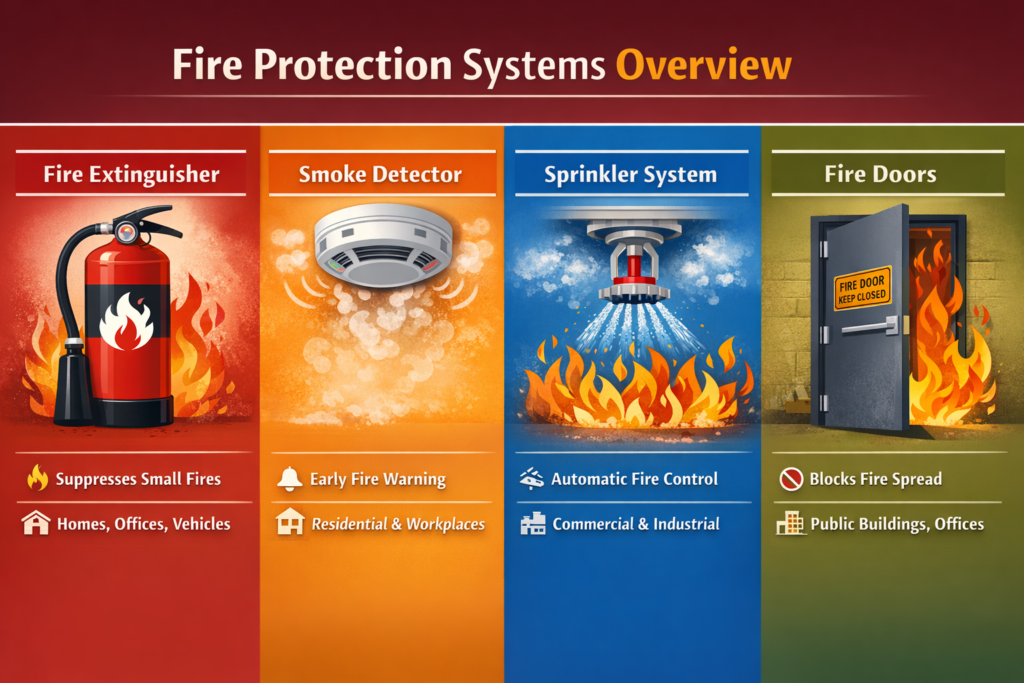
The following table provides a clear overview of common fire protection systems and their uses:
| System | Function | Application Area |
|---|---|---|
| Fire Extinguisher | Used to control or extinguish small fires | Homes, offices, vehicles |
| Smoke Detector | Detects smoke and provides early warning | Residential & workplaces |
| Fire Alarm System | Alerts occupants during fire emergencies | Buildings, public spaces |
| Sprinkler System | Automatically suppresses fire using water | Commercial & industrial |
| Fire Doors | Prevent fire and smoke from spreading | Offices, hospitals, malls |
| Fire-Resistant Materials | Slow down fire spread and protect structure | Buildings & construction |
Fire protection systems such as alarms, sprinklers, and extinguishers play a vital role in controlling fire incidents. To explore these systems and their applications in detail, refer to this fire safety complete guide to prevention equipment risk assessment.
TYPES OF FIRE PROTECTION
Fire protection is generally divided into two main categories:
Active Fire Protection
Passive Fire Protection
Both are equally important and work together to create a complete safety system.
ACTIVE FIRE PROTECTION (AFP)
Active fire protection includes systems and devices that actively respond when a fire occurs. These systems require action—either automatic or manual—to control or extinguish fire.
1. Fire Extinguishers
Fire extinguishers are portable devices used to control or put out small fires before they spread.
How They Work:
They release substances such as water, foam, powder, or carbon dioxide to remove one of the fire elements (heat, oxygen, or fuel).
Where They Are Used:
- Homes
- Offices
- Factories
- Vehicles
Why They Are Important:
- Provide immediate response to small fires
- Prevent fire from growing into a major incident
- Easy to use with proper training
Key Tip:
Different fires require different extinguishers (e.g., electrical fires vs oil fires), so selecting the correct type is essential.
2. Automatic Sprinkler Systems
Sprinkler systems are installed in buildings to automatically release water when fire is detected.
How They Work:
- Heat from fire activates sprinkler heads
- Water is released directly onto the fire source
- Helps control or extinguish flames
Where They Are Used:
- Commercial buildings
- Shopping malls
- Warehouses
- Hospitals
Why They Are Important:
- Operate automatically without human intervention
- Control fire at an early stage
- Reduce fire spread and damage significantly
Key Insight:
Sprinklers often activate only in the affected area—not the entire building.
3. Smoke Detectors and Fire Alarms
These systems are designed to detect smoke or heat and alert people immediately.
How They Work:
- Smoke detectors sense particles in the air
- Fire alarms produce loud signals or alerts
- Trigger evacuation procedures
Where They Are Used:
- Homes
- Offices
- Schools
- Public buildings
Why They Are Important:
- Provide early warning before fire spreads
- Allow people to evacuate safely
- Reduce panic by giving timely alerts
Key Tip:
Regular testing is necessary to ensure proper functioning.
PASSIVE FIRE PROTECTION (PFP)
Passive fire protection includes built-in features of a building that help contain fire and slow its spread. These systems do not require activation—they are always in place.
1. Fire-Resistant Walls and Doors
These are specially designed structures that can withstand fire for a certain period of time.
How They Work:
- Made from materials that resist heat and flames
- Prevent fire from spreading between rooms
- Provide safe escape routes
Where They Are Used:
- Offices
- Hospitals
- Industrial buildings
Why They Are Important:
- Contain fire within a specific area
- Protect escape routes for evacuation
- Reduce overall building damage
2. Fire-Rated Construction Materials
These materials are used during construction to increase a building’s resistance to fire.
Examples:
- Fire-resistant glass
- Special coatings and insulation
- Concrete and treated steel
Why They Are Important:
- Slow down fire spread
- Maintain structural integrity during fire
- Provide more time for evacuation
3. Structural Compartmentation
Compartmentation involves dividing a building into sections to limit the spread of fire and smoke.
How It Works:
- Fire barriers and partitions separate areas
- Prevent fire from spreading quickly
- Control smoke movement
Why It Is Important:
- Keeps fire contained in one area
- Protects unaffected parts of the building
- Improves effectiveness of firefighting efforts
FIRE PROTECTION SYSTEMS OVERVIEW
| System | Function | Application Area |
|---|---|---|
| Fire Extinguisher | Suppresses small fires quickly | Homes, offices, vehicles |
| Smoke Detector | Detects smoke and provides early warning | Residential and workplaces |
| Sprinkler System | Automatically controls and suppresses fire | Commercial and industrial |
| Fire Doors | Prevents fire and smoke spread | Public buildings, offices |
3. FIRE PREPAREDNESS
Fire preparedness is the action-oriented pillar of fire safety. While prevention reduces the chances of fire and protection systems help control it, preparedness ensures that people know exactly what to do when a fire occurs.
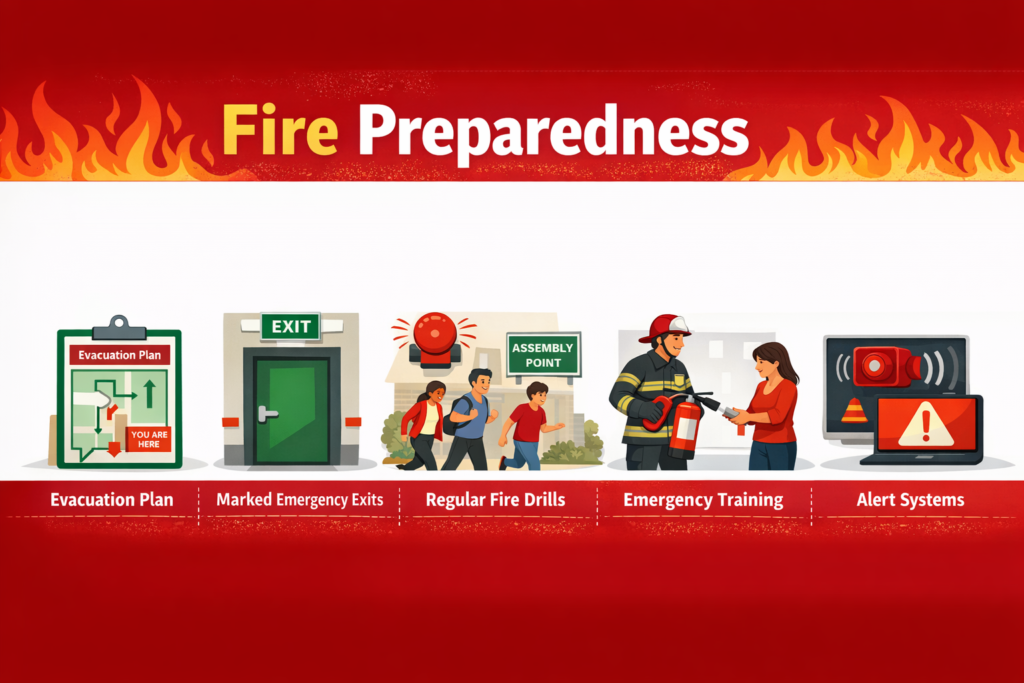
In real emergencies, confusion and panic can be more dangerous than the fire itself. Fire preparedness focuses on planning, training, coordination, and communication so that individuals and organizations can respond quickly, calmly, and effectively.
A well-prepared environment ensures:
- Faster evacuation
- Reduced injuries and fatalities
- Better coordination during emergencies
- Minimal chaos and panic
Use the checklist below to evaluate your fire preparedness level:
| Preparedness Activity | Description | Importance | Status (✔ / ✘) |
|---|---|---|---|
| Evacuation Plan Developed | Clear plan showing escape routes and procedures | Ensures quick and organized evacuation | ✔ / ✘ |
| Emergency Exits Marked | Clearly visible and accessible exit routes | Helps people exit safely during emergencies | ✔ / ✘ |
| Fire Drills Conducted | Regular practice of evacuation procedures | Builds confidence and reduces panic | ✔ / ✘ |
| Safety Training Completed | Training on fire response and equipment use | Improves response and decision-making | ✔ / ✘ |
| Communication Systems Ready | Alarm systems and alerts for emergencies | Provides timely warning and coordination | ✔ / ✘ |
KEY PREPAREDNESS MEASURES
These are the essential actions that help people respond safely during a fire emergency.
1. Develop a Clear Fire Evacuation Plan
A fire evacuation plan is a step-by-step guide that explains how people should exit a building safely during a fire.
What It Includes:
- Escape routes from each room or area
- Location of emergency exits
- Instructions on how to respond to alarms
- Roles and responsibilities
Why It Is Important:
- Eliminates confusion during emergencies
- Provides clear direction for safe evacuation
- Helps people act quickly without hesitation
Example:
In an office, the evacuation plan may show primary and secondary exit routes, ensuring people have alternatives if one path is blocked.
2. Identify and Mark Emergency Exits
Emergency exits are designated pathways that allow people to leave a building safely during a fire.
Key Features:
- Clearly visible exit signs
- Unobstructed pathways
- Proper lighting (especially in low visibility)
Why It Is Important:
- Helps people quickly locate exits during smoke or darkness
- Prevents crowding and confusion
- Ensures smooth and safe evacuation
Important Note:
Blocked or poorly marked exits can lead to serious injuries or fatalities.
3. Conduct Regular Fire Drills
Fire drills are practice exercises that simulate real fire situations.
What Happens During a Drill:
- Alarm is activated
- People evacuate using planned routes
- Assembly at designated points
- Evaluation of response time and behavior
Why It Is Important:
- Familiarizes people with evacuation procedures
- Builds confidence and reduces panic
- Identifies weaknesses in the plan
Example:
Employees practicing evacuation every few months will respond faster in real emergencies.
4. Train Individuals in Emergency Procedures
Training ensures that people understand how to act during a fire and use safety equipment properly.
What Training Covers:
- How to use fire extinguishers
- How to respond to alarms
- Safe evacuation techniques
- Assisting others during emergencies
Why It Is Important:
- Improves decision-making under pressure
- Reduces panic and confusion
- Enables quick and effective response
Key Insight:
Untrained individuals may panic, while trained individuals act confidently and safely.
5. Maintain Communication Systems for Alerts
Communication systems are used to inform and guide people during emergencies.
Examples:
- Fire alarm systems
- Public address systems
- Emergency notifications
Why It Is Important:
- Provides immediate warning
- Gives clear instructions during evacuation
- Ensures coordination among occupants
Example:
A fire alarm alerts everyone instantly, allowing evacuation to begin without delay.
Fire safety also offers valuable career opportunities for those interested in protecting lives and property. If you want to pursue this path, this guide on how to become a fire safety officer provides step-by-step information.
FIRE EMERGENCY PLANNING STEPS
These steps help create a complete and effective emergency plan.
Identify All Possible Exit Routes
Every building should have multiple escape routes.
Why It Matters:
- One route may be blocked by fire or smoke
- Alternative paths ensure safe evacuation
Always plan at least two exits from each area.
Assign Responsibilities to Individuals
Clear roles improve coordination during emergencies.
Examples of Roles:
- Fire wardens to guide evacuation
- Team leaders to manage groups
- First aid responders
Why It Matters:
- Prevents confusion
- Ensures accountability
- Improves response efficiency
Establish Safe Assembly Points
Assembly points are safe locations outside the building where people gather after evacuation.
Why It Matters:
- Helps confirm everyone has exited safely
- Prevents people from re-entering the building
- Allows emergency services to operate effectively
Practice Evacuation Procedures Regularly
Regular practice ensures readiness.
Why It Matters:
- Reinforces learning
- Identifies gaps in planning
- Improves evacuation time
Practice transforms planning into real-life action.
FIRE PREPAREDNESS CHECKLIST
| Preparedness Activity | Why It Is Important | Status (✔ / ✘) |
|---|---|---|
| Evacuation Plan Developed | Provides clear instructions during emergency | ✔ / ✘ |
| Fire Drills Conducted | Ensures readiness and reduces panic | ✔ / ✘ |
| Emergency Exits Marked | Helps quick and safe evacuation | ✔ / ✘ |
| Safety Training Completed | Improves response and decision-making | ✔ / ✘ |
APPLICATION OF FIRE SAFETY
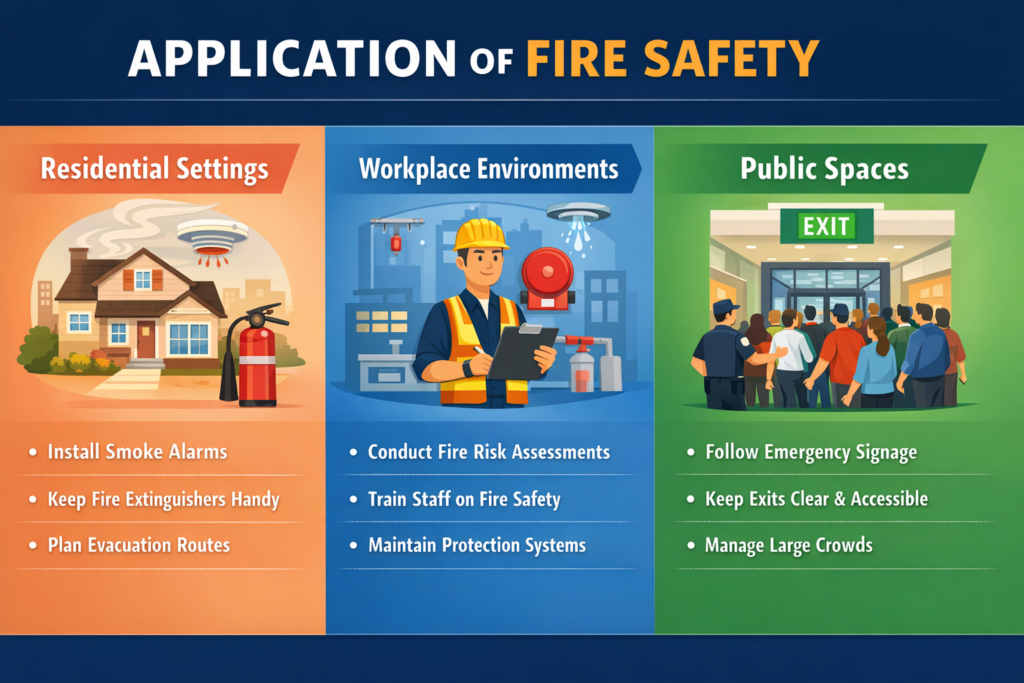
Fire safety is not a one-size-fits-all approach. While the core principles remain the same, their application varies depending on the environment. Homes, workplaces, and public spaces each have different risks, layouts, and occupant behaviors, which means fire safety measures must be adapted accordingly.
Applying fire safety effectively involves understanding:
- The type of environment
- The level of risk involved
- The number and behavior of occupants
- The available safety systems
When fire safety is tailored to specific settings, it becomes more practical, efficient, and effective in preventing incidents and ensuring safe evacuation.
The table below summarizes how fire safety measures are applied across different environments:
| Environment | Key Measures | Purpose | Example Actions |
|---|---|---|---|
| Residential Settings | Smoke alarms, fire extinguishers, evacuation plans | Protect family members and ensure quick escape | Install alarms, plan escape routes, keep extinguisher |
| Workplace Environments | Risk assessments, staff training, system maintenance | Reduce workplace fire risks and improve response | Conduct inspections, train staff, maintain alarms |
| Public Spaces | Safety signage, clear exits, crowd management | Ensure safe evacuation of large groups | Mark exits, manage crowds, follow instructions |
FIRE SAFETY IN RESIDENTIAL SETTINGS
Homes are one of the most common places where fires occur, often due to daily activities such as cooking, electrical usage, and heating appliances. Since families may include children, elderly individuals, or people unfamiliar with emergency procedures, fire safety in residential settings must be simple, accessible, and easy to follow.
Install Smoke Alarms
Smoke alarms are essential for early detection of fire in homes.
Why It Is Important:
- Fires can spread rapidly, especially at night when people are asleep
- Smoke inhalation is a leading cause of fatalities
- Early alerts provide crucial time to escape
Best Practices:
- Install alarms on every floor and near sleeping areas
- Test alarms regularly
- Replace batteries as needed
Key Insight: A working smoke alarm can mean the difference between life and death.
Keep Fire Extinguishers Accessible
Having a fire extinguisher at home allows for quick action during small fires.
Why It Is Important:
- Small fires can be controlled before they grow
- Immediate response reduces damage
- Useful in kitchens, garages, and near electrical areas
Best Practices:
- Place extinguishers in easily reachable locations
- Ensure all family members know how to use them
- Regularly check for functionality
Plan Household Evacuation Routes
Every household should have a clear and simple escape plan.
Why It Is Important:
- Fires create panic and confusion
- Pre-planned routes ensure quick exit
- Helps all family members act without delay
Best Practices:
- Identify at least two exits from each room
- Practice evacuation with family members
- Choose a safe meeting point outside
Key Insight: Practice ensures that even children know how to respond
FIRE SAFETY IN WORKPLACE ENVIRONMENTS
Workplaces often involve larger spaces, more people, and higher risks, especially in industries dealing with machinery, chemicals, or electrical systems. Fire safety in workplaces must be structured, regulated, and regularly monitored.In workplace environments, identifying hazards early is essential. Learning what is a fire risk assessment can help organizations systematically evaluate risks and improve safety measures.
Conduct Fire Risk Assessments
A fire risk assessment is a systematic evaluation of potential fire hazards in the workplace.
Why It Is Important:
- Identifies possible sources of fire
- Helps implement preventive measures
- Ensures compliance with safety regulations
What It Includes:
- Identifying hazards
- Evaluating risks
- Implementing control measures
- Reviewing safety procedures
Ensure Staff Training and Awareness
Employees must be trained to understand risks and respond appropriately.
Why It Is Important:
- Untrained staff may panic or act incorrectly
- Training improves response time
- Encourages a culture of safety
Training Topics:
- Fire evacuation procedures
- Use of fire extinguishers
- Emergency communication
Key Insight: A well-trained team can prevent small incidents from becoming major disasters.
Maintain Fire Protection Systems
Workplaces rely heavily on fire protection systems, which must always be functional.
Why It Is Important:
- Systems like alarms and sprinklers provide immediate response
- Faulty equipment can fail during emergencies
- Regular maintenance ensures reliability
Best Practices:
- Conduct routine inspections
- Test alarms and sprinklers regularly
- Repair or replace faulty equipment immediately
FIRE SAFETY IN PUBLIC SPACES
Public spaces such as shopping malls, hospitals, schools, and transport hubs involve large numbers of people, often unfamiliar with the environment. Fire safety here focuses on clear guidance, accessibility, and crowd control.
Follow Safety Signage and Instructions
Safety signs provide essential guidance during emergencies.
Why It Is Important:
- Helps people locate exits quickly
- Provides direction in unfamiliar environments
- Reduces confusion and panic
Examples:
- Exit signs
- Fire exit routes
- Emergency instructions
Ensure Clear Access to Emergency Exits
Emergency exits must always be accessible and unobstructed.
Why It Is Important:
- Blocked exits can cause delays and accidents
- Quick access is critical during evacuation
- Ensures smooth movement of large crowds
Best Practices:
- Keep exit routes clear at all times
- Avoid placing obstacles near exits
- Regularly inspect pathways
Implement Crowd Management Strategies
Managing large groups of people is essential during emergencies.
Why It Is Important:
- Prevents overcrowding and panic
- Ensures orderly evacuation
- Reduces risk of injury
Strategies Include:
- Trained staff to guide people
- Clearly marked evacuation routes
- Controlled entry and exit points
Key Insight: Proper crowd management can save lives in high-occupancy areas.
IMPORTANCE OF FIRE SAFETY MANAGEMENT
Fire safety management is a structured and continuous process that brings together all elements of fire safety—prevention, protection, and preparedness—into one coordinated system. Instead of treating these elements separately, effective management ensures they work together in a planned, organized, and monitored way.
It involves:
- Identifying fire hazards and risks
- Implementing control measures
- Maintaining fire protection systems
- Training people and conducting drills
- Regularly reviewing and improving safety practices
Fire safety management is not a one-time activity; it is an ongoing responsibility that requires constant attention, evaluation, and improvement. When properly implemented, it creates a safe, compliant, and well-prepared environment.
KEY BENEFITS OF FIRE SAFETY MANAGEMENT
1. Reduces Fire-Related Incidents
One of the most important benefits of fire safety management is its ability to significantly lower the chances of fire incidents occurring.
How It Works:
- Regular risk assessments identify potential hazards
- Preventive measures eliminate or control risks
- Safe practices are enforced in daily operations
Why It Matters:
- Prevents accidents before they happen
- Reduces injuries and fatalities
- Protects property and assets
Example:
In a workplace, identifying faulty wiring early and repairing it can prevent a major fire outbreak.
Key Insight: Most fires are preventable when risks are properly managed.
2. Improves Response Efficiency
Fire safety management ensures that when a fire does occur, the response is quick, organized, and effective.
How It Works:
- Emergency plans provide clear instructions
- Fire drills prepare individuals for real situations
- Defined roles ensure coordinated action
Why It Matters:
- Reduces panic and confusion
- Speeds up evacuation
- Minimizes damage and injuries
Example:
Trained employees who know evacuation routes can exit a building faster and assist others during emergencies.
Key Insight: Preparedness transforms chaos into controlled action.
3. Enhances Organizational Safety Culture
A strong fire safety management system promotes a culture of safety and responsibility within an organization or community.
What This Means:
- People become more aware of fire risks
- Safety becomes part of daily behavior
- Individuals take responsibility for maintaining safe conditions
Why It Matters:
- Encourages proactive thinking
- Reduces careless actions
- Improves overall workplace morale
Example:
Employees who are regularly trained in fire safety are more likely to report hazards and follow safety procedures.
Key Insight: A strong safety culture prevents risks before they become problems.
4. Ensures Compliance with Regulations
Fire safety management helps organizations meet legal and regulatory requirements set by authorities.
What It Involves:
- Following fire safety laws and standards
- Maintaining proper documentation
- Conducting regular inspections and audits
Why It Matters:
- Avoids legal penalties and fines
- Prevents business disruptions or closures
- Builds trust with employees and stakeholders
Example:
A company that regularly conducts fire drills and maintains safety equipment is more likely to pass safety inspections successfully.
Key Insight: Compliance is not just about avoiding penalties—it ensures real safety.
CONCLUSION
Fire safety is not just a set of guidelines—it is a continuous responsibility and a critical part of everyday life for individuals, organizations, and communities. Fires can occur unexpectedly, but their impact can be greatly reduced when proper safety measures are in place and consistently followed.
A well-rounded fire safety approach is built on three essential pillars: prevention, protection, and preparedness. Each of these plays a vital role. Prevention focuses on identifying and eliminating risks before they lead to fire incidents. Protection ensures that if a fire does occur, systems are in place to detect, control, and limit its spread. Preparedness equips people with the knowledge, training, and confidence to respond quickly and safely during emergencies.
When these elements are combined into a structured and proactive system, they create a strong defense against fire hazards. This not only reduces the likelihood of fire incidents but also minimizes potential damage, protects lives, and supports a safe and organized response.
For individuals, practicing fire safety means being aware of potential hazards, maintaining safe habits, and ensuring that homes are equipped with essential safety devices. For organizations, it involves implementing policies, maintaining equipment, training staff, and ensuring compliance with safety standards.
Ultimately, fire safety is about creating a culture of awareness, responsibility, and preparedness. By taking consistent and informed actions, it is possible to build environments where risks are controlled, safety is prioritized, and people are better protected from the devastating effects of fire.For a complete framework that combines prevention, protection, and preparedness, explore our fire safety blueprint guide.