
Fire Safety Blueprint: Building a Safer Environment Through Prevention & Preparedness
Fire safety is more than just a legal requirement—it is a vital responsibility that plays a key role in protecting lives, safeguarding property, and ensuring the smooth continuity of daily operations. Fires can occur without warning and escalate rapidly, often resulting in serious consequences such as injuries, financial loss, and long-term disruption. In many situations, these incidents are preventable, arising from overlooked hazards, lack of awareness, or inadequate safety planning. This makes it essential to adopt a proactive and well-structured approach to fire safety rather than relying on reactive measures.
In modern environments, where buildings, systems, and workplaces are becoming increasingly complex, the nature of fire risks has also evolved. Electrical faults, improper storage of flammable materials, human error, and equipment failures are just a few of the many factors that can contribute to fire incidents. Without a clear and organized safety strategy, even small risks can quickly turn into major emergencies. Therefore, it is crucial for individuals and organizations to focus on prevention, preparedness, and continuous improvement, as explained in this guide on fire safety essentials including prevention, protection, and preparedness.
This is where the concept of a Fire Safety Blueprint becomes highly valuable. It represents a comprehensive and structured framework that brings together all essential elements of fire safety into one cohesive system, similar to what is covered in this complete guide to fire safety, prevention, equipment, and risk assessment. Rather than offering isolated tips, it provides a clear roadmap for identifying potential hazards, conducting thorough risk assessments, implementing preventive measures, installing effective fire protection systems, and preparing for emergency situations.
This guide is designed to help you build a safer environment through a balanced and practical approach to prevention and preparedness. Whether you are a homeowner aiming to protect your family, a safety professional managing workplace risks, or a business owner ensuring compliance and continuity, this blueprint offers the knowledge and actionable steps needed to reduce fire risks and respond effectively in case of an emergency, and it can also support those interested in learning how to become a fire safety officer.
By following this structured approach, you can move beyond basic compliance and take meaningful steps toward creating a safer, more resilient environment where risks are minimized, and safety is prioritized at every level.
What is Fire Safety & The Fire Safety Blueprint Framework
What is Fire Safety?
Fire safety is a comprehensive and structured approach that combines practices, systems, planning, and human awareness to reduce the risk of fire and minimize its impact if it occurs. It goes far beyond simply installing alarms or fire extinguishers—it is a complete safety framework that operates before, during, and after a fire incident.If you are new to this topic, it is important to first understand what is fire safety and why it plays a critical role in protecting lives and property.
At its core, fire safety is about being proactive rather than reactive. Instead of only responding to emergencies, it emphasizes:
- Identifying risks at an early stage
- Controlling hazards before they escalate
- Preparing people to respond quickly and safely
This proactive mindset is what transforms fire safety from a basic requirement into a lifesaving system.
Understanding Fire Safety as a “Blueprint”
To fully understand fire safety, it is important to view it as a blueprint.
A fire safety blueprint is a structured, step-by-step plan that guides individuals and organizations in creating and maintaining a safe environment. Just like an architectural blueprint shows how a building should be designed and constructed, a fire safety blueprint defines how safety should be built, implemented, and continuously improved.
A Well-Designed Fire Safety Blueprint Ensures:
- Risks are identified and controlled systematically
- Safety measures are implemented in a logical sequence
- Everyone understands their roles and responsibilities
- There is a clear plan for emergency response and recovery
This structured approach makes fire safety:
- Easier to understand
- More effective to implement
- Consistent across different environments
In simple terms:
The blueprint acts as a roadmap that guides every fire safety action—from prevention to emergency response.
Key Objectives of Fire Safety
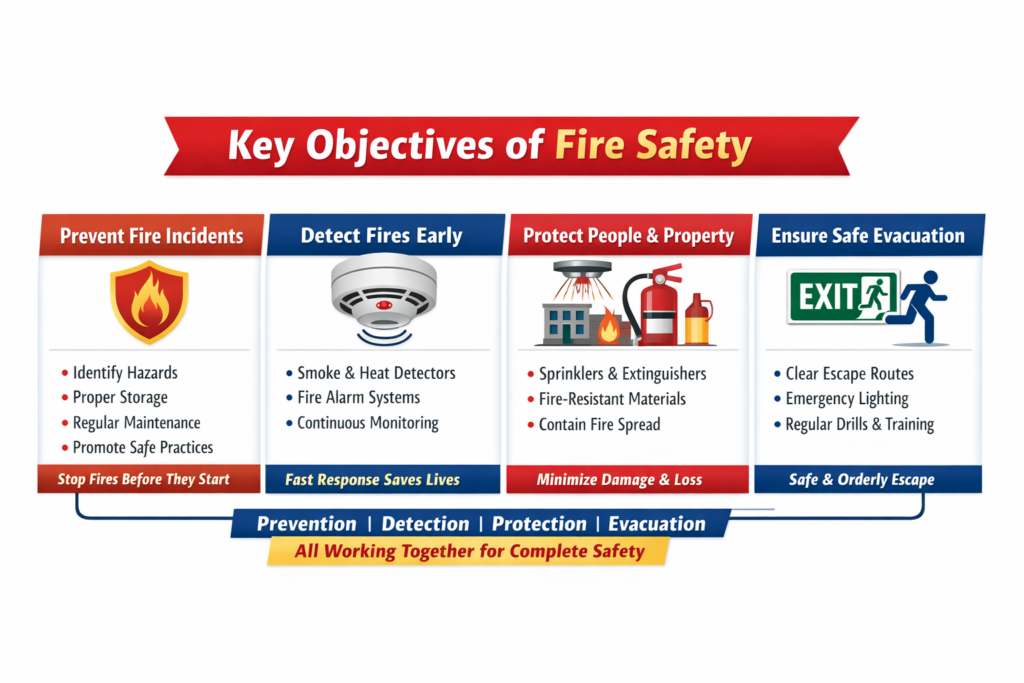
Fire safety is built around four core objectives. These objectives form the foundation of every effective fire safety system and directly support the blueprint approach.
1. Prevent Fire Incidents
The first and most important goal is prevention—stopping fires before they start.
How Prevention is Achieved:
- Identifying hazards such as faulty wiring or flammable materials
- Ensuring proper storage and handling of dangerous substances
- Maintaining equipment and electrical systems regularly
- Promoting safe behaviors among occupants and employees
Why It Matters:
Prevention is the most effective and cost-efficient safety measure. When risks are controlled early, the chances of fire incidents are significantly reduced.
Simply put:
If a fire never starts, there is no danger to manage.
2. Detect Fires Early
Even with strong preventive measures, fires can still occur. Early detection is essential to minimize damage and save lives.
Key Detection Measures:
- Installing smoke detectors and heat sensors
- Using fire alarm systems to alert occupants immediately
- Monitoring high-risk areas continuously
Why It Matters:
- Enables quick response
- Prevents fire from spreading
- Improves chances of safe evacuation
In simple terms:
The sooner a fire is detected, the easier it is to control.
3. Protect People and Property
Fire safety also focuses on minimizing the impact of fire through protective systems and structural measures.
Key Protection Measures:
- Fire-resistant building materials
- Fire suppression systems such as sprinklers
- Availability of fire extinguishers
- Compartmentalization to stop fire spread
Why It Matters:
These systems act as a second line of defense, helping to:
- Contain fire
- Reduce damage
- Protect lives and assets
Simply put:
Protection reduces the impact when prevention is not enough.
4. Ensure Safe Evacuation
When a fire occurs, the highest priority is ensuring that people can evacuate safely and efficiently.
Key Evacuation Requirements:
- Clearly marked emergency exits
- Well-designed evacuation routes
- Emergency lighting and signage
- Regular fire drills and training
Why It Matters:
- Reduces panic during emergencies
- Ensures organized evacuation
- Saves lives
In simple terms:
A clear escape plan ensures everyone can leave safely.
The table below provides a quick overview of the key objectives of fire safety:
| Objective | Key Actions | Purpose |
|---|---|---|
| Prevent Fire Incidents | Identify hazards, proper storage, regular maintenance, safe behavior | Stop fires before they start |
| Detect Fires Early | Install smoke & heat detectors, fire alarms, continuous monitoring | Enable quick response |
| Protect People & Property | Fire-resistant materials, sprinklers, extinguishers, compartmentation | Minimize damage and loss |
| Ensure Safe Evacuation | Clear routes, emergency exits, signage, fire drills | Ensure safe and quick evacuation |
Bringing It All Together
A strong fire safety strategy is not based on a single action—it is the result of integrating all key elements into one cohesive system.
- Prevention reduces the chances of fire
- Detection ensures quick awareness
- Protection limits damage
- Preparedness enables safe evacuation
When these elements are combined within a clear and structured fire safety blueprint, they create a robust, reliable, and highly effective safety system that protects both people and property.
Why This Matters
Understanding fire safety through a structured blueprint approach provides significant advantages:
- Helps individuals and organizations make informed decisions
- Improves overall safety culture and awareness
- Ensures compliance with safety regulations
- Builds a resilient and secure environment
In simple terms, fire safety is not just about equipment—it is about planning, awareness, responsibility, and continuous improvement, all guided by a well-defined blueprint.
The Fire Safety Blueprint Framework
Creating a truly safe environment requires more than basic precautions. Fire safety must be treated as a continuous, structured, and strategic process.
The Fire Safety Blueprint Framework ensures that:
- Risks are not ignored or overlooked
- Safety measures are applied in a logical and effective manner
- Responsibilities are clearly defined
- There is a strong plan for prevention and emergency response
Instead of reacting to fire incidents, this framework focuses on:
Proactive prevention
Strong protection systems
Effective emergency preparedness
Core Components of the Fire Safety Blueprint
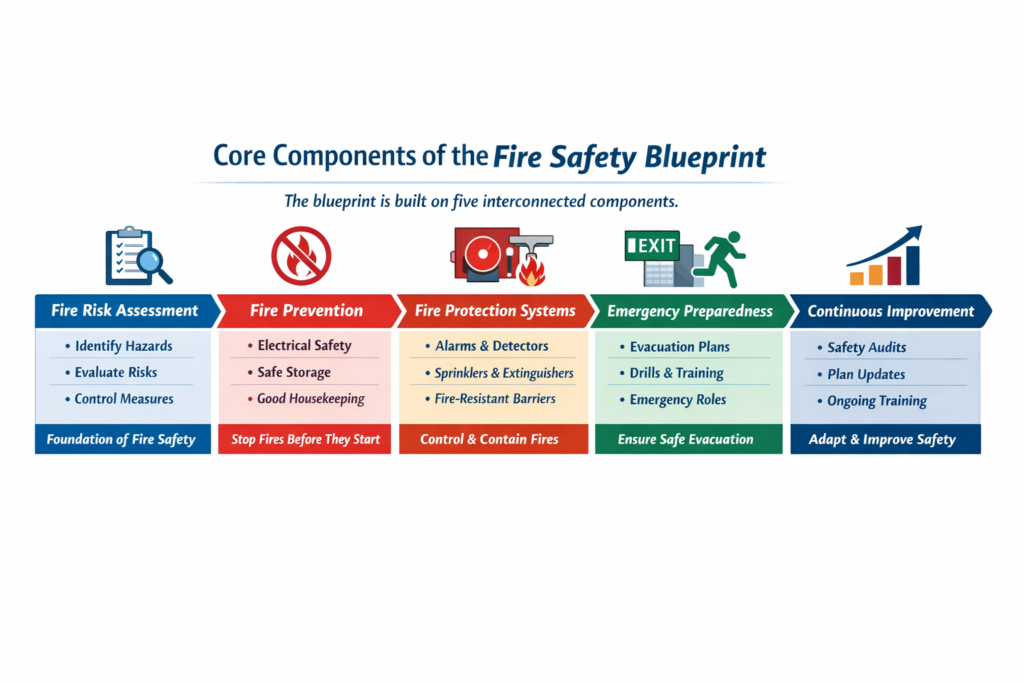
The table below summarizes the core components of the Fire Safety Blueprint:
| Component | Key Activities | Purpose |
|---|---|---|
| Fire Risk Assessment | Identify hazards, evaluate risks, implement controls, review findings | Understand and control fire risks |
| Fire Prevention | Electrical safety, safe storage, housekeeping, equipment maintenance | Stop fires before they start |
| Fire Protection Systems | Detection systems, suppression systems, passive protection | Control and limit fire damage |
| Emergency Preparedness | Evacuation planning, roles, alarm systems, fire drills | Ensure safe and quick response |
| Continuous Improvement | Safety audits, plan updates, training, system upgrades | Maintain and enhance safety over time |
The blueprint is built on five interconnected components, each playing a critical role in creating a complete fire safety system.
1. Fire Risk Assessment (The Foundation)
Fire risk assessment is the starting point and backbone of the entire framework.
What It Involves:
- Identifying fire hazards
- Determining who is at risk
- Evaluating risk levels
- Implementing control measures
- Recording and reviewing findings
Examples of Fire Hazards:
- Faulty electrical wiring
- Overloaded circuits
- Flammable liquids and gases
- Heat-producing equipment
Why It Matters:
- Prevents incidents before they occur
- Prioritizes high-risk areas
- Guides all safety decisions
“What could go wrong, and how do we stop it?”
2. Fire Prevention
Prevention focuses on eliminating risks before a fire can start.
Key Strategies:
Electrical Safety
- Inspect systems regularly
- Avoid overloaded sockets
Safe Storage
- Store flammable materials safely
- Keep ignition sources away
Housekeeping
- Remove waste regularly
- Keep exits clear
Maintenance
- Maintain equipment
- Replace faulty systems
Importance:
- Reduces fire incidents
- Saves costs
- Improves daily safety
3. Fire Protection Systems
These systems help detect and control fires when they occur.
Types:
Detection Systems
- Smoke alarms
- Heat detectors
Suppression Systems
- Sprinklers
- Fire extinguishers
Passive Protection
- Fire-resistant walls
- Compartmentation
Importance:
- Limits fire spread
- Reduces damage
- Increases survival chances
4. Emergency Preparedness
Preparedness ensures effective response during emergencies.
Key Elements:
Evacuation Planning
- Escape routes
- Assembly points
Roles
- Fire wardens
- Emergency coordinators
Systems
- Alarm systems
- Emergency lighting
Training
- Fire drills
- Staff training
Importance:
- Reduces panic
- Saves lives
- Ensures quick response
5. Continuous Improvement
Fire safety must be regularly updated and improved.
Key Activities:
- Safety audits
- Plan updates
- Learning from incidents
- Upgrading systems
Importance:
- Keeps safety effective
- Adapts to new risks
- Ensures long-term protection
Simple Fire Safety Blueprint Cycle
You can understand the entire framework as a continuous cycle:
Improve continuouslyety is always active, updated, and effective.otection, and preparedness—the three pillars of this blueprint.
Identify risks
Prevent hazards
Install protection
Prepare people
The Fire Safety Blueprint Framework
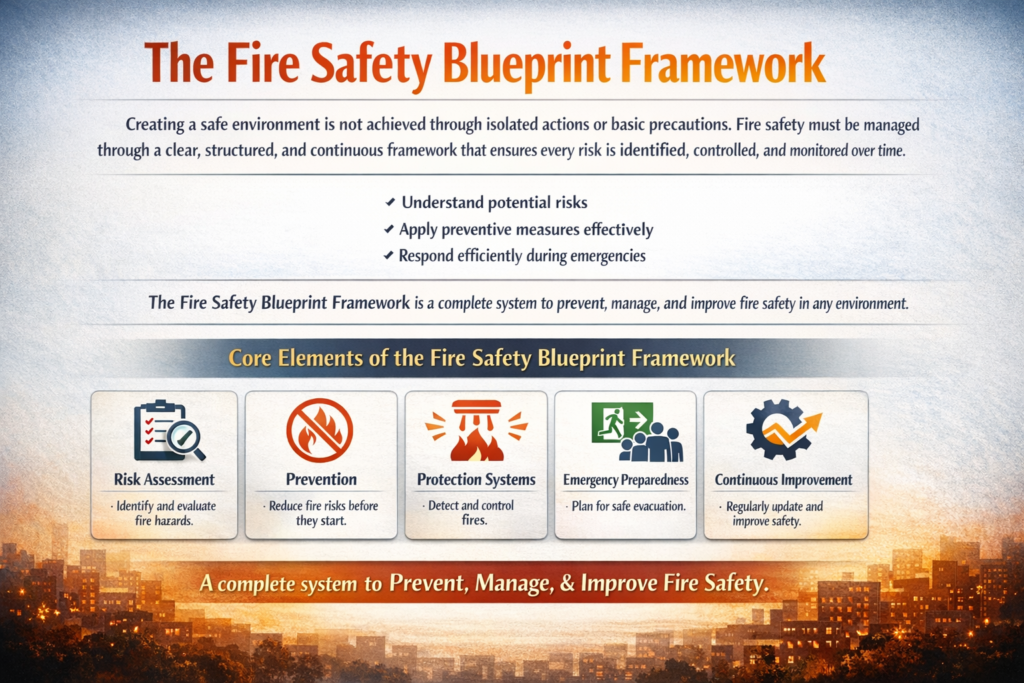
The table below summarizes the Fire Safety Blueprint Framework and its key components:
| Component | Key Activities | Purpose |
|---|---|---|
| Risk Assessment | Identify hazards, evaluate risks, implement controls, review findings | Understand and control fire risks |
| Prevention | Electrical safety, safe storage, housekeeping, equipment maintenance | Stop fires before they start |
| Protection Systems | Detection systems, suppression systems, passive protection | Control and limit fire damage |
| Emergency Preparedness | Evacuation planning, roles, alarm systems, training | Ensure safe and quick emergency response |
| Continuous Improvement | Safety audits, plan updates, training, system upgrades | Maintain and enhance safety over time |
Creating a safe environment is not achieved through isolated actions or basic precautions. Fire safety must be managed through a clear, structured, and continuous framework that ensures every risk is identified, controlled, and monitored over time. This is known as the Fire Safety Blueprint Framework.
A “framework” means a systematic approach—a step-by-step method where each part supports the others. Instead of relying on guesswork or reacting after an incident, this approach ensures that fire safety is planned, organized, and continuously improved.
This blueprint helps individuals and organizations:
- Understand potential risks
- Apply preventive measures effectively
- Respond efficiently during emergencies
- Maintain safety standards over time
In simple terms:
The Fire Safety Blueprint Framework is a complete system that guides how to prevent, manage, and improve fire safety in any environment.
Core Elements of the Fire Safety Blueprint Framework
To build a truly safe and resilient environment, fire safety is divided into five key components. Each component has a specific role, and together they form a complete safety system.
1. Risk Assessment
Risk assessment is the foundation of the entire framework. It is the first step because you cannot control a risk unless you clearly understand it.
What is Risk Assessment?
It is a systematic process of identifying potential fire hazards, evaluating how dangerous they are, and deciding how to reduce or eliminate them.
What Does Risk Assessment Include?
Identifying Fire Hazards
This involves recognizing anything that could start a fire, such as:
- Faulty electrical wiring
- Overloaded circuits
- Flammable liquids and gases
- Heat-generating equipment
Identifying People at Risk
Different individuals may be affected differently:
- Employees and workers
- Visitors and customers
- Vulnerable individuals (elderly, disabled, children)
Evaluating the Risk
This step answers:
- How likely is a fire to occur?
- How severe could the damage be?
Implementing Control Measures
After identifying risks, actions are taken to reduce them:
- Removing hazards
- Improving safety procedures
- Installing protective systems
Recording and Reviewing
- Document findings
- Regularly update assessments as conditions change
Why Risk Assessment is Important
- Prevents fire incidents before they occur
- Helps prioritize high-risk areas
- Forms the basis for all safety decisions
Simply put:
“What could go wrong, and how do we prevent it?”
2. Prevention (Stopping Fires Before They Start)
Once risks are identified, the next step is to eliminate or control them. Prevention focuses on reducing the chances of a fire occurring in the first place.
Key Fire Prevention Measures
Electrical Safety
Electrical issues are one of the most common causes of fire.
- Inspect wiring regularly
- Avoid overloading circuits
- Use certified electrical equipment
Safe Storage of Materials
Improper storage can lead to serious hazards.
- Store flammable substances safely
- Keep ignition sources away
- Follow safety guidelines for chemicals
Good Housekeeping
A clean environment reduces fire risks.
- Remove waste and debris regularly
- Keep escape routes clear
- Avoid accumulation of combustible materials
Equipment Maintenance
Faulty equipment can easily cause fires.
- Conduct regular maintenance
- Repair or replace damaged equipment
- Monitor system performance
Why Prevention is Critical
- Reduces fire incidents significantly
- Saves costs related to damage and loss
- Creates a safer working and living environment
In simple terms:
“Stop the fire before it starts.”
3. Protection Systems (Controlling and Limiting Fire Damage)
Even with strong prevention, fires may still occur. Fire protection systems are designed to detect, control, and minimize the impact of fire.
Types of Fire Protection Systems
Detection Systems
These systems provide early warning:
- Smoke detectors
- Heat detectors
- Fire alarm systems
Early detection helps people respond quickly.
Fire Suppression Systems
These systems help control or extinguish fire:
- Sprinkler systems
- Fire extinguishers
- Gas suppression systems
Passive Fire Protection
These are built-in safety features:
- Fire-resistant walls and doors
- Compartmentation to prevent spread
- Fireproof construction materials
Why Protection Systems Matter
- Control fire before it spreads
- Reduce damage to property
- Increase chances of survival
Simply put:
“If a fire starts, how do we control it?”
4. Emergency Preparedness (Being Ready to Respond)
Preparedness ensures that when a fire occurs, people can respond quickly, calmly, and effectively.
Key Elements of Emergency Preparedness
Evacuation Planning
- Clearly marked escape routes
- Accessible emergency exits
- Designated assembly points
Roles and Responsibilities
- Fire wardens
- Emergency coordinators
- First responders
Emergency Systems
- Alarm systems
- Emergency lighting
- Clear signage
Training and Drills
- Conduct regular fire drills
- Train employees on procedures
- Educate occupants on safety practices
Why Preparedness is Important
- Reduces panic during emergencies
- Ensures safe and organized evacuation
- Saves lives through quick action
In simple terms:
“If a fire happens, how do we respond safely?”
5. Continuous Improvement (Maintaining and Enhancing Safety)
Fire safety is not a one-time setup—it requires ongoing monitoring and improvement.
Key Activities for Continuous Improvement
- Conduct regular safety audits and inspections
- Update fire safety plans as needed
- Learn from past incidents and near misses
- Upgrade systems and technologies
Why Continuous Improvement is Essential
- Keeps safety measures effective
- Adapts to new risks and changes
- Ensures long-term protection
Simply put:
“How do we keep improving our fire safety system?”
How All Components Work Together
The Fire Safety Blueprint Framework is not made up of separate steps—it is a connected and integrated system.
- Risk Assessment identifies hazards
- Prevention reduces the chances of fire
- Protection systems limit damage
- Preparedness ensures safe response
- Continuous improvement keeps everything effective
Simple Way to Understand the Framework
You can think of this as a continuous cycle:
- Identify risks
- Prevent hazards
- Install protection systems
- Prepare people for emergencies
- Review and improve regularly
This cycle ensures that fire safety remains:
- Effective
- Active
- Updated
Fire Risk Assessment (Foundation of Safety)
Fire risk assessment is the first and most critical step in any fire safety strategy. It forms the foundation of the entire Fire Safety Blueprint, because without understanding the risks, it is impossible to control or prevent them effectively.Fire risk assessment is the foundation of any effective fire safety plan. To understand this concept in more detail, you can read our complete guide on what is a fire risk assessment.
In simple terms, a fire risk assessment helps you answer three key questions:
- What could cause a fire?
- Who could be affected?
- How can the risk be reduced or eliminated?
Rather than reacting after an incident, this process allows individuals and organizations to take a proactive approach, identifying potential dangers before they lead to serious consequences.
What is Fire Risk Assessment?
You can also learn more about identifying hazards and applying control measures in our detailed guide on fire safety risk assessment and hazard management.A fire risk assessment is a systematic and structured process used to:
- Identify fire hazards in a building or workplace
- Evaluate the level of risk associated with those hazards
- Implement control measures to reduce or eliminate risks
- Ensure the safety of people, property, and operations
It is not a one-time activity—it must be regularly reviewed and updated to remain effective.
Why Fire Risk Assessment is Important
Understanding and conducting a proper fire risk assessment provides several important benefits:
- Helps prevent fire incidents before they occur
- Protects lives by identifying vulnerable individuals
- Reduces potential damage to property and assets
- Ensures compliance with fire safety regulations
- Supports effective emergency planning
In simple words:
Fire risk assessment is the starting point of all fire safety decisions.
Key Steps in Fire Risk Assessment
To conduct an effective fire risk assessment, you must follow a step-by-step process. Each step plays a vital role in building a complete safety strategy.
1. Identify Fire Hazards
The first step is to identify anything that could start a fire or contribute to its spread.
Common Fire Hazards Include:
Electrical Hazards
- Faulty wiring
- Overloaded sockets
- Damaged electrical equipment
Flammable Materials
- Liquids such as fuel, chemicals, or solvents
- Gases and combustible substances
- Paper, wood, and textiles
Heat Sources
- Machinery that produces heat
- Cooking equipment
- Open flames or sparks
Why This Step Matters
If hazards are not identified, they cannot be controlled. Recognizing these risks early helps in preventing fire incidents completely.
Simply put:
“Find what could start a fire.”
2. Identify People at Risk
Not everyone faces the same level of risk during a fire. This step focuses on identifying who may be affected and how vulnerable they are.
People at Risk May Include:
- Employees working in high-risk areas
- Visitors or customers unfamiliar with the building
- Children or elderly individuals
- People with disabilities or limited mobility
Why This Step Matters
Understanding who is at risk helps in:
- Designing better evacuation plans
- Providing additional support where needed
- Reducing injuries and fatalities
In simple terms:
“Who needs protection the most?”
3. Evaluate and Reduce Risks
Once hazards and people at risk are identified, the next step is to evaluate the level of risk and take action to reduce it.
Risk Evaluation Involves:
- Assessing how likely a fire is to occur
- Determining how severe the consequences could be
Risk Reduction Measures Include:
- Removing or replacing hazardous materials
- Installing fire detection and alarm systems
- Improving storage and handling procedures
- Enhancing safety practices and training
Why This Step Matters
This step transforms awareness into action. It ensures that identified risks are not ignored but actively controlled.
Simply put:
“How dangerous is the risk, and how can we reduce it?”
4. Record Findings
After completing the assessment, it is important to document all findings and actions taken.
What Should Be Recorded?
- Identified hazards
- People at risk
- Risk levels
- Control measures implemented
- Emergency procedures
Why This Step Matters
- Provides a clear record for future reference
- Helps in audits and inspections
- Ensures accountability and consistency
In simple terms:
“Write it down so it can be followed and improved.”
5. Review and Update Regularly
Fire risk assessment is not a one-time task. It must be reviewed and updated regularly to remain effective.
When Should You Review?
- After any fire incident or near miss
- When new equipment or processes are introduced
- When building layout changes
- At regular scheduled intervals
Why This Step Matters
- Ensures safety measures stay relevant
- Adapts to new risks and changes
- Maintains long-term effectiveness
Simply put:
“Keep improving your fire safety plan.”
How Fire Risk Assessment Fits into the Blueprint
Fire risk assessment is the foundation of the Fire Safety Blueprint Framework.
- It identifies risks → which guides prevention
- It highlights dangers → which informs protection systems
- It supports planning → which improves emergency preparedness
- Without proper risk assessment:
- Safety measures may be ineffective
- Risks may go unnoticed
- Emergency response may fail
Common Fire Hazards Table
| Hazard Type | Examples | Risk Level |
|---|---|---|
| Electrical | Faulty wiring, overloaded sockets | High |
| Chemical | Flammable liquids, gases | High |
| Human Behavior | Smoking, negligence | Medium |
| Structural | Poor building design | Medium |
Fire Prevention Strategies
Fire prevention is the most effective and proactive approach to fire safety. Instead of dealing with the consequences of a fire, prevention focuses on eliminating risks before a fire can even start. This not only protects lives and property but also reduces financial losses, operational disruptions, and legal liabilities.
In the context of the Fire Safety Blueprint, prevention acts as the first line of defense, ensuring that hazards are controlled at their source.
Why Fire Prevention is Important
Effective fire prevention strategies help to:
- Reduce the likelihood of fire incidents
- Protect people, property, and assets
- Maintain business continuity
- Lower repair and insurance costs
- Improve overall safety culture
In simple terms:
The best way to deal with fire is to stop it from happening in the first place.
Key Fire Prevention Measures
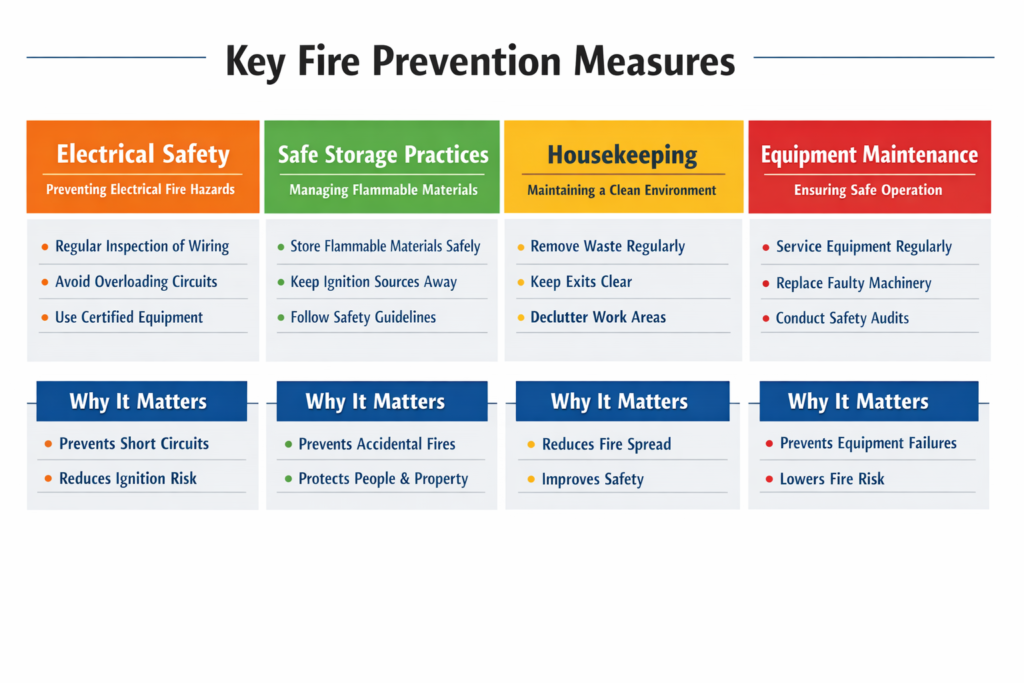
The table below summarizes the key fire prevention measures and their purpose:
| Prevention Area | Key Actions | Purpose |
|---|---|---|
| Electrical Safety | Inspect wiring, avoid overload, use certified equipment | Prevent electrical fires |
| Safe Storage | Store flammable materials safely, keep ignition sources away, follow guidelines | Prevent accidental ignition |
| Housekeeping | Remove waste, keep exits clear, maintain clean workspace | Reduce fire spread risk |
| Equipment Maintenance | Service equipment, replace faulty parts, conduct safety audits | Prevent malfunctions and sparks |
To create a safe environment, fire prevention must be implemented through multiple control measures. Each of the following areas plays a critical role in reducing fire risks.
1. Electrical Safety (Preventing Electrical Fire Hazards)
Electrical faults are one of the leading causes of fire incidents in homes and workplaces. Poor wiring, overloaded circuits, and faulty equipment can easily generate heat and sparks, leading to fire.
Key Electrical Safety Practices
Regular Inspection of Wiring
- Inspect electrical systems periodically
- Identify damaged wires or loose connections
- Replace outdated or worn-out wiring
Avoid Overloading Circuits
- Do not plug too many devices into one socket
- Use appropriate extension cords
- Distribute electrical load properly
Use Certified and Safe Equipment
- Always use approved and certified electrical appliances
- Avoid low-quality or damaged equipment
- Ensure proper installation by qualified professionals
Why Electrical Safety Matters
- Prevents short circuits and overheating
- Reduces risk of sparks and ignition
- Ensures safe operation of electrical systems
Simply put:
Safe electricity use = lower fire risk.
2. Safe Storage Practices (Managing Flammable Materials)
Improper storage of flammable materials is a major fire hazard. Substances like fuels, chemicals, and gases can easily ignite if not handled correctly.
Key Safe Storage Practices
Proper Storage of Flammable Materials
- Store flammable substances in designated areas
- Use fire-resistant storage cabinets
- Clearly label all hazardous materials
Keep Ignition Sources Away
- Maintain distance between flammable materials and heat sources
- Avoid open flames near storage areas
- Control static electricity where applicable
Follow Safety Guidelines
- Adhere to storage regulations and standards
- Limit the quantity of stored flammable materials
- Ensure proper ventilation
Why Safe Storage is Important
- Prevents accidental ignition
- Reduces fire intensity if it occurs
- Protects both people and property
In simple terms:
Store safely to avoid dangerous fire situations.
3. Housekeeping (Maintaining a Clean and Safe Environment)
Good housekeeping is one of the simplest yet most effective fire prevention methods. A cluttered or poorly maintained environment increases the chances of fire spreading quickly.
Key Housekeeping Practices
Maintain Clean Workspaces
- Keep areas free from unnecessary materials
- Organize tools and equipment properly
- Avoid clutter in work areas
Remove Waste Regularly
- Dispose of combustible waste such as paper, cardboard, and fabric
- Empty bins frequently
- Use proper waste disposal systems
Keep Escape Routes Clear
- Ensure exits and pathways are always accessible
- Avoid blocking emergency exits
- Clearly mark evacuation routes
Why Housekeeping Matters
- Reduces fuel for fire
- Prevents fire from spreading rapidly
- Improves overall safety and efficiency
Simply put:
A clean space is a safer space.
4. Equipment Maintenance (Ensuring Safe Operation)
Faulty or poorly maintained equipment is a common source of fire hazards. Regular maintenance ensures that machines and systems operate safely and efficiently.
Key Maintenance Practices
Regular Servicing of Machinery
- Follow maintenance schedules
- Inspect equipment for faults
- Lubricate and clean machinery regularly
Replace Damaged Equipment
- Remove defective tools and machines
- Upgrade outdated systems
- Ensure safe replacements are installed
Conduct Fire Safety Audits
- Perform regular safety checks
- Identify potential risks in equipment
- Take corrective actions immediately
Why Equipment Maintenance is Important
- Prevents overheating and mechanical failure
- Reduces risk of sparks and ignition
- Extends equipment lifespan
In simple terms:
Well-maintained equipment reduces fire risks significantly.
Integrating Prevention into the Fire Safety Blueprint
Fire prevention is not a standalone activity—it is a core part of the Fire Safety Blueprint Framework.
- It works alongside risk assessment to identify hazards
- Supports protection systems by reducing fire occurrence
- Enhances emergency preparedness by minimizing incidents
Fire Protection Systems
Even with strong fire prevention measures in place, it is not always possible to eliminate all risks. Fires can still occur due to unforeseen circumstances such as equipment failure, human error, or external factors. This is where Fire Protection Systems become essential.
Fire protection systems act as a critical second line of defense. Their purpose is to detect fires early, control their spread, and minimize damage to people, property, and operations.
In the Fire Safety Blueprint, protection systems ensure that if prevention fails, there is still a reliable mechanism in place to manage the situation effectively.
Purpose of Fire Protection Systems
Fire protection systems are designed to:
- Detect fire at the earliest possible stage
- Alert occupants immediately
- Control or extinguish fire before it spreads
- Protect lives and reduce property damage
- Support safe evacuation procedures
In simple terms:
If a fire starts, protection systems help control it and keep people safe.
Types of Fire Protection Systems
Fire protection systems are generally divided into two main categories:
- Fire Detection Systems (to identify fire early)
- Fire Suppression Systems (to control or extinguish fire)
Both systems work together to create a complete and effective fire response mechanism.
1. Fire Detection Systems (Early Warning Systems)
Fire detection systems are designed to identify the presence of fire or smoke at an early stage and alert occupants immediately.
Early detection is crucial because it:
- Provides more time to respond
- Reduces fire spread
- Increases chances of safe evacuation
Common Types of Fire Detection Systems
Smoke Detectors
Smoke detectors are one of the most commonly used fire detection devices.
They work by:
- Detecting smoke particles in the air
- Triggering an alarm when smoke is present
Best for:
- Offices, homes, and general indoor areas
Heat Detectors
Heat detectors respond to changes in temperature rather than smoke.
They activate when:
- A fixed temperature is exceeded
- There is a rapid rise in temperature
Best for:
- Kitchens
- Industrial environments
- Areas with dust or steam (where smoke detectors may give false alarms)
Fire Alarm Systems
Fire alarm systems are integrated systems that:
- Receive signals from detectors
- Alert occupants through sound and visual signals
- May automatically notify emergency services
Key Features:
- Audible alarms (sirens)
- Visual alerts (flashing lights)
- Central control panels
Why Detection Systems are Important
- Provide early warning
- Allow quick response
- Prevent small fires from becoming major incidents
Simply put:
The sooner a fire is detected, the safer everyone will be.
2. Fire Suppression Systems (Controlling and Extinguishing Fire)
While detection systems alert people, suppression systems take action to control or extinguish the fire.
These systems are designed to:
- Reduce fire intensity
- Prevent fire spread
- Minimize damage
Common Types of Fire Suppression Systems
Sprinkler Systems
Sprinkler systems automatically release water when a fire is detected.
They work by:
- Activating when heat reaches a certain level
- Spraying water directly onto the fire
Benefits:
- Quickly controls fire
- Reduces fire spread
- Operates automatically without human intervention
Fire Extinguishers
Fire extinguishers are portable devices used to manually control small fires.
They come in different types depending on fire class:
- Water (for solid materials)
- CO₂ (for electrical fires)
- Foam and dry powder (multi-purpose use)
Important:
- Must be easily accessible
- Users should be trained to operate them
Gas Suppression Systems
Gas suppression systems are used in sensitive environments where water could cause damage.
They work by:
- Releasing inert gas or chemical agents
- Reducing oxygen levels or interrupting the chemical reaction of fire
Best for:
- Server rooms
- Data centers
- Laboratories
Why Suppression Systems are Important
- Control fire before it spreads
- Protect valuable equipment and assets
- Reduce damage and recovery costs
In simple terms:
Suppression systems help stop the fire from growing.
How Fire Protection Systems Fit into the Blueprint
Fire protection systems are a key part of the Fire Safety Blueprint Framework:
- They support risk assessment by addressing identified hazards
- They enhance prevention measures by providing backup protection
- They work alongside emergency preparedness to ensure safe evacuation
Detection vs Suppression (Simple Comparison)
| Detection Systems | Suppression Systems |
|---|---|
| Identify fire early | Control or extinguish fire |
| Alert occupants | Act directly on fire |
| Examples: alarms, detectors | Examples: sprinklers, extinguishers |
Fire Extinguisher Types Table
| Type | Suitable For | Color Code |
|---|---|---|
| Water | Wood, paper | Red |
| Foam | Liquids | Cream |
| CO₂ | Electrical fires | Black |
| Dry Powder | Multi-purpose | Blue |
Emergency Preparedness & Evacuation Planning
Even with strong prevention and protection systems in place, emergencies can still occur. In such situations, the most important factor is how well people are prepared to respond. This is where Emergency Preparedness and Evacuation Planning becomes a critical part of the Fire Safety Blueprint.
Preparedness ensures that when a fire happens, individuals are able to act quickly, remain calm, and follow a clear plan to reach safety. Without proper planning, even a small fire can lead to panic, confusion, and serious consequences.
In simple terms:
Preparedness is about knowing exactly what to do before an emergency happens.
Why Emergency Preparedness is Important
Effective emergency planning helps to:
- Save lives by ensuring quick and safe evacuation
- Reduce panic and confusion during emergencies
- Improve coordination among occupants and staff
- Minimize injuries and delays
- Support emergency responders
Simply put:
A well-prepared environment responds faster and safer.
Key Elements of Emergency Preparedness & Evacuation Planning
A strong evacuation plan is built on several essential components. Each element plays a vital role in ensuring a safe and organized response during a fire emergency.
1. Clear Evacuation Routes (Safe Pathways to Exit)
Evacuation routes are the designated paths that people must follow to safely exit a building during a fire.
Key Features of Effective Evacuation Routes:
- Clearly marked and easy to understand
- Free from obstructions at all times
- Wide enough to handle the number of occupants
- Designed to lead directly to safe exit points
Why Evacuation Routes Matter:
- Help people move quickly without confusion
- Reduce overcrowding and delays
- Ensure a smooth and orderly evacuation
In simple terms:
People should always know the safest way out.
2. Emergency Exits (Safe Exit Points)
Emergency exits are designated doors or escape points that allow people to leave the building safely.
Key Requirements for Emergency Exits:
- Clearly visible and properly labeled
- Easily accessible and never locked or blocked
- Equipped with emergency lighting
- Open in the direction of evacuation
Why Emergency Exits are Important:
- Provide immediate access to safety
- Prevent bottlenecks during evacuation
- Ensure compliance with safety standards
Simply put:
An exit that is blocked or unclear can become a major risk during a fire.
3. Assembly Points (Safe Gathering Areas)
Assembly points are predefined safe locations outside the building where people gather after evacuation.
Key Features of Assembly Points:
- Located at a safe distance from the building
- Easily accessible and clearly communicated
- Large enough to accommodate all occupants
- Known to all employees or residents
Why Assembly Points Matter:
- Help account for all individuals
- Prevent people from re-entering the building
- Assist emergency responders in managing the situation
In simple terms:
After exiting, everyone must gather at a safe and known location.
4. Alarm Systems (Early Warning Mechanism)
Alarm systems play a crucial role in alerting people immediately when a fire is detected.
Key Features of Effective Alarm Systems:
- Loud and clearly audible signals
- Visual alerts for hearing-impaired individuals
- Connected to fire detection systems
- Regularly tested and maintained
Why Alarm Systems are Important:
- Provide early warning
- Trigger immediate evacuation
- Reduce response time
Simply put:
The faster people are alerted, the safer they are.
Additional Elements of Effective Preparedness
Beyond the basic components, a complete emergency plan should also include:
Roles and Responsibilities
Assigning responsibilities ensures that everyone knows what to do.
- Fire wardens to guide evacuation
- Emergency coordinators to manage response
- First aid responders
Training and Fire Drills
Regular training is essential for preparedness.
- Conduct fire drills periodically
- Educate occupants on evacuation procedures
- Practice different emergency scenarios
Emergency Lighting and Signage
- Ensure visibility during power failure
- Clearly mark exits and escape routes
Why These Elements Matter
- Improve confidence and readiness
- Reduce confusion during real emergencies
- Ensure smooth execution of evacuation plans
How Emergency Preparedness Fits into the Fire Safety Blueprint
Emergency preparedness is a key component of the Fire Safety Blueprint Framework:
- It supports risk assessment by planning for identified risks
- It complements prevention and protection systems
- It ensures safe and effective response during emergencies
Simple Evacuation Process
A well-prepared evacuation follows a clear sequence:
- Alarm is activated
- People follow evacuation routes
- Exit through emergency doors
- Gather at assembly points
- Await further instructions
Fire Evacuation Plan
A fire evacuation plan is one of the most critical components of emergency preparedness. It provides a clear, structured set of instructions that helps people evacuate safely and efficiently during a fire.
Without a proper evacuation plan, even a small fire can lead to panic, confusion, delays, and serious injuries. A well-designed plan ensures that everyone knows exactly what to do, where to go, and how to respond.
In simple terms:
A fire evacuation plan is a roadmap that guides people to safety during an emergency.
Why a Fire Evacuation Plan is Important
A proper evacuation plan helps to:
- Ensure quick and safe evacuation
- Reduce panic and confusion
- Protect lives and minimize injuries
- Improve coordination during emergencies
- Support emergency responders
Step-by-Step Fire Evacuation Plan
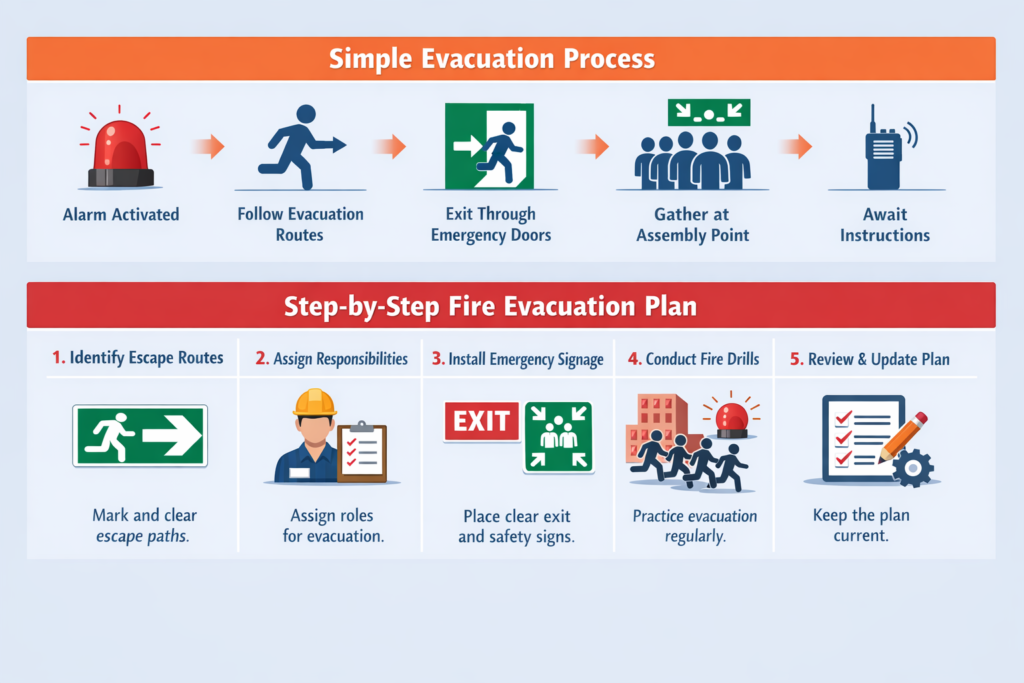
The table below summarizes the fire evacuation process and planning steps:
| Step / Element | Key Actions | Purpose |
|---|---|---|
| Alarm Activation | Trigger alarm, alert occupants immediately | Start evacuation quickly |
| Follow Evacuation Routes | Use designated escape paths, avoid blocked areas | Ensure safe movement |
| Exit Safely | Use emergency exits, avoid elevators | Reach safe area quickly |
| Assembly Point | Gather at designated location | Account for all individuals |
| Await Instructions | Stay at assembly point, follow guidance | Ensure safety and coordination |
| Identify Escape Routes | Plan multiple routes, keep paths clear | Avoid confusion during emergencies |
| Assign Responsibilities | Fire wardens, coordinators, responders | Improve organization and control |
| Emergency Signage | Install exit signs, directional arrows | Guide people clearly |
| Fire Drills | Practice evacuation, test systems | Improve preparedness |
| Review & Update Plan | Update after changes or incidents | Maintain effectiveness |
To create an effective evacuation strategy, follow these essential steps:
1. Identify Escape Routes
Escape routes are the paths people follow to exit the building safely.
Key Considerations:
- Provide multiple escape routes in case one is blocked
- Ensure routes are clearly marked and easy to follow
- Keep pathways free from obstacles at all times
- Design routes that lead directly to safe exits and assembly points
Why This Step Matters:
- Prevents confusion during emergencies
- Ensures smooth and fast evacuation
- Reduces the risk of crowding and delays
Simply put:
Everyone should know at least two ways out.
2. Assign Responsibilities
During an emergency, having clearly defined roles ensures better coordination and control.
Key Roles to Assign:
- Fire Wardens: Guide people to exits and ensure evacuation
- Supervisors: Check that all areas are cleared
- First Aid Responders: Assist injured individuals
- Emergency Coordinators: Manage the overall response
Why This Step Matters:
- Prevents confusion about who is in charge
- Ensures faster and more organized evacuation
- Improves accountability
In simple terms:
When everyone knows their role, evacuation becomes smoother and safer.
3. Install Emergency Signage
Clear signage is essential to guide people during an emergency, especially in unfamiliar environments.
Important Signage Includes:
- Exit signs
- Directional arrows for escape routes
- Assembly point indicators
- Fire equipment locations
Why This Step Matters:
- Helps people navigate quickly
- Reduces panic and hesitation
- Improves visibility during low-light conditions
Simply put:
Clear signs guide people to safety without confusion.
4. Conduct Regular Fire Drills
Fire drills are essential for ensuring that the evacuation plan works effectively in real situations.
What Fire Drills Should Include:
- Practice evacuation procedures
- Test alarm systems
- Evaluate response time
- Identify weaknesses in the plan
Why This Step Matters:
- Builds confidence among occupants
- Helps identify and fix problems
- Improves overall preparedness
In simple terms:
Practice makes evacuation faster and safer.
5. Review and Update the Plan
An evacuation plan must be regularly reviewed and updated to remain effective.
When to Review:
- After drills or real incidents
- When building layout changes
- When new equipment is installed
- Periodically as part of safety audits
Why This Step Matters:
- Keeps the plan relevant
- Adapts to new risks
- Ensures continuous improvement
Simply put:
A plan that is not updated can become ineffective.
Common Fire Safety Mistakes (Expert Insight)
Even with safety measures in place, many organizations fail due to avoidable mistakes. Understanding these mistakes helps improve safety and prevent serious incidents.
1. Ignoring Regular Inspections
Problem:
- Equipment and systems are not checked regularly
Risk:
- Faulty alarms or extinguishers may fail during emergencies
Solution:
- Conduct routine inspections and maintenance
2. Lack of Employee Training
Problem:
- Employees are unaware of safety procedures
Risk:
- Panic and confusion during emergencies
Solution:
- Provide regular fire safety training and awareness programs
3. Poor Emergency Planning
Problem:
- No clear evacuation strategy
Risk:
- Delays and unsafe evacuation
Solution:
- Develop and communicate a structured evacuation plan
4. Overconfidence in Equipment
Problem:
- Relying only on alarms and extinguishers
Risk:
- Ignoring human response and planning
Solution:
- Combine equipment with training and preparedness
Key Takeaway:
Avoiding these mistakes can significantly improve:
- Fire safety performance
- Emergency response effectiveness
- Compliance with safety standards
Simply put:
Good planning and awareness are just as important as equipment.
Modern Fire Safety Trends
Fire safety is continuously evolving with advancements in technology. Modern systems are designed to be smarter, faster, and more efficient.
1. Smart Fire Detection Systems
Features:
- Advanced sensors
- Real-time alerts
- Integration with building systems
Benefit:
- Faster and more accurate detection
2. AI-Based Monitoring
Features:
- Uses artificial intelligence to detect fire patterns
- Predicts potential risks
Benefit:
- Improves early warning and decision-making
3. IoT-Enabled Fire Alarms
Features:
- Connected devices
- Remote monitoring via mobile or computer
Benefit:
- Allows real-time monitoring from anywhere
4. Automated Suppression Systems
Features:
- Automatically activate during fire
- Minimal human intervention required
Benefit:
- Quick response reduces fire spread and damage
How This Section Fits into the Fire Safety Blueprint
- Evacuation planning ensures safe response
- Avoiding mistakes improves overall effectiveness
- Modern technologies enhance detection and protection systems
Conclusion
Fire safety is not a one-time task but a continuous process that requires careful planning, awareness, and regular improvement. By following a structured Fire Safety Blueprint, individuals and organizations can effectively identify risks, implement preventive measures, and ensure preparedness for emergencies. This systematic approach helps reduce fire hazards and creates a safer environment for everyone.
Adopting a proactive mindset toward fire safety—focusing on prevention, protection, and preparedness—plays a vital role in minimizing risks and avoiding serious incidents. It not only helps save lives but also protects property, business operations, and long-term stability.
Ultimately, a strong commitment to fire safety, supported by continuous evaluation and improvement, ensures that safety measures remain effective over time. A well-prepared environment is always more resilient, capable of responding quickly, and better equipped to handle fire-related risks.