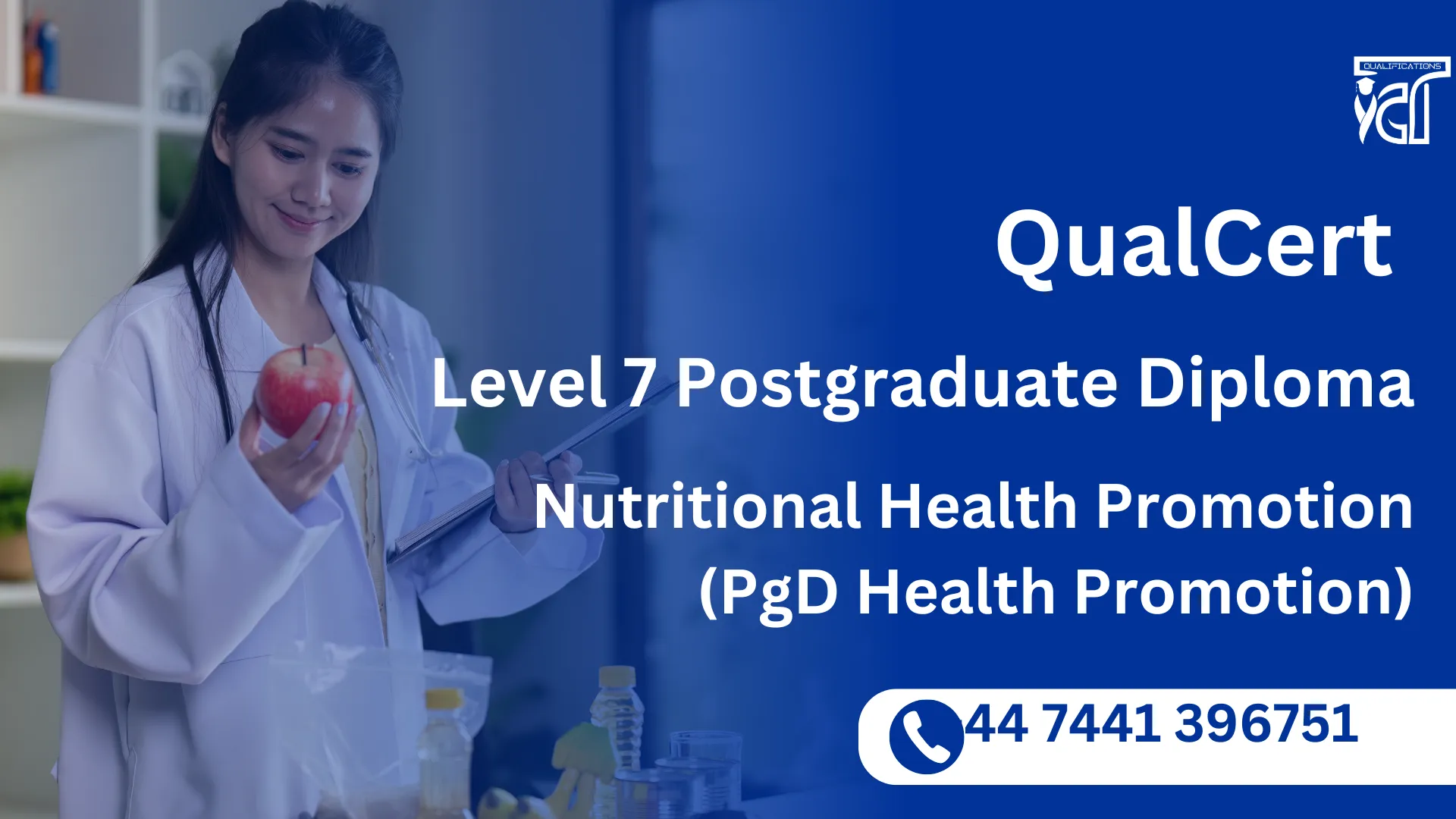
The QualCert Level 7 Postgraduate Diploma in Nutritional Health Promotion is an advanced qualification designed to empower learners with the expertise to promote healthier lifestyles, prevent diet-related diseases, and influence public health strategies through evidence-based nutrition. This program integrates scientific knowledge, behavioral approaches, and policy frameworks to prepare participants for leadership roles in health promotion and nutrition advocacy.
Learners will explore key areas such as nutritional epidemiology, health communication, community nutrition, and the design of intervention programs. The course emphasizes the role of nutrition in disease prevention, sustainable food systems, and population health improvement. It also highlights the importance of cultural sensitivity, ethical practice, and global perspectives in promoting nutrition and wellness.
Through applied projects, case studies, and research-focused modules, participants will develop advanced skills in nutritional assessment, program planning, and policy analysis. The curriculum fosters innovation, critical thinking, and practical application, enabling learners to design and implement effective health promotion strategies across diverse populations.
Ultimately, this diploma equips learners to become specialists capable of advancing public health nutrition, guiding community initiatives, and shaping food and health policies. With its international recognition and advanced focus, the PgD Health Promotion serves as a pathway to senior roles in healthcare, NGOs, government agencies, and academic research, while contributing to the global demand for sustainable and impactful health promotion practices.
QualCert Level 7 Postgraduate Diploma in Nutritional Health Promotion (PgD Health Promotion)
The QualCert Level 7 Postgraduate Diploma in Nutritional Health Promotion (PgD Health Promotion), offers 120 Credits, requiring a Total Qualification Time (TQT) of 1200 hours, including 600 Guided Learning Hours (GLH).
| Unit Ref# | Unit Title | Credit | GLH | TQT |
| QC29123- 1 | Advanced Nutritional Biochemistry | 20 | 100 | 200 |
| QC29123-2 | Nutritional Physiology and Metabolism | 20 | 100 | 200 |
| QC29123-3 | Diet, Disease and Preventive Nutrition | 20 | 100 | 200 |
| QC29123-4 | Food Science, Safety and Innovation | 20 | 100 | 200 |
| QC29123-5 | Research Methods in Nutritional Sciences | 20 | 100 | 200 |
| QC29123-6 | Dissertation / Applied Research Project in Nutritional Sciences | 20 | 100 | 200 |
GLH (Guided Learning Hours) and TQT (Total Qualification Time) are terms commonly used in vocational qualifications to help define the amount of time a learner is expected to spend on their studies.
1. GLH (Guided Learning Hours)
GLH refers to the number of hours a learner spends being directly taught, supervised, or supported during their course. This includes the time spent in activities such as:
- Classroom instruction
- Practical workshops
- One-on-one tutoring or mentoring sessions
- Online learning sessions with tutor support
In other words, GLH represents the time that learners are actively engaged with their instructors or learning activities.
2. TQT (Total Qualification Time)
TQT represents the total amount of time a learner is expected to invest in completing a qualification, including:
- GLH (Guided Learning Hours): Time spent on direct learning, as explained above.
- Self-Directed Learning: This includes time spent on independent study, research, assignment completion, preparation for exams, and any other work the learner does outside of direct teaching hours.
TQT is a broader measure that includes all the time required to achieve the qualification. It helps learners and employers understand the overall commitment required for the qualification.
Key Differences Between GLH and TQT:
- GLH focuses on direct learning with guidance or supervision.
- TQT includes GLH as well as independent study time and other learning-related activities.
Example:
If a qualification has a TQT of 600 hours and a GLH of 250 hours, it means the learner should spend 250 hours in direct learning (classroom, online, or tutor-led sessions) and 350 hours on independent study or research.
Learning Outcomes for the QualCert Level 7 Postgraduate Diploma in Nutritional Health Promotion (PgD Health Promotion):
Nutritional Science for Health Promotion
- Critically evaluate the relationship between diet, nutrition, and disease prevention.
- Apply evidence-based nutritional science to support community and individual health outcomes.
- Assess the role of macro and micronutrients in promoting optimal health.
- Analyse how nutritional strategies can improve public health indicators.
Behavioural Science and Nutrition Education
- Examine psychological, cultural, and social factors influencing dietary behaviours.
- Design effective nutrition education interventions tailored to diverse populations.
- Apply behaviour change theories to encourage healthier lifestyle choices.
- Critically appraise current strategies in nutrition education and health promotion.
Public Health Nutrition and Policy Development
- Assess the role of nutrition in public health frameworks and global health priorities.
- Evaluate the effectiveness of food and nutrition policies in addressing health inequalities.
- Formulate evidence-based recommendations for public health nutrition strategies.
- Interpret epidemiological data to support nutrition-related policy decisions.
Health Promotion Strategies and Programme Planning
- Develop comprehensive health promotion programmes targeting nutrition-related issues.
- Integrate multidisciplinary approaches to address diet-related health challenges.
- Apply project management skills to design, implement, and evaluate nutrition initiatives.
- Assess the impact of community engagement on health promotion success.
Research Methods in Nutritional Health Promotion
- Apply advanced research methodologies to investigate nutrition and health promotion issues.
- Critically analyse qualitative and quantitative data in nutrition-related research.
- Evaluate ethical considerations in public health and nutritional research.
- Design and present a detailed research proposal addressing a current issue in health promotion.
Dissertation / Applied Research Project in Nutritional Health Promotion
- Conduct an independent research project in nutritional health promotion.
- Demonstrate the ability to gather, analyse, and interpret complex data.
- Apply critical thinking and academic writing skills to produce a postgraduate-level dissertation.
- Provide practical recommendations for policy, practice, or further research in health promotion.
This advanced diploma equips learners with the expertise, practical skills, and recognition needed to excel in the field of nutritional health promotion. It is designed to strengthen professional credibility, enhance career prospects, and empower participants to contribute to healthier communities and global public health strategies.
Enhanced Knowledge and Expertise
- Gain advanced understanding of nutritional epidemiology, health communication, and community nutrition
- Learn evidence-based approaches to designing and implementing health promotion programs
- Explore the role of nutrition in disease prevention, sustainable food systems, and population health improvement
- Develop expertise in policy frameworks, ethical practice, and culturally sensitive health promotion strategies
Practical Application and Skills Development
- Apply theoretical knowledge through case studies, applied projects, and program planning exercises
- Strengthen analytical, problem-solving, and leadership skills for public health nutrition initiatives
- Acquire competencies in nutritional assessment, intervention design, and policy analysis
- Build confidence in translating scientific research into effective health promotion strategies
Career Advancement Opportunities
- Progress to senior roles in healthcare, NGOs, government agencies, and international health organizations
- Enhance employability in nutrition consultancy, public health leadership, and community program management
- Position yourself as a specialist capable of influencing food and health policies
- Use this internationally recognized qualification as a pathway to doctoral studies or advanced certifications
Contribution to Society and Global Impact
- Play a vital role in promoting healthier lifestyles and preventing diet-related diseases
- Contribute to sustainable nutrition strategies that address global health challenges
- Influence public health initiatives and advocate for evidence-based nutrition practices
- Empower communities by supporting access to safe, effective, and culturally appropriate health promotion programs
This program is designed for individuals who are passionate about advancing their expertise in nutrition and health promotion. The ideal learner is someone motivated to apply evidence-based strategies, influence public health initiatives, and contribute to healthier communities through sustainable nutrition practices.
Learners Seeking Advanced Knowledge and Expertise
- Individuals with a background in nutrition, dietetics, public health, food science, or healthcare
- Those eager to explore nutritional epidemiology, health communication, and community-based nutrition programs
- Learners motivated to understand the role of nutrition in disease prevention and health promotion
- Candidates who value evidence-based approaches and global perspectives in health promotion
Learners Focused on Practical Application and Skills Development
- Professionals aiming to apply theory through case studies, program design, and applied research projects
- Those interested in strengthening analytical, problem-solving, and leadership skills for public health nutrition initiatives
- Learners who want to develop competencies in nutritional assessment, intervention planning, and policy analysis
- Participants seeking confidence in translating scientific research into effective health promotion strategies
Learners Aspiring for Career Advancement
- Nutrition consultants, dietitians, healthcare professionals, and public health specialists aiming for leadership roles
- Individuals seeking career progression in NGOs, government agencies, international health organizations, or academia
- Learners who want to position themselves as specialists capable of influencing food and health policies
- Candidates looking to use this internationally recognized qualification as a pathway to doctoral studies or advanced certifications
Learners Committed to Societal Contribution and Global Impact
- Those passionate about promoting healthier lifestyles and preventing diet-related diseases
- Learners motivated to contribute to sustainable nutrition strategies that address global health challenges
- Individuals who want to influence public health initiatives and advocate for evidence-based nutrition practices
Completing the QualCert Level 7 Postgraduate Diploma in Nutritional Health Promotion opens diverse pathways for learners to advance academically, professionally, and in research. This qualification is designed to serve as both a specialized credential and a foundation for higher-level opportunities in nutrition, health promotion, and public health.
Academic Progression
- Eligibility to pursue Level 8 qualifications such as doctoral studies or advanced research programs in nutrition, health promotion, or public health
- Pathways to specialized certifications in community nutrition, health communication, epidemiology, and food policy
- Opportunities to contribute to scholarly publications, conferences, and international collaborations in health promotion and nutrition
- Access to advanced academic networks in healthcare, food science, and public health research
Professional Advancement
- Progression to senior roles in healthcare, NGOs, government agencies, and international health organizations
- Opportunities to work in nutrition consultancy, public health leadership, and community program management
- Enhanced career prospects in policy development, health education, and sustainable nutrition initiatives
- Recognition as a specialist capable of leading initiatives that integrate nutrition, health promotion, and population wellness
Research and Development Opportunities
- Engagement in applied research projects exploring diet-related diseases, community health interventions, and sustainable food practices
- Contribution to evidence-based practices in nutritional health promotion and disease prevention
- Development of new frameworks for population health strategies and wellness programs
- Collaboration with universities, research centers, and international organizations on global nutrition and health challenges
Societal Impact and Leadership
- Ability to influence public health policies and advocate for sustainable nutrition and health promotion strategies
- Contribution to designing community programs that promote healthier lifestyles and prevent diet-related diseases
- Leadership in shaping international strategies for nutrition education, food sustainability, and public health promotion
- Empowerment to become a thought leader in the growing global field of nutritional health promotion
Entry Requirements
Entry Requirements for the QualCert Level 7 Postgraduate Diploma in Nutritional Health Promotion (PgD Health Promotion):
- Age: Learners must be at least 21 years old at the start of the programme.
- Education: Completion of a Level 6 qualification (or equivalent) in nutrition, dietetics, public health, food science, health sciences, biology, or a related discipline. Alternatively, substantial professional experience in nutrition, healthcare, or public health promotion may be considered in place of formal qualifications
- Work Experience: A minimum of 2–3 years of relevant work experience in nutrition consultancy, dietetics, healthcare, food industries, NGOs, or public health services
- English Proficiency: Competence in English or the language of instruction, typically at CEFR Level B2 or equivalent. Ability to read, write, and communicate effectively in academic and professional contexts.
Register Now
Qualification Process
Qualification Process for the QualCert Level 7 Postgraduate Diploma in Nutritional Health Promotion (PgD Health Promotion)
- Self-Assessment:
Begin by evaluating your eligibility to ensure you meet the qualification requirements, including work experience, knowledge, and language proficiency. - Registration:
Complete your registration by submitting the required documents, including a scanned copy of a valid ID, and paying the registration fee. - Induction:
An assessor will conduct an induction to confirm your eligibility for the course and explain the evidence requirements. If you do not meet the criteria, your registration will be canceled, and the fee will be refunded. - Assignmnets & Evidence Submission:
Provide all assignmnets and the necessary evidence based on the assessment criteria outlined in the course. If you are unsure of the required evidence, consult with the assessor for guidance on the type and nature of evidence needed. - Feedback and Revision:
The assessor will review your submitted evidence and provide feedback. Evidence that meets the criteria will be marked as “Criteria Met,” while any gaps will be identified. You will be asked to revise and resubmit if needed. - Competence Evidence:
Submit final evidence demonstrating that all learning outcomes have been met. This evidence will be marked as “Criteria Met” by the assessor once it is satisfactory. - Internal Quality Assurance (IQA):
The Internal Quality Assurance Verifier (IQA) will review your evidence to ensure consistency, quality, and compliance with standards. - External Verification:
The IQA will submit your portfolio to QualCert External Quality Assurance Verifiers (EQA) for final confirmation. The EQA may contact you directly to verify the authenticity of your evidence. - Certification:
Upon successful completion of all checks, QualCert will issue your official certificate, confirming that you have attained the QualCert Level 7 Postgraduate Diploma in Nutritional Health Promotion (PgD Health Promotion).